
Reliability Inc’s Turnaround: From Shrinking Revenues to Operational Resilience
Despite a 13.6% revenue decline in 2025, Reliability Inc improved gross margins and generated positive operating cash flow.
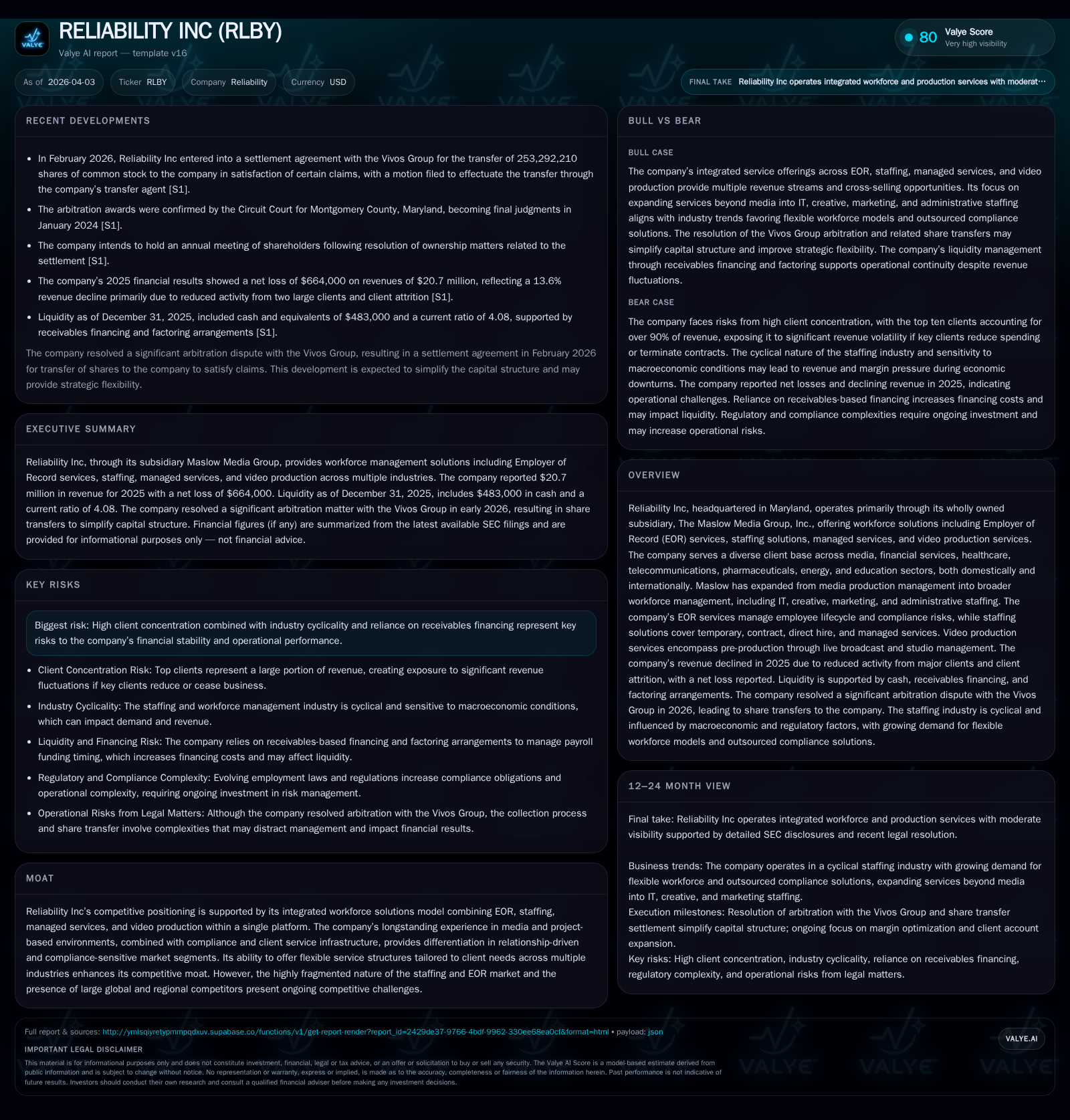
Reliability Inc experienced a top-line contraction driven mainly by reduced Employer of Record (EOR) revenues but counterbalanced this with meaningful staffing segment growth and cost discipline. The company’s operational adjustments yielded a 90 basis point gross margin expansion and a turnaround to positive operating cash flow in 2025. However, concentrated client exposure, reliance on receivables financing, and legacy legal disputes within its capital structure continue to pose challenges. Looking ahead, management is focused on expanding higher-margin staffing and managed services while navigating federal spending uncertainties and working capital sensitivities.
Historical Performance and Key Growth Drivers
Reliability Inc’s financial trajectory over recent years embodies a balancing act between shrinking revenues predominantly from its Employer of Record (EOR) services and operational discipline leading to improved profitability metrics. In fiscal year 2025, total revenue from its wholly owned subsidiary Maslow Media Group dropped by approximately 13.6%, falling from $23.98 million in 2024 to $20.72 million [S1],[F1]. This decline was mainly attributable to reduced activity within the EOR segment which constitutes over three-quarters of total revenues — approximately 79.2% in 2025 [S11].
Yet the narrative is nuanced; while EOR revenue waned, the Staffing Solutions segment recorded a significant expansion, increasing revenue by $771,000 or +23.4% year-over-year, supported by growing demand for IT, creative, marketing, and administrative workforce services beyond traditional media roles [S1],[S13]. This diversification has been instrumental in partially offsetting overall top-line pressures.
Historical performance (annual)
| FY | Net ($) | CFO ($mm) | OpInc ($) | Capex ($) | Net YoY |
|---|---|---|---|---|---|
| 2025 | -664000 | 2 | -830000 | -11.8% | |
| 2024 | -594000 | -3 | -707000 | 68000 | +19.7% |
| 2023 | -740000 | 3 | -749000 | 9000 | -0.1% |
| 2022 | -739000 | -1 | -906000 | 9000 |
Source: SEC companyfacts cache [F1].
Capital returns and efficiency (annual)
| FY | FCF ($mm) | ROE% |
|---|---|---|
| 2025 | -10.0 | |
| 2024 | -3 | -8.1 |
| 2023 | 3 | -9.3 |
| 2022 | -1 | -8.5 |
Source: SEC companyfacts cache [F1].
Management’s execution has focused on improving gross margin profiles amid these shifts — reducing SG&A expenses by $117K (3%) from $3.9 million in 2024 to $3.78 million in 2025 [S1]. Although operating losses widened marginally due to increased corporate overhead related to public company compliance and legacy legal matters, these were largely non-cash or one-time in nature.
Business Mix Evolution: Staffing, EOR, and Video Services Dynamics
Maslow Media Group’s transition from predominantly media sector-focused Employer of Record services into broader workforce solutions reflects strategic vertical expansion within existing accounts as well as new client acquisition targeting multi-state employers and professional service firms [S13].
The diverse service offerings include:
- Employer of Record (EOR): Handling onboarding/offboarding compliance risks, payroll administration across jurisdictions; traditionally dominant but facing cyclical headwinds [S11],[S13].
- Staffing Solutions: A growing suite encompassing temporary/contract professionals across media, IT, marketing, HR; capturing rising industry demand for flexible workforce models [S11],[S13].
- Direct Hire & Managed Services: Fee-based direct placements without payroll risk plus longer-duration managed contracts offering improved margin stability [S13].
- Video Production Services: Script-to-screen production with crew deployment expertise; niche but complementary given historical roots [S1],[S11].
The integrated delivery platform enables Reliability Inc to leverage cross-selling opportunities within top clients while mitigating customer acquisition costs — a crucial competitive advantage in an otherwise fragmented staffing landscape rife with large global competitors and tech-enabled disruptors [S13].
Revenue Declines versus Margin Expansion: Dissecting the 2025 Financials
Despite a $3.26 million decrease in total revenue in 2025 compared to the prior year, gross profit declined far less steeply by $240K or roughly 7.5%, landing at $2.95 million [S1],[F1]. This represents a gross margin improvement of approximately 90 basis points, raising the figure from 13.3% in FY24 to around 14.2% in FY25.
Margin uplift was largely driven by higher-margin staffing solutions whose gross margin expanded materially from 18.7% in FY24 to an elevated rate of about 23% in FY25 [S1]. Selective cost containment measures—such as outsourcing certain administrative tasks—and streamlining sales leadership further supported operational leverage gains [S14].
However, operating income before interest and tax reflect continued losses of $830K in FY25 (worsened by roughly -17% versus FY24), influenced by corporate governance overhead including public reporting compliance expenses nearing $743K annually alongside ongoing legal expenditures linked primarily to arbitration-award recoveries [S1],[S14],[S17].
The net effect is an ongoing net loss ($664K), though slightly wider than the previous year's deficit [$594K], signaling ongoing challenges yet modest stabilization trends within core operations [F1],[S1].
Liquidity and Receivables Financing: Managing Payroll Funding Amid Client Payment Risks
Payroll funding dynamics constitute a central liquidity pressure point given that field talent compensation generally precedes client receivable collections—a timing mismatch compounded by the high concentration among large enterprise customers with extended payment terms [S4],[S29]. Approximately two clients alone accounted for nearly 58% of total revenue and even higher shares of accounts receivable outstanding as of year-end FY25 (41% client B; almost 20% client A), representing material credit exposure [S18],[S29].
To bridge funding windows reliably, Reliability employs multiple receivables financing strategies:
- Traditional factoring with Gulf Coast Business Credit allowing for immediate liquidity albeit at higher interest rates (~10–11%), involving full recourse sale-like arrangements backed by eligible invoices up to roughly a 93% advance rate; outstanding factoring balance decreased significantly by late FY25 indicating repayment efforts [$455K vs prior $2.4M] [S9],[S10],[S24].
- Receivables purchase programs with JPMorgan Chase Bank and MUFG Bank Ltd., which offer lower-cost capital (~80–235 bps above SOFR depending on tenor), though funds arrive after several days post invoice approval rather than immediately—a tradeoff between cost reduction and timing flexibility important for select large client receivables [S5],[S8].
These funding modalities remain essential yet costly components affecting operating performance given dependence on timely client payments amid sector cyclicality and operational scaling efforts.
Capital Structure, Legal Settlements, and Impact on Equity Ownership
Following complex legacy financial disputes post-merger involving Vivos Holdings LLC (the “Vivos Group”), Reliability sought arbitration for debt recovery relating to undisclosed borrowing arrangements impacting Maslow Media Group subsidiaries prior to consolidation [S1],[S3],[S22]. Arbitration awards granted damages including fraud penalties totaling around $8.8 million as of December 31, 2025; enforcement proceeded via court confirmation establishing final judgment status early in calendar year FY24 [S22].
In February 2026 a settlement agreement was reached whereby Vivos Group agreed to transfer approximately 253 million shares of Reliability common stock back to the Company toward satisfying claims—practically equating to approximately an 84% reduction in outstanding stock on record—intended for treasury stock classification post-transfer execution through the company's transfer agent [S3],[S12],[S22]. This action aims to simplify the capital structure plagued with complexity related to related-party obligations but also raises important considerations around potential shareholder dilution dynamics given concentrated equity ownership changes.
Meanwhile capital allocation remains conservatively managed given ongoing net losses; there are no disclosed dividends or share repurchase programs as per filings [F1],[S1]. Working capital stood at roughly $6.65 million at FY25-end with adjusted figures after excluding notes receivable substantially compressed reflecting liquidity constraints but still showing positive current ratio dynamics greater than four times coverage relative to current liabilities [$2.15 million] [F1],[S24].
Future Outlook: Market Constraints, Client Concentration, and Growth Opportunities
Management commentary reflects cautious optimism grounded on selective pipeline expansions beyond traditional media-centric federal accounts into broader professional services sectors including IT staffing—areas exhibiting fundamentally more predictable workforce demand coupled with regulatory-driven outsourcing needs under evolving worker classification standards nationwide [S2],[S13]. Nonetheless near-term prospects face headwinds such as federal budget uncertainty exemplified by Department of Government Efficiency ("DOGE") directives discouraging perceived non-essential spending potentially suppressing media-related staffing volumes at certain government clients—though materiality remains limited at this juncture [S2].
Client concentration risk remains elevated with just five customers accounting for over three quarters of total revenue—a structural vulnerability given extended payment cycles further exacerbated by industry cyclicality.
Cost control initiatives and margin mix shifts toward higher-value-added staffing solutions are expected levers for profitability enhancement alongside prudent cash flow management supported by refinements in receivables financing maturities.
Analyst Watchpoints: Revenue Recovery Signals and Capital Allocation Priorities
Critical metrics for monitoring Reliability’s recovery include stabilization or incremental growth within the staffing segment revenues which currently drive margin improvements amidst retreating EOR contributions [F1]. Operating income trends reflecting narrowing losses correlated with corporate overhead expense discipline will be a barometer of effective scale economics realization.
Cash flow sustainability through normalized operating cash inflows remains central given prior volatility highlighted by a dramatic CFO turnaround (+174%), supporting free cash flow generation estimated near $1.85 million after capex outlays primarily directed toward technology infrastructure upgrades such as ADP Workforce Now implementation and select hardware investments [$11K capex reported for FY25] [F1],[S14]. Capital allocation remains conservative absent any announced dividend or buyback program emphasizing focus on deleveraging working capital cycles.
Lastly resolving share transfer processes tied to the Vivos settlement could unlock strategic flexibility including potential M&A moves or equity financings—but these remain contingent on broader market conditions.
This analysis relies exclusively on publicly filed SEC disclosures up through Q4 fiscal year ending December 31, 2025 ([F1], [S#]) without speculative projections or investment recommendations.
Disclaimer: This is research-only, informational analysis and not investment advice. It may include AI-generated interpretation and general industry context. Always verify important details using primary sources.

Comments