
Patriot National Bancorp’s Strategic Reset: Addressing Regulatory Strains and Growth Prospects
Patriot National Bancorp's 2025 transformation responds to regulatory mandates by tightening capital and refocusing client segments, with growth hinging on remediation success.
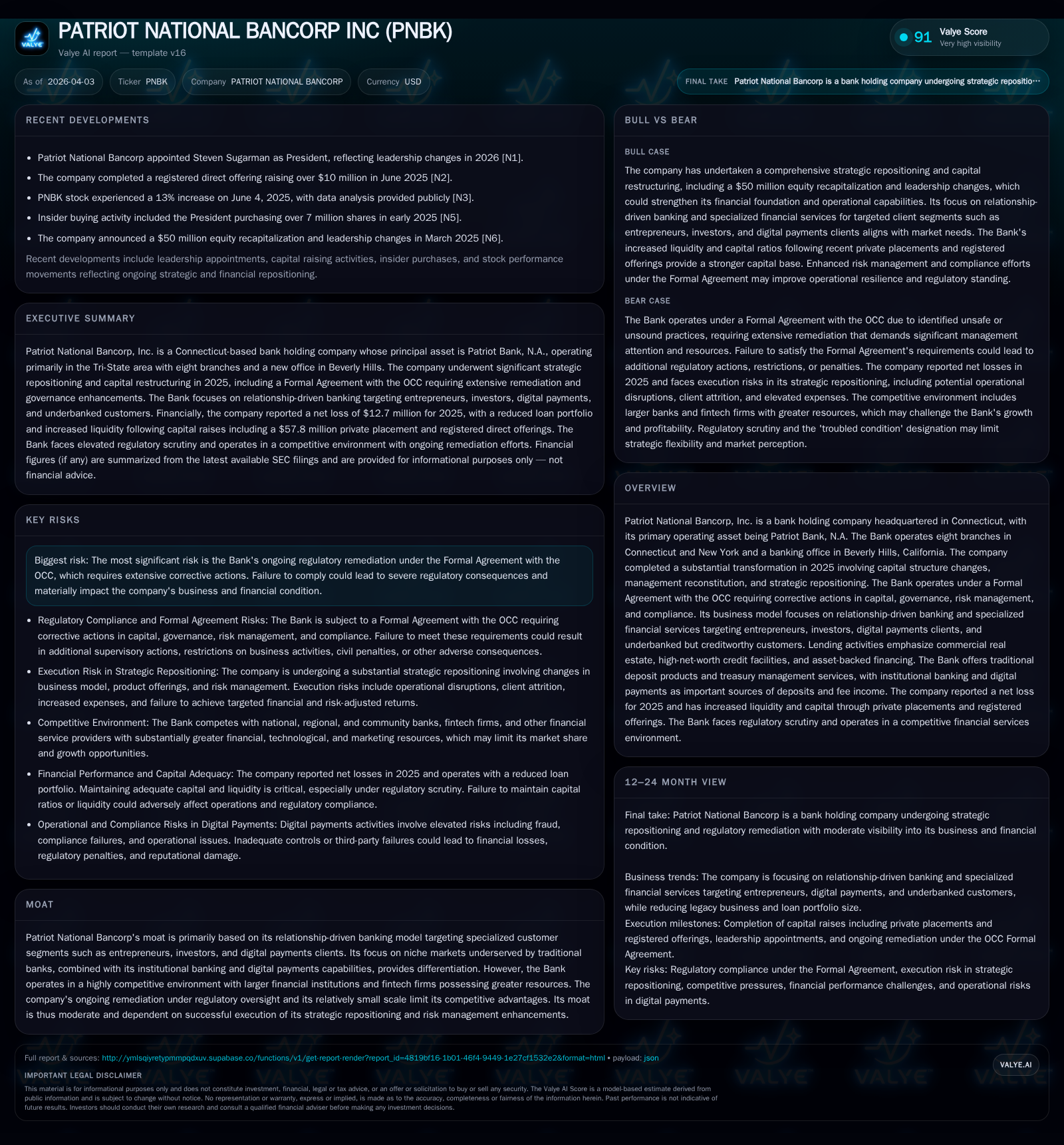
Patriot National Bancorp undertook a comprehensive restructuring in 2025 to address critical regulatory shortcomings identified by the OCC. This included capital recapitalization, management overhaul, and strategic pivot toward relationship-driven banking focused on entrepreneurs, investors, and digital payment clients. Despite narrowing losses from -$39.9M in 2024 to -$12.7M in 2025 [F1], the bank remains under a Formal Agreement with ongoing compliance risk. Liquidity strengthened via capital raises and debt restructuring, but cash flow remains negative. The near-term outlook centers on achieving OCC-mandated remediation milestones while heavily constrained by supervisory designations impacting growth avenues and capital returns.
From Losses to Leadership: Historical Performance and Transformation Drivers
Patriot National Bancorp’s financial trajectory over recent years underscores the magnitude of its ongoing turnaround. After posting net income of $6.2 million in 2022 [F1], the company swung sharply into losses hitting approximately -$41.8 million in 2023 and -$39.9 million in 2024 [F1]. These losses reflect operational challenges compounded by regulatory deficiencies that culminated in the OCC’s issuance of a Formal Agreement in early 2025 [S1]. Importantly, the net loss narrowed significantly in 2025 to around -$12.7 million [F1], signaling incremental progress attributable to a substantial management reconstitution, governance overhaul, and recapitalization efforts completed that year [S1]. Equity surged from roughly $4.3 million at the end of 2024 to nearly $94.7 million by end-2025 due to capital raises underpinning the strategic reset [F1],[S1]. This transformation centered on enhancing risk controls and refocusing business lines while maneuvering within binding regulatory constraints.
Historical performance (annual)
| FY | Net ($mm) | CFO ($mm) | Capex ($) | Net YoY |
|---|---|---|---|---|
| 2025 | -13 | -14 | 172000 | +68.1% |
| 2024 | -40 | 3 | 55000 | -854.3% |
| 2023 | -4 | -11 | 412000 | -167.8% |
| 2022 | 6 | 7 | 414000 |
Source: SEC companyfacts cache [F1].
Capital returns and efficiency (annual)
| FY | Div | FCF ($mm) | ROE% |
|---|---|---|---|
| 2025 | 0 | -14 | -13.4 |
| 2024 | 0 | 3 | -935.1 |
| 2023 | 0 | -11 | -9.4 |
| 2022 | 0 | 7 | 10.3 |
Source: SEC companyfacts cache [F1].
Note: Capex values are relatively low reflecting limited fixed asset investments during this period.
Regulatory Framework and Formal Agreement Compliance Dynamics
The impetus for Patriot’s reset was its January 17, 2025 Formal Agreement with the OCC—a regulatory mandate following findings of unsafe or unsound practices across multiple dimensions including strategic planning oversight failures; deficiencies in capital planning; weak Bank Secrecy Act/Anti-Money Laundering (BSA/AML) controls; inadequate payment activities supervision; suboptimal credit administration; and concentration risk mismanagement [S1],[S14],[S16]. The Formal Agreement imposes stringent requirements mandating remedial action plans for governance reforms and construction of sustainable risk controls accompanied by extensive board-level oversight [S1]. Significantly, the bank is designated as being in "troubled condition," limiting its eligibility for certain activities under U.S. bank regulatory definitions which constrains acquisitions and branch expansions [S23].
While aiming to correct foundational deficiencies that materially impact operational safety and soundness metrics as well as shareholder value potential, the compliance burden is considerable—requiring sustained management focus on rebuilding culture alongside system enhancements [S1]. Failure to meet timelines or produce satisfactory outcomes exposes Patriot to heightened supervisory intervention risks such as restrictions on growth initiatives or civil penalties [S14]. The remediation efforts thus constitute both a cost center depressing near-term profitability and a potential structural enabler if successfully executed.
Refocused Client Segments and Business Model Evolution
Post-formal agreement activities crystallized a strategic repositioning toward relationship-driven banking targeting niche clientele underserved by larger peers [S1],[N1],[S4]. Key segments include entrepreneurs; investors; high-net-worth individuals; institutional digital payments clients such as fintech program managers; and creditworthy but underbanked customers residing within its traditional Tri-State footprint plus emerging areas like Beverly Hills following the Q1’26 office opening [S9],[N1].
This model emphasizes customized lending such as commercial real estate credits secured by deep client relationships; asset-backed lending tailored for families and business owners; lines of credit tied to securities or business assets; plus specialty institutional banking services that align well with fintech partnerships handling prepaid cards and ACH processing [S7],[N1]. Legacy non-core product lines have been pared back or eliminated consistent with tightened risk appetite parameters [S7]. This focus has qualitative moat implications: while Patriot lacks scale versus major competitors competing for mass retail deposits or wholesale banking mandates, its specialization coupled with enhanced digital payments capabilities positions it distinctively versus commodity community banks reliant on legacy deposit franchise models.
Liquidity and Capital Structure: Strengthening the Balance Sheet
Liquidity conditions improved materially across the course of the strategic reset during calendar year 2025 supported by private placement equity issuances totaling approximately $60 million deployed directly into Patriot Bank’s Tier 1 common equity layer [S8],[S9],[S15]. On-hand liquidity rose substantially with cash balances swelling from roughly $144 million at end-2024 to over $178 million by September 30th, 2025 after adjusting for pledged collateral limitations related to Federal Home Loan Bank borrowings [S5],[S6]. Total liquidity ratios advanced from approximately ~16% on-hand liquidity relative to liabilities at end-2024 to around ~32% by third quarter ‘25—a critical cushion considering deposit outflows experienced during this period [S5].
Borrowings declined meaningfully with Federal Home Loan Bank advances reduced near zero from prior levels reflective of less reliance on external funding lines given strengthened capital buffers [S6]. Brokered deposits contracted correspondingly aiding liability diversification.[S24] Nevertheless internal limits on borrowing capacity combined with regulatory expectations around concentrated funding sources imply vigilance is required amid ongoing volatility risks.
The loan portfolio contracted substantially from about $707 million at end-2024 to $589 million as of September ‘25 reflecting deliberate run-off/curtailment of legacy exposures deemed inconsistent with updated risk appetite frameworks [S21]. Reduction focused primarily on consumer & other loans alongside some residential real estate credits whereas commercial real estate remained an emphasis aligned with new strategy priorities [S21].
Profitability Headwinds and Path to Operating Cash Flow Improvement
Profitability trends mirror volatile returns punctuated by expense hikes linked chiefly to regulatory compliance costs including personnel additions across risk management functions [F1],[S13]. Operating cash flows swung back negative at approximately -$14M for FY25 compared to positive ~$2.7M during FY24 despite improved net income loss figures—reflecting elevated working capital investments in infrastructure upgrades alongside increased provisioning related to credit quality reassessments mandated under stricter examination standards [F1],[S13].
The tightening of credit administration policies driven directly by Formal Agreement stipulations contributed both positively via lower problem loan formation but also pressured short-term interest income growth due to loan book shrinkage [S16],[F1]. Additionally, non-interest income showed upward mobility fueled principally by escalating digital payments segment revenue boosted through expanded program manager relationships—a bright spot partially offsetting cost escalation impacts (notably salaries/benefits) reflected in higher non-interest expenses reported throughout FY25 vs prior periods [S13].
Strategic Repositioning Milestones to Monitor in 2026 and Beyond
Key forward-looking markers lie predominantly within continued formal remediation compliance trajectories where timely achievement may dictate supervisory leniency or ongoing constraint intensity affecting growth vectors including new product introductions or geographic footprint expansions [N1],[S2]. Enhanced BSA/AML frameworks including program manager due diligence upgrades, suspicious activity monitoring systems maturation, and comprehensive employee training rollouts remain prioritized initiatives flagged within recent quarterly disclosures along with ongoing governance reviews by the Compliance Committee established post-Formal Agreement enactment [N1],[S1].
From a portfolio standpoint, early-stage high-net-worth lending programs along with institutional treasury management solutions warrant observation as leading indicators whether projected revenue diversification is materializing enabling incremental margin improvement beyond legacy lines subdued under refinancing or runoff scenarios documented through Q3 ‘25 filings.
Additionally, the success of recent executive appointments such as Steven Sugarman’s elevation to President role reflects management’s intent to enhance leadership depth essential for sustainable execution of these multifaceted plans [N1]. These milestones collectively serve as pivotal signals governing whether remediated controls translate into restored operating privileges pushing Patriot closer toward release from Formal Agreement status.
Capital Allocation Priorities Given Current Financial Constraints
Capital allocation discipline aligns squarely with preservation imperatives given persistent net losses estimated at -13.4% return on equity for FY25 based on available figures comparing net loss against year-end equity balances ($-12.7M / $94.7M) [F1]. Consequently, dividends remain suspended since before this transformation phase started (no payouts since at least FY22), and no share repurchases have occurred reflecting low tolerance for discretionary uses of scarce capital outside investment directed at hardening balance sheet resilience or underwriting business model evolution needs [F1],[S4].
Management continues prioritizing deleveraging strategies including lower brokerage deposit usage mixed prudently with selective debt maturities refinanced under more favorable terms without increasing leverage pressure—as evidenced in senior notes maturity extensions fully repaid prior to their scheduled dates—and maintaining liquidity headroom consistent with OCC capital plans enforcing minimum Tier I ratios ranging between ~9-11% thresholds mandated since formal agreement inception [S8],[S18].[S19]
The emphasis remains tilted towards internal value creation through earnings improvement rather than external distributions until clear evidence emerges that structural risks have abated sufficiently.
Risks Embedded in the Remediation Process and Market Competitiveness
Despite constructive progress signals, risk exposure envelops numerous dimensions undermining confidence in foreseeable stability: high execution risk related to remediating extensive control gaps identified particularly across BSA/AML monitoring critical for compliance sustainability; going reputational vulnerability hostage to perceptions amplified by "troubled condition" status limiting partnerships or deposit retention capabilities; persistent technology-related operational risks tied especially to third-party program manager dependency within digital payments activities increasing transactional fraud exposures; and intense competition exerted by larger banks or fintech firms possessing scale advantages capable of eroding Patriot's nascent moat built around specialized client solutions—all forming convoluted headwinds constraining strategic momentum expansion possibilities unless managed adeptly without lapse culminating in costly setbacks potentially exacerbating financial strain or even triggering enforcement escalations beyond existing Formal Agreement constraints [S14],[S16],[N1].[S22]
Overall, the bank's future operational latitude hinges critically on its ability not only to fulfill formal remediation directives promptly but also tangibly strengthen underlying franchise fundamentals driving sufficient returns commensurate with investor expectations absent dilution effects continuing past best efforts noted recently.
This analysis is grounded entirely upon company filings as of early April 2026 together with relevant market disclosure without predictive assertions beyond explicit company guidance where provided. The discussion excludes investment recommendations or price projections consistent with Valye News policies.
Disclaimer: This is research-only, informational analysis and not investment advice. It may include AI-generated interpretation and general industry context. Always verify important details using primary sources.

Comments