
enCore Energy's Expanding Uranium Footprint Fuels Ambitious Growth Strategy
An exploration-stage uranium producer leveraging ISR technology and strategic asset development to address rising domestic nuclear fuel demand.
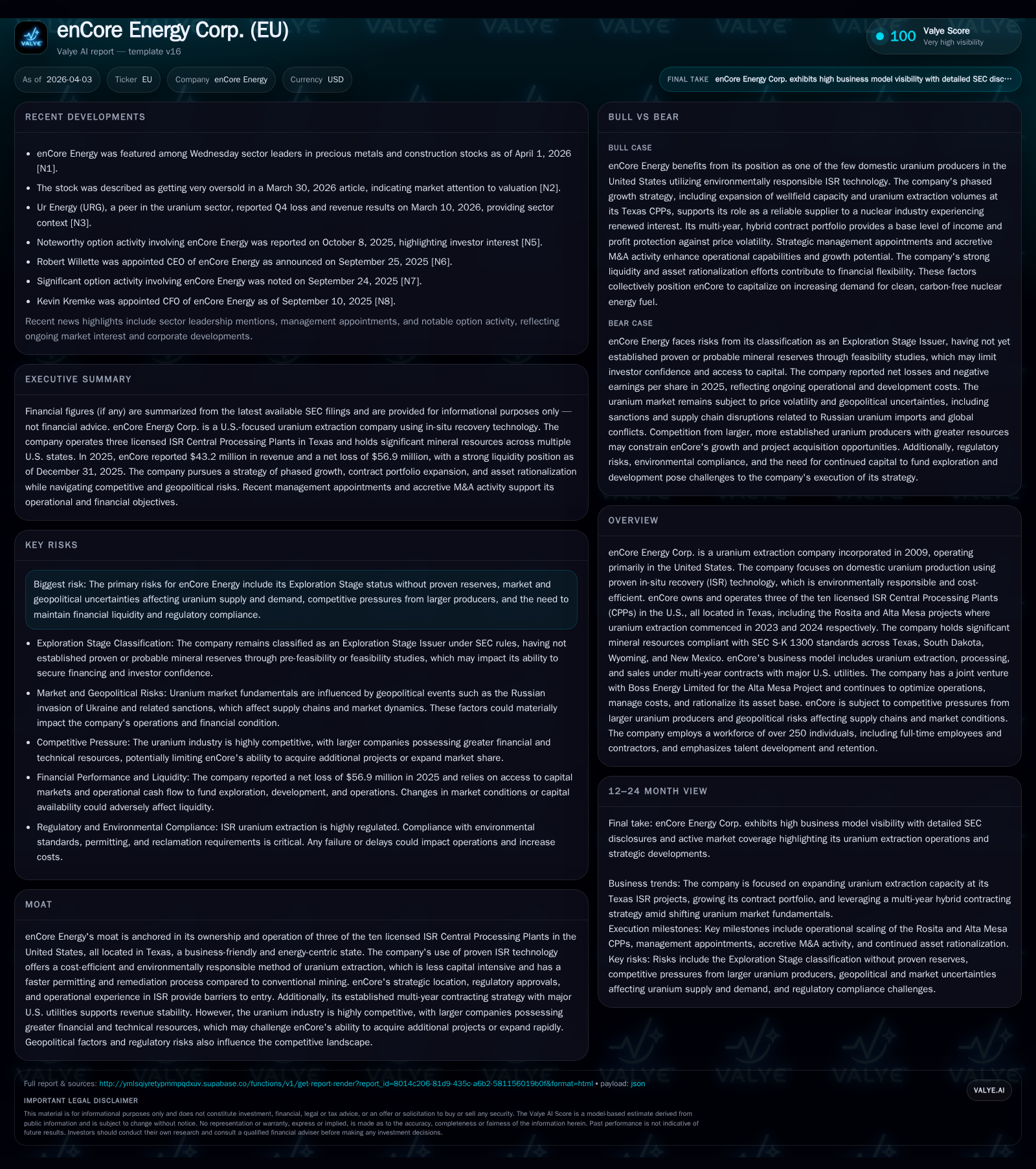
enCore Energy Corp. has transitioned from exploration to active uranium extraction with the commissioning of its Rosita and Alta Mesa ISR Central Processing Plants in Texas, driving a 223% revenue increase in 2025. Despite this growth, the company recorded operating losses exceeding $65 million amid scaling costs and capital investments, reflected in a negative return on equity near -25%. enCore’s competitive advantage lies in its licensed ISR CPPs and favorable regulatory environment, supported by long-term contracts with major U.S. utilities. The growth pipeline includes further exploration projects in South Dakota and Wyoming, contingent on reserve confirmations and regulatory milestones under SEC S-K 1300 standards.
Transition from Exploration Stage to Uranium Producer: Historical Drivers and Performance
enCore Energy’s financial profile shifted markedly from exploration towards uranium production amid a tightening U.S. nuclear fuel market. Extraction commenced at the Rosita Central Processing Plant (CPP) in late 2023 followed by Alta Mesa CPP mid-2024, resulting in revenue growth from $13.4 million in FY2024 to $43.2 million in FY2025 — a robust 223% increase [F1]. This increase was driven primarily by uranium sales enabled through its three licensed In-Situ Recovery (ISR) CPPs located strategically in Texas.
Despite top-line expansion, operating losses surged over threefold to approximately $65.8 million in FY2025 from $20.1 million the prior year [F1]. These losses reflect elevated operating expenses associated with scaling operations, start-up inefficiencies, and intensified capital deployment tied to commissioning new CPPs [S1]. The company remains classified as an Exploration Stage Issuer per SEC S-K 1300 guidance since it has not established proven or probable mineral reserves validated through feasibility studies — a prerequisite for Development Stage classification — despite active production [S1]. This status underscores ongoing exploration risks.
Historical performance (annual)
| FY | Rev ($mm) | Net ($mm) | CFO ($mm) | OpInc ($mm) | Rev YoY | Net YoY |
|---|---|---|---|---|---|---|
| 2025 | 43 | -57 | -25 | -66 | +223.0% | -232.5% |
| 2024 | 13 | -17 | -45 | -20 |
Source: SEC companyfacts cache [F1].
Capital returns and efficiency (annual)
| FY | FCF ($mm) | ROE% |
|---|---|---|
| 2025 | -45 | -24.8 |
| 2024 | -57 | -6.0 |
Source: SEC companyfacts cache [F1].
Table: enCore Energy Annual Financial Performance Summary FY2024-FY2025 [F1]
Operational Advances in In-Situ Recovery: The Rosita and Alta Mesa Projects
enCore exclusively employs ISR technology across its uranium assets. ISR involves injecting lixiviants underground to dissolve uranium for recovery without conventional mining — reducing surface disruption and environmental impact while lowering capital intensity [S1]. This method also accelerates permitting compared to traditional mines.
Situated in South Texas’ prolific uranium belt, Rosita and Alta Mesa projects operate three of only ten fully licensed ISR CPPs nationally — a strong competitive position enhanced by Texas’ pro-energy regulatory environment [S1]. At Alta Mesa, enCore holds a controlling 70% stake with Boss Energy Limited owning the remainder; this joint venture expands operational capacity while sharing capital obligations [S17]. Together these facilities align with enCore's strategy to supply domestic uranium essential for carbon-free nuclear power amid growing U.S. energy security emphasis.
Ongoing wellfield pattern development is critical for improving throughput and cost efficiency over time [S21]. Regulatory licensing remains complex; however, federal executive orders designating uranium as a critical mineral may accelerate permitting favorable to enCore’s expansion [S1].
Revenue Expansion Amid Margin Pressures
Production scale-up drove significant revenue gains but also margin pressures from increased capital expenditures (+76% YoY to $20M) alongside rising operating expenses (+18%) [F1][S15]. Cost per pound of extracted uranium improved notably year-over-year aided by reduced cash costs ($34.88/lb vs $43.06/lb prior year), supporting future competitiveness [S15].
Revenue concentration is high: three customers accounted for approximately 99% of total revenues in FY2025 — roughly split as 63%, 25%, and 11% — indicating reliance on a limited customer base but anchored by multi-year contracts with major U.S. utilities [S4]. These agreements underpin predictable volumes despite spot market price pressures due to embedded ceiling provisions [S15]. While expanding revenue derives principally from contracted uranium volumes shipped primarily within the U.S., operating leverage has yet to yield profitability due to upfront investments related to commissioning and wellfield development [F1][S15].
Growth Pipeline: Texas Expansion and Exploration Projects
enCore plans to build on its Texas presence by advancing exploration-stage properties in South Dakota and Wyoming [S1][N3]. These projects hold promise but require pre-feasibility studies confirming proven/probable reserves under SEC S-K rules — necessary steps before broader financing or operational scaling [S1]. Regulatory approval timelines remain uncertain given the complex permitting environment for nuclear materials nationwide.
Capital Allocation: Investment Intensity Versus Cash Flow Dynamics
Capital expenditures nearly doubled from $11.3 million in FY2024 to $20 million in FY2025 focused on commissioning activities at Alta Mesa alongside upgrades at Rosita [F1]. Operating cash flow burn moderated from -$45 million to about -$25 million over the same period [F1], indicating improving operational leverage though still negative.
Free cash flow remained negative near -$45 million reflecting heavy upfront infrastructure investments inherent with ISR deployment at scale [F1]. Liquidity remains strong with cash balances of approximately $52 million and a current ratio above eight times as of December 31, 2025 — providing resilience against near-term refinancing risks given debt maturities extend beyond five years [F1][S6][S14]. No dividends or share repurchases were declared consistent with reinvestment priorities during this growth phase [S10][S12].
Customer Concentration and Contractual Backdrop
enCore’s uranium sales depend heavily on a concentrated customer base comprised of leading U.S.-based utilities engaged via multi-year contracts featuring fixed minimum volume commitments that enhance revenue visibility despite commodity price volatility [S4]. This structure mitigates short-term spot price risks but concentrates counterparty exposure; one customer accounted for all trade accounts receivable as of December 31, 2025 totaling about $4.9 million [S4].
These contracts align with federal incentives such as clean energy credits under the Inflation Reduction Act that support nuclear reactor life extensions — key demand drivers underpinning enCore’s expansion plans [S1].
Sector Risks and Regulatory Environment
The risk profile reflects common challenges for junior uranium producers including Exploration Stage classification delays, capital-intensive expansions amid commodity volatility, geopolitical supply uncertainties including import restrictions, and complex permitting regimes [S21][S24]. Although ISR technology offers streamlined remediation relative to traditional mining easing regulatory burdens somewhat, federal environmental assessments and local opposition can cause project delays impacting reserve certification timelines critical for financing under SEC S-K standards [S24][S21].
Competition from larger global producers with deeper financial resources poses additional challenges that could limit enCore’s pace or scope of reserve development.
Monitoring Milestones: Investor Watchlist
Key developments investors should monitor include:
- Achieving proven or probable mineral reserve certifications through pre-feasibility studies meeting SEC S-K section 1300 criteria — pivotal for transitioning out of Exploration Stage status [S1];
- Stabilization and optimization of Alta Mesa CPP production throughput during calendar year 2026;
- Renewal or extension of existing utility contracts ensuring revenue continuity;
- Regulatory changes accelerating permitting under critical minerals designations impacting project pipeline;
- Macroeconomic indicators such as additional nuclear reactor life extension announcements influencing aggregate demand;
- Market sentiment shifts exemplified recently by oversold conditions affecting equity access dynamics [N3];
These factors collectively chart enCore's path from exploratory ambitions toward becoming an integrated domestic uranium supplier critical amid growing clean energy imperatives.
This analysis is based exclusively on publicly filed financial disclosures for enCore Energy Corp., citing numerics strictly grounded on reported data without speculative forward-looking estimates or investment advice.
Disclaimer: This is research-only, informational analysis and not investment advice. It may include AI-generated interpretation and general industry context. Always verify important details using primary sources.

Comments