
Faraday Future Battles Financial Strains While Advancing Electric Autonomous Intelligence Vehicles
The company struggles with liquidity and repeated losses even as it develops innovative electric and robotics products.
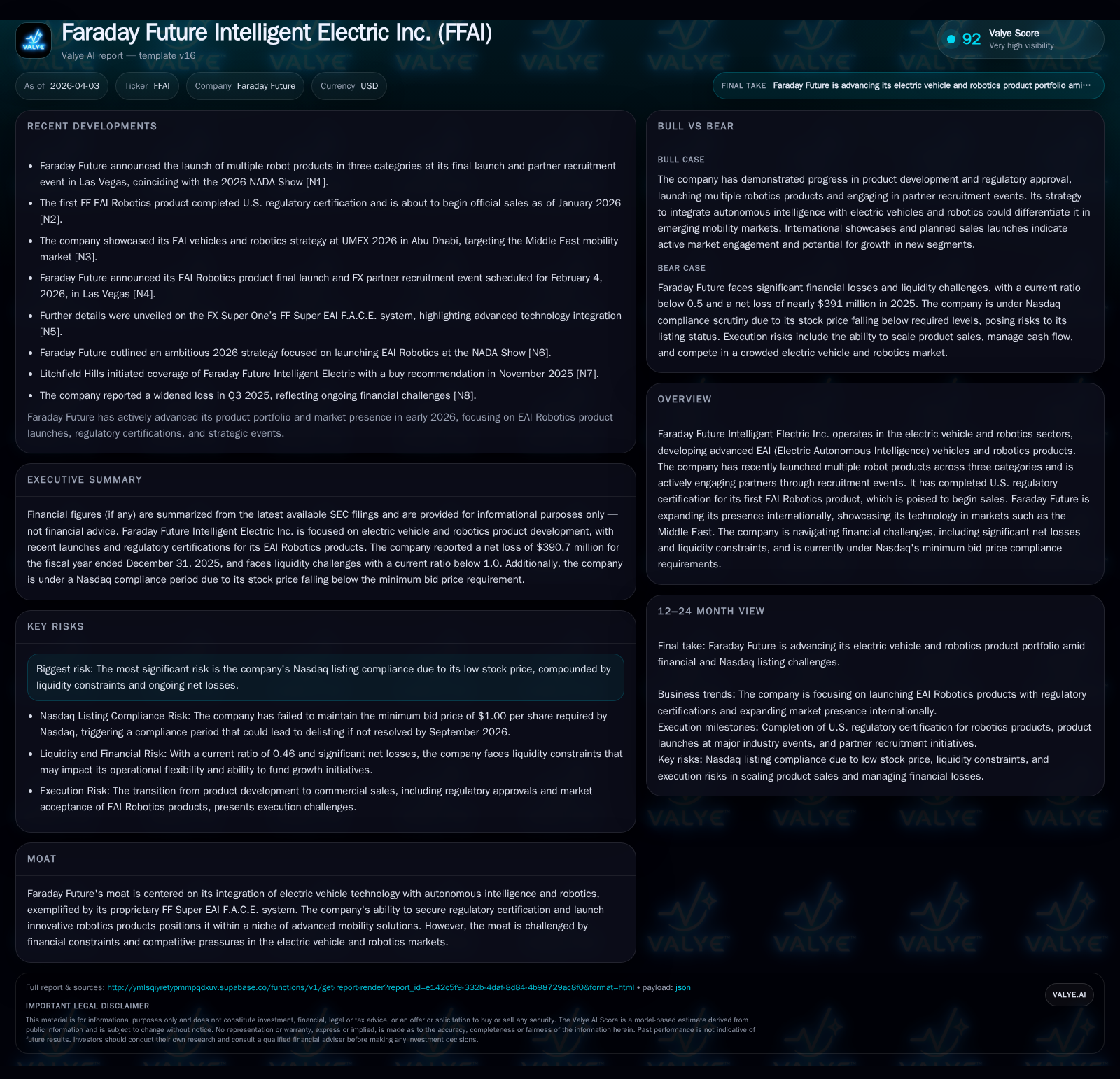
Faraday Future Intelligent Electric Inc. continues to pioneer integration of electric vehicles with autonomous intelligence, launching new robotics products and completing regulatory certifications suitable for initial sales. Despite product progress, the company remains heavily loss-making with negative operating income and cash flow metrics, facing substantial liquidity shortfalls and Nasdaq listing compliance risks due to low share price. Growth prospects hinge on expanding international presence and converting non-binding reservations into firm sales amid a challenging capital structure and operating environment.
Company Overview and Business Model
Faraday Future Intelligent Electric Inc. (FFAI) focuses on designing and engineering next-generation intelligent electric vehicles integrated with autonomous intelligence technologies. Headquartered in Gardena, California, the company operates through its primary subsidiary Faraday&Future Inc. in the U.S., supplemented by Chinese subsidiaries mainly engaged in manufacturing and technology development [S1].
Its core offering centers around the development of Electric Autonomous Intelligence (EAI) vehicles supplemented by a suite of robotics products leveraging its proprietary FF Super EAI F.A.C.E. system. This system integrates software-defined connectivity with user-centric autonomous capabilities aiming to carve out a niche in the advanced mobility landscape.
Historical Financial Performance
Faraday Future has experienced persistent operating losses since at least 2022 as it invests heavily in product development, regulatory approvals, scaling manufacturing capability, and global market expansion. The company's key financials over the past four fiscal years demonstrate deepening losses and cash flow challenges:
Historical performance (annual)
| FY | Net ($mm) | CFO ($mm) | OpInc ($mm) | Capex ($mm) | Net YoY |
|---|---|---|---|---|---|
| 2025 | -391 | -2 | -331 | 8 | -9.8% |
| 2024 | -356 | -70 | -150 | 8 | +17.6% |
| 2023 | -432 | -278 | -286 | 31 | +28.3% |
| 2022 | -602 | -383 | -437 | 123 |
Source: SEC companyfacts cache [F1].
Capital returns and efficiency (annual)
| FY | Buybacks ($) | FCF ($mm) | ROE% |
|---|---|---|---|
| 2025 | -10 | 1429.1 | |
| 2024 | -78 | -309.5 | |
| 2023 | 0 | -309 | -189.2 |
| 2022 | 767000 | -506 | -299.6 |
Source: SEC companyfacts cache [F1].
These figures highlight several characteristics of Faraday Future's historical performance:
- Operating losses peaked in FY2022 before temporarily improving in FY2024 but worsened again significantly in FY2025.
- Net income follows a similar trajectory with annual losses ranging from ~$350 million to ~$600 million.
- Operating cash flows remain negative reflecting capital-intensive operations without positive inflows from vehicle sales or operational efficiencies.
- Capital expenditures have substantially declined from high investment levels in earlier years but remain ongoing to support production capacity.
- Equity declined sharply to negative territory in FY2025 signaling erosion of shareholder value from cumulative losses [F1].
Recent Developments and Product Launches
Faraday Future recently completed U.S regulatory certification for its first EAI Robotics product series, indicating readiness for commercial sales launch . Additionally, multiple robot products were introduced across three categories reflecting an effort to diversify beyond pure automotive offerings.
Internationally, the company is expanding presence particularly in Middle East markets where local leadership has been reoriented toward business execution emphasizing regional growth opportunities [S5]. However, these markets for advanced electric autonomous vehicles remain nascent outside established hubs like China or Europe.
Growth Prospects and Constraints
Potential Drivers
- Technology Integration: Leveraging proprietary software-driven EAI platforms could differentiate offerings if coupled with scalable production.
- Regulatory Approval Milestones: The recent U.S certification opens pathways for domestic sales; further regulatory clearances are pivotal.
- International Expansion: Targeting middle-eastern markets may unlock incremental revenue streams amid global EV demand growth.
- Partnership Engagements: Ongoing partner recruitment suggests attempts to bolster R&D capabilities and supply chains.
Limiting Factors
- Financial Constraints: Persistent net losses and strained liquidity limit ability to fund expansion without dilution or debt issuance.
- Market Acceptance Uncertainty: Non-binding reservation deposits may not convert into binding sales; nascent consumer acceptance poses revenue risk.
- Competitive Pressures: Facing established EV makers (Tesla, Lucid) plus emerging autonomous robotic competitors reduces pricing power.
- Supply Chain Dependencies: Reliance on single-source suppliers introduces potential production vulnerabilities.
- Regulatory Compliance Risks: Beyond initial certifications, evolving global regulations could delay rollouts.
- Nasdaq Listing Risk: Share price below $1 triggers risk of delisting absent corrective measures such as reverse stock splits or business turnarounds [S9],[S21].
Capital Structure and Liquidity Profile
Despite raising equity capital historically, Faraday Future’s balance sheet shows deteriorating financial health entering FY2026:
- Cash & equivalents totaled approximately $35 million against current liabilities near $148 million leading to a current ratio of about 0.46 indicating liquidity stress [F1].
- Negative equity at year-end signals cumulative deficits outweigh shareholder capital inflows.
- Operating cash flow remained negative at $2.1 million while capital expenditures hovered around $7.6 million yielding free cash flow roughly -$9.8 million suggesting ongoing funding needs just to maintain operations.
- The company reported no dividends or material stock repurchases recently but announced plans to buy back shares equivalent in value to executive deferred compensation during March-May 2026 as a retention incentive [S6],[S18],[S26].
- Debt levels are significant though exact amounts are detailed primarily in periodic liquidity disclosures; refinancing risks persist particularly if capital markets conditions worsen or earnings fail to improve substantially [S9]-[S17].
Nasdaq Listing Compliance Challenges
A formal notice received from Nasdaq cited failure to maintain minimum bid price of $1 per share over a consecutive trading period starting February through March 2026 [S9],[S18],[S21]. The company has until September 16, 2026 to regain compliance or possibly extend this deadline by another six months subject to meeting other listing standards including market capitalization requirements.
Failure to accomplish this would lead Nasdaq to initiate delisting procedures potentially impacting investor confidence and access to capital markets.
Management is considering strategic alternatives including reverse stock splits and other corporate actions though risks around shareholder approval remain uncertain.
Returns and Capital Allocation Summary
Due to ongoing deficits there is no return on equity (ROE) measure applicable beyond the grossly negative equity base yielding an artificial distortion if calculated simply by dividing net loss by negative equity (~1429% with inverse interpretation) [F1].
Capital allocation remains focused on survival—no dividends have been paid since inception aligning with typical early-stage EV startups prioritizing reinvestment over distributions. Minimal repurchases have occurred historically though recent programs suggest modest buyback activity aimed at retention rather than capital return.[F1],[S4]-[S8]
Risk Factors Highlighted by Management
Key risks explicitly outlined include:
- Insufficient liquidity possibly forcing bankruptcy absent new capital influxes.[S1]
- Difficulty converting reservation interest into confirmed vehicle orders depressing forward sales visibility.[S1]
- Single-source supplier dependencies introducing operational risks.[S1]
- Exposure to intense competition amidst rapidly evolving EV/autonomy/robotics landscape.[S1]
- Legal proceedings including prior SEC investigations pose reputational/legal uncertainties.[S7]
- Nascent status of main product lines creating execution risk.[S1]
These risks contribute heavily to the speculative nature of any engagement with the company's common stock outlined by management.[S1]
Industry Context (Analysis)
Electric vehicle manufacturers aiming at integrating autonomous intelligence face steep barriers related to technology complexity, capital intensity, regulatory scrutiny, and customer adoption hurdles — challenges magnified for lesser-capitalized players like Faraday Future competing versus deep-pocketed incumbents such as Tesla or BYD.
Meanwhile robotics segments tied closely with AI autonomy present emerging yet immature markets where scale economies have yet to solidify commercial viability broadly beyond pilot deployments or niche applications.
Advancements require not only innovative platforms but efficient manufacturing scale-ups coupled with robust supply chain diversification strategies—a crucial constraint for Faraday Future given concentrated supplier exposure noted above.
What To Watch Next (Analysis)
Absent explicit forward guidance disclosed within filings or news releases,[N#]/[S#] investors should monitor:
- Progress on regaining Nasdaq minimum bid price compliance including any proxy solicitation for reverse splits.
- Quarterly updates on production volumes especially related to the FF91 Futurist series or new robotics line unit shipments that may convert reservations into recognized revenues.
- Further capital raises or debt refinancing efforts which will be critical for sustaining operations through market development phases.
- Updates regarding legal matters arising from past SEC scrutiny or new investigations potentially affecting governance credibility.
- Expansion outcomes from Middle Eastern initiatives revealing demand traction outside traditional EV hubs.
Conclusion
Faraday Future Intelligent Electric Inc operates at the confluence of electrification and artificial intelligence applied to mobility equipment covering both vehicles and robots—a potentially fertile niche underscored by its proprietary integrated platform technology achievements culminating in recent regulatory certifications readying first-sale launches.
However, this technological progress is overshadowed by persistent financial distress manifested through sustained multi-hundred-million-dollar annual losses, depleted equity bases turning negative in fiscal 2025, dangerously low liquidity ratios, minimal positive net operating cash flows compounded by sizeable ongoing capex needs.[F1]
Nasdaq listing precariousness adds visible external pressure demanding near-term share price recovery measures while underlying business scalability and market acceptance remain uncertain amid fierce competition throughout EV autonomy ecosystems.[S9][S21]
Stakeholders will need compelling evidence of operational ramp-up coupled with meaningful order conversion credibly mitigating existential balance sheet vulnerabilities to fully assess whether Faraday Future can transition from ambitious startup phases toward sustainable commercial viability.
Disclaimer: This is research-only, informational analysis and not investment advice. It may include AI-generated interpretation and general industry context. Always verify important details using primary sources.

Comments