
Independence Power Holdings Surges with Battery Storage Fleet and Operational Software Edge
The company’s transformative growth stems from commercial management of a 101-unit containerized BESS fleet powered by a proprietary software platform, offset by short-term cash flow and governance challenges.
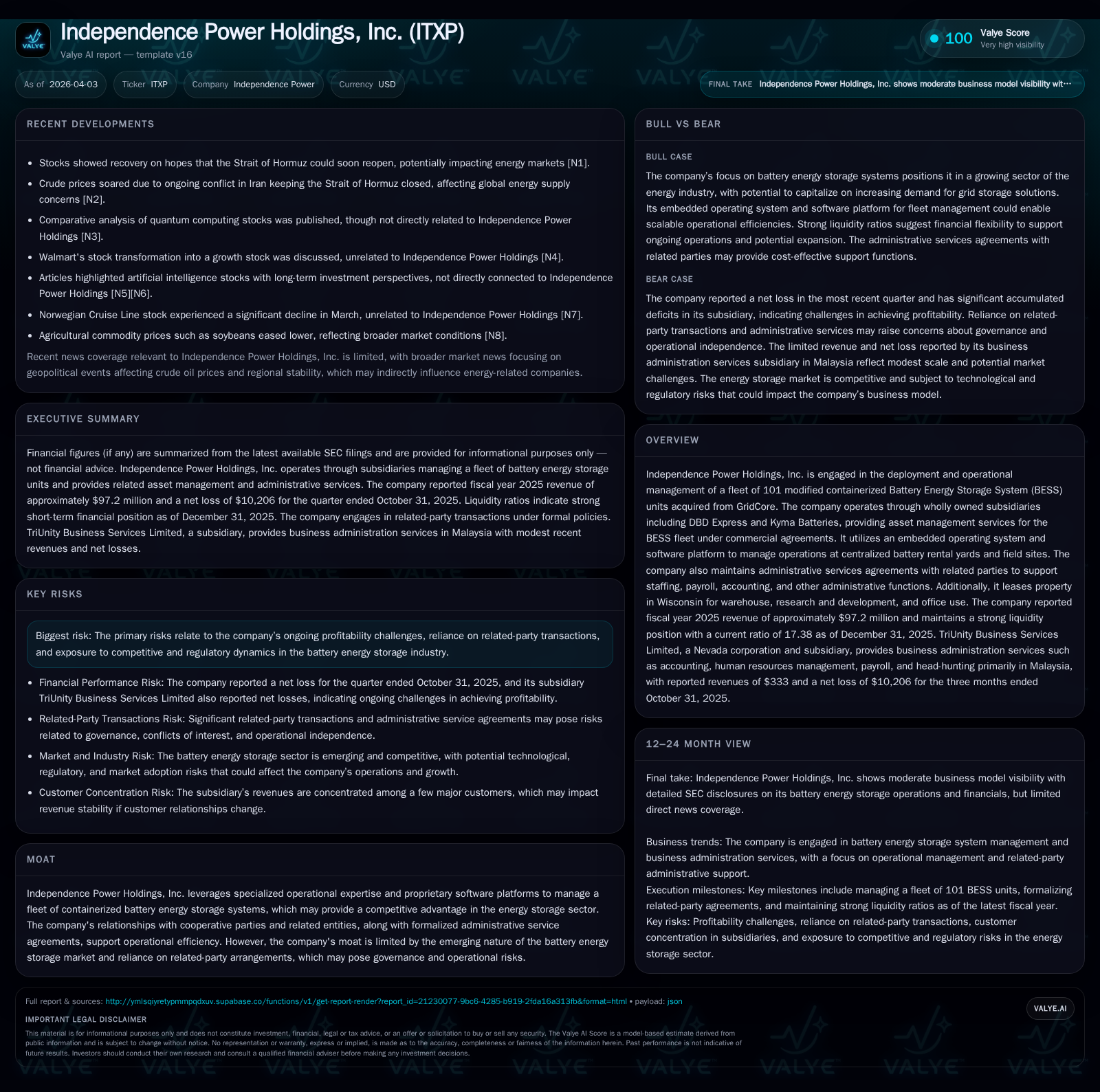
Independence Power Holdings reported explosive revenue and operating income growth in fiscal 2025 driven by its deployment and operational management of a large-scale fleet of modified containerized Battery Energy Storage System (BESS) units. The company’s embedded operating system and asset management agreements underpin its distinctive business model, enabling centralized control of battery rental yards and field deployments. However, near-term profitability is constrained by negative operating cash flows reflecting scaling costs and reliance on related-party administrative services introduces governance considerations. With strong liquidity supported by sizeable current assets and GridCore note receivables, Independence Power is positioned to expand its software services and asset management offerings, though execution risks remain high given the nascent nature of the energy storage market.
Rapid Revenue and Operating Income Growth: Leveraging a Fleet of Containerized BESS Units
Independence Power Holdings experienced an extraordinary transformation in fiscal year 2025 marked by a leap from nominal revenues of approximately $22,127 to $97.2 million—a velocity rarely seen outside early-stage tech adopters or asset-light transitions [F1]. This more than 439,000% increase was catalyzed by the commercial-scale deployment and operational management of a fleet comprising 101 modified containerized Battery Energy Storage System (BESS) units acquired from GridCore pursuant to the company’s strategic acquisition path [S1]. The revenue recognized predominantly stems from asset management fees under formal commercial agreements with Cooperative parties who own these battery assets.
The conversion to positive operating income at $85.7 million from a prior loss position reflects both scale effects and the monetization of services intrinsic to managing this BESS fleet effectively at centralized rental yards and dispersed field locations. Such operational leverage underscores the transition from developmental expenditures into revenue-producing operations recognized under ASC 606 revenue recognition principles [F1], [S1].
This fleet-based asset-light model aligns with sector trends emphasizing software-enabled operations over capital-intensive asset ownership. The company’s deployment leverages containerized battery modules—allowing modular scalability and flexible siting—a competitive characteristic increasingly rationalizing grid-scale energy storage economics.
Software Platform and Asset Management: The Company's Distinctive Operating Model
Central to Independence Power’s value creation is its proprietary embedded operating system coupled with a scalable software platform designed for real-time management and telemetry integration across its fleet. These tools enable enhanced performance optimization, fault detection, predictive maintenance scheduling, and energy dispatching critical for maximizing throughput efficiency in battery energy storage assets deployed across variable grid environments [S1].
This Platform-as-a-Service (PaaS) approach constitutes an operational moat by embedding technical expertise in fleet control that extends beyond physical hardware ownership. Asset management agreements executed through subsidiaries like Kyma Batteries grant Independence Power contractual rights to provide ongoing services including deployment logistics, operational oversight, maintenance coordination, and data analytics support.
Such contracts form predictable recurring revenue streams while enabling standardized procedures across multiple Cooperative partners—offering economies in both human capital deployment and technical resources. Industry peers recognize that integrated software platforms are increasingly essential for navigating complex performance profiles inherent to lithium-ion based grid storage solutions.
Related-Party Administrative Services: Benefits and Risks
Operational efficiency is further enabled through a related-party Administrative Services Agreement with IPAS Asset Management effective January 2026. IPAS provides essential services such as staffing recruitment/training, payroll processing, accounting support, policy development, financial advisory services, and other administration functions on a cost-plus nominal fee basis [S1].
While leveraging affiliated entities can reduce overhead fixed costs and accelerate organizational ramp-up phases typical for emerging energy technology firms, it introduces dependencies that may elevate operational risk factors. Termination clauses allow notice-driven disengagement; however, governance scrutiny is warranted given the concentration of critical back-office functions offloaded externally rather than developed internally.
Such arrangements may attract heightened examination from auditors or regulators concerned with potential conflict-of-interest scenarios or transparency in cost allocations—classic concerns in closely-held firms reliant upon related-party transactions.
Balance Sheet Strength and Liquidity Position Amid Operating Cash Flow Challenges
As evidenced at fiscal year-end 2025 presented in the company’s consolidated statements, Independence Power maintains solid liquidity foundations. Reported current assets stood at approximately $24.6 million compared to current liabilities of roughly $1.4 million yielding a robust current ratio near 17.4x—a clear indicator of short-term solvency well beyond normal industry benchmarks [F1], [S9].
Notably contributing to this liquidity cushion is the sizable note receivable originating from GridCore which continues providing principal and interest payments under structured terms supporting working capital needs during the operating loss phase. This collateralized structure reduces refinancing risk while allowing Independence Power strategic runway to invest in scaling software development efforts without immediate pressure on external debt markets.
Nonetheless, operating cash flow remains negative at $337K largely reflecting upfront expenses tied to platform enhancement initiatives and expanding organizational infrastructure necessary for sustaining rapid growth trajectories [F1], [S1]. Monitoring these investment rates against incoming operating cash flows will be key to evaluating when scalability leads to positive free cash flow generation.
Growth Outlook: Commercial Agreements and Scaling Software Service Revenues
Looking forward, Independence Power's growth case depends critically on expanding its portfolio of commercial agreements with Cooperative partners as well as enhancing software service revenues linked with ongoing upgrades to fleet telemetry analytics capabilities [S1]. While explicit future guidance has not been issued publicly, the company's disclosures highlight ongoing investments aimed at scaling IT infrastructure necessary for supporting increased service volumes.
Potential growth drivers include broader adoption across regional electric cooperatives seeking turnkey battery rental yard solutions that integrate both hardware management and advanced operational intelligence platforms. However, challenges such as competitive pressures from alternative energy storage providers and regulatory shifts may cap upside expansion unless mitigated effectively (analysis).
Key operational milestones warrant close attention including contract renewals with initial Cooperative parties as well as diversification into new partnership ecosystems potentially unlocking incremental recurring license fees.
Capital Allocation Strategy: Equity Contributions, Dividends, and Buybacks Status
Capital allocation remains conservative consistent with an early commercial phase profile. Cash flow deficits generated by operations have primarily been funded through equity contributions as indicated by significant increases in additional paid-in capital on balance sheets reviewed through FY2025-end [F1], [S1].
The company's statements do not reflect any dividends or share repurchases announced or executed indicating retention of capital focused entirely on building foundational technology assets and service capacity.
Return metrics such as ROE are currently negligible due largely to net losses reported during rapid scale-up but are expected to evolve positively once operating margins stabilize post-commercialization hurdles.
Governance Considerations in Related-Party Arrangements
Given reliance on several related-party entities for essential administrative support alongside sizeable contractual outlays—such as terminated but historically material Management Services Agreements—the company faces elevated governance considerations highlighted explicitly within SEC risk disclosures [S1], [S13].
Ensuring transparency around these affiliated transactions requires rigorous controls encompassing arm’s-length pricing validation processes, audit committee oversight mechanisms, disclosure adequacy pertaining to terms such as termination rights or cost recovery parameters.
Such governance scrutiny ensures stakeholder confidence especially amidst evolving regulatory landscapes governing emerging technology firms dependent upon tightly knit corporate groups intra-affiliate dealings.
Financial Metrics Overview: Historical Performance in Table
Historical performance (annual)
| FY | Rev ($mm) | Net ($mm) | CFO ($) | OpInc ($mm) | Rev YoY | Net YoY |
|---|---|---|---|---|---|---|
| 2026 | 97 | -3 | -337267 | 86 | +439216.1% | -10791.5% |
| 2025 | 0 | 0 | -32098 | 0 |
Source: SEC companyfacts cache [F1].
Capital returns and efficiency (annual)
| FY | ROE% |
|---|---|
| 2026 | -3.8 |
| 2025 | 179.9 |
Source: SEC companyfacts cache [F1]. *Equity's YoY % change less meaningful due to prior negative base.[F1]
This table crystallizes Independence Power Holdings’ leapfrogging fiscal transition underscoring how substantial revenue recognition contrasts against sustained net losses indicative of growth-related investment burdens typical for pioneering energy technology operations.
This analysis integrates all currently available audited financials alongside detailed SEC disclosures up to March 31st, 2026 without extrapolating beyond verified data points or presumed managerial forecasts absent explicit guidance.
Disclaimer: This is research-only, informational analysis and not investment advice. It may include AI-generated interpretation and general industry context. Always verify important details using primary sources.

Comments