
TuHURA’s Pipeline Expansion and Capital Strategies Underpin Future Growth Prospects
TuHURA Biosciences bolsters its immuno-oncology pipeline through strategic acquisition and advances late-stage clinical trials while managing liquidity and compliance challenges.
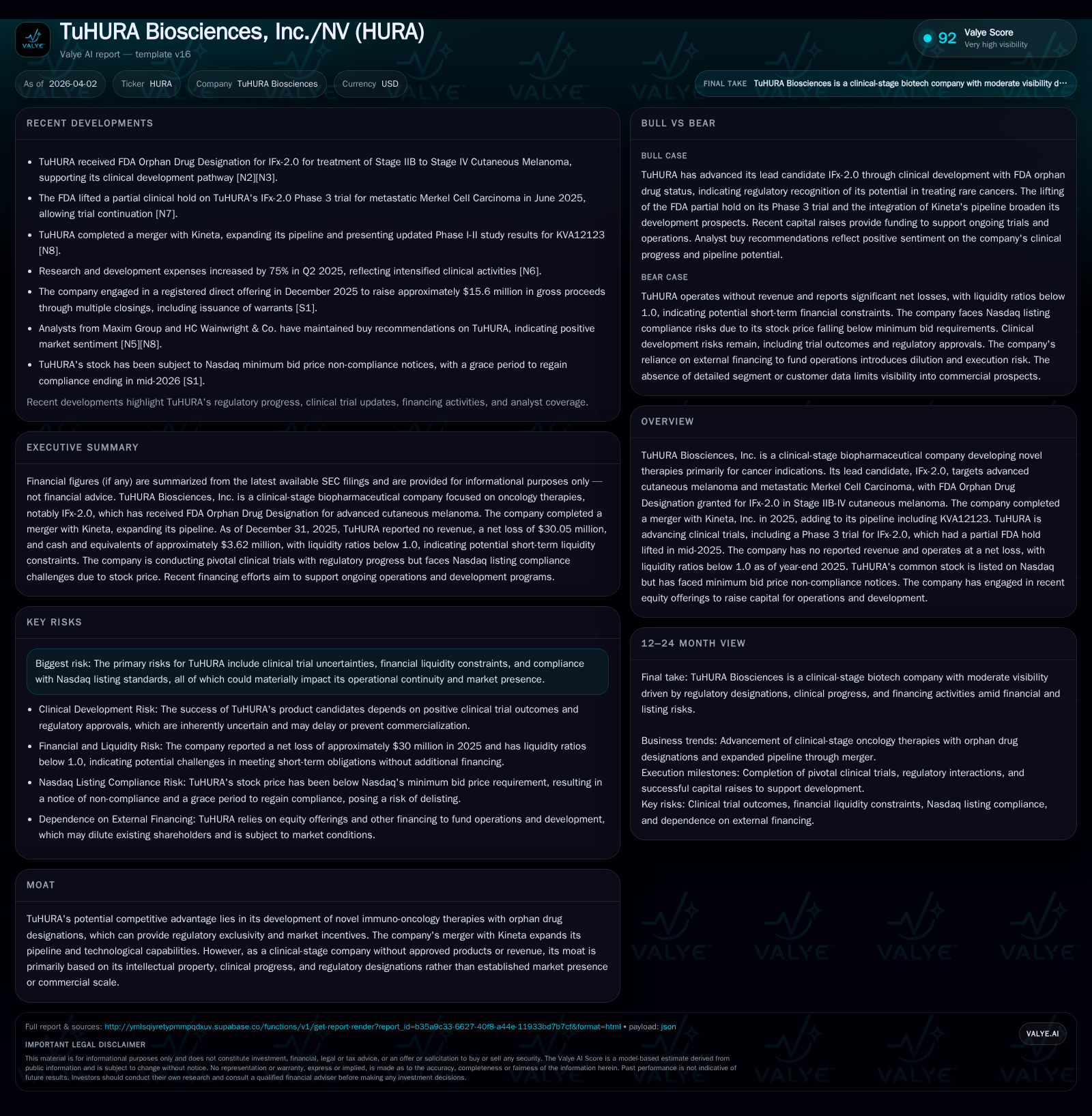
TuHURA Biosciences continues to develop its novel immuno-oncology therapies, notably advancing the IFx-2.0 candidate into a Phase 3 trial for Merkel cell carcinoma after resolving a partial FDA clinical hold. The 2025 merger with Kineta expanded its pipeline with additional promising agents targeting tumor immunosuppression. Despite the absence of revenues and sustained net losses, TuHURA has actively addressed funding needs via multiple equity offerings and bridge loans to support ongoing clinical programs. However, liquidity pressures and Nasdaq minimum bid price compliance issues present operational risks that require monitoring ahead of pivotal clinical milestones.
Clinical Development Trajectory: From Immune Activation to Bi-Specific ADCs
TuHURA Biosciences focuses on pioneering immuno-oncology therapies designed to overcome resistance mechanisms that limit efficacy in current cancer treatments. Central to its platform is Immune Fx™ (IFx), technology engineered to activate innate immunity by making tumor cells mimic bacterial infection signals, prompting an immune response against cancer cells otherwise evasive to immune checkpoint inhibitors. The lead candidate IFx-2.0 targets advanced cutaneous melanoma (stage IIB-IV) and metastatic Merkel Cell Carcinoma (MCC).
Following the lifting of a partial FDA clinical hold in mid-2025, TuHURA launched a randomized placebo-controlled Phase 3 trial for IFx-2.0 implemented as adjunctive therapy alongside pembrolizumab (Keytruda®) in first-line treatment for checkpoint inhibitor-naïve MCC patients, leveraging the FDA's accelerated approval pathway [S1]. This progression marks a significant milestone since TuHURA remains pre-revenue but with an advancing late-stage pipeline.
Beyond IFx-2.0, the 2025 Kineta merger broadened TuHURA's immuno-oncology spectrum by adding TBS-2025 (formerly KVA1213), an anti-VISTA monoclonal antibody intended to disrupt tumor microenvironment immunosuppression predominantly mediated by myeloid cells—especially relevant in acute myeloid leukemia (AML) where immune evasion contributes to relapse [S1]. Planning for Phase 1b/2 clinical evaluation of TBS-2025 in relapsed/refractory NPM1-mutated AML is underway.
Further adding innovation potential, TuHURA advances bi-specific antibody-drug conjugates (ADCs) targeting Delta Opioid Receptor (DOR) on Myeloid Derived Suppressor Cells (MDSCs), aiming to prevent T cell exhaustion and resistance development post-checkpoint blockade [S1]. The diversity of modalities—from innate immune agonism to checkpoint inhibition and ADCs—exemplifies a multi-pronged R&D approach addressing tumor heterogeneity and immunosuppressive niches.
M&A Impact on Pipeline Synergy and Innovation Potential
The mid-2025 acquisition of Kineta represented a strategic augmentation of TuHURA’s pipeline with assets complementary to the IFx platform. By integrating TBS-2025’s novel VISTA-targeting mechanism—a checkpoint distinct from PD-1/PD-L1 pathways—the company broadens its therapeutic arsenal against tumors with primary or acquired resistance [S1].
This merger also symbolizes execution ambition by transitioning from a single-platform focus toward diversified immunomodulatory approaches aimed at overcoming complex tumor microenvironment barriers—a critical challenge across hematologic malignancies and solid tumors alike.
Although commercial products remain absent, these synergies position TuHURA to capture potential orphan drug market exclusivities supported by regulatory designations such as that granted for IFx-2.0 in melanoma. The enriched pipeline may attract later-stage partnerships or licensing opportunities contingent on upcoming clinical data success.
Financial Runway: Revenue Absence, Operating Losses, and Liquidity Trends
Consistent with many early-stage biotechs without marketed products, TuHURA reported no revenue for fiscal years through 2025 [F1]. The company’s operating results reflect deepening net losses reaching approximately $30 million in 2025 compared to $21.7 million in 2024—a year-over-year increase of nearly 38.6%, driven primarily by escalating R&D expenditures necessary for advancing late-stage trials [F1].
Operating cash flow (CFO) declined sharply by roughly 87.6% year-over-year to negative $27.6 million in 2025 reflecting increased burn rates amid expanded clinical operations [F1]. Capital expenditures remain minimal relative to overall outflow.
Liquidity challenges are underscored by a current ratio of approximately 0.78 (current assets around $4.62 million versus current liabilities close to $5.92 million as of end-2025), signaling short-term obligations exceeding available liquid resources [F1]. Without commercial inflows, operational continuity depends heavily on external financing.
Capital Infusions and Equity Offerings: Underpinning Operations and Trials
To manage liquidity constraints, TuHURA executed several capital raises during late 2025 involving registered direct offerings posted in December that collectively target gross proceeds exceeding $15 million across multiple closings with attached common warrants exercisable at about $1.95 strike prices beginning six months post issuance [S10][S11][S22]. These financings help satisfy bridge loan obligations (~$3.4 million) extended by related parties under secured promissory notes amended as recently as December 2025 [S7][S14][S25], supporting near-term working capital needs.
Placement agent fees approximated around 7% at initial closing plus expenses; placement agents also received warrants representing about 3% additional dilution [S10][S21]. Such terms exemplify standard biotech late clinical-stage fundraising practices but impose significant shareholder dilution risk needing ongoing attention.
While these maneuvers provide essential runway extension, continuous funding demands amidst trial progress create cyclical capital dependency unless mitigated by partnerships or milestone-based inflows.
Regulatory Milestones: Orphan Drug Designation and FDA Communications
TuHURA’s regulatory journey includes orphan drug designation granted by the FDA for IFx-2.0 targeting Stage IIB-IV cutaneous melanoma — offering potential seven years market exclusivity post approval which could materially enhance commercial attractiveness [S1].
Moreover, the partial clinical hold imposed on the pivotal Phase 3 trial was lifted mid-2025 after addressing FDA concerns allowing patient enrollment under the FDA accelerated approval framework [S1][N1]. This regulatory clearance was fundamental in enabling continuation towards registration-quality evidence generation in MCC indication.
Positive interactions with regulatory bodies provide critical validation points underpinning investor confidence despite early-stage status; however, ultimate approvals depend heavily on pending clinical outcomes.
Assessing Operational Risks: Nasdaq Compliance and Funding Vulnerabilities
Operational risk factors include ongoing Nasdaq minimum bid price non-compliance due to the company’s share price trading below $1.00 over extended periods triggering notices issued early 2026 with an initial grace period extending to July 28, 2026 [S22]. Failure to regain compliance risks delisting which would impact liquidity and institutional investor interest.
Additionally, tight liquidity ratios combined with substantial near-term operating deficits amplify vulnerability to market dislocations or fundraising setbacks [F1][S4][S20]. Trial outcome uncertainties inherent in developmental biopharma heighten volatility affecting both operational planning and capital markets access.
TuHURA publicly acknowledges these risk domains within SEC filings emphasizing cautious path forward intertwined between scientific milestones achievement and successful financial stewardship [S4].
Near-Term Catalysts to Watch: Phase 3 Trial Outcomes and Trial Initiation
Investor focus converges primarily on interim and final results from the ongoing Phase 3 trial of IFx-2.0 in advanced Merkel cell carcinoma patients which will critically shape future regulatory submissions or commercial prospects [S1][N1]. Positive signals here could unlock expedited approval pathways leveraging prior accelerated approval designation.
Simultaneously, commencement of Phase1b/2 combination studies for TBS-2025 targeting relapsed/refractory AML introduces another value inflection event demonstrating pipeline diversification benefits provided by Kineta integration[S1]. Data from these studies could validate novel VISTA-blockade concepts addressing mechanisms resistant to existing checkpoint inhibitors.
No explicit financial guidance or milestone forecasts have been disclosed; thus market watchers should monitor pipeline advancements through official Company updates taking note that success or failure here will disproportionately impact valuation due to early-stage status.
ROE, Cash Flow Dynamics, and Capital Efficiency in Pre-Revenue Stage
Reflecting its development stage profile, TuHURA’s returns metrics remain profoundly negative; approximate return on equity stands near -144%, calculated from latest available net loss (~$30 million) against modest shareholders’ equity ($20.9 million at end-2025) [F1]. Free cash flow approximates negative $27.7 million illustrating acute cash consumption primarily driven by research activities absent offsetting revenue streams.
Such financial patterns typify pre-commercial biotech entities where capital allocation prioritizes sustaining R&D pipelines over profitability measures until product commercialization ensues or strategic partnerships are secured.
Efficient capital stewardship going forward will be instrumental given limited liquidity buffers; this underscores importance of balancing pipeline investment against dilution risks inherent in recurrent financing rounds.
Historical performance (annual)
| FY | Rev | Net ($mm) | CFO ($mm) | Capex ($) | Net YoY |
|---|---|---|---|---|---|
| 2025 | 0 | -30 | -28 | 76083 | -38.6% |
| 2024 | 0 | -22 | -15 | 57906 | -48.0% |
| 2023 | -15 | -12 | +35.4% | ||
| 2022 | -23 | -20 |
Source: SEC companyfacts cache [F1].
Capital returns and efficiency (annual)
| FY | FCF ($mm) | ROE% |
|---|---|---|
| 2025 | -28 | -143.6 |
| 2024 | -15 | -148.6 |
| 2023 | -2004.0 | |
| 2022 | -192.1 |
Source: SEC companyfacts cache [F1]. |Partial prior years data available from filings
Disclaimer: This report is based solely on publicly available SEC filings as of April 2, 2026 ([F1],[S#]) and Nasdaq news coverage ([N1]). It does not constitute investment advice or endorsement.
Disclaimer: This is research-only, informational analysis and not investment advice. It may include AI-generated interpretation and general industry context. Always verify important details using primary sources.

Comments