
Pharvaris N.V. Advances Late-Stage Rare Disease Therapies with Strong Cash Position but Deepening Losses
Pharvaris focuses on hereditary angioedema and bradykinin-mediated diseases, progressing clinical trials while managing significant R&D expenses and capital needs.
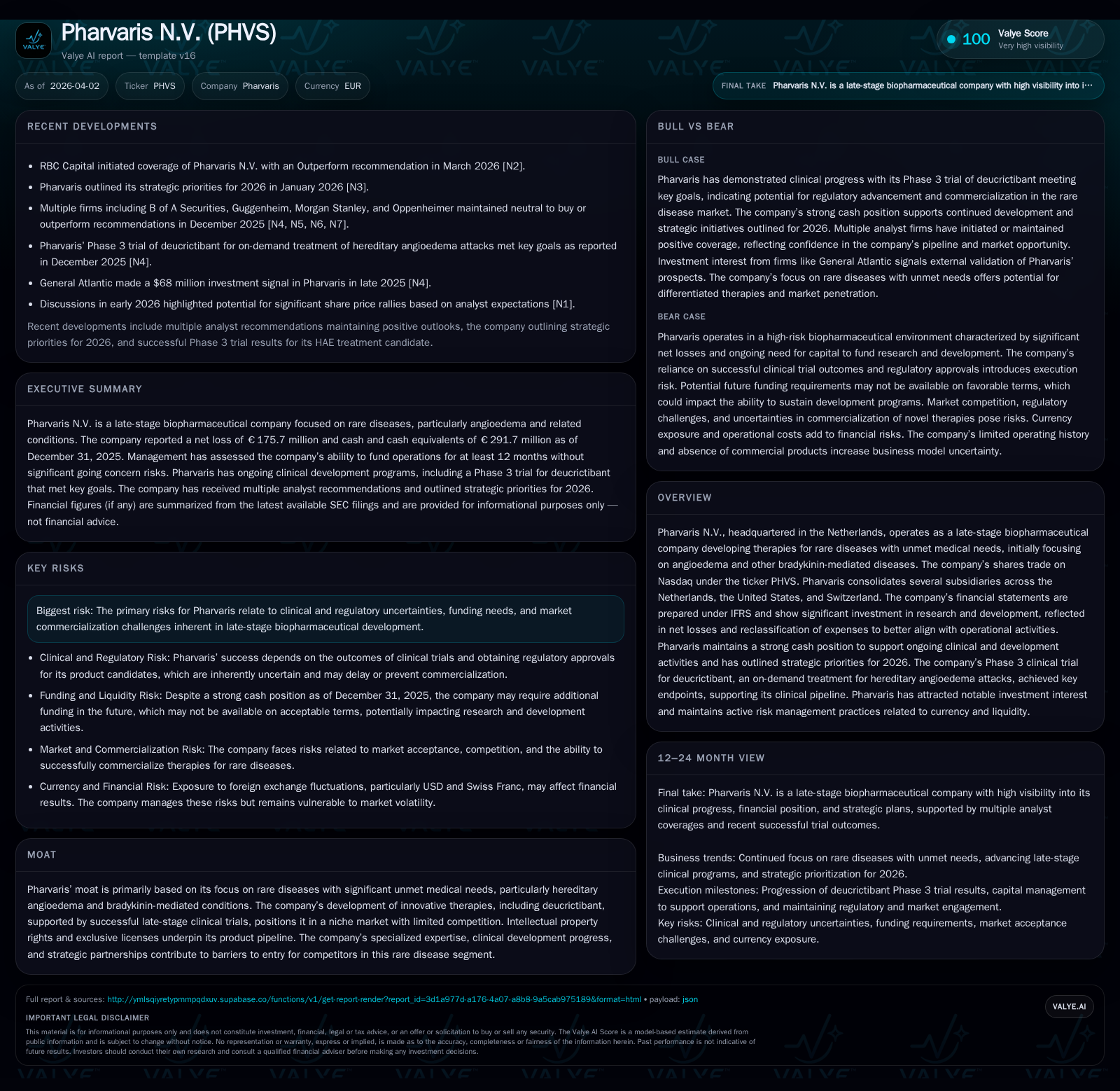
Pharvaris N.V., a Netherlands-based late-stage biopharmaceutical company, specializes in rare diseases such as hereditary angioedema. It reported substantial net losses deepening to €175.7 million in 2025 driven by increased R&D investment, particularly clinical development expenses. The company’s cash reserves rose modestly to €291.7 million by year-end 2025 following equity financing activities that underpin its near-term liquidity. With no product revenues yet, Pharvaris’ growth prospects hinge on upcoming regulatory milestones and commercial launches for its proprietary treatments like deucrictibant. Operational execution risks and potential funding needs remain key challenges.
Company Background and Focus
Pharvaris N.V., headquartered in Leiden, the Netherlands, operates as a late-stage clinical-stage biopharmaceutical company targeting rare diseases characterized by significant unmet medical needs. Its initial focus is on hereditary angioedema (HAE) and other bradykinin-mediated conditions—debilitating illnesses that currently have limited effective therapies [S1]. Pharvaris’ main investigational product is deucrictibant, designed as an on-demand oral treatment for HAE attacks, which has recently completed successful Phase 3 clinical trials [N1]. The firm consolidates subsidiaries across Europe (Netherlands, Switzerland) and the United States reflecting its cross-border operational structure [S1].
Historical Financial Performance
Pharvaris has consistently operated at a net loss given the absence of commercial products to date and heavy investment in research and development activities gearing towards regulatory filings and product launches.
Historical performance (annual)
| FY | Net ($mm) | Net YoY |
|---|---|---|
| 2025 | -176 | -30.9% |
| 2024 | -134 | -33.1% |
| 2023 | -101 | -32.2% |
| 2022 | -76 |
Source: SEC companyfacts cache [F1].
Capital returns and efficiency (annual)
| FY | ROE% |
|---|---|
| 2025 | -64.8 |
| 2024 | -50.1 |
| 2023 | -26.3 |
| 2022 | -51.1 |
Source: SEC companyfacts cache [F1].
Net income has widened every year reflecting amplified R&D outlays associated with clinical progression.
Operating losses deepened approximately 31% year-on-year from €134 million (2024) to nearly €176 million (2025), driven predominantly by an increase in clinical expenses (+€12 million), personnel costs (+€8 million), manufacturing (+€2.6 million), and nonclinical programs (+€4 million) [S10]. Despite these losses, equity remained stable near €270 million at the end of 2025 due to fundraising efforts [F1].
Capital Structure and Liquidity
As of December 31, 2025, Pharvaris held cash and cash equivalents totaling €291.7 million, a slight increase from €280.7 million at end-2024 [F1], supported by net proceeds of roughly €160.6 million from share issuance transactions offset by transaction costs of €10.9 million [S1]. This sizeable cash position is invested in liquid instruments with high credit ratings, mitigating credit risk [S16]. The firm maintains no borrowings or debt exposure, thus incurring no interest rate risk [S16].
The company’s liquidity management strategy ensures it maintains sufficient reserves to cover expected liabilities for at least twelve months post-reporting date [S3]. Research and development contractual commitments stood at €119.2 million as of end-2025 versus €109.9 million a year prior with additional potential milestone payments up to €8 million under license agreements with Brain Biotech AG [S1]. These obligations mainly derive from contracts with CROs for clinical trials and CDMOs for manufacturing oversight.
Research & Development Spending
R&D continues to represent the bulk of Pharvaris's expenditure; total R&D expense rose from about €98.6 million in FY24 to €124.5 million in FY25 [S10][F1]. Clinical trials accounted for over half this amount (~€67.7m), underpinning pivotal studies including those for deucrictibant’s Phase 3 trial culmination.
Personnel-related costs also climbed sharply reflecting expanded scientific teams integral to supporting complex development programs (€35.8m in FY25 vs €27.8m in FY24) alongside production costs related to manufacturing scale-up (~€12m). Nonclinical-related expenses more than doubled year-over-year likely due to additional toxicology or formulation work necessary prior to regulatory submissions (€7.5m).
The company follows IFRS standards under which it does not capitalize development costs since criteria such as technical feasibility or probable future economic benefits have not been conclusively established due to regulatory nature; hence all these expenditures are expensed immediately against earnings impacting profitability negatively [S10][S13].
Operating Cash Flow & Financial Health
Cash used in operating activities increased from approximately €120 million (FY24) to €137 million (FY25) as losses burgeoned commensurate with program intensification [F1][S11]. Investing activities remained immaterial while financing activities provided strong inflows driven by new equity issues totaling around €171 million gross proceeds minus associated issuance costs (€10-11m) [S11][S15].[N2]
The balance sheet remains robustly funded to execute ongoing late-stage trials along with preparation for anticipated commercialization initiatives pending regulatory approvals.
Growth Prospects & Strategic Outlook
Pharvaris's future trajectory depends critically on the regulatory success of its lead drug candidate deucrictibant along with expanding indications within bradykinin-driven diseases where unmet medical need persists [S1][N1]. Successful commercialization would pivot the company toward revenue generation after years of investment.
The firm's moat stems from exclusivity rights covering novel therapeutics targeting rare genetic therapies where competition remains limited alongside patent protections enforced through licensing agreements notably with Brain Biotech AG [S1][N2]. Partnerships supporting development offer risk-sharing mechanisms complementing internal capabilities.
However, growth is capped by classic biopharma developmental risks: uncertain regulatory decisions across jurisdictions; hurdles in market acceptance for orphan disease drugs; pricing & reimbursement negotiations; and securing long-term capital if launch-readiness expenditures escalate beyond current projections [S1].
Investors should watch upcoming milestones such as FDA/EMA filings for deucrictibant approval dates, commercial launch preparatory activities—including scaling manufacturing capacity—and progress evaluating additional pipeline candidates expanding the therapeutic portfolio.
Returns & Capital Allocation
With no product sales yet, Pharvaris exhibits negative returns on equity (-64.8% for FY25), reflecting ongoing losses financed via equity raises rather than operational cash flow generation [F1]. Dividends or share repurchases are non-existent given financial resource prioritization toward research development and regulatory processes [S20]. Capital allocation remains heavily tilted toward funding R&D programs—an expected stance consistent with companies at late-stage clinical development.
Currency Exposure & Market Risks
Pharvaris operates internationally with revenues (future), expenses, assets, and liabilities denominated primarily in euros, US dollars, and Swiss francs resulting in foreign currency fluctuations materially impacting reported figures each year due to translation effects between reporting periods [S16][S17][S19]. The weakening of USD relative to EUR in recent periods generated net foreign exchange losses recognized substantially within annual income statements (~€11m loss in FY25) impacting comparative performance metrics.
Furthermore, reliance on equity markets for capital raises means share price volatility could pose fundraising timing challenges amid market downturns.[N2] Regulatory setbacks or competitive advancements represent additional downside operational risks.
Conclusion
Pharvaris N.V.'s commitment to addressing rare bradykinin-mediated diseases places it distinctively within a specialized biopharma niche endowed with significant unmet therapeutic needs supported by compelling late-stage clinical progress such as deucrictibant’s pivotal data achievements.[N1] The company’s strong cash position entering 2026 provides a buffer enabling continued aggressive R&D investment essential for bringing products through approval paths.
However, widening net losses fueled by intensifying development expenditures underscore typical biotech financial dynamics requiring sustained external capital support absent near-term commercialization revenue inflows.[F1][S1] Strategic execution encompassing regulatory wins, manufacturing scale-up readiness, market access strategies alongside maintaining sufficient liquidity will be critical determinants shaping Pharvaris’s transition from a research-heavy biotechnology entity into a commercially viable pharmaceutical enterprise.
This analysis is based solely on publicly available information including Pharvaris N.V.’s SEC filings as of April 2, 2026 ([F1],[S#]) and recent news reports ([N#]). It does not constitute investment advice or recommendations.
Disclaimer: This is research-only, informational analysis and not investment advice. It may include AI-generated interpretation and general industry context. Always verify important details using primary sources.

Comments