
Mainz Biomed’s Strategic Shift: From Cancer Diagnostics to Quantum Cybersecurity
Mainz Biomed pivots from colorectal cancer screening to pancreatic cancer diagnostics and post-quantum cybersecurity amid financial constraints and operational restructuring.
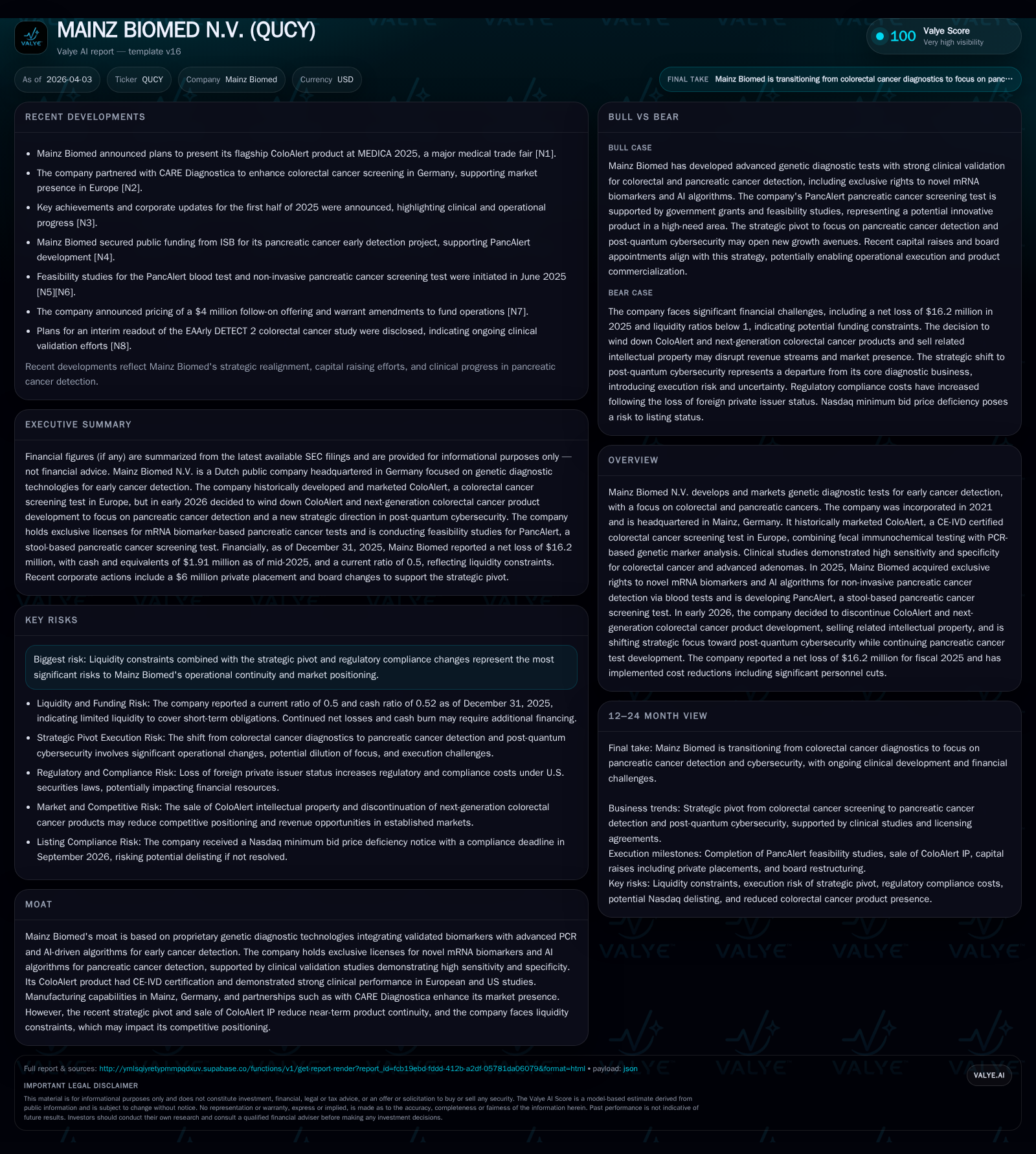
Founded in 2021, Mainz Biomed initially focused on colorectal cancer screening with its ColoAlert product, demonstrating strong clinical specificity and sensitivity. In early 2026, the company discontinued ColoAlert and related colorectal pipeline development due to funding limitations, divesting associated intellectual property. It secured exclusive rights to novel mRNA biomarkers and AI algorithms for non-invasive pancreatic cancer detection, developing PancAlert with governmental grant support. Concurrently, leadership changes signal expansion into post-quantum cybersecurity, accompanied by plans to rebrand as Quantum Cyber N.V. The company faces liquidity challenges with a current ratio near 0.5 at year-end 2025 and relies on recent $6 million private placement financing. Shareholder approvals on preferred share conversions and corporate name change are key upcoming milestones amid Nasdaq listing compliance pressures.
Historical Growth Anchored in Genetic Cancer Biomarkers
Mainz Biomed’s early growth centered on developing non-invasive genetic diagnostic tests for early cancer detection, primarily colorectal cancer (CRC). Its flagship product, ColoAlert, integrated a fecal immunochemical test (FIT) with PCR-based analysis targeting genetic markers such as KRAS and BRAF mutations [S28]. ColoAlert obtained CE-IVD certification in the European Union under IVD regulations, evidencing compliance with regulatory safety and performance standards [S28].
Clinical validations demonstrated robust performance: the ColoFuture study (EU cohort) reported CRC sensitivity of 94% with specificity of 97%, while the US-based eAArly DETECT study showed CRC sensitivity of 97% with similar specificity levels [S21]. Both studies also indicated approximately 80% sensitivity for advanced adenomas — precursors to colorectal cancer — reflecting potential for early lesion detection. These results leveraged AI-driven machine learning algorithms developed through partnerships with Liquid Biosciences to optimize biomarker integration [S21].
Despite promising clinical data, Mainz Biomed incurred substantial operating losses driven by intensive research and development investments coupled with limited commercial traction. For fiscal year ending December 31, 2025, the company reported an operating loss of approximately $16.1 million and net loss near $16.2 million [F1]. Revenue remained nominal ($1 reported), reflecting minimal commercial scale or reporting lags [F1]. The balance sheet revealed working capital challenges with a current ratio around 0.5 at year-end 2025 [F1].
Historical performance (annual)
| FY |
|---|
| 2025 |
| 2023 |
Source: SEC companyfacts cache [F1].
Financial figures sourced from latest annual data per [F1].
Strategic Pivot: Discontinuation of ColoAlert and Next-Generation Colorectal Products
In early 2026, Mainz Biomed formally exited its colorectal cancer diagnostic business. A board resolution in February led to discontinuation of ColoAlert manufacturing and next-gen CRC pipeline development alongside workforce reductions exceeding 60% concentrated in these segments [S1][N1][S13]. On March 28, the company sold ColoAlert intellectual property assets under an agreement reducing outstanding debt obligations [S13]. Intellectual property tied to next-generation CRC products remains actively marketed for sale.
This withdrawal marks a significant shift away from Mainz Biomed’s core historical asset base despite ColoAlert being its primary revenue-related product. The move reflects prioritization of capital preservation amid liquidity constraints and strategic realignment toward new technologies outside traditional oncology diagnostics [S1][S13].
Emerging Opportunities: PancAlert Development and Post-Quantum Cybersecurity Expansion
Concurrently, Mainz Biomed secured exclusive licenses in March 2025 from Liquid Biosciences covering novel mRNA biomarkers and AI algorithms aimed at non-invasive pancreatic cancer detection via blood tests [S18]. Preliminary validation studies demonstrated promising accuracy metrics (~95% sensitivity and ~98% specificity) across patient cohorts totaling nearly 300 subjects evaluated for pancreatic malignancy presence [S18].
Leveraging these assets, Mainz is developing PancAlert—a stool-based screening test variant—benefiting from non-refundable governmental grants offsetting developmental costs [S18]. While still pre-commercialization with regulatory approvals pending, PancAlert represents a focal point for near-term clinical advancement.
Parallel to this oncology focus shift is an expansion into post-quantum cybersecurity markets signaled by February–March 2026 appointments of David Lazar as co-Chief Executive Officer and Robert Liscouski as non-executive Chairman [S1][N1]. Plans include rebranding as Quantum Cyber N.V., reflecting diversification beyond biotech into emerging high-tech security sectors that require distinct expertise and resource allocation.
Financial Position and Capital Structure Considerations
As of December 31, 2025, Mainz Biomed held approximately $1.8 million in current assets against $3.7 million in current liabilities resulting in a current ratio near 0.5 — indicative of liquidity pressure [F1]. Operating cash flows remain negative with free cash flow deficits estimated at around $11 million annually (based on CFO minus Capex) underscoring ongoing cash burn without significant revenue inflows [F1].
To address funding needs amidst restructuring costs and product development expenditures, the company completed a $6 million private placement in February 2026 led by David Lazar involving issuance of series A-E preferred shares convertible at various ratios into ordinary shares pending shareholder approval [N1][S25][S10][S16]. This financing is critical for sustaining general corporate operations including PancAlert advancement.
However, the convertible preferred shares present meaningful dilution risk. Upon full conversion—subject to shareholder approval—the preferred shares could increase outstanding ordinary shares by over 95%, significantly diluting existing shareholders’ interests [S10][S16]. Additionally, Nasdaq notified Mainz Biomed in March 2026 regarding minimum bid price deficiencies placing the company under a compliance period through September 2026 to regain listing standards or face delisting risks [S15].
Governance Changes Aligned With Strategic Transition
Governance adjustments accompany operational shifts: David Lazar was appointed co-CEO and director with contractual rights including board nomination privileges linked to his equity stake acquired through private placements [S8][N1]. Robert Liscouski’s role as non-executive Chairman complements leadership experienced in cybersecurity sectors overseeing strategic transformation efforts [S1][N1].
These changes coincide with planned corporate rebranding subject to shareholder vote scheduled April 22, aiming to rename the company Quantum Cyber N.V., symbolizing expanded focus embracing cybersecurity alongside oncology diagnostics initiatives [S7][N1].
Investor Outlook: Upcoming Catalysts and Risks
Key events anticipated over H2 CY2026 include:
- Regulatory milestones crucial for PancAlert’s commercial launch or pivotal validation phases given its early development stage relative to prior CRC products [N1][S18].
- Shareholder votes on preferred share conversions underpinning substantial equity dilution risks tied directly to controlling interests associated with Lazar-affiliated parties [N1][S10][S16].
- Approval of corporate name change reinforcing repositioning strategy; failure could undermine brand evolution efforts impacting investor confidence [N1][S7].
- Progress updates regarding quantum cybersecurity initiatives remain limited but represent material diversification risks given required specialized R&D investment beyond historical biotech scope.
- Continued financial discipline necessary due to persistent negative free cash flows juxtaposed against limited near-term revenues raising solvency concerns absent further capital infusions or operational efficiencies [F1][N1][S25].
- Legal contingencies currently minimal though ongoing litigation involving Boustead Securities exists without material impact forecasted thus far but warrants monitoring [S6].
Capital Allocation Review: Reinvestment Focused Without Dividends or Buybacks
Since inception through latest filings there have been no dividend payments or share repurchase programs reported; all available capital has been directed toward research & development activities along with corporate restructuring costs amid evolving business focus areas [F1][S4][S5].
The company’s equity structure includes multiple series (A through E) of preferred shares convertible into ordinary shares at rates ranging from nine shares per preferred share up to two hundred twenty-five shares per preferred share depending on tranche classification. These arrangements create complex convertible securities accounting treatments producing significant dilution potential if fully converted post-shareholder approvals are obtained [S4][S7][S10][S19][S24][S26].
Authorized share capital limits have been increased substantially consistent with Dutch corporate governance procedures permitting board discretion within approved caps. Proposed reverse stock splits (ratios between one-for-two up to one-for-one hundred) await shareholder approval at forthcoming meetings enabling tactical flexibility but also altering share count ceilings considerably from prior levels toward higher magnitudes following implementation decisions by the Board ahead of voting sessions planned April 22, 2026 [S7][N1].
Capital management effectiveness combined with milestone execution will be critical determinants shaping Mainz Biomed’s valuation trajectory amid this broad dilution backdrop.
This analysis is based on public filings including SEC disclosures ([F1], [S#]) and verified news sources ([N#]) without providing investment advice or recommendations.
Disclaimer: This is research-only, informational analysis and not investment advice. It may include AI-generated interpretation and general industry context. Always verify important details using primary sources.

Comments