
Iron Horse Acquisition II Corp. Faces Critical Business Combination Deadline
A newly public SPAC with $230 million raised navigates the ticking clock and liquidity challenges to complete its initial business combination.
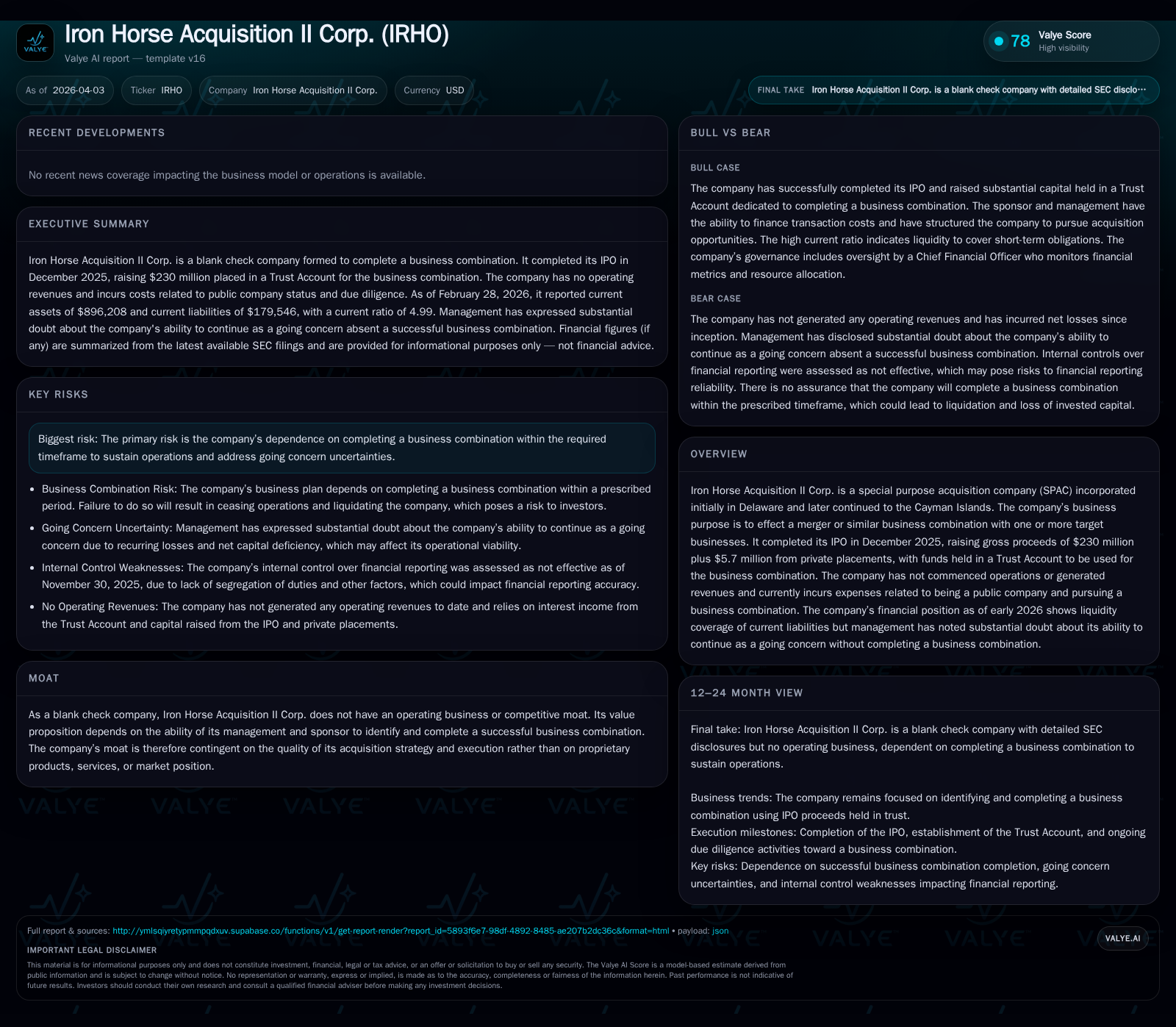
Iron Horse Acquisition II Corp. launched as a blank check company in late 2024 and successfully completed a $230 million IPO in December 2025, establishing a trust account to finance an ultimate business combination. As a non-operating entity, it has incurred net losses related to organizational and public company costs but currently maintains strong liquidity with a current ratio of approximately 5. The firm faces mounting execution risk due to its pending deadline to consummate a qualifying merger within 24 months of the IPO, underscored by management's noted substantial doubt about going concern absent such transaction. Investors should closely monitor transaction announcements, shareholder votes, and capital consumption in the coming months.
From Inception to IPO: Early Steps and Capital Raise
Iron Horse Acquisition II Corp., originally incorporated as a Delaware entity on November 26, 2024, underwent corporate restructuring during mid-2025. On July 25, 2025, it continued its existence as a Cayman Islands exempted company. Subsequently, on September 30, 2025, Iron Horse Acquisition II Corp. merged with the earlier incorporated Cayman Island entity, consolidating under the offshore jurisdiction [S1][S6]. This restructuring aligns with common SPAC practice to leverage favorable jurisdictional regimes for acquisition vehicles.
On December 18, 2025, Iron Horse consummated its Initial Public Offering (IPO), issuing 23 million units priced at $10 each. Including full exercise of the underwriters’ over-allotment option (3 million units), this generated gross proceeds of $230 million [S1][S4]. Simultaneously, it arranged a private placement of 570,000 units at $10 each—$3.7 million of which were purchased by its Sponsor and $2 million by Cantor Fitzgerald & Co.—yielding an additional $5.7 million in gross proceeds [S1][S22].
The offering’s structure focused on maximizing capital available for a future business combination by incurring all upfront organizational and offering costs prior to escrow funding. Deferred underwriting commissions totaling approximately $11 million plus cash underwriting fees also impacted net proceeds [S23][S26]. The process reflects standard industry approaches balancing investor dilution against sponsor incentives.
Financial Snapshot: Operating History and Current Position
As is customary for blank check companies, Iron Horse has generated no operating revenues since inception. Expenses through November 30, 2025 consisted mainly of legal fees, audit and compliance costs tied to its public status. Net loss for fiscal year ended November 30 amounted precisely to $204,391 [F1][S1]. The company reported virtually no cash on hand before IPO close ($432) but subsequently received material proceeds held primarily in a Trust Account.
By February 28, 2026 (latest quarterly data), Iron Horse showed current assets of approximately $896 thousand versus current liabilities near $180 thousand—a current ratio of roughly 4.99—demonstrating sound short-term liquidity [F1]. This liquidity primarily reflects funds released outside the Trust Account post-IPO to cover ongoing working capital requirements.
Historical performance (annual)
| FY |
|---|
| 2025 |
Source: SEC companyfacts cache [F1].
*Data approximate from narrative context [S1][S6] **Quarter end data [F1]
The sharp improvement in liquidity ratios between November '25 and February '26 reflects timing around IPO close and fund release from escrow.
SPAC Mechanics: The Trust Account and Sponsor Involvement
Fundamental to Iron Horse’s capital management is its segregated Trust Account where gross IPO proceeds ($230 million) are deposited immediately upon closing [S1][S23]. These monies are invested primarily in U.S. Treasury bills or comparable highly liquid instruments with maturities under 185 days or eligible money market funds conforming with Rule 2a-7 [S26]. This preserves principal while awaiting consummation of an initial business combination or potential liquidation.
Sponsor participants subscribed substantial Founder Shares pre-IPO amounting to approximately $32 thousand for nearly six million shares (~20% equity post-IPO excluding potential forfeiture) [S4][S6]. Notably up to 750k founder shares were subject initially to forfeiture contingent on underwriters’ full over-allotment exercise—but this condition resolved positively after completion [S4]. Meanwhile private placement units purchased alongside the public offering carry lock-up provisions preventing transfer until after the first qualifying business combination [S7][S22].
Promissory notes issued by the Sponsor before IPO totaled $300k used for partial offering expense payments and were fully repaid upon offering close [S4]. Furthermore, insiders may extend unsecured working capital loans after IPO closure but before deal closing; such loans are non-interest bearing and convertible into private placement units under specified terms [S17][S21].
The company's governance documents ensure sponsor alignment by compelling Founder Shares vote support toward any proposed business combination and waiver of redemption rights thereof [S8][S9]. Rights holders receive fractional ordinary shares upon combination consummation but lack direct redemption or voting privileges.
Timeline and Imperatives for Completing a Business Combination
Per contractual obligations established during its IPO process and NASDAQ listing rules compliance mandates [S12], Iron Horse must complete an initial business combination within twenty-four months following IPO close (i.e., by December 18, 2027). Failure initiates mandatory liquidation whereby public shareholders redeem pro-rata portions of Trust Account balances at roughly $10 per share plus accrued interest less permitted deductions for winding down expenses [S1][S23][S25].
Management explicitly documented substantial doubt concerning continued operations absent completion of the business combination within this timeline given limited retained working capital beyond Trust Account funds [S25]. Thus operations currently hinge critically on merger execution risk—a hallmark challenge faced universally across blank check companies.
Capital Deployment Strategy and Sponsor Shareholdings
Funds outside escrow primarily finance due diligence activities associated with target identification including legal review fees, travel expenses related to evaluation of prospective acquisitions as well as ongoing G&A expenditures required by operating as listed entities [S17][S8]. These amounts are small relative to hundreds of millions secured in escrow but essential for transactional readiness.
Insider ownership rests chiefly with IRHO SPAC Sponsor LLC whose members hold about 21% post-IPO equity including Founder Shares and private placement shares purchased concurrently with public investors [S9]. This stake ensures motivational alignment through meaningful skin-in-the-game participation offsetting inherent incentive asymmetry between sponsor promoters and passive public shareholders.
Working capital loans extended by insiders can convert into private placement units priced at $10 apiece subject to discretion; as of latest filings no such loans remain outstanding indicating prudent financial discipline early in lifecycle though capacity remains for accelerated spending if mandated midsize deals arise swiftly [F1][S21].
Risks Related to Business Combination Delays and Liquidity
The stage at which Iron Horse operates naturally exposes it entirely to execution risk concentrated in accomplishing timely completion of its initial business combination under SEC mandate [S1][S5]. Delays beyond expiration trigger re-purchase obligations that could deplete operating funds needed for corporate overhead prior to wind-down. Moreover, the shares' value hinges fully on successful transaction closure lacking intrinsic product or service moats characteristic of operating firms.
Sponsor financial backing partially mitigates risks through committed mechanisms including voting covenants favoring combinations alongside contractual redemption waivers from insiders’ Founder Shares [S9][S22]. Still deferred underwriting commissions totaling nearly $11 million become payable only on completion reinforcing economic pressure within deal timelines [S23].
Shareholder redemption rights further introduce variability as large-scale redemptions shrink effective deal proceeds potentially impeding economics thus requiring careful target valuation calibration far exceeding minimum NASDAQ fair market value thresholds ([≥80%] Trust Account balance) often driving complex deal structuring.
What Investors Should Monitor Going Forward
While no explicit guidance or milestones beyond regulatory time windows have been disclosed at this stage investors should focus keenly on several developments:
- Announcement(s) concerning definitive agreements on initial target(s) suitable under NASDAQ's fair market value rules;
- Proxy statements setting dates for shareholder votes regarding approvals or redemptions connected with proposed business combinations;
- Quarterly updates reflecting interest income accruing within Trust Account evidencing preservation/amplification albeit limited returns due to conservative investments;
- Any insider-sponsored working capital loans or supplemental fundraising indicative of increasing operational burn rates;
- Regulatory disclosures outlining amendments affecting timelines or changes in advance terms affecting shareholder redemption provisions.
Absent such information forthcoming in official filings or communications investors remain exposed purely to binary event risk centered on deal closure decisions within mandated periods.
This report is prepared solely for informational purposes based on publicly filed SEC documents related to Iron Horse Acquisition II Corp., without giving investment advice or recommendations. Details herein reflect company disclosures up until early April 2026; subsequent developments are not included.
Disclaimer: This is research-only, informational analysis and not investment advice. It may include AI-generated interpretation and general industry context. Always verify important details using primary sources.

Comments