
Byrn, Inc.'s Dormancy and Capital Structure Weigh on Growth and Returns
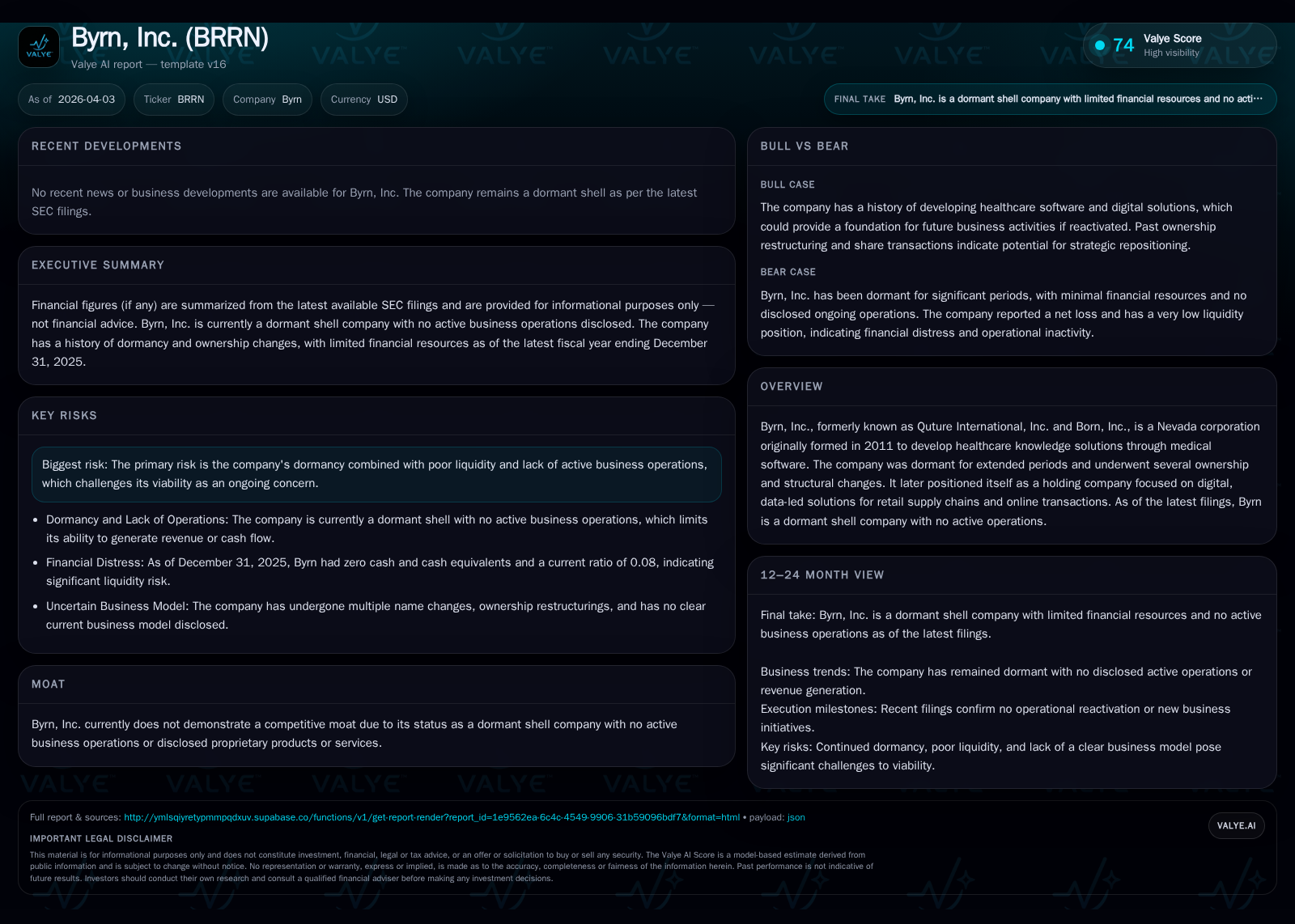
Byrn, Inc., a dormant shell with a complex corporate history, shows no active operations and sustained losses impacting its viability.
Originally founded in 2011 as a healthcare software innovator, Byrn, Inc. has experienced multiple ownership changes, periods of dormancy, and a pivot to a holding company model without active business. Its financials reflect persistent operating losses and negative equity, with no revenues since 2012 and zero cash reserves by the end of 2025. The company lacks any current moat or competitive positioning, facing severe liquidity constraints and minimal prospects for growth absent new strategic initiatives.
Corporate History and Past Growth
Byrn, Inc., initially incorporated in Nevada in April 2011 under the name Quture International, began as an emerging healthcare knowledge solutions company focused on medical software designed to standardize clinical performance metrics and improve patient outcomes [S1]. However, its initial ambition did not translate into sustained commercial traction. By March 2013, the company entered an extended period of dormancy lasting until December 2019 [S1].
The company's share capital structure underwent significant changes early on, increasing authorized common shares from 900 million to 2.5 billion plus 10 million blank check preferred shares in August 2011 [S1]. Despite this authorization expansion and multiple corporate reorganizations including reverse stock splits (notably a 1-for-1000 split in November 2020), Byrn failed to generate meaningful revenue beyond approximately $40.9K ending April 2012 [F1].
Ownership shifts were pivotal: Custodian Ventures LLC took custodianship in late 2019 appointing David Lazar as sole director/officer [S1]. Lazar received super-voting preferred shares convertible into common stock reflecting large voting control [S1]. In September 2020, these preferred shares transferred to FiveT Capital Holding AG, which became majority voting shareholder [S1]. Subsequent management resignations followed immediately.
A brief attempt to pivot via a share exchange with UK-based Alkeon Creators resulted in an accounting acquisition but was ultimately voided leaving Byrn a dormant shell from February 2021 through mid-2023 [S5]. The most recent name change to Byrn Inc. occurred July 2024 as part of an apparent rebranding without operational restart [S5].
Financial Performance Overview
Byrn's most recent financials reflect its inactive status:
Historical performance (annual)
| FY | Net ($) | CFO ($) | OpInc ($) | Net YoY |
|---|---|---|---|---|
| 2025 | -40025 | -45800 | -40025 | +11.0% |
| 2024 | -44987 | -46075 | -44987 | -112.0% |
| 2023 | -21221 | -15677 | -21221 | -346.6% |
| 2022 | -4752 | -4752 |
Source: SEC companyfacts cache [F1].
Capital returns and efficiency (annual)
| FY | ROE% |
|---|---|
| 2025 | 41.4 |
| 2024 | 79.5 |
| 2023 | 70.5 |
| 2022 | 53.4 |
Source: SEC companyfacts cache [F1].
(Revenue last reported at ~$40.9K ending April 2012; subsequent years show no material revenue) [F1]
Operating income and net income have consistently been negative with losses accelerating from under $5k in FY22 to roughly $40k in FY25. Operating cash flows remain deeply negative reflecting ongoing cash burn [F1]. Meanwhile, equity has eroded into deeply negative territory (-$96.6K by FY25), signifying net liabilities exceeding assets [F1]. Current liabilities stood at approximately $96.6K at year-end 2025 against nominal current assets previously reported at $7.5K (early 2013), yielding an extremely low current ratio (~0.08) indicative of acute liquidity risk [F1].
Capital Allocation and Returns
Byrn does not pay dividends nor engage in share buybacks according to the latest SEC filings; such capital returns measures are practically irrelevant given its dormant status [S3][S5][S6]. Historical capital allocation actions have focused on structural corporate maneuvers such as reverse stock splits and issuance/transfer of preferred shares with enhanced voting rights that consolidated ownership control rather than deploying capital toward growth initiatives [S1][S3].
Reported return metrics such as ROE are distorted by negative equity; for instance, the approximate ROE calculated as net income divided by equity is around positive 41%, reflecting the accounting effect of negative book value rather than economic profitability [F1]. Cash flow data confirm persistent outflows without free cash generation.
Competitive Positioning and Industry Context
Due to lack of active operations and no disclosed proprietary products or services beyond the original healthcare analytics software concept that never matured commercially, Byrn holds no discernible competitive moat. Its brief positioning as a holding entity focusing on digital retail supply chain solutions did not manifest into tangible assets or market presence [S5]. Without operational activity or product development efforts documented in filings, Byrn remains uncompetitive within the broader tech landscape.
Risks Highlighted by Filings
Key risks stem from longstanding dormancy combined with minimal liquidity evidenced by zero cash reserves at year-end 2025 [F1] and extensive liabilities relative to assets. The balance sheet weakness coupled with absence of revenues threatens going concern status absent fresh capital injections or strategic transactions [S4][S7]. No material legal proceedings burden the company currently but prolonged inactivity typically correlates with heightened regulatory compliance challenges.
Outlook: What to Watch
No explicit forward-looking guidance or milestones are provided in current filings regarding business revival, new product launches, partnerships, or acquisitions that could drive growth [N/A]. Monitoring potential changes in ownership structures or any filing updates signaling operational recommencement would be key indicators.
Given its profile as a dormant shell company lacking active operations or clear strategic direction as of early 2026, Byrn’s future depends largely on external catalysts such as acquisition interest or transformative corporate actions.
Conclusion
Byrn, Inc.’s trajectory exemplifies the challenges small public companies face when initial product-market fit fails and subsequent pivots do not materialize into viable businesses. With no revenues outside of a minor amount reported more than a decade ago and consistent operating losses widening yearly alongside negative equity indicating deteriorating fundamental viability. The firm’s capital moves appear primarily administrative rather than growth-oriented underscoring its status as a non-operating shell.
Absent meaningful new initiatives or capital infusions disclosed formally by management, Byrn remains unlikely to produce shareholder returns driven by operations or technological innovation. Investors should interpret its filings as evidence of extended dormancy with attendant liquidity constraints rather than nascent growth.
Disclaimer: This analysis is based exclusively on publicly available financial disclosures and SEC filings as of April 2026. It does not constitute investment advice or recommendations but aims to provide an objective assessment grounded in documented facts.
Disclaimer: This is research-only, informational analysis and not investment advice. It may include AI-generated interpretation and general industry context. Always verify important details using primary sources.

Comments