
Pharming Group's Rare Disease Focus Catalyzes Revenue Growth and Operational Expansion
Pharming advances in immunological and genetic disorders drive revenue gains and pipeline diversification amid regulatory milestones.
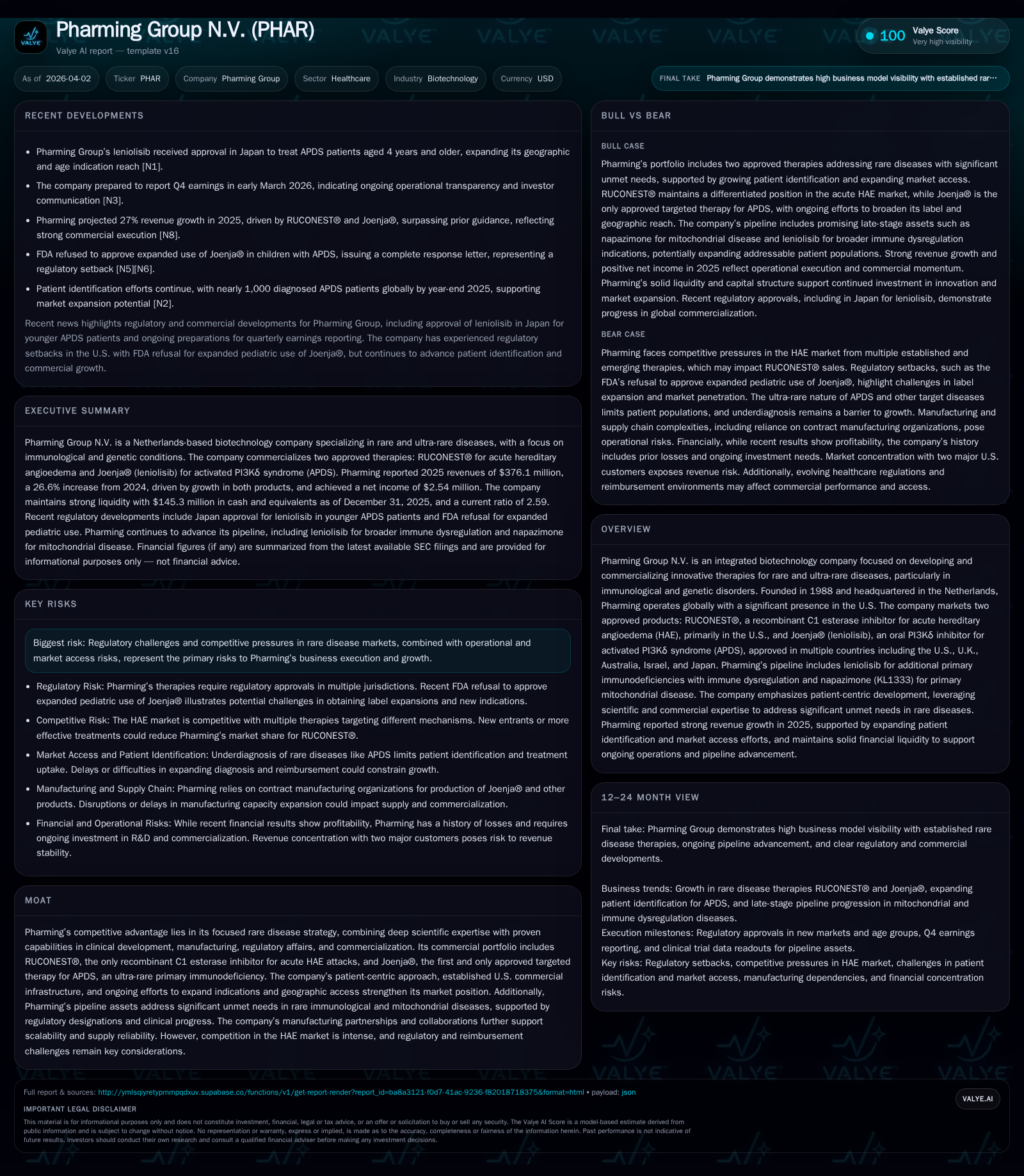
Pharming Group N.V. reported significant revenue growth in 2025 fueled by strong sales of RUCONEST® and Joenja®, reflecting expanded patient access and geographic reach. The acquisition of Abliva AB added napazimone (KL1333) to its pipeline targeting primary mitochondrial diseases, enhancing the company’s ultra-rare disease portfolio. Regulatory progress includes a positive European CHMP opinion for Joenja® for APDS, with final marketing approval expected in mid-2026. Despite increased operating expenses tied to commercial expansion and R&D, Pharming ended 2025 with a strengthened cash position and returned to profitability after prior losses.
Overview
Pharming Group N.V., headquartered in the Netherlands, is a globally integrated biotechnology company pioneering treatments for rare and ultra-rare diseases with high unmet needs, focusing on immunological and genetic disorders.[S1][S21] The company markets two approved products: RUCONEST®, a recombinant C1 esterase inhibitor for acute hereditary angioedema (HAE), mainly commercialized in the U.S., and Joenja® (leniolisib), an oral PI3Kδ inhibitor approved across multiple territories including the U.S., UK, Australia, Israel, Japan, and soon the EU.[S1][N3]
Since its founding as GENFARM B.V. in 1988, Pharming has evolved into a specialist biopharma firm leveraging deep expertise across clinical development, manufacturing, regulatory affairs, and commercialization to serve rare disease communities.[S1][S29] Its strategy centers on patient-centric development and expanding geographic access while aggressively nurturing a pipeline targeting additional immune dysregulation disorders and mitochondrial diseases.[S1][S14]
Past Growth & Historical Performance
The company demonstrates solid top-line momentum anchored by its flagship products:
Historical performance (annual)
| FY | Net ($mm) | Net YoY |
|---|---|---|
| 2025 | 3 | +121.4% |
| 2024 | -12 | -12.3% |
| 2023 | -11 | -177.1% |
| 2022 | 14 |
Source: SEC companyfacts cache [F1].
Capital returns and efficiency (annual)
| FY | ROE% |
|---|---|
| 2025 | 0.9 |
| 2024 | -5.4 |
| 2023 | -4.8 |
| 2022 | 6.7 |
Source: SEC companyfacts cache [F1].
Net income and equity figures are from audited IFRS filings [F1]. Revenues are not explicitly disclosed but are noted to have grown driven by RUCONEST® (+26%) and Joenja® (+29%) sales increases in 2025.[S1]
Revenues accelerated with RUCONEST® increasing largely due to rising U.S. demand attributable to an expanded prescribing base and higher patient uptake.[S1][S21] Meanwhile, Joenja®, launched commercially in April 2023 in the U.S., registered strong growth as patient transition onto therapy proceeded swiftly.[S1]
Operational expenditures rose as Pharming scaled commercial infrastructure across multiple regions including the U.S., Europe, Australia, Israel, preparing for broader approvals.[S1][S14] Increased R&D focused on pediatric clinical trials for leniolisib (Joenja®) and advancement of napazimone (KL1333) following Abliva AB acquisition contributed further to expense growth.[S1][S14]
Despite this expenditure environment, Pharming returned to profitability in 2025 with net income of $2.54 million reversing prior multi-year losses exceeding $10 million each year through 2024.[F1]
Future Growth Prospects
Near-term growth drivers include expanding market penetration geographically and therapeutically:
- RUCONEST®: Continued growth expected primarily from the U.S. market as physician awareness rises alongside potential label expansions or reimbursement enhancements.[S21]
- Joenja® (leniolisib): Recent approval for APDS treatment in Japan for patients aged four years and older,[N3] complemented by EMA CHMP positive opinion recommending marketing authorization for patients aged twelve years and older,[N2][S3]. Final EU decision expected Q2 2026.[N2][S3]
- Pipeline Expansion: Mitochondrial disease candidate napazimone (KL1333), acquired via Abliva AB addition last year,[S1][S14], targets underserved ultra-rare diseases offering long-term potential dependent on successful trial progression.
Pharming is also evaluating leniolisib for additional primary immunodeficiencies involving immune dysregulation beyond APDS,[S1], broadening potential indications.
Forecasts / Milestones / Expectations
Formal quantified guidance is not provided within available disclosures,[N2][N1]. Key upcoming milestones include:
- Final EU marketing authorization decision for Joenja® following CHMP recommendation expected mid-2026,[N2][S3].
- Progress updates on Phase II trials of leniolisib for non-APDS immunodeficiencies,[S1].
- Early-stage results or regulatory feedback on napazimone post-Abliva acquisition programs.[S14]
- Potential launches or reimbursement advances in Canada and broader EU markets.[S1]
Risks consist of regulatory hurdles; competitive pressures especially within HAE therapeutic space; pricing challenges from third-party payors; and complex global legal compliance requirements including data privacy laws.[S19][S10]
Returns / Capital Allocation
Pharming improved capital efficiency markedly in 2025 with positive net income of $2.54 million compared to losses exceeding $11 million prior year,[F1]. This translates to approximately a 0.9% return on equity based on $277 million equity at year-end.[F1]
Liquidity remains robust with combined cash, cash equivalents plus marketable securities totaling approximately $179 million at December 31, 2025,[F1][S5], sufficient to fund operations beyond twelve months under current plans.
Capital expenditures remain modest around $0.7 million annually focused on facility machinery upgrades within Dutch manufacturing sites.[S1]
No dividends or share repurchase programs are currently disclosed; management prioritizes reinvestment into clinical development and commercial expansion initiatives.[S5]
Competitive Position & Risks
Pharming operates within specialized rare disease niches where differentiation relies on scientific innovation, regulatory lead times, manufacturing expertise, and market access execution.[S19]
Advantages include:
- RUCONEST®, a recombinant C1 esterase inhibitor offering established acute HAE treatment.
- Joenja®, the only approved targeted therapy addressing activated PI3Kδ syndrome.
- Pipeline additions diversifying into mitochondrial diseases with few existing therapies.
- Geographic breadth including U.S., Europe (pending full EU approval), Asia-Pacific.
Risks include regulatory complexity encompassing HIPAA/HITECH compliance,[S4], pricing pressures from government payors,[S16], patent uncertainties,[S22], customer concentration reliant on two major U.S. partners accounting for over three quarters of revenues,[S21], plus competition from larger biopharma incumbents active in HAE therapies.[S19]
Summary Table: Selected Financial Highlights
| FY | Net Income ($M) | Equity ($M) | Cash+Sec ($M) | Net Income YoY % |
|---|---|---|---|---|
| 2025 | 2.54 | 277 | 179 | +121 |
| 2024 | -11.84 | 221 | 168 | -- |
Cash+Sec = cash & equivalents plus marketable securities derived from [F1] and [S5].
This analysis synthesizes available public data sources without conjecture or investment advice. Forward-looking statements reflect company disclosures subject to risks detailed in official SEC filings including regulatory approvals uncertainties, competitive dynamics, legal compliance complexities, payor reimbursement trends, operational execution challenges, and macroeconomic factors impacting biotechnology firms focused on ultra-rare diseases.
Disclaimer: This is research-only, informational analysis and not investment advice. It may include AI-generated interpretation and general industry context. Always verify important details using primary sources.

Comments