
Charlie's Holdings Battles Regulatory Challenges to Sustain Niche Market Share
Charlie's Holdings confronts FDA regulatory hurdles and competitive pressures while maneuvering financial and operational complexities in the synthetic nicotine vapor market.
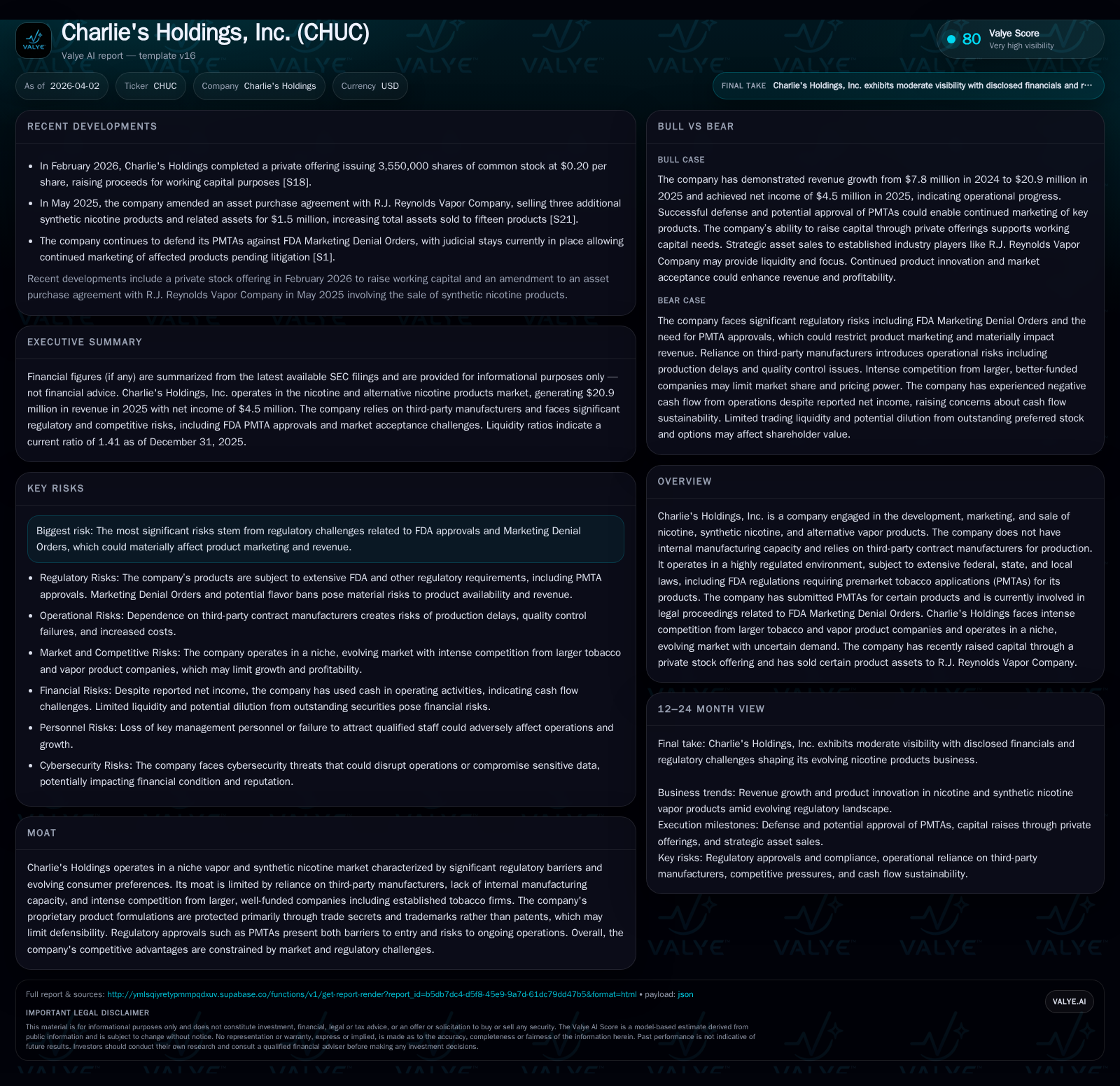
Charlie's Holdings, Inc. operates in the evolving synthetic nicotine and vapor products segment, marked by intense regulatory scrutiny and stiff competition from industry giants. Historically, the company's revenue has remained relatively flat with operating losses narrowing yet still persistent through 2025. Regulatory challenges around FDA premarket tobacco applications (PMTAs) and Marketing Denial Orders (MDOs) pose principal risks to product marketing and sales continuity. Despite positive net income in 2025 driven by non-cash factors, cash flow remains negative, requiring recent capital raises to sustain operations. The firm's competitive moat is constrained by reliance on third-party manufacturers and limited intellectual property protections.
Revenue Trajectory and Profitability Trends Over Four Years
Charlie's Holdings has seen relatively stable revenue around the $16 million mark in recent years with a subtle downturn in year-over-year terms. Specifically, reported revenues were approximately $22.7 million in FY2019 before falling to roughly $16.3 million in FY2023, reflecting a compound pressure that may stem from tightening regulations and market competition [F1]. Operating income trends exhibit persistent losses though those deficits have moderated notably from -$3.45 million in FY2024 to -$2.16 million in FY2025—a roughly 37% improvement year-over-year but still negative at an absolute level [F1]. Notably, net income shifted from negative territory peaking at -$4.16 million in FY2024 to a surprising positive net income of $4.5 million in FY2025 [F1], which indicates unusual accounting items or one-off gains that do not correspond with operational cash generation.
Operating cash flows starkly contrast the net income narrative: cash used in operations expanded from approximately -$2 million in FY2024 to -$5.78 million in FY2025 [F1]. Modest capital expenditures (Capex) of $23 thousand were recorded for FY2025 further deepening free cash flow deficits to an estimated -$5.8 million that year [F1], illustrating that profitability on paper is not currently translating into positive liquidity.
Historical performance (annual)
| FY | Net ($mm) | CFO ($mm) | OpInc ($mm) | Capex ($) | Net YoY |
|---|---|---|---|---|---|
| 2025 | 4 | -6 | -2 | 23000 | +208.2% |
| 2024 | -4 | -2 | -3 | -98.7% | |
| 2023 | -2 | -1 | -2 | 0 | -31.5% |
| 2022 | -2 | -2 | -2 | 189000 |
Source: SEC companyfacts cache [F1].
Capital returns and efficiency (annual)
| FY | FCF ($mm) | ROE% |
|---|---|---|
| 2025 | -6 | 131.4 |
| 2024 | 233.7 | |
| 2023 | -1 | 1956.1 |
| 2022 | -2 | -93.6 |
Source: SEC companyfacts cache [F1].
Note: Data gaps for some fiscal years are due to available disclosures.
The disconnect between accounting profitability and cash burns signals non-cash gains or possibly timing differences in revenue recognition or accrued expenses and highlights underlying liquidity stress.
Regulatory Environment Impacting Market Access and Product Viability
Charlie's Holdings operates under an intensely regulated framework dominated by the U.S. Food and Drug Administration’s oversight of tobacco-derived and synthetic nicotine products. Key among these regulations is the requirement to submit premarket tobacco applications (PMTAs) governing marketing authorization for products deemed "Deemed Tobacco Products." Failure to obtain FDA authorization could mandate removal of certain vapor products from the U.S. market [S4].
The company submitted PMTAs for selected products including menthol- or tobacco-flavored variants prior to regulatory deadlines; however, Marketing Denial Orders (MDOs) issued by the FDA against some submissions pose critical operational hurdles [S8]. Legal actions followed promptly: Charlie’s filed emergency motions resulting in temporary administrative stays granted by federal courts which preserve product listings while substantive judicial review proceeds [S8].
This regulatory quagmire not only introduces uncertainty regarding product availability but also materially impacts revenue streams given the inability to market restricted offerings during protracted reviews or if MDOs ultimately stand unlifted.
Legal Proceedings and the Status of Critical FDA PMTA Applications
From a litigation standpoint, Charlie's Holdings faces no direct pending lawsuits as per management disclosures; rather, its exposure largely derives from indirect legal risks connected with defense against the FDA’s MDOs pertaining to PMTA-reviewed products [S6].
Emergency stays at the U.S. Court of Appeals effectively permit continued sales of affected products under specified conditions while underlying regulatory challenges proceed administratively and judicially [S8]. Management expresses guarded optimism avoiding expectations of materially adverse legal outcomes based on ongoing defenses but recognizes these proceedings remain pivotal for sustaining operations.
Competitive Positioning within the Synthetic Nicotine Vapor Industry
Competition is fierce within this niche vapor sector where Charlie's competes primarily against well-capitalized tobacco conglomerates often labeled "big tobacco" possessing entrenched distribution channels, robust R&D budgets, and deep regulatory compliance expertise [valye_report_excerpt.moat, S29]. Charlie’s positioning hinges on proprietary product formulations safeguarded largely through trade secrets and trademarks instead of patents—which limits its protection scope against reformulations or imitation.
Without internal manufacturing capabilities—reliant instead upon contract manufacturing partners—Charlie’s faces additional supply chain vulnerabilities including potential quality control issues or production delays that could impair market responsiveness amid dynamic regulatory compliance demands [valye_report_excerpt.moat, S13].
Capital Raising Initiatives and Use of Proceeds from Recent Stock Offering
To mitigate liquidity pressures stemming from sustained negative operating cash flows despite reported profitability, Charlie’s conducted a private stock offering early in 2026 raising gross proceeds of approximately $710,000 consisting partly of $510,000 cash injections complemented by $200,000 debt forgiveness by investors [S3]. These funds target working capital support aimed at plugging operational funding shortfalls caused chiefly by ongoing cash burn.
This raise underscores a financing bridge necessity rather than broad-based expansion capital deployment.
Financial Health: Cash Flow Challenges and Liquidity Metrics
Despite reported equity growing positively to about $3.42 million by end of FY2025 following prior years’ negative equity balances indicative of accumulated losses ([F1]), underlying liquidity remains fragile with operating cash flow deficits near -$6 million juxtaposed against nominal Capex spending (~$23k), creating persistently negative free cash flow.
Current assets stood at roughly $10.7 million versus current liabilities near $7.6 million as of December 31, 2025 yielding a current ratio of about 1.41—a borderline adequate cushion but potentially vulnerable given ongoing operational expenditure needs amid unpredictable regulatory landscapes [F1].
Working capital adequacy requires monitoring especially considering any higher compliance costs or changes leading to additional capital demands.
Expectations for Future Growth Amid Product Innovation and Market Constraints
Charlie’s management stresses continuous innovation imperative given rapidly evolving consumer preferences within vapor alternatives sector coupled with shifting regulatory boundaries restricting effective marketing campaigns [S1, S7]. Restrictions on advertising content imposed by FDA curtail brand differentiation opportunities rendering product acceptance efforts challenging.
Moreover, future growth hinges on successful development and commercialization of novel formulations alongside maintaining regulatory compliance—delays or failures here could constrain top-line expansions substantially.
Capital Allocation: Dividends, Buybacks, and Returns on Equity
The company ceased dividend payments after high distributions in earlier years (notably over $18 million paid out in FY2019), reflecting a shift toward conserving liquidity amid operational challenges ([F1]). No share repurchases have been announced recently indicating focus remains on financial stabilization rather than shareholder returns [S25, S27].
Nonetheless, net income turnaround yielded an approximate return on equity north of 130% in FY2025 calculated against an equity base marginally above $3 million—such elevated ROE figures stem primarily from low equity denominators rather than consistent earnings strength ([F1]). This ROE contrasts sharply with persistent free cash flow deficits underscoring financial statement nuances requiring cautious interpretation.
Key Risks Related to Manufacturing Outsourcing and Personnel Dependency
Operationally Charlie's lacks internal manufacturing infrastructure necessitating dependence on third-party contractors—a structural risk exposing supply-chain reliability issues including possible recalls due to quality variance or delivery delays impacting sales fulfillment timing [S1]. While backup supplier options exist according to disclosures they could entail incremental costs or transition timeframes detrimental to competitiveness [S13].
Additionally, critical management personnel concentration risk is noted prominently; key founders such as Chief Operating Officer Ryan Stump and President Henry Sicignano III perform essential functions without established succession plans creating potential vulnerabilities should unexpected transitions occur amidst a challenging industry environment ([S1], valye_report_excerpt.moat).
Disclaimer: This report is intended solely for informational purposes based on publicly available data as cited above through April 2, 2026. It does not constitute investment advice or recommendations regarding securities mentioned herein.
Disclaimer: This is research-only, informational analysis and not investment advice. It may include AI-generated interpretation and general industry context. Always verify important details using primary sources.

Comments