
Talon Capital Corp. Launches Public Chapter with SPAC Dynamics and Capital Strategy
Talon Capital Corp. emerges as a newly public SPAC with a robust capital structure and a clear pathway toward its initial business combination.
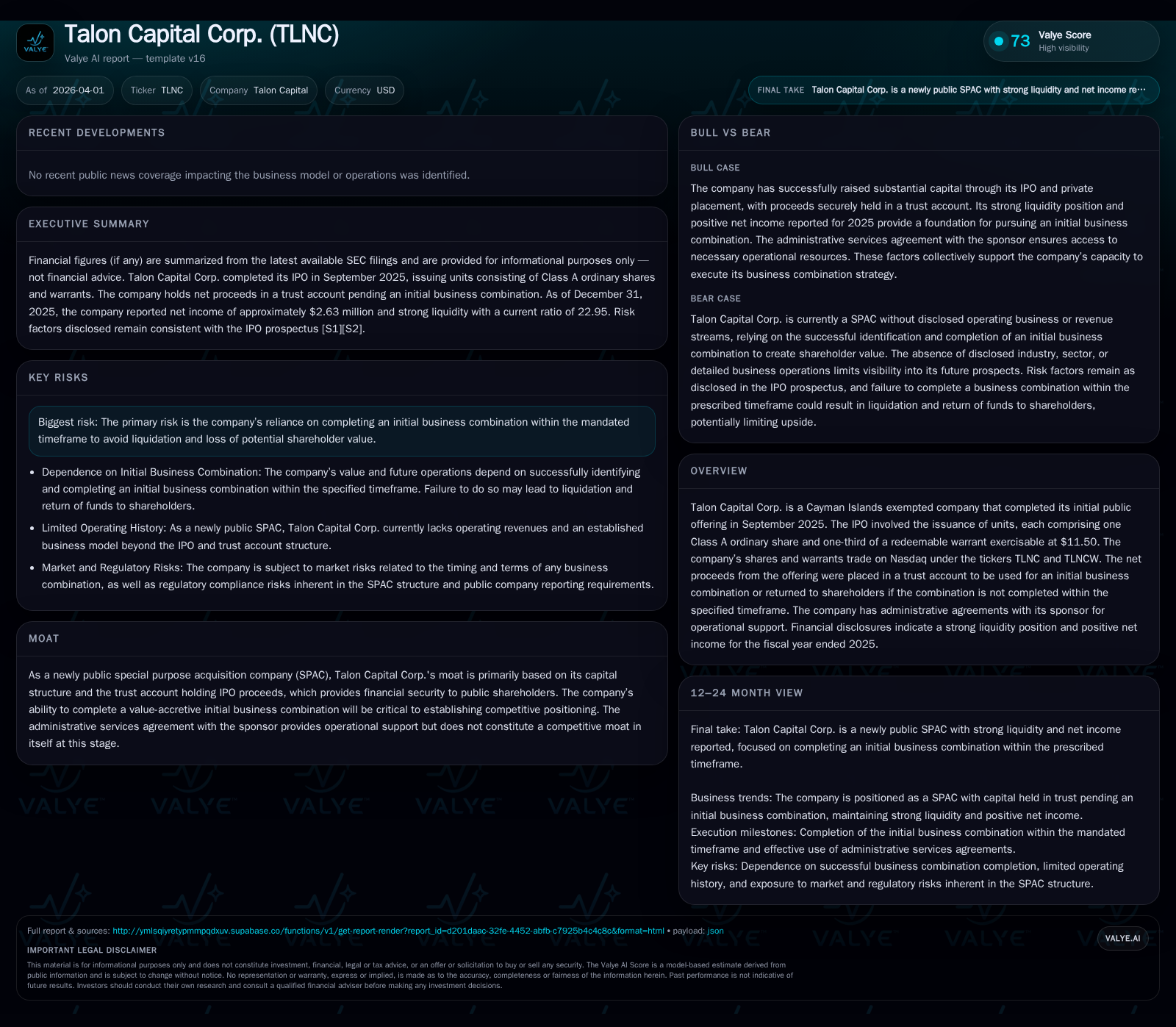
Talon Capital Corp., formed in May 2025 and going public in September 2025, has established a capital framework typical for a blank check company, securing $249 million in gross proceeds held within a trust account to protect public investors. The company’s first fiscal year ending in 2025 showed net income derived entirely from interest on trust-held funds, highlighting the absence of operating revenues. Going forward, Talon's growth depends entirely on successfully identifying and closing a business combination before the mandated deadline. Governance is anchored by an administrative services agreement with its Sponsor and a lean board of directors, while risks remain centered on timely deal execution and regulatory compliance. Returns to shareholders remain unrealized pending the consummation of a target acquisition.
Historical Performance: Foundation Built on Structuring and Early Financials
Talon Capital Corp., incorporated in May 2025 as a Cayman Islands exempted company for the purpose of achieving an initial business combination, has naturally exhibited financials consistent with startups in the special purpose acquisition company (SPAC) category. For its inaugural fiscal period ending December 31, 2025, Talon reported net income of approximately $2.63 million. This figure is entirely attributable to interest earned on cash held within its trust account — total interest income reached about $3.17 million but was partially offset by general and administrative expenses totaling $547 thousand [F1][S1].
As anticipated for a blank check entity pre-combination, no operating revenues were generated since Talon has no active business operations to date [S1]. Liquidity metrics reveal robust stability; current assets stood at roughly $2.95 million against current liabilities near $129 thousand, yielding an exceptionally strong current ratio near 22.95x [F1]. This high ratio stems from cash balances reserved primarily for upcoming deal-related activities and ongoing administrative costs.
Historical performance (annual)
| FY |
|---|
| 2025 |
Source: SEC companyfacts cache [F1].
Capital Structure Deep Dive: IPO Proceeds, Trust Account Mechanics, and Sponsor Roles
The cornerstone of Talon’s financial architecture lies in its successful Initial Public Offering (IPO), consummated on September 10, 2025. The offering comprised 24.9 million units priced at $10 each (including an over-allotment exercise), generating gross proceeds of $249 million [S1][S6]. Concurrently, Talon raised an additional $7.79 million from private placement units sold to the Sponsor and Cohen & Company Capital Markets [S1][S8].
Each unit consists of one Class A ordinary share coupled with one-third of a redeemable warrant exercisable at $11.50 per share — terms aligned with standard SPAC structures that balance investor protection with potential upside [S6][S7]. Importantly, all net proceeds (excluding certain fees totaling roughly $9.96 million deferred underwriters’ commissions) reside in a trust account segregated for public shareholders' benefit and managed by Odyssey Transfer and Trust Company [S1][S13].
The trust funds are primarily invested in U.S. government securities maturing within six months or held as cash equivalents; withdrawals are tightly regulated — only interest income up to specified limits can be accessed to cover working capital or tax obligations without dipping into principal [S1][S13]. This structural setup is foundational in SPACs as it ensures principal protection while facilitating operational liquidity.
Parallelly, Talon retains operational support via an amended administrative services agreement with its Sponsor effective September 16, 2025; this codifies provisions enabling access to office space, utilities, and secretarial assistance critical during the pre-deal phase [S8][S9].
SPAC Mandate and Growth Catalysts: What Talon’s Future Hinges Upon
By mandate design, Talon functions as a blank check company without active business operations or revenue streams absent execution on an acquisition [S1]. Its entire growth trajectory — indeed its raison d'être — depends on identifying and effecting an initial business combination within the stipulated timeline which ends September 10, 2027 unless extended by shareholder vote [S13].
Potential deal types include mergers via share exchanges or asset acquisitions among various structuring options common within SPAC transactions . Successful completion will unlock operational revenues and potentially significant value creation for shareholders if accretive opportunities are targeted.
However, failure to consummate such transaction results in mandatory liquidation wherein trust account principal is returned net of permitted costs — exposing investors principally to time risk rather than operational volatility [S3]. This timing constraint is the pivotal growth catalyst and strategic pressure point defining Talon's nascent lifecycle.
Governance and Administrative Backbone: Sponsor Agreements and Board Composition
Governance arrangements align with conventional SPAC frameworks where early-stage oversight balances founder/sponsor influence with independent directorships. As of the company's IPO closing date in September 2025, the board comprises three directors: Charles Leykum (CEO), Shawn Reynolds, and Thomas Simons [S8]. All board members benefit from indemnity agreements ensuring protection from liabilities arising out of their corporate roles—standard practice mitigating personal risk during uncertain early phases [S8][S15].
The Sponsor holds significant influence through both founder shares (approximately 8.26 million after forfeitures) and private placement units but its role is circumscribed operationally by the administrative services agreement [S9][S15]. This arrangement centralizes logistical support like office facilities while separating day-to-day management from target selection decisions maintaining governance clarity.
Key Risks Facing Talon: Regulatory, Timeline Pressures, and Market Environment
Explicitly stated risks focus predominantly on the inherent reliance upon completion of the initial business combination within defined parameters to forestall liquidation—a binary outcome that dictates the company's viability post-IPO [S3][S4].
No material litigation or regulatory proceedings are currently disclosed against Talon or its officers which mitigates ancillary risks often complicating SPAC transactions at inception [S3]. Nevertheless regulatory scrutiny around SPAC disclosures remains heightened industry-wide representing ongoing compliance vigilance needs.
Market conditions impacting valuation multiples or deal attractiveness could indirectly constrain Talon’s ability to finalize compelling acquisition terms; however such factors are not specifically enumerated in current filings but form part of general SPAC environment dynamics .
Forecast Considerations: Milestones to Monitor for Value Creation
While Talon has not issued formal guidance or forecasted milestones beyond regulatory requirements given its blank check nature, investors should monitor several key events indicative of progress: announcement dates pertaining to identified initial targets; details divulged regarding transaction structures including any mix of equity/debt consideration; delays or extensions related to the mandated completion window; public commentary on due diligence advances; warrant exercise levels signaling shareholder confidence; and any amendments affecting redemption rights or shareholder resolution outcomes.
These checkpoints typically precede valuation inflection points reflecting market reaction to perceived strategic clarity versus uncertainty inherent at this stage .
Cash Flow and Returns: Operating Expenses, ROE Analysis, and Shareholder Implications
Cash flows currently portray typical pre-combination patterns dominated by minimal operating costs related primarily to legal compliance, audit fees, due diligence expenses alongside modest working capital use offset by steady interest inflows from substantial trust account balances [F1][S8]. From inception through December 31, 2025 cash used in operating activities was approximately $465 thousand compared with net interest earnings maintaining positive net income margins overall.
ROE stands negative at around -36%, reflecting equity dominance over nominal earnings given absence of active operations or investment returns beyond trust interest yields [F1]. Distributions remain non-existent as dividend policies are deferred until after acquisition completion when operating profits may permit returns.
Share repurchase programs are also absent aligning with capital preservation priorities typical for SPAC vehicles holding large cash pools awaiting deployment on target deals rather than returning capital prematurely.
This analysis synthesizes available public financial disclosures and company statements without extrapolation beyond demonstrated facts. The prospective nature inherent in Talon Capital Corp.’s lifecycle warrants cautious interpretation focused on stated mechanics rather than speculative valuations or investment recommendations.
Disclaimer: This is research-only, informational analysis and not investment advice. It may include AI-generated interpretation and general industry context. Always verify important details using primary sources.

Comments