
NewHold Investment Corp. III: SPAC's Strategic Pursuit in Industry 4.0
NewHold Investment Corp. III leverages seasoned SPAC experience and a unique investor network to target industrial technology firms aligned with Industry 4.0 innovation themes.
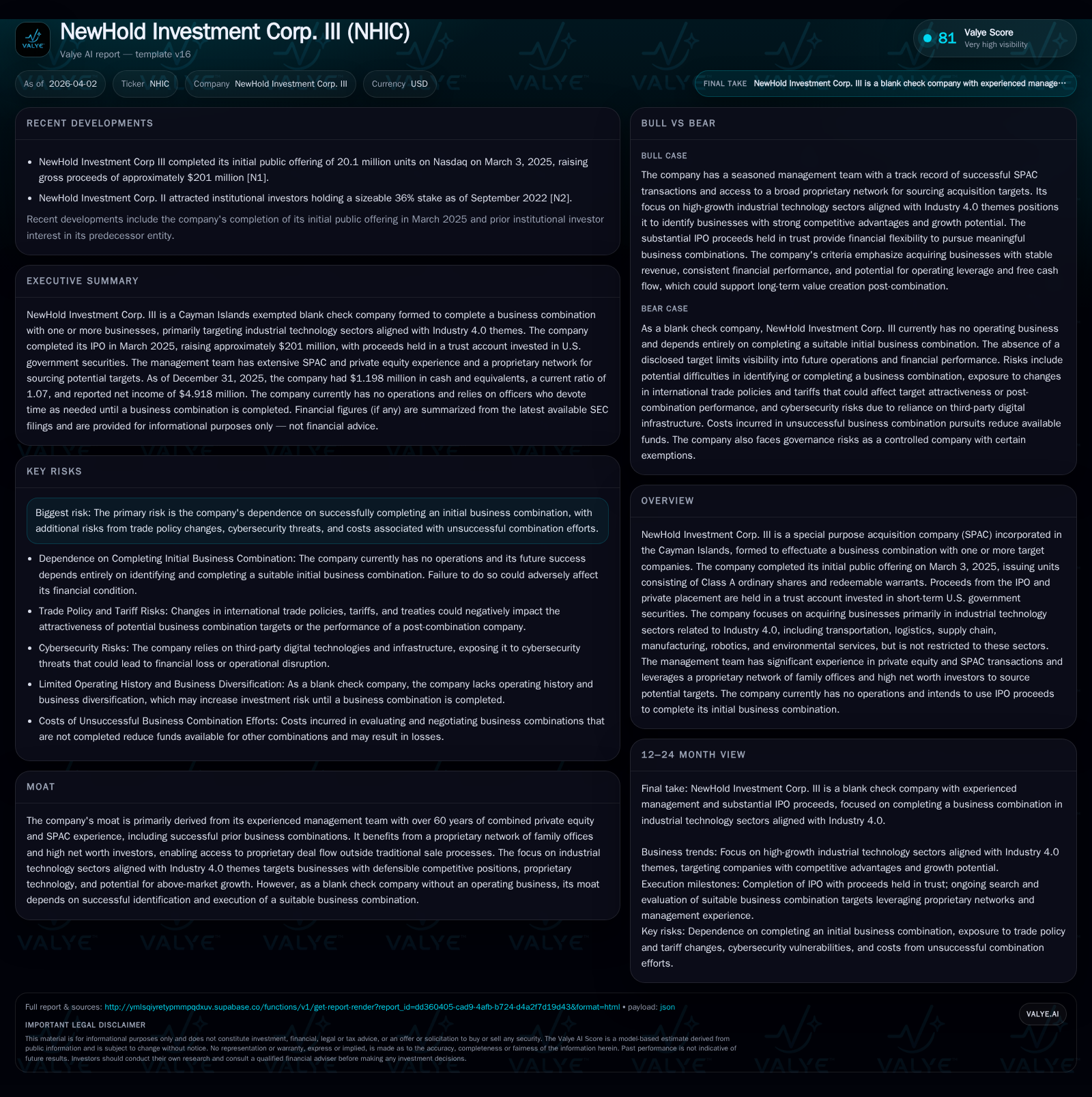
Incorporated as a Cayman Islands exempted special purpose acquisition company (SPAC), NewHold Investment Corp. III completed its IPO in March 2025, raising over $201 million to pursue business combinations primarily in the rapidly evolving industrial technology sector connected to Industry 4.0 trends. The firm’s moat hinges on a management team with decades of private equity and prior SPAC deal expertise supported by a proprietary network of family offices and high net worth investors, enabling access to differentiated deal flow. While financial performance to date reflects typical SPAC pre–business combination costs and no operating revenue, substantial capital remains secured in trust, supporting future acquisitions. Risks include the inherent uncertainty of completing a qualifying business combination, potential trade policy disruptions impacting target valuations, and SPAC-specific shareholder approval dynamics.
Foundation and IPO Performance: The Initial Step for NHIC
NewHold Investment Corp. III (NHIC) was incorporated as a Cayman Islands exempted company specifically as a blank check vehicle formed to complete one or more qualifying business combinations [S1]. The company held its initial public offering on March 3, 2025, successfully issuing approximately 20.1 million units priced at $10 each. This offering included full exercise of an over-allotment option adding roughly 2.6 million units [S1], thus raising gross proceeds totaling about $201.1 million [S1][F1]. Concurrently, a private placement provided an additional ~780,100 units purchased by the sponsor entity and underwriter representatives at the same unit price.
Each unit comprised one Class A ordinary share plus half a redeemable warrant exercisable at $11.50 per share. The net proceeds including deferred underwriting fees were placed into a trust account invested solely in short-term U.S. Treasury obligations or qualified money market funds with maturities capped at approximately six months—consistent with regulatory requirements designed to preserve capital pre-business combination [S1][S6]. This capital raise size positions NHIC well above typical middle-market SPAC entry levels and grants it meaningful firepower to pursue large-scale industrial technology targets.
Management Expertise and Deal Sourcing: Building a Proprietary Moat
NHIC's primary competitive advantage lies not in operational assets but in intellectual capital—specifically, the management team's combined private equity and SPAC experience exceeding six decades . Key leaders have notable track records closing multiple successful transactions under prior Hennessy Capital-branded SPACs which evaluated hundreds of targets cumulatively [S11][S12].
More critically, their proprietary sourcing capability emerges from leveraging NewHold Enterprises' broad family office network comprising over 100 entities managing assets north of $1 billion alongside nearly as many high net worth individual investors [S11]. This strategic nexus grants NHIC unique early access to proprietary deal flow often unavailable through traditional banker-driven processes, potentially improving transaction quality and fit.
This expert team dynamic mitigates typical SPAC risks related to poor target selection while aligning their focus on businesses demonstrating stable revenue profiles coupled with innovation-led growth trajectories suitable for public market scaling.
Industry 4.0 Focus: Target Sectors and Market Themes Explained
NHIC concentrates on industrial technology companies primed for disruption or transformation through Industry 4.0 principals—digitization combined with automation—that reshape manufacturing efficiency and supply chains [S4]. Primary sectors within this thesis include:
- Transportation & Logistics,
- Distribution & Supply Chain Management,
- Value-added Manufacturing & Robotics,
- Grid Resiliency,
- Environmental Services,
- Advanced Sensor Technologies.
The investment criteria prioritize companies exhibiting defensible competitive moats through proprietary technologies or intellectual property, positioned for above-market revenue growth driven by new product introductions or acquisition consolidation strategies [S4][S24]. These businesses are sought for their capacity to deliver operating leverage—scaling revenues faster than associated cost increases—and strong free cash flow generation potential, essential traits for sustainable public company performance.
For instance, flexible mass production capabilities responding to customer demands for customization represent a key value driver within portfolio candidates. Similarly, supply chain optimization employing integrated technology solutions addresses persistent inefficiencies intensified by global disruptions, underscoring NHIC’s focus on tech-enabled operational advances [S24].
Financial Snapshot: Analysis of NHIC’s Operating Results and Capital Position
As a newly listed blank check company without active operations aside from target search activities, NHIC's financial results are reflective of IPO-related activity with no operational revenues reported [F1]. For the fiscal year ending December 31, 2025, NHIC posted an operating loss near $2.09 million primarily representing administrative expenses [F1]. Notably, net income was positive at approximately $4.92 million due largely to non-cash accounting surrounding warrants issued during the IPO process rather than core business earnings [F1].
Liquidity remains solid but concentrated: cash and equivalents approximate $1.2 million outside the ~$209 million held securely in the trust account per SEC disclosures [F1][S6]. Current assets slightly exceed current liabilities yielding a current ratio near 1.07x—a modest buffer appropriate given minimal ongoing operations [F1]. Return on equity is negative at roughly -70.7%, which is customary considering the absence of earnings-producing assets pre-business combination [F1].
FY2025 Summary Financials
Historical performance (annual)
| FY |
|---|
| 2025 |
Source: SEC companyfacts cache [F1].
Cash & Equivalents: ~$1.2M; Current Assets: ~$1.33M; Current Liabilities: ~$1.25M; Current Ratio: 1.07x; ROE: -70.7% (all data end FY2025) [F1]
Risks and Challenges: Trade Policies, Regulatory Environment, and SPAC-Specific Risks
NHIC's foremost risk emanates from its mission-critical need to consummate an initial business combination before mandated deadlines lapse, failing which liquidation would be triggered potentially eroding shareholder value [S1][S3]. The company's thematic focus on industrial tech linked closely to complex global supply chains exposes it further to shifts in international trade policies.
Recent global tariff volatility has disproportionately impacted manufacturing input costs and export opportunities across these sectors [S2]. U.S.-imposed tariffs provoke reciprocal actions abroad that may depress revenues or increase costs for candidate companies post-merger, complicating deal valuation models substantially versus historical precedents [S2]. These scenarios amplify execution uncertainty given that target companies’ financial profiles could deteriorate rapidly after deal announcement but before close.
Furthermore, SPAC-specific challenges include the need for shareholder approval processes which carry potential for redemptions reducing available deal funding; protracted votes may increase transaction closure risk; and governance complexities around sponsor insider purchase programs can affect perception despite intended share price support mechanisms [S5][S13][S21].
Legal exposure currently appears minimal with no material litigation outstanding; however, inherent counterparty risks remain usual within acquisition negotiations [S3].
Capital Structure and Allocation Strategy Ahead of Business Combination
IPO proceeds (~$201 million net) are ring-fenced pending completion of an approved business combination per Nasdaq listing rules and SEC regulations [S6][S8]. The trust account investments are confined predominantly to short-dated U.S Treasury instruments or similarly liquid government-backed securities minimizing credit risk while providing modest yield.
Capital allocation flexibility includes structured rights allowing founders and insiders—under Rule 10b-18 safe harbor provisions—to purchase shares privately or via open market transactions around merger events intended both to underpin stock price stability and navigate shareholder redemption pressures without breaching securities laws [S5][S21].
Post-merger financing needs have been anticipated given that NHIC targets larger deals beyond mere trust fund size constraints via supplemental equity or debt issuances contemporaneous with combination closings as detailed by corporate filings [S8][S23]. There is presently no committed external financing arranged but incremental capital raises remain procedurally feasible.
Public shareholders retain explicit rights at closing including cash redemption privileges calculated based on trust account balances less taxes payable approximating $10 per share plus accrued interest [S13][S20]. Delivery protocols involving electronic transfers or physical certificate submission ahead of vote dates help streamline redemptions post-announcement mitigating administrative delays observed elsewhere in SPAC transactions [S17].
Evaluating Growth Potential: What Investors Should Watch Next
A critical horizon event will be NHIC’s announcement of an initial business combination candidate typically due within an estimated window spanning roughly two years post-IPO (i.e., by early 2027 unless extended). Investors should carefully scrutinize whether announced targets align squarely within NHIC’s industrial tech thesis embracing Industry 4.0 enablers reflecting strong competitive positions alongside demonstrated operating leverage potential.
Subsequent milestones include monitoring financial performance indicators from any acquired entity particularly gross margin stability/improvements signaling effective integration of technology-driven efficiencies alongside revenue growth affirming addressable market expansion strategies highlighted pre-acquisition.
Additionally important will be the broader macro environment relating to ongoing international trade policy evolution which could materially influence profitability outlooks for portfolio companies reliant on cross-border supply chains or international customer bases given tariff uncertainties outlined previously.
Shareholder meeting outcomes deciding merger approvals will also serve as barometers reflecting investor confidence around valuation fairness alongside sponsor commitment reflected via permitted insider market transactions supporting share prices.
Overall growth potential depends heavily on execution discipline translating thematic focus into accretive acquisitions capable of scaling public markets benefits such as access to diverse capital pools facilitating further external growth initiatives or R&D investments aligned with industry disruption dynamics.
This analysis is based exclusively on publicly available information from SEC filings dated up to April 2, 2026 and does not constitute investment advice.
Disclaimer: This is research-only, informational analysis and not investment advice. It may include AI-generated interpretation and general industry context. Always verify important details using primary sources.

Comments