
Golden Growers Cooperative: Final Chapter and Financial Footprint of a Unique Agricultural Partnership
Golden Growers Cooperative’s cooperative model generated steady lease-derived income but faces strategic closure after member vote on dissolution.
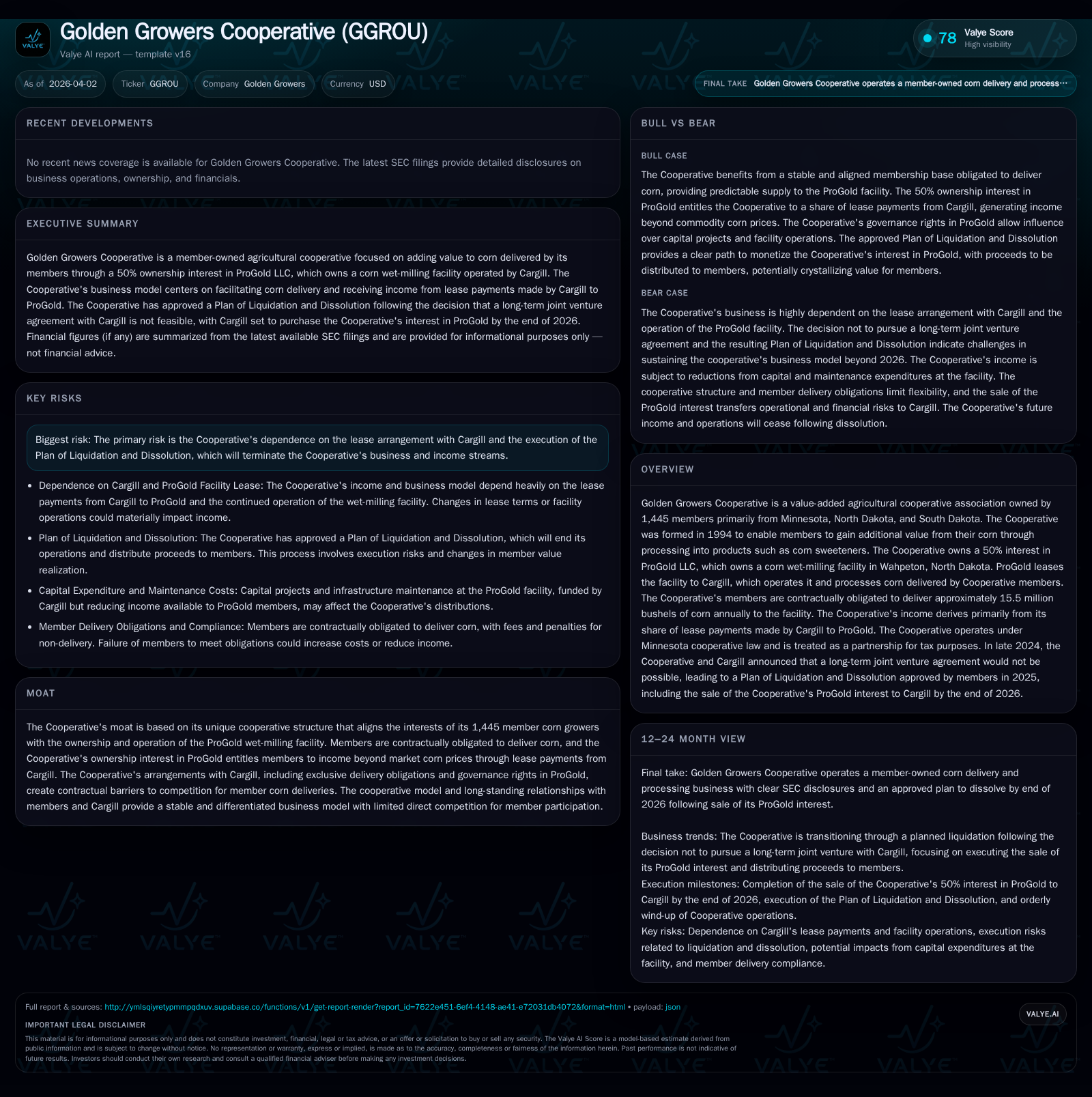
Golden Growers Cooperative, founded in 1994 to add value for member corn growers via ownership in a corn wet-milling facility, secured long-term revenue through an exclusive lease agreement with Cargill. The cooperative’s structure, binding members to deliver over 15 million bushels annually, created a protected economic moat by aligning member interests with the ProGold facility. Recent years showed steady lease payments as the main income source, but challenges in renewing joint venture agreements led to a member-approved Plan of Liquidation in 2025. This will terminate operating revenues upon lease expiration in 2026 and result in asset sale proceeds distributed to members, marking a definitive pivot from ongoing operations to capital return.
Foundational Growth Through Member Alignment and Contractual Commitments
Golden Growers Cooperative was established in 1994 as a value-added agricultural cooperative primarily comprising members from Minnesota, North Dakota, and South Dakota. It enabled member corn growers to receive additional value beyond commodity prices by owning a 50% interest in ProGold Limited Liability Company (ProGold), which operates a corn wet-milling facility in Wahpeton, North Dakota [S1][S22].
The cooperative structure mandates members deliver approximately 15.5 million bushels of corn annually under binding contracts that underpin supply security and align incentives with cooperative income distributions derived from ProGold's operations [S1][S21]. Delivery methods—physical delivery (Method A) or Cooperative-arranged acquisition (Method B)—include associated incentive payments or fees designed to optimize logistics and encourage compliance [S21]. This framework has historically insulated the Cooperative from direct competition for grower participation [S16].
Stable Revenue Generation via Long-Term Lease with Cargill
Since November 1997, the ProGold facility has been leased exclusively to Cargill Incorporated, which operates the plant and processes the corn delivered by Cooperative members [S1]. The Facility Lease commenced January 1, 2018, extended through December 31, 2026, with annual lease payments escalating from $15.5 million in 2023 to $16 million annually thereafter [S12][S14]. Golden Growers' income primarily derives from these lease payments.
Capital projects totaling approximately $25 million during the lease term are funded by Cargill and depreciated by them due to their leasehold interest; meanwhile ProGold bears certain infrastructure maintenance costs that reduce distributable income proportionally between owners [S14]. Members face penalties for delivery shortfalls ensuring contractual compliance and revenue stability [S23].
Historical Financial Performance
Historical performance (annual)
| FY | Rev ($mm) | Net ($) | CFO ($) | OpInc ($mm) | Rev YoY | Net YoY |
|---|---|---|---|---|---|---|
| 2025 | 62 | 1406000 | -396000 | 6 | +0.5% | -9.9% |
| 2024 | 62 | 1561000 | -396000 | 6 | -29.6% | |
| 2023 | 88 | -281000 | 5 | -18.1% | ||
| 2022 | 107 | -410000 | 6 |
Source: SEC companyfacts cache [F1].
The data reflects revenue contraction since the peak year of FY2022 coinciding with operational wind-down activities. Despite this decline in scale, operating income improved modestly due to controlled expenses. Net income showed a slight year-over-year decrease as reported through Q3 periods [F1]. Operating cash flow remained negative at approximately $400K annually due primarily to working capital timing effects and maintenance obligations amid minimal capital expenditures consistent with an asset-light model [F1].
Strategic Liquidation Following Joint Venture Renewal Failure
Negotiations to renew the joint venture operating terms between Golden Growers and Cargill failed amid economic conditions by late 2024 [S12]. Consequently, at the Annual Meeting on March 19, 2025, members overwhelmingly approved (>99%) a Plan of Liquidation and Dissolution authorizing board action for orderly wind-down including sale of the cooperative's entire interest in ProGold [S9][S17].
Under this plan and the Operating Agreement terms effective March 1, 2022, upon Facility Lease expiration on December 31, 2026 (or earlier if triggered), Cargill will purchase Golden Growers’ interest for $81 million plus half of any remaining lease payments due through that date [S12][S19].
Transitioning From Operating Revenues To Capital Return
After closing the sale and settling liabilities, proceeds along with other remaining cooperative assets will be distributed pro rata among members based on units held—a transition from operational earnings toward capital return aligned with dissolution procedures governed by Minnesota cooperative statutes [S1][S9].
Capital Allocation Profile: Limited Reinvestment With Focus on Member Distributions
Historically Golden Growers has prioritized returning cash flows over reinvesting given its limited asset base beyond equity interest in ProGold [F1][S11][S18]. Patronage-based distributions correlate closely with net income derived from lease payments.
Operating cash flow remains negative primarily due to working capital dynamics and maintenance spending though capital expenditures are minimal reflecting an asset-light profile [F1][S14]. As a partnership for tax purposes under Subchapter K of the IRC, tax benefits flow directly through members enhancing net returns tied closely to volume delivered rather than growth investments [S1].
Operational Dependencies And Emerging Risks Pre-Dissolution
The Cooperative's reliance on Cargill for both facility operation under lease terms and administrative coordination presents core operational concentration risk [S10][S23]. The aging wet-milling facility built in the mid-1990s requires increasing maintenance expenditures shared proportionally between owners that can reduce distributable income unexpectedly [S14].
Failed joint venture renewal attempts highlight challenges posed by macroeconomic conditions limiting mutually agreeable investment strategies beyond current lease terms [S12][S15]. Regulatory compliance costs remain manageable but could increase capital demands further constraining residual earnings prior to dissolution completion [S14][S15].
Governance And Member Consensus Support Smooth Wind-Down
Governance remains orderly with unanimous director elections at the March 19, 2026 meeting signaling strong member alignment behind management stewardship amid structural transition [S3][S18]. The near-unanimous adoption of the liquidation plan evidences disciplined cooperative governance prioritizing collective equity protection over individual dissent when facing finite business lifespan realities [S9]. This consensus enables efficient execution of dissolution steps ensuring timely realization of member value.
This report synthesizes disclosed regulatory filings through April 2026 combined with company facts data without speculative assumptions beyond documented facts. It provides a comprehensive view of Golden Growers Cooperative’s historic performance dynamics alongside strategic transitions toward orderly liquidation.
Disclaimer: This is research-only, informational analysis and not investment advice. It may include AI-generated interpretation and general industry context. Always verify important details using primary sources.

Comments