
TherapeuticsMD, Inc.: Royalty Growth and Patent Battles Shaping the Future
TherapeuticsMD relies heavily on licensing royalties from patented hormone therapies while confronting significant patent litigation and contractual disputes that cloud its revenue outlook.
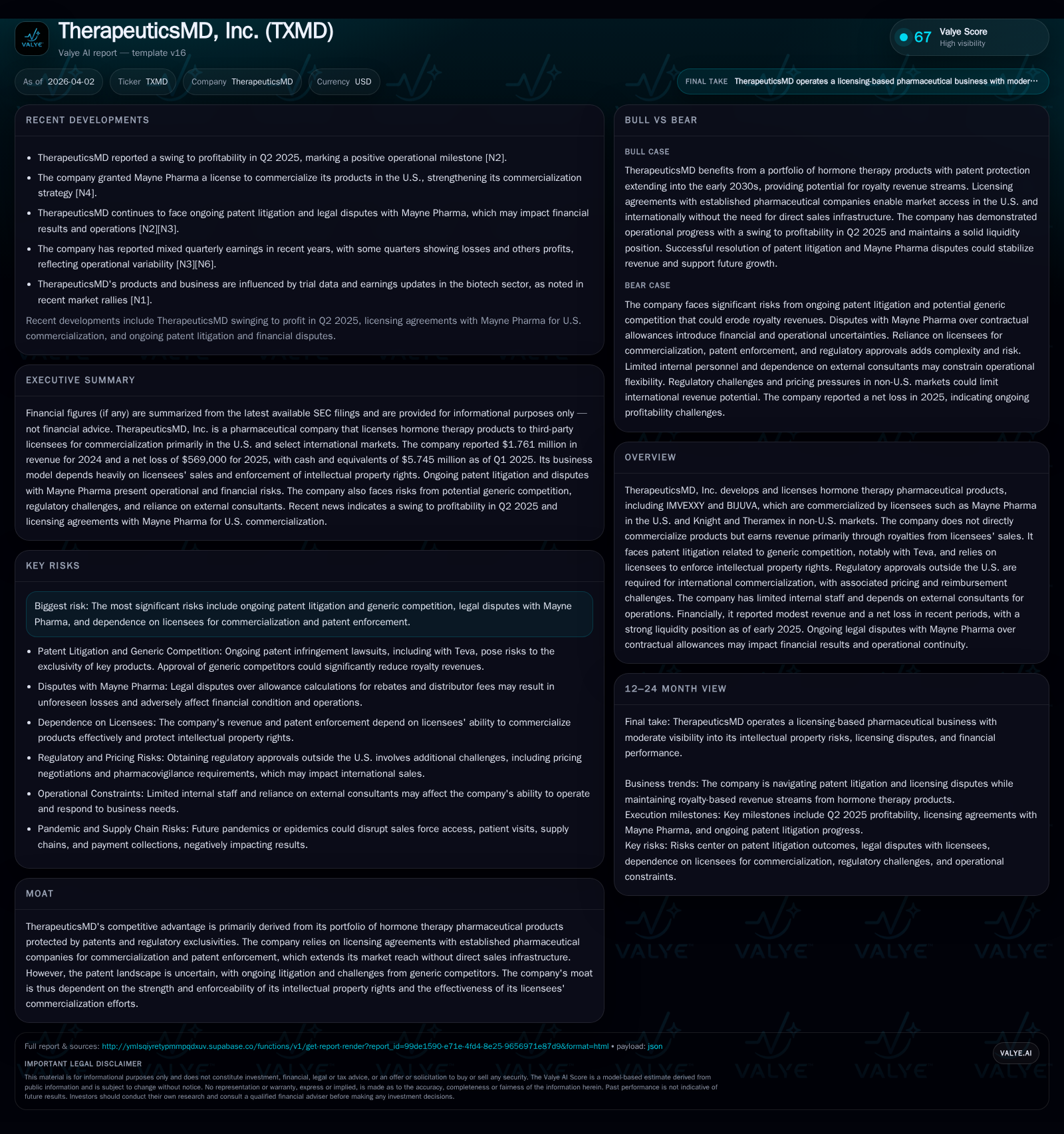
TherapeuticsMD, Inc. operates primarily as a licensor of hormone therapy pharmaceutical products like IMVEXXY and BIJUVA, generating revenue through royalties collected from licensees such as Mayne Pharma. Over recent years, the company has experienced modest top-line growth driven by increased royalty income but continues to operate at a net loss with improving financial metrics. Central to its outlook are ongoing patent litigations initiated by generic competitors Teva and Sun Pharma challenging product exclusivity beyond 2032–2033 and a complex contractual dispute with Mayne Pharma over rebate calculations and returns allowances creating operational uncertainties. The company's capital allocation strategy remains conservative with no dividends or buybacks, relying largely on external consultants for operations. Future growth hinges on successful patent litigation outcomes, effective licensee commercialization efforts, and regulatory approvals in new markets.
Licensing Royalties Drive Past Growth Yet Bring Legal Complexities
TherapeuticsMD’s business model centers on licensing patented hormone therapy drugs like IMVEXXY and BIJUVA to pharmaceutical partners who commercialize these products while paying royalties back to TherapeuticsMD. This model enables the company to leverage established sales forces without bearing direct commercialization costs but inherently links its revenue visibility to licensee performance.
Financially, the firm realized revenue growth of roughly 35% from about $1.3 million in FY2023 to $1.76 million in FY2024 [F1], attributed chiefly to expanded royalty income from existing licensed products. However, total revenue remains modest relative to operating expenses.
While the royalty structure allows leveraging third-party capabilities for broader market reach—including Mayne Pharma in the U.S. and Knight/Theramex internationally—the approach also multiplies commercial risk exposure given TherapeuticsMD’s dependence on partners’ sales execution and regulatory compliance [S1].
Patent Litigation Threatens Product Exclusivity and Royalty Streams
At the core of TherapeuticsMD’s competitive moats lie patent protections for key hormone therapies expiring between 2032 and 2033. Since early 2020, Teva Pharmaceuticals initiated Paragraph IV certifications challenging patents relevant to IMVEXXY’s composition and methods, prompting TherapeuticsMD to file infringement lawsuits seeking injunctions against generic entry prior to patent expiration [S1, S11].
Additionally, Sun Pharma filed an ANDA application accompanied by a similar Paragraph IV certification in June 2024 contesting IMVEXXY patents’ validity [S1]. These litigation efforts aim to secure FDA approval for generics potentially displacing branded sales.
The outcomes of these litigations have immediate financial impact: a successful challenge could accelerate loss of exclusivity (LOE), thereby reducing royalty payments as generics enter the market. While statutory stays initially delayed FDA approvals—extended further during litigation pauses—the stay was lifted in November 2024 with active proceedings now focused on claim construction phases that interpret patent scope [S11].
This phase is pivotal; adverse rulings here could undermine TherapeuticsMD’s patent enforcement capability. The company has incurred millions in legal costs associated with these disputes but accounts for such expenses anticipating eventual success defending patents [S11]. Nevertheless, uncertainties persist around final outcomes and timing.
Contractual Disputes with Mayne Pharma: A Significant Operational Hurdle
Beginning February 2024, TherapeuticsMD entered into contentious disputes with its primary licensee Mayne Pharma over rebate allowance calculations pertaining to payer contracts and wholesale distributor fees defined under their transactional agreement [S2]. Significant discrepancies surfaced between TherapeuticsMD’s estimates versus those reported by Mayne.
Compounding matters were disagreements over return allowances and net working capital settlements tied to one-time transactions or accounting treatments under the License Agreement [S5]. These issues culminated in TherapeuticsMD filing suit against Mayne in April 2025 claiming breach of contract alongside allegations of fraudulent inducement and unjust enrichment related chiefly to Mayne’s interpretation or execution of contract provisions [S4, S14].
Mayne countered with its own lawsuit alleging breach of contract claims against TherapeuticsMD plus additional indemnification demands under the same agreements [S7]. Both entities subsequently filed motions seeking dismissal of varied claims, leading courts to partially sustain certain allegations while ordering dispute resolution mechanisms for others [S14].
This fragmented legal landscape introduces significant operational risks by disrupting revenue recognition patterns derived from licensee sales reports and rebates reconciliation. Moreover, cash flow forecasts remain uncertain until final outcomes emerge from these evolving litigations.
Financial Trends: Modest Revenue Rise Amidst Net Losses and Strong Liquidity
A summary of recent annual financial metrics reveals measured improvements amid persistent net losses:
Historical performance (annual)
| FY | Rev ($) | Net ($mm) | OpInc ($mm) | Rev YoY | Net YoY |
|---|---|---|---|---|---|
| 2025 | -1 | -4 | +73.9% | ||
| 2024 | 1761000 | -2 | -5 | +35.3% | +78.8% |
| 2023 | 1302000 | -10 | -9 | -109.2% | |
| 2022 | 112 | 1 |
Source: SEC companyfacts cache [F1].
Capital returns and efficiency (annual)
| FY | ROE% |
|---|---|
| 2025 | -2.1 |
| 2024 | -8.0 |
| 2023 | -35.1 |
| 2022 | 318.7 |
Source: SEC companyfacts cache [F1].
Despite recurring operating losses driven by high legal costs and administrative expenses connected with litigation and licensing management processes, there is a clear trend toward narrowing losses year-over-year from FY2023 through FY2025.
Importantly, TherapeuticsMD maintains solid liquidity reflected by a current ratio exceeding 3x as of late 2025 ($14.45 million current assets vs $4.79 million current liabilities) ensuring it can meet short-term obligations despite unprofitable operations [F1]. This liquidity buffer underpins stability amid legal uncertainties.
Capital Allocation Reflects Strategic Conservatism
TherapeuticsMD’s capital deployment underscores strategic conservatism consistent with its stage as a licensing entity primarily focused on intellectual property monetization rather than expansive commercial investment.
The company does not pay dividends nor has it engaged in share repurchase programs as per filings up through late 2025 [S13]. Capital expenditures remain negligible at approximately $34k annually around FY2021–FY2022 levels—supporting limited internal infrastructure predominantly reliant on consultants rather than full staff expansion [F1][S1].
Return on equity approximates negative 2.1% based on FY2025 figures calculated from net loss over equity base [$-569k / $26.9M], indicating no profitability yet some improvement relative to prior deeper losses [F1].
This cautious approach aligns with managing risks amid ongoing litigation but limits near-term shareholder returns.
Outlook Hinges on Legal Outcomes and Partner Performance
Future growth prospects depend heavily on successful defense of patent exclusivities through ongoing litigation processes including key claim construction rulings currently underway [S14], favorable resolution of contractual disputes with Mayne Pharma affecting royalty flows [S14], effective commercialization by licensees such as Mayne Pharma domestically and Knight/Theramex internationally [S1], as well as navigating regulatory challenges abroad which may limit international expansion opportunities due to diverse reimbursement landscapes [S26].
Risks remain material including accelerated generic competition post-litigation potentially compressing royalties substantially; partner disputes impairing revenue visibility; reliance on external consultants limiting operational flexibility; plus evolving healthcare regulations adding compliance costs.
Historical Financial Performance Summary (USD)
| Fiscal Year | Revenue | Operating Income | Net Income |
|---|---|---|---|
| FY2025 | -4,390,000 | -569,000 | |
| FY2024 | 1,761,000 | -4,760,000 | -2,181,000 |
| FY2023 | 1,302,000 | -8,523,000 | -10,278,000 |
Disclaimer: This analysis synthesizes publicly available company filings without offering investment advice or predictions regarding securities performance.
Disclaimer: This is research-only, informational analysis and not investment advice. It may include AI-generated interpretation and general industry context. Always verify important details using primary sources.

Comments