
TMC the metals Co Inc. Confronts Regulatory Hurdles and Capital Constraints While Advancing Seabed Mining
The company’s progress hinges on securing U.S. permits and financing to commercialize deep-sea polymetallic nodules, critical for future metal supply.
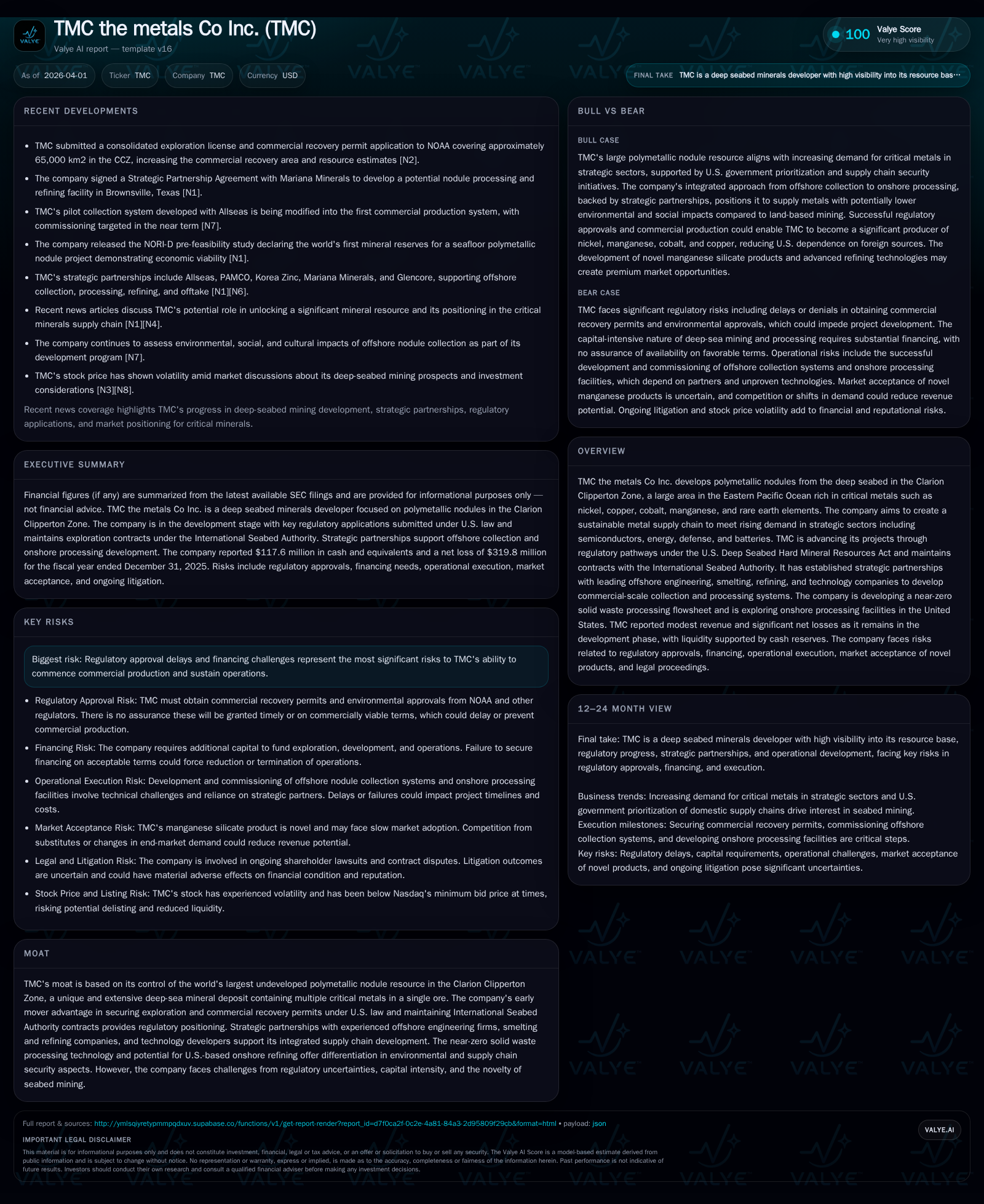
TMC the metals Co Inc. (TMC) is pioneering commercial-scale deep seabed mining for polymetallic nodules rich in nickel, cobalt, copper, manganese, and rare earth elements, aiming to supply critical metals for strategic U.S. sectors. Despite holding rights to the world's largest undeveloped nodule resource and partnerships with seasoned offshore and refining players, TMC remains in a development stage marked by steep regulatory uncertainties under both U.S. (DSHMRA) and international (ISA) frameworks, ongoing litigation, and significant capital demands outpacing current cash flows. The company reported increasing net losses totaling over $319 million in 2025 on minimal revenue, reflecting heavy investment in technical studies and permitting efforts ahead of commercial operations. Close attention to permit approvals, financing milestones, and offshore/onshore facility developments will be vital for assessing potential breakthroughs.
Company Overview
TMC the metals Co Inc. is focused on unlocking polymetallic nodules from the seabed of the Clarion Clipperton Zone (CCZ), an extensive area in the Eastern Pacific Ocean known for its abundant deposits of nickel, cobalt, copper, manganese, and rare earth elements (REEs). These metals are deemed critical by the U.S. government due to their strategic importance across semiconductors, energy storage, defense sectors, and marine industries [S1][S22]. Unlike terrestrial mining projects which extract single or few metals per ore body, TMC’s nodules combine multiple valuable metals within discrete rocks resting unattached on the seafloor—a unique geological setting providing a concentrated source of key inputs.
The company’s mission centers on creating a "metal commons," emphasizing sustainability by aiming for near-zero waste during processing and promoting metal reuse over time [S1]. Beyond environmental considerations, TMC emphasizes securing an integrated U.S.-controlled supply chain—from offshore collection conducted via U.S. permits to potential domestic onshore refining facilities—addressing strategic concerns around geopolitical supply vulnerabilities [S22].
Historical Performance
Financially, TMC remains firmly in a developmental phase without commercial production revenue. Its top-line revenues remain negligible—only $410 thousand as of mid-2024—with escalating net losses reflective of substantial investment in R&D, technical validation, permitting activities, and corporate overhead [F1]. The net income plummeted from -$82 million in 2024 to -$320 million in 2025 while operating income contracted similarly from -$81 million to -$140 million in 2025 [F1]. This deterioration stems from increased expenditures tied to advancing pre-feasibility studies (e.g., NORI Area D PFS), pilot tests with partners like Allseas offshore vessel programs, environmental assessments under new regulations launched by NOAA in early 2026 [S1][S3][S22].
Operating cash flows have remained negative but relatively steady at roughly -$43 million annually despite capex cuts exceeding 50% year-over-year as the firm adopts a capital-light strategy to extend its runway amid constricted financing options [F1][S24][S25]. The current liquidity position features approximately $118 million cash against liabilities totaling $59 million—yielding a current ratio above 2—although shareholders’ equity turned negative during 2025 signaling past losses have eroded net assets substantially [F1].
Historical performance (annual)
| FY | Net ($mm) | CFO ($mm) | OpInc ($mm) | Capex ($) | Net YoY |
|---|---|---|---|---|---|
| 2025 | -320 | -43 | -140 | 245000 | -290.3% |
| 2024 | -82 | -43 | -81 | 515000 | -11.1% |
| 2023 | -74 | -60 | -72 | +56.8% | |
| 2022 | -171 | -67 | -174 |
Source: SEC companyfacts cache [F1].
Capital returns and efficiency (annual)
| FY | FCF ($mm) | ROE% |
|---|---|---|
| 2025 | -43 | 956.4 |
| 2024 | -44 | 478.7 |
| 2023 | -675.8 | |
| 2022 | -411.9 |
Source: SEC companyfacts cache [F1].
*Revenue is minimal and not yet material as no commercial output has been realized.
Future Growth Prospects
TMC’s growth hinges entirely on translating its vast seabed resources into commercially viable extraction and processing operations—a path fraught with novel technical and regulatory challenges:
Regulatory milestones: TMC must secure exploration licenses and crucially a commercial recovery permit under the U.S.' Deep Seabed Hard Mineral Resources Act (DSHMRA), which remains untested for seafloor mining projects at scale [S1][S23]. NOAA’s comprehensive review includes environmental impact assessments under NEPA plus considerations stemming from new regulations consolidating application processes starting January 2026 [S22][N2]. Approval delays or denial could materially set back timelines.
Environmental & social license: Given that no commercial seabed nodule mining has occurred worldwide yet, pressure from NGOs and public scrutiny present reputational risks alongside complex ecological impacts that must be mitigated thoughtfully through marine technology innovation targeting near-zero solid waste footprints [S1][S23].
Technical execution risk: Offshore collection system development led by Allseas represents cutting-edge ocean engineering but includes manufacturing/testing unknowns; similarly onshore processing solutions engaging PAMCO’s smelting expertise and Korea Zinc’s refining technologies aim for a vertically integrated approach though feasibility studies are ongoing [S22][N2].
Market drivers: Robust demand forecasts exist for nickel (recently added to U.S. Defense Industrial Base Consortium targets), cobalt copper manganese plus emerging needs for REEs underpin TMC’s rationale; however commodity price volatility could impact project economics sharply given capital intensity [S1].
While promising according to pre-feasibility outcomes indicating economic viability at large scale (NORI Area D PFS declared first mineral reserves for seafloor nodules globally), no commercial production or sales milestones have been reached yet—highlighting a gulf between resource potential and actual monetization [S1].
Forecasts / Milestones / Expectations
No explicit company guidance on revenue or production timelines has been given through March 31, 2026 filings; instead TMC signals that enabling steps include:
- Completion/refinement of project economics analyses,
- Commissioning offshore collection systems,
- Progress on securing foreign/onshore processing permits,
- Environmental impact mitigation validation,
- Building out U.S.-based or allied nation refining capacity.
The timeline remains highly contingent on favorable regulatory reviews under DSHMRA which may extend over several years including legal challenges from third parties or NGOs based on environmental grounds [S23]. Similarly ISA approval processes internationally add layers of uncertainty even if leveraged primarily for exploration contracts currently held [S1][N2]. Market observers should monitor licensing progress through NOAA filings plus partnership announcements regarding plant construction or off-take agreements as key inflection points.
Returns / Capital Allocation
Given ongoing net losses exceeding $300 million annually combined with absence of operating revenue or positive free cash flow generation (~-$43m estimated free cash flow calculated as operating cash flow minus capex), TMC does not pay dividends nor engage in share repurchases [F1][S26]. Instead capital allocation presently focuses heavily on sustaining critical R&D programs:
- Equity declined sharply culminating in negative net equity — reflecting historical accumulated losses eroding shareholder value [F1].
- Capex reductions reflect deferment of large-scale asset buildouts until regulatory/certainty milestones improve liquidity profiles [F1][S25].
- The company maintains some financial flexibility albeit dependent upon raising additional funding via equity sales or debt; this poses dilution risk amid volatile share prices attributed partly to regulatory uncertainty and lack of revenues [S24][S25].
No reports indicate plans for dividends or buybacks; instead focus rests on conserving capital through a "capital-light" operational posture aimed at extending endurance pending hopefully successful commercialization licensing outcomes.
Competitive Landscape & Strategic Moat
TMC’s moat is rooted primarily in ownership/control over one of Earth’s largest known polymetallic nodule fields offering multi-metal concentration advantages versus dispersed land mining projects. Early mover status securing ISA contracts concurrently with establishing a formal U.S. legal pathway through DSHMRA reinforces regulatory positioning uncommon among peers exploring seabed resources globally.
Strategic alliances anchor capabilities: Allseas brings decades of ultra-deep marine engineering provenance including pioneering heavy-lift vessel tech adapted here to nodule retrieval; PAMCO and Korea Zinc offer proven smelting/refining experience adaptable to this new ore type reducing operational learning curves; Mariana applies advanced AI software-driven execution improving permitting speed and cost control efficacy [S22][N2].
Despite this assemblage of strengths customized for an innovative frontier industry marked by:
- High upfront capital investment,
- Unprecedented permitting environments,
- Environmental sensitivities,
- Technological uncertainties, the company remains far from cash-flow break-even: success critically depends on overcoming these external influences faster than competitors attempting similar exploratory projects across emerging seabed mining jurisdictions.
Key Risks Summary
Multiple substantial risks underpin TMC’s outlook:
- Regulatory risk: NOAA has yet to grant any commercial recovery permits under DSHMRA; delays or denials would derail business models materially creating existential threats to liquidity or proof-of-concept operations [S1][S23].
- Litigation risk: Ongoing shareholder lawsuits alleging misrepresentations as well as recent contract-related disputes potentially threaten financial reserves even if litigations are vigorously defended with uncertain outcomes ahead [S4][S7][S8].
- Financing risk: The need for further capital injections amid volatile securities markets—especially considering repeated share issuance potential diluting existing shareholders—and constrained credit availability introduces execution risks if adequate funds cannot be secured timely [F1][S24][S25].
- Technical risk: Novelty of polymetallic nodule extraction created engineering challenges both offshore collection systems not yet fully tested at scale and specialized refining processes may require more time/money than estimated causing cost overruns or delays.
- Environmental/Public perception: Activism from NGOs concerned over deep ocean ecological disturbances could lead to reputational damage complicating permitting approval processes or attracting costly litigation/public opposition temporarily halting operations.
Conclusion & What To Watch Next (Analysis)
TMC stands at a critical juncture between promising resource abundance coupled with substantive technological partnerships against unresolved regulatory landscapes that have no immediate historic precedent globally for commercial seabed mining ventures. While management achievements such as pioneering mineral reserve declarations underpin potential economic viability beyond exploration phases much depends now on successful permit issuance under emergent U.S. regulatory frameworks plus sufficient capital acquisition amid macroeconomic volatility.
Investors tracking TMC should closely monitor updates related to:
- NOAA’s review outcomes for exploration license expansions and commercial recovery permits,
- Construction progress or formal agreements around offshore collector fabrication,
- Onshore processing facility feasibility results including decisions about domestic vs allied nations’ siting,
- Resolution—or material progress—in pending legal disputes impacting corporate governance or cash flows,
- Commodity market movements influencing project economics particularly nickel/cobalt pricing trends.
Should these catalysts align favorably over the coming quarters/years TMC could pivot closer toward initial stages of production thus validating its role as supplier of strategically vital metals central to U.S. national priorities. Conversely persistent delays or capital shortages heighten prospect of protracted development timelines or structural recapitalizations risking shareholder dilution further.
This analysis is based solely on publicly available information through April 1, 2026 ([F1], SEC filings S1-S29; news N1-N13). It does not constitute investment advice or recommendations. Readers should conduct independent research before consideration of any investment decision regarding TMC the metals Co Inc.
Disclaimer: This is research-only, informational analysis and not investment advice. It may include AI-generated interpretation and general industry context. Always verify important details using primary sources.

Comments