
Pyxis Tankers Inc. Navigates Fleet Expansion Amid Earnings Pressure and Market Volatility
Despite a strategic fleet modernization and joint ventures, Pyxis Tankers faced declining revenues and compressed earnings in 2025, balancing capital expenditures with disciplined liquidity management.
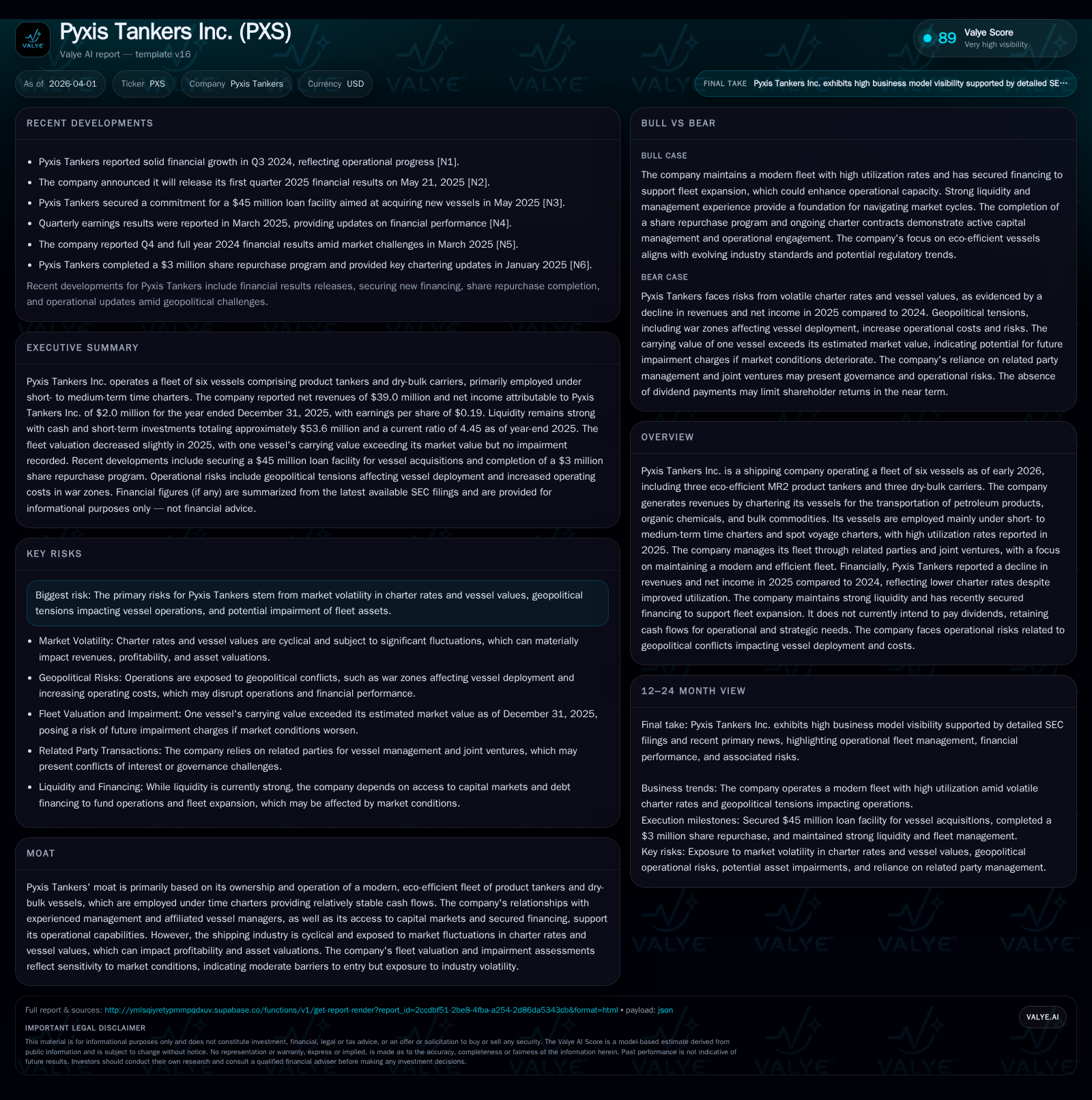
Pyxis Tankers Inc., operating a six-vessel fleet including eco-efficient product tankers and dry-bulk carriers, reported a 14.2% revenue decline and an 84.5% drop in net income for 2025 amid softer charter rates. The company expanded its fleet through acquisitions and joint ventures financed by secured loans with favorable terms, bolstering liquidity with cash and working capital rising to $35.6 million and $43.9 million respectively. Share repurchases continued modestly while dividends remain suspended as the firm prioritizes reinvestment and debt servicing. Geopolitical tensions and market uncertainties pose ongoing risks impacting voyage costs and earnings visibility.
Financial Performance Overview: A Transition from Growth to Contraction
Pyxis Tankers’ financial performance from FY2021 through FY2025 illustrates a marked shift driven by external market conditions. Revenue peaked at $58.3 million in FY2022 before declining to $45.5 million in FY2023 and further down to $39.0 million in FY2025, a 14.2% decrease compared to the prior year [F1]. This decline occurred despite generally high vessel utilization under time charters.
Operating income followed a similar pattern, swinging from a loss of -$8.5 million in FY2021 to positive territory in subsequent years but contracting sharply by 85.9% to $5.9 million in FY2025 [F1]. Net income decreased by 84.5% year-over-year to just under $2 million, underscoring significant margin compression.
Operating cash flow also contracted by nearly 28% year-over-year to approximately $13.6 million last year, indicating pressure on cash generation during earnings challenges [F1].
Historical performance (annual)
| FY | Rev ($mm) | Net ($mm) | CFO ($mm) | OpInc ($mm) | Rev YoY | Net YoY |
|---|---|---|---|---|---|---|
| 2025 | 39 | 2 | 14 | 6 | -84.5% | |
| 2024 | 13 | 19 | -65.3% | |||
| 2023 | 45 | 37 | 21 | 42 | -22.1% | +176.6% |
| 2022 | 58 | 13 | 8 | 17 | +130.2% |
Source: SEC companyfacts cache [F1].
Capital returns and efficiency (annual)
| FY | Buybacks ($) | FCF ($mm) | ROE% |
|---|---|---|---|
| 2025 | 472000 | -31 | 2.1 |
| 2024 | 1486000 | -26 | 13.8 |
| 2023 | 1244000 | -7 | 38.4 |
| 2022 | 5 | 21.8 |
Source: SEC companyfacts cache [F1].
*Note: Some prior-year CFO data estimated from filings [F1]
Geopolitical Risks Impacting Operations
Pyxis acknowledges the impact of geopolitical tensions on its operations and market conditions [S1]. The ongoing Russian-Ukrainian conflict alongside escalations involving the U.S., Israel, and Iran have introduced volatility in crude oil prices, bunker fuel costs, insurance premiums, and regulatory compliance.
The tanker Pyxis Karteria was positioned within the Persian Gulf conflict zone as of early-2026, exposing it to increased operational risk including potential voyage delays and higher insurance expenses [S1]. Additionally, the presence of Russian and Ukrainian nationals among crew members presents continuity risks, although no operational disruptions have been reported.
These factors contribute to variable voyage costs such as demurrage charges and elevated bunker consumption expenses affecting profitability.
Fleet Composition and Strategic Acquisitions
As of March 23, 2026, Pyxis operates six vessels: three MR2 eco-efficient product tankers (Pyxis Lamda, Theta, Karteria) and three dry-bulk carriers (Konkar Ormi – eco-Ultramax; Konkar Asteri – eco-Kamsarmax; Konkar Venture – eco-Kamsarmax joint venture) [S1].
The Konkar Asteri acquisition was completed in early-2024 for approximately $26.6 million funded via secured debt combined with cash reserves [S11]. The Konkar Venture joint venture closed mid-2024 involved common control transactions with Chairman Valentis Valentis owning the minority stake [S1][S11]. Both vessels are equipped with ballast water treatment systems aligning with environmental regulations.
Fleet management is centralized through related parties ensuring operational efficiencies [S22], while scheduled dry-dockings support compliance with classification society requirements [S23].
Revenue Decline Despite Stable Utilization
Revenue contraction in FY2025 primarily reflects weaker charter hire rates across both product tanker and dry-bulk segments despite steady vessel employment on short- to medium-term time charters [N1][F1]. Time charters provide revenue stability but limit upside during market upswings.
Operating income reduction incorporates fixed cost absorption challenges alongside higher voyage-related expenses linked to geopolitical factors [F1][N1]. Interest expense benefits from refinancing actions contributed positively to net income remaining slightly positive despite margin pressures.
Capital Structure Highlights
Pyxis utilized secured loans exceeding $30 million for vessel acquisitions including:
- $14.5 million loan for Konkar Asteri,
- $16.5 million loan for Konkar Venture, featuring five-year maturities with quarterly amortizations plus balloon payments between $8 million to over $10 million [S3][S6][S15].
Interest rates are based on Term SOFR plus margins ranging from approximately 1.8% to 2.35%, reflecting current financing conditions for shipping assets [S3][S7].
Refinancing completed in late-2025 reduced interest spreads on existing loans for vessels Pyxis Lamda and Theta while extending maturities [S7][S15]. These actions contributed to cash & equivalents increasing from about $39.6 million at end-2024 to nearly $35.6 million by end-2025 alongside a working capital surplus of $43.9 million [F1][S5].
No new equity issuances occurred during this period; Series A convertible preferred shares were fully redeemed earlier eliminating dilution concerns [S9].
Share Repurchase Program and Dividend Policy
Share repurchases were moderate at approximately $472K during FY2025 under board authorization, reflecting constrained free cash flow amid capital expenditure demands [F1][S4]. Buybacks occurred at average prices near $3-$4 per share.
No dividends were declared or planned given ongoing earnings volatility coupled with restrictive loan covenants requiring minimum liquidity levels and security cover ratios limiting distributions absent sufficient surplus profits [S10][S14][S24].
Outlook: Key Factors for Investors to Monitor
While no explicit forward guidance is provided by management, investors should watch:
- Charter Rate Trends: Recovery or further softness will critically influence revenue given time-charter-heavy employment.
- Geopolitical Developments: Conflict escalation or resolution affects voyage risk premiums and insurance costs.
- Dry-Docking Schedules: Planned maintenance downtime impacts vessel availability temporarily.
- Loan Maturities: Refinancing risk associated with balloon payments due within the next several years.
- Asset Valuations: Market-driven impairments could affect balance sheet strength as reflected in impairment testing frameworks [S28].
In summary, Pyxis Tankers balances its fleet modernization strategy focused on environmental compliance against challenging market dynamics characterized by earnings volatility largely driven by external macroeconomic factors beyond management control.
This analysis is based solely on publicly available information without investment recommendations or price forecasts implied.
Disclaimer: This is research-only, informational analysis and not investment advice. It may include AI-generated interpretation and general industry context. Always verify important details using primary sources.

Comments