
Nuvve Holding's V2G Platform Faces Revenue Contraction and Persistent Losses Amid Expansion Focus
Nuvve Holding Corp. continues to advance its AI-driven vehicle-to-grid technology despite declining revenue and ongoing net losses.
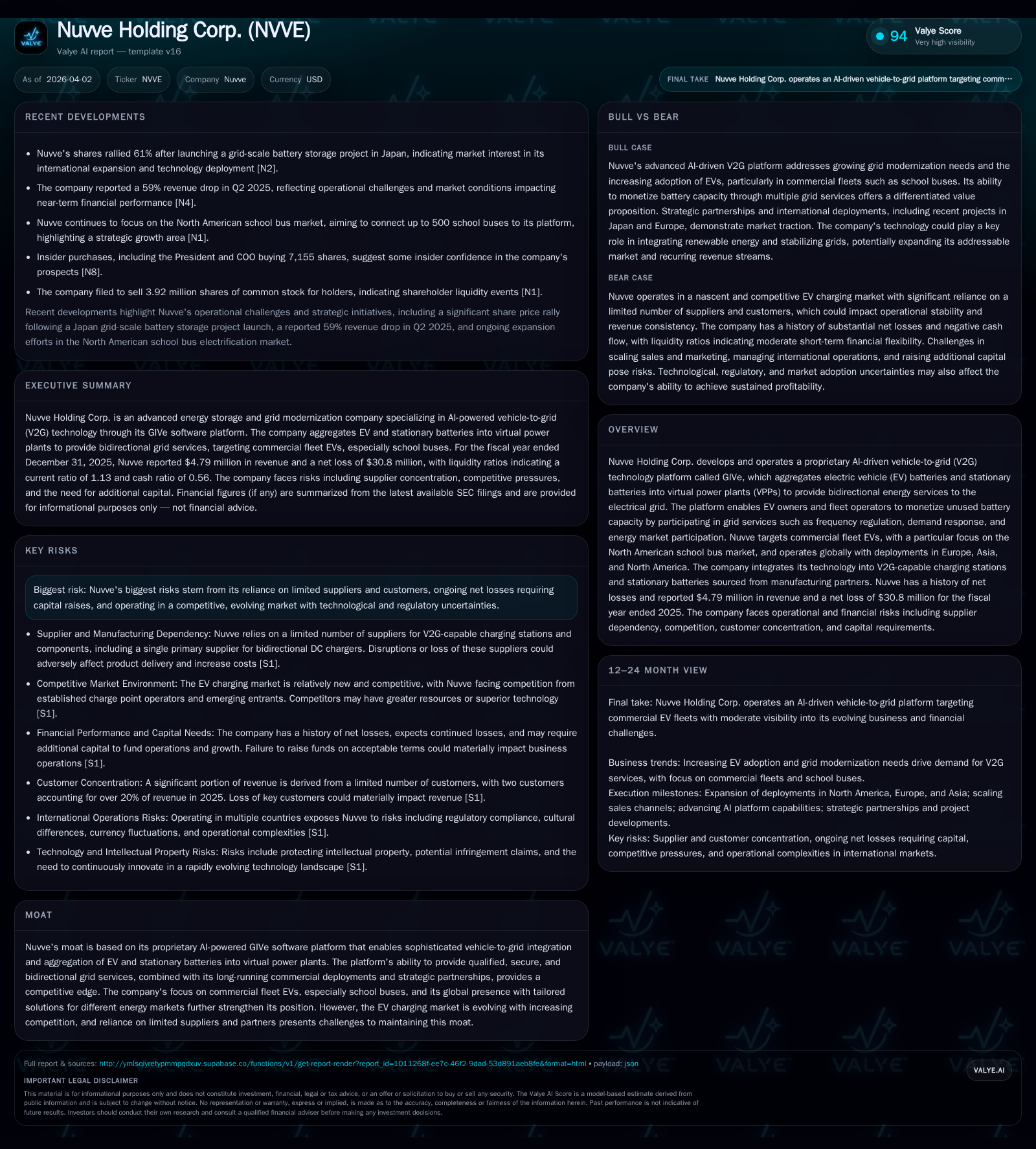
Nuvve Holding Corp. operates the proprietary GIVe platform, a cutting-edge software that aggregates electric vehicle battery capacity to provide grid services globally. In recent years, revenues have declined from peak levels attained in 2023, with 2025 revenues falling approximately 9.3% year-over-year to $4.79 million. The company remains unprofitable, reporting a substantial net loss of over $30.8 million in 2025 and negative operating cash flow. Strategic emphasis on commercial fleet electrification, particularly North American school buses, along with stationary storage integration, underpin future growth prospects, albeit subject to competitive pressures and supply chain dependencies.
Historical Performance
Nuvve Holding Corp., since inception, has centered its business model around its proprietary GIVe platform—a sophisticated AI-driven vehicle-to-grid (V2G) software solution that aggregates electric vehicle and stationary battery capacity into virtual power plants (VPPs). The company leverages this platform to offer bidirectional energy services such as frequency regulation, demand response, and energy market participation to the electrical grid.
Financially, the company’s topline revenue revealed significant volatility over the past four years: an initial $5.37 million in 2022 climbed sharply to a peak of $8.33 million in 2023 before consecutively declining through 2024 ($5.29 million) and further down by approximately 9.3% year-over-year to $4.79 million in 2025 [F1]. This trajectory reflects transitional challenges typical of early-stage tech companies scaling disruptive energy solutions with grant-dependent commercial deployments transitioning toward broader market penetration.
Operating income has consistently been negative, exacerbating from -$36.9 million in 2022 to -$32.2 million in 2025, with fluctuations due partially to investment ramp-ups and technology development expenses [F1]. Net income followed a similar path, widening net losses from -$24 million in 2022 to -$30.8 million in 2025, indicating that despite revenues normalizing downward post-peak, operating costs remain substantial relative to sales generation.
Operating cash flow continues negative trends, with a reported outflow of $16.6 million in 2025 closely aligned with previous years’ high cash burn rates indicating still-maturing commercialization efforts [F1]. Capital expenditures are minimal relative to overall spending (~$57k in 2025), consistent with Nuvve’s asset-light software-centric model reliant on third-party hardware integration.
Historical performance (annual)
| FY | Rev ($mm) | Net ($mm) | CFO ($mm) | OpInc ($mm) | Rev YoY | Net YoY |
|---|---|---|---|---|---|---|
| 2025 | 5 | -31 | -17 | -32 | -9.3% | -77.2% |
| 2024 | 5 | -17 | -16 | -20 | -36.6% | +44.4% |
| 2023 | 8 | -31 | -21 | -32 | +55.1% | -30.3% |
| 2022 | 5 | -24 | -34 | -37 |
Source: SEC companyfacts cache [F1].
Capital returns and efficiency (annual)
| FY | FCF ($mm) | ROE% |
|---|---|---|
| 2025 | -17 | 1842.3 |
| 2024 | -16 | 1379.8 |
| 2023 | -21 | -418.5 |
| 2022 | -35 | -88.3 |
Source: SEC companyfacts cache [F1].
*Note: YoY percentages reflect comparison year-over-year for periods shown where applicable [F1].
Growth Prospects and Market Opportunity
Nuvve’s strategy revolves around deepening penetration within commercial fleet electrification—particularly targeting the North American school bus segment recognized as one of the highest priority markets globally due to its size (>600K buses predominantly diesel-powered), anticipated accelerated electrification rates by OEMs responding to fleet demand shifts [S4][S14]. School buses’ high parked time (~97%), combined with fleet operational predictability makes them optimal candidates for V2G services wherein unused battery capacity can be monetized back into the grid.
The GIVe platform not only facilitates dispatchable grid services but also supports integration with stationary batteries deployed across varied applications such as universities and municipal infrastructures enhancing reciprocal revenue streams beyond just mobile assets [S14]. Further geographic expansion into Europe and Asia—markets offering varying incentive landscapes—complements North American efforts but introduces complexity given multifaceted regulatory environments.
The addressable markets encompass grid services valued between $3 billion to $250 billion annually depending on service type (frequency regulation through energy arbitrage), underscoring significant long-term potential for virtual power plant scalability if adoption barriers are overcome [S10].
Key growth drivers:
- Expansion of electric fleets beyond school buses into other heavy-duty segments like transit buses and delivery trucks.
- Increasing scale of grid service contracts translating into recurring SaaS-like revenues from the GIVe platform.
- Strategic partnerships such as those formerly held within Dreev JV facilitating European deployments (though recent divestiture suggests refocus on core markets) [S4].
- Enhancement of forecasting and AI-based optimization functionalities improving platform value proposition.
Constraints include supply-side vulnerabilities due to dependence on limited manufacturers for bi-directional DC chargers like Tellus Power Green; risks around delays or bottlenecks can materially impact project rollouts [S23]. Competition intensifies as incumbent charge point operators upgrade capabilities though incumbents typically lack mature bidirectional solutions inherent to Nuvve’s IP portfolio vetted by multiple transmission system operators [S13][S15]. Regulatory variability especially regarding data privacy laws (GDPR/CCPA), utility rate structures and incentives inject ongoing operational risk requiring agile compliance measures [S8][S22][S18].
Forecasts and Milestones
Management has not disclosed explicit financial guidance or hard milestones within recent filings or announcements; however key performance indicators worthy of attention include:
- Growth rate in number of school buses connected via V2G-capable chargers (management projects up to approximately 500 bus connections near term).
- Revenue mix evolution from government grants towards commercial recurrent grid service contracts.
- Customer retention rates and expansion within top accounts given notable revenue concentration.
- Progression on expanding vendor base for charging station supply chains mitigating single-source risks.
- Expansion initiatives into new international territories balanced against capital expenditure discipline.
Monitoring these operational metrics alongside quarterly financial updates will provide visibility into whether Nuvve can translate its technological lead into scalable commercial success.
Capital Allocation and Returns
Nuvve’s balance sheet reflects a challenging position with equity turning negative at roughly -$1.67 million by end-2025 from positive levels earlier indicating accumulated deficit erosion amidst elevated losses [F1]. This underscores the critical need for continued equity raises or other funding sources to sustain runway given negative operating cash flows exceeding $16 million annually.
No dividends or share repurchase activities have been reported recently; the company remains focused on reinvesting capital primarily into R&D enhancements of its GIVe platform coupled with sales capability expansions rather than capital returns [F1][S27]. Given persistent unprofitability and structural cash burn reflective of early commercialization stages within complex energy tech sectors this allocation emphasis aligns with typical industry practice prioritizing growth over near-term returns.
Indirectly calculable return metrics such as ROE are not meaningful owing to negative equity base compounded by sizeable net losses (~1840% approximate absolute ROE figure is mainly an artifact reflecting negative denominator rather than genuine profitability) [F1]. Cash conservation supplemented by selective capital deployment towards critical growth enablers will remain vital going forward.
Industry Context and Competitive Positioning
The broader EV charging ecosystem is evolving rapidly driven by electrification mandates globally but remains fragmented with competition across software platforms (charge management without V2G capability), hardware makers expanding connected charger offerings and energy aggregators alike. Nuvve’s moat rests heavily on intellectual property ownership comprising key patents governing bi-directional power flow aggregation and longstanding certification relationships enabling grid participation internationally—a rare blend not easily replicated by new entrants without extensive development timelines. Competitors with greater financial horsepower challenge market share but often lack integrated bidirectional platforms crucial for monetizing vehicle batteries as grid assets at scale. Yet risks linked to supplier dependency (for specialized DC chargers), technological obsolescence risks if newer battery standards alter compatibility norms without rapid adaptation represent material hurdles. Furthermore regulatory uncertainties—from electric utility statutes modulation affecting compensation structures for grid services to stringent privacy frameworks complicate product deployment strategies especially outside home jurisdiction. Overall market maturation will require continued investment balanced against pragmatic capitalization strategies mindful of investor appetite amid ongoing net losses.
Risks Summary
Outlined risks include:
- Continued net losses triggering capital raise requirements with associated dilution risk impacting shareholder value expectations [S1][S27].
- Customer concentration risk demonstrated by top two clients representing >20% revenues; loss or contract renegotiation presents earnings volatility risk [S6][S7].
- Supply chain fragility due to limited supplier pool for V2G charging stations potentially delaying installations or inflating costs [S23].
- Litigation risks related to intellectual property infringement claims which could entail costly remedies or operational restrictions [S24].
- Regulatory shifts across multiple jurisdictions bearing high compliance cost burdens impacting margins and go-to-market viability [S8][S22][S29].
- Cybersecurity vulnerabilities inherent in complex software integrations risking service interruptions or reputational harm [S21].
- Dependence on nascent EV fleet adoption cycles which may be slower or impacted by macroeconomic factors reducing capital expenditure willingness among customers [S1][N1].
Conclusion
Nuvve Holding Corp stands as a pioneering entity within the emergent vehicle-to-grid space utilizing proprietary AI-enhanced software technologies addressing a niche yet potentially sizable opportunity at the confluence of electrification and grid modernization efforts globally. While historical financials paint a picture of top-line contraction juxtaposed against heavy investments contributing to sustained net losses and negative cash flows indicating early stage risk profile typical of high-tech energy startups,[F1] management’s strategic focus on targeted verticals like North American school bus electrification coupled with expansion efforts into stationary storage markets underscore a pathway for eventual scale formation.[S4][S14]
Challenges abound pertaining to competitive dynamics exacerbated by supplier concentration risk alongside dynamic regulatory environments requiring nimble adaptation. Monitoring customer diversification progress alongside commercial revenue ramping away from government grants will be critical markers going forward absent explicit guidance. Capital stewardship balancing technology investments against liquidity constraints is paramount given current financial positioning.[F1]
Investors would be well served continuing close scrutiny on quarterly operational deliveries including unit connects within priority sectors such as school buses plus revenue composition shifts offering insights into commercial traction while cognizant of embedded execution risks intrinsic at this stage.
This analysis is provided solely for informational purposes reflecting data available as of April 2nd, 2026. It does not constitute investment advice or recommendations regarding Nuvve Holding Corp or any securities referenced herein.
Disclaimer: This is research-only, informational analysis and not investment advice. It may include AI-generated interpretation and general industry context. Always verify important details using primary sources.

Comments