
Lyra Therapeutics’ Strategic Crossroads After Clinical Setbacks and Nasdaq Delisting
Lyra’s suspension of its flagship LYR-210 development, combined with dwindling liquidity and delisting from Nasdaq, marks a pivotal inflection in the company’s clinical biopharma journey.
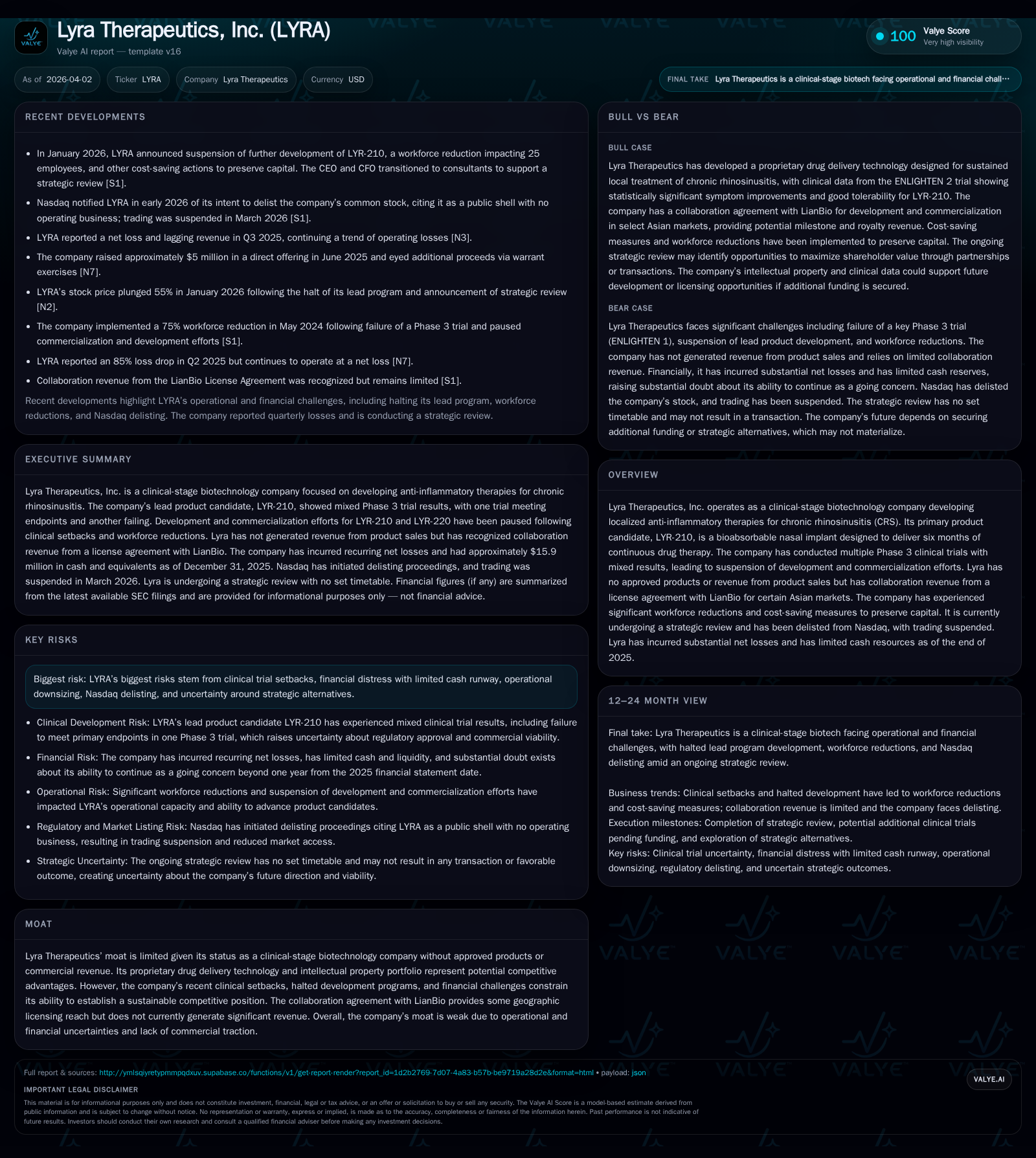
Lyra Therapeutics, once buoyed by promising Phase 3 trial data for its LYR-210 nasal implant targeting chronic rhinosinusitis (CRS), has abruptly suspended further development following mixed clinical outcomes. The failure of ENLIGHTEN 1 to meet primary endpoints and the subsequent workforce reductions underscored operational strains intensified by a Nasdaq delisting and capped liquidity resources. Despite a positive ENLIGHTEN 2 readout, regulatory mandates for additional trials coupled with minimal revenue streams and ongoing strategic review cloud near-term recovery prospects. The company confronts challenging capital allocation decisions and an eroded equity base while holding modest intellectual property over localized anti-inflammatory drug delivery technology.
Clinical Milestones and Setbacks: The Rise and Pause of LYR-210
Lyra Therapeutics built its clinical narrative around LYR-210, a proprietary bioabsorbable nasal implant designed to deliver mometasone furoate directly to sinonasal tissues for six-month continuous treatment of chronic rhinosinusitis (CRS)—a condition affecting roughly 14 million Americans characterized by debilitating inflammation. The technology aimed to combine ease of in-office administration with sustained localized drug delivery, offering a differentiated approach compared to systemic or conventional sprays.
In May 2024, the company announced that its ENLIGHTEN 1 Phase 3 trial failed to achieve statistical significance on the primary endpoint: improvement in the three cardinal symptoms composite score (3CS) at week 24 for CRS patients without nasal polyps [S1][S2]. This setback led Lyra to halt commercialization efforts for LYR-210 immediately and pause development on LYR-220, a related larger implant variant targeting more extensive sinonasal anatomies.
The ENLIGHTEN 1 failure triggered drastic workforce reductions—approximately 75% cut impacting 87 full-time employees—reflective of the company’s urgent need to preserve capital amid this strategic pivot [S1][S2]. Manufacturing activities for both implants were also suspended.
Contrastingly, the subsequent ENLIGHTEN 2 trial reported positive topline results in mid-2025. It met primary and key secondary endpoints showing statistically significant symptom improvement across multiple patient subsets including those without nasal polyps as well as pooled populations at the 24-week mark [S2]. Importantly, symptom benefits appeared as early as week four. Safety profiles remained favorable with no serious product-related adverse events noted.
Despite ENLIGHTEN 2’s encouraging data, regulatory discussions with the FDA revealed the necessity for an additional confirmatory trial before a New Drug Application (NDA) filing can be pursued for LYR-210 indications [S2]. This requirement imposes further uncertainty, contingent on the company’s ability to secure sufficient financing under constrained operational scenarios.
In aggregated data sets focused on patients with nasal polyps—a subgroup less represented in earlier analyses—LYR-210 showed consistent positive efficacy trends but fell short of providing sufficient regulatory clarity needed to confidently advance approval pathways [S2].
Financial Performance Trends and Operational Shifts Over Four Years
Lyra’s financial trajectory through FY2025 reflects progressive operational contraction aligned with its clinical challenges. Annual operating losses narrowed from $96.3 million in FY2024 to $31 million in FY2025; net losses similarly improved from $93.4 million to $28.9 million [F1]. This improvement largely results from reduced R&D expenditures following program suspensions and headcount cuts rather than top-line growth.
Operating cash flow losses also diminished markedly from $70 million in FY2024 to $28.9 million in FY2025 alongside a steep reduction in capital expenditure spending—plummeting approximately 95% year-over-year from nearly $2.34 million to just $116 thousand—highlighting curtailed investment in manufacturing or infrastructure upgrades [F1].
Historical performance (annual)
| FY | Net ($mm) | CFO ($mm) | OpInc ($mm) | Capex ($mm) | Net YoY |
|---|---|---|---|---|---|
| 2025 | -29 | -29 | -31 | 0 | +69.0% |
| 2024 | -93 | -70 | -96 | 2 | -49.1% |
| 2023 | -63 | -63 | -67 | 1 | -13.4% |
| 2022 | -55 | -43 | -56 | 0 |
Source: SEC companyfacts cache [F1].
Capital returns and efficiency (annual)
| FY | FCF ($mm) | ROE% |
|---|---|---|
| 2025 | -29 | 269.8 |
| 2024 | -72 | -805.9 |
| 2023 | -64 | -70.1 |
| 2022 | -44 | -68.5 |
Source: SEC companyfacts cache [F1].
This financial deterioration coincided with equity erosion that culminated in negative stockholders’ equity of approximately $10.7 million as of December 31, 2025—from positive equity positions exceeding $80 million just three years prior—underscoring cumulative losses outpacing capital injections [F1].
Liquidity Status and Capital Structure
At year-end FY2025 Lyra held only $15.9 million in cash and cash equivalents down from nearly $40.6 million at end-2024—a sharp depletion reflective of ongoing operating cash burn [F1][S4]. The company has historically raised $429.8 million since inception across various financings mostly involving equity securities including redeemable convertible preferred stock and multiple private placements such as the April 2022 Financing ($96.3M net proceeds) and May 2023 Financing ($46.5M net proceeds) [S4][S5][S6].
Recent market dynamics compounded by Nasdaq's delisting notice received February 2, 2026 severely restrict Lyra's ability to access public equity markets [S1][S3]. Delisting followed board-approved workforce reductions and cessation of appealing Nasdaq's determination due to Lyra being classified as a "public shell" under Listing Rule 5101 [S1][S3]. Trading suspension commenced March 17, 2026.
Amid these constraints liquidity preservation became paramount including attempts to negotiate early termination of costly leases [S8]. Collaboration revenue streams remain negligible; Lyra recognized only $5.1 million from its licensing agreement with LianBio covering certain Asian markets as of December 31, 2025—with LianBio itself undergoing wind-down processes complicating revenue consistency [S7][S17].
Strategic Review Initiatives: Navigating Limited Options
Following the January 2026 announcement halting all development programs related to LYR-210 alongside workforce reduction affecting approximately one-quarter of remaining employees indicates acknowledgment within management that preserving cash supersedes near-term clinical ambitions [S1][S3]. CEO Maria Palasis Ph.D. and CFO Jason Cavalier transitioned into consultancy roles to support ongoing strategic alternative evaluations inclusive but not limited to asset sales licensing deals or restructuring transactions.
No definitive timetable accompanies this review process leaving shareholders uncertain about tangible future milestones or transaction completion likelihoods. Prior initiatives attempted during mid-to-late 2025 such as directed offerings yielded limited proceeds (~$5M gross via June direct offering) insufficient for substantial program revitalization under current operating losses [S26][S25].
Growth Outlook Dependent on External Funding and Regulatory Outcomes
Realistic assessment points toward a conditional growth scenario heavily tethered to external funding acquisition enabling commencement of additional FDA-mandated trials required for NDA submissions [S2]. Without such injections commercial reentry remains stalled indefinitely while prevailing collaboration revenues fail meaningfully offset fixed costs.
In light of paused manufacturing operations and halted commercial deployments since mid-2024 there is no near-term pathway currently visible for organic revenue generation absent successful liquidity events or strategic partnerships licensing out assets.
The license agreement with LianBio offers some geographic breadth potential but contributes insignificantly relative to cash burn rates especially as LianBio seeks third-party acquisitions themselves limiting reciprocal financial support stability [S17].
Capital Allocation: No Dividends or Buybacks Amid Financial Distress
Consistent with typical clinical-stage biotech profiles Lyra has not initiated dividends nor engaged share repurchases during recent periods given persistent losses undermining distributable cash flow foundations [F1][S7]. Negative retained earnings culminating in equity deficit position distorts conventional return metrics such as ROE—nominally reported around +270% due to negative denominator distortions provide no meaningful economic signal here [F1].
Capital expenditures collapsed reflecting freeze on expansion projects with spend of merely $116K in FY2025 versus multimillion dollar investments previously revealing tight fiscal stewardship albeit forced by clinical setbacks absent growth financing avenues.
Technology Moat and Competitive Positioning Amid Industry Flux
Lyra’s core intellectual property centers on its proprietary bioabsorbable nasal implant platform intended for localized anti-inflammatory drug delivery via mometasone furoate embedment ensuring sustained sinonasal exposure over half-year intervals—a differentiator against traditional topical corticosteroid approaches which rely on patient adherence.
However recent clinical program discontinuations stall momentum towards capturing a defensible commercial niche amid competitors advancing alternative CRS therapeutics including biologics targeting eosinophilic inflammation phenotypes or novel delivery technologies achieving prolonged symptom control.
While the implant technology holds intrinsic value for longer-duration therapies potentially reducing systemic side effects dose frequency issues its translational risk postclinical trial failures combined with financial scarcity constrains any robust moat establishment presently [S1].
Key Risks Highlighted by Recent SEC Filings
The company extensively details risk factors encompassing clinical development uncertainties including potential failure to meet endpoints or secure approvals; historical inability to generate revenues besides scarce collaboration fees; liquidity insufficiencies indicated by continued operating losses approximately $29M in FY2025 despite prior mass layoffs; limited cash runway evident through low year-end balances compounded by Nasdaq delisting restricting capital market access; litigation risks currently immaterial but unresolved contract disputes foreshadow operational fragility; dependency on third-party manufacturers whose termination agreements have affected program continuity; general biotechnology sector hazards such as regulatory shifts competition technological innovation pace demand cycles; execution risk associated with indefinite strategic alternatives review lacking firm commitments or clear outcomes; concentration credit risk stemming from custodial banks holding uninsured deposits exceeding insured limits raising vulnerability during financial disruptions [S1][S11][S14][S20][S27].
This analysis refrains from prognosticating investment outcomes yet underscores tangible operational impasses confronting Lyra Therapeutics post clinical disappointments and stock market exclusion. The company's fortunes hinge critically on potential future financings or transactions capable of reactivating stalled product candidates within stringent regulatory frameworks while managing scant liquidity amidst sizable overhead structures faded by attrition.
Disclaimer:
This document is prepared solely for informational purposes based on disclosed filings as of April 02, 2026; it does not constitute investment advice or recommendations. All numerical facts are sourced explicitly from company filings without extrapolation or speculation beyond stated material.
Disclaimer: This is research-only, informational analysis and not investment advice. It may include AI-generated interpretation and general industry context. Always verify important details using primary sources.

Comments