
Tevogen Bio Holdings Stakes Its Future on Precision Allogeneic T Cell Therapies
Tevogen pursues pioneering precision allogeneic T cell therapies, balancing scientific innovation with pressing financial and regulatory challenges at a critical clinical stage.
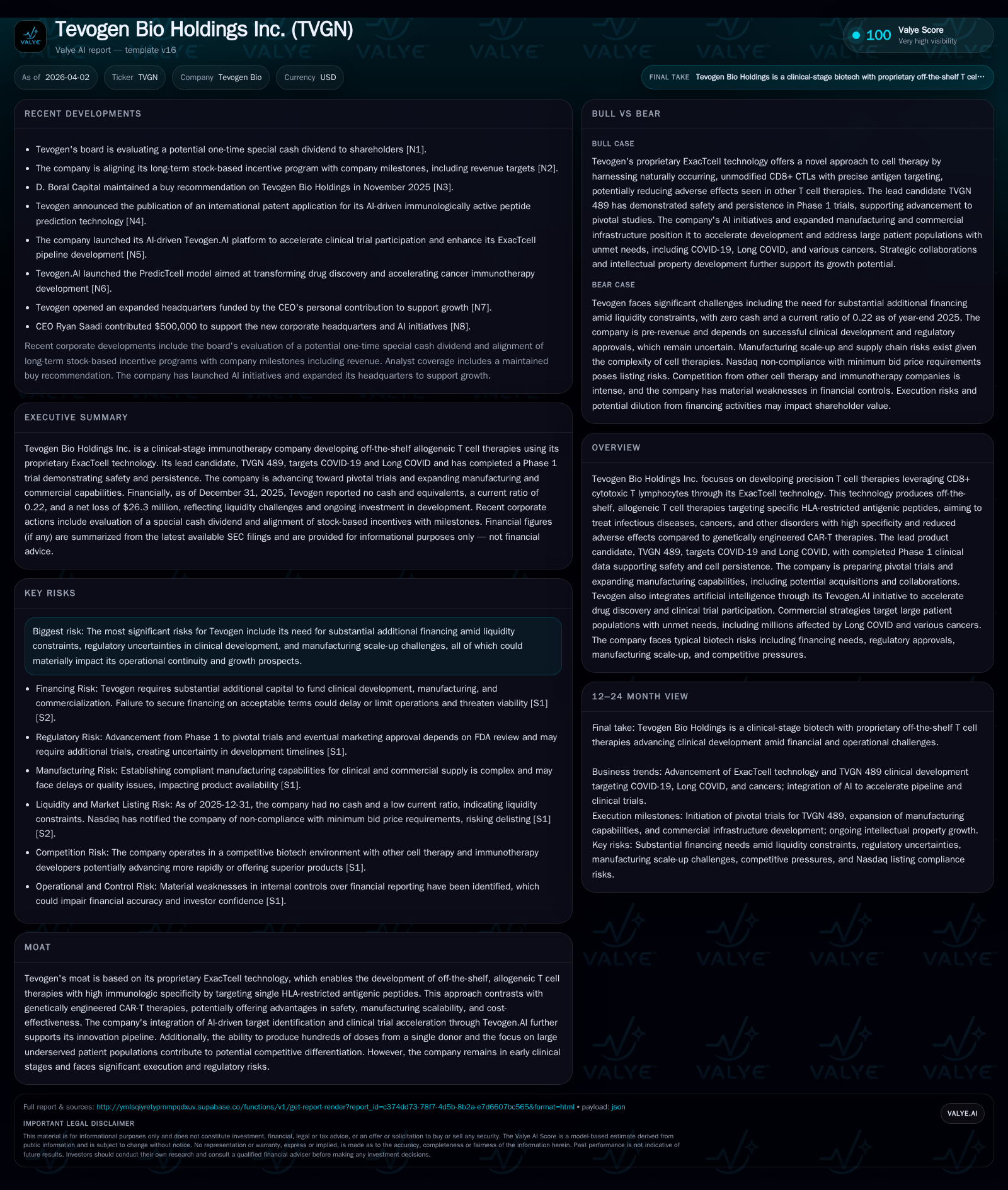
Tevogen Bio Holdings centers its strategy on ExacTcell, a proprietary platform that generates off-the-shelf CD8+ cytotoxic T cell therapies targeting specific HLA-restricted epitopes. While Phase 1 trial data for lead candidate TVGN 489 in COVID-19 and Long COVID show early safety and durability signals, the company operates under significant liquidity constraints and regulatory uncertainties. Despite improving operating losses in fiscal 2025, Tevogen’s cash position is depleted, and executing pivotal trials alongside manufacturing scale-up remains an uphill task. The integration of AI through Tevogen.AI reflects an ambition to accelerate development, but near-term milestones hinge heavily on financing and regulatory pathways.
From Early Promise to Financial Headwinds: Tevogen's Growth Trajectory
Founded in 2020, Tevogen Bio Holdings has focused efforts on pioneering precision T cell therapies addressing infectious diseases and cancer through its ExacTcell technology. Over four fiscal years ending 2025, the company has operated without commercial revenues while incurring significant operating losses. According to financial filings [F1], operating income improved from a loss of $53.6 million in FY2024 to a smaller loss of $26.1 million in FY2025 — a more than 50% year-over-year improvement reflecting cost controls or program prioritization amid persistent R&D spend. However, net income remained negative at approximately -$26.3 million in FY2025.
Cash flow from operations also remains negative, totaling about -$12.3 million in FY2025 declining slightly year-over-year. Capital expenditures have halved compared to previous years but remain modest around $64 thousand as Tevogen likely prioritizes R&D over fixed asset investments. Critically, the company's liquidity situation is strained: its cash and equivalents reached $0 at fiscal year-end 2025 with current liabilities outpacing current assets by over threefold (current ratio: 0.22) [F1]. This ratio starkly illustrates short-term solvency risk without immediate capital infusion.
Historical performance (annual)
| FY | Net ($mm) | CFO ($mm) | OpInc ($mm) | Capex ($) | Net YoY |
|---|---|---|---|---|---|
| 2025 | -26 | -12 | -26 | 64439 | -91.4% |
| 2024 | -14 | -12 | -54 | 133000 | -20289.7% |
| 2023 | 0 | -1 | -101.5% | ||
| 2022 | 4 | 0 |
Source: SEC companyfacts cache [F1].
Capital returns and efficiency (annual)
| FY | FCF ($mm) | ROE% |
|---|---|---|
| 2025 | -12 | 319.1 |
| 2024 | -12 | 205.7 |
| 2023 | 0.4 | |
| 2022 | -29.8 |
Source: SEC companyfacts cache [F1].
Operating losses have improved but remain deep amidst escalating clinical expenditures; zero reported cash reserves at the end of FY2025 spell liquidity urgency.
ExacTcell: Scientific Innovation Beyond CAR-T Constraints
Tevogen’s foundational innovation lies in its proprietary ExacTcell technology—a platform leveraging naturally occurring CD8+ cytotoxic T lymphocytes (CTLs) isolated from donors to create precision allogeneic cell therapies that selectively target single human leukocyte antigen (HLA)-restricted antigenic peptides [S1]. Unlike genetically engineered CAR-T therapies which rely on chimeric antigen receptor modifications creating broad specificity but often associated with severe cytokine release syndrome or neurotoxicity issues, ExacTcell utilizes T cells bearing native T cell receptors optimized ex vivo against viral or tumor antigens.
The importance of HLA restriction means each product targets peptide fragments presented within particular HLA alleles—making therapy highly immunologically specific while reducing cross-reactivity risks against healthy tissues. This approach aims to overcome key bottlenecks faced by conventional CAR-Ts including complex autologous manufacturing logistics and safety issues driven by engineered receptor overactivation.
From a manufacturing perspective, ExacTcell’s off-the-shelf allogeneic format enables hundreds of therapeutic doses generated per donor batch under current Good Manufacturing Practice (cGMP) standards [S1]. This scalability advantage has potential cost-effectiveness implications when compared to patient-specific autologous therapies requiring individualized manufacturing cycles.
Product Pipeline Spotlight: TVGN 489 in COVID-19 and Long COVID
The lead clinical candidate under the ExacTcell umbrella is TVGN 489—a therapy targeting SARS-CoV-2 viral peptides relevant to both acute COVID-19 infection as well as Long COVID persistent symptoms primarily in immunocompromised or elderly populations where vaccination efficacy may be limited [S1]. Phase 1 clinical data demonstrate favorable safety profiles with observed persistence of administered T cells over time—suggesting potential for durable therapeutic effect.
TVGN 489 addresses significant unmet medical needs given limited options for chronic COVID symptom management among high-risk groups. Pivotal trials are planned to evaluate efficacy endpoints supporting potential regulatory approval.
However, evolving SARS-CoV-2 variants present uncertainty regarding antigenic conservation and efficacy across future viral landscapes—a challenge typical for immunotherapies targeting mutating viruses. Additionally, patient recruitment may prove challenging as pandemic waves subside due to increased immunity levels.
Funding the Vision: Capital Allocation, Burn Rate, and Liquidity Gaps
Financial disclosures reveal a critical funding gap posing existential risks if unresolved promptly [F1], [N1], [S16], [S22]. With zero cash reserves as of December 31st, 2025 coupled with negative equity exceeding $8 million [F1], the company lacks internal resources for sustained operations.
The March 2026 announcement of a reverse stock split led to a share price decline exceeding 20%, signaling market concerns about dilution risk or recapitalization needs [N1]. Historically funded via convertible preferred stock offerings along with debt instruments subject to covenants limiting flexibility [S16], Tevogen faces typical biotech cash burn dynamics exacerbated by ongoing clinical trial costs and ramping manufacturing expenses.
Future financing efforts will require careful capital allocation prioritizing pivotal trial initiation while managing costs amid unyielding R&D demands.
Regulatory and Manufacturing Challenges for Clinical-Stage Biotechs
Tevogen operates under stringent regulations encompassing FDA oversight plus compliance with healthcare fraud-and-abuse laws including Anti-Kickback Statute and False Claims Act enforcement detailed extensively in filings . Marketing authorization depends not only on positive clinical outcomes but also navigating reimbursement landscapes affected by government pricing pressures.
Manufacturing scale-up challenges are pronounced for allogeneic cell therapies requiring robust cGMP-compliant facilities capable of producing consistent batches at scale without quality compromises—delays here can impact trial supply or commercialization timelines.
Product liability risks during clinical testing necessitate robust risk management given inherent safety concerns associated with cellular immunotherapies [S9]. These regulatory and operational complexities compound financial pressures facing Tevogen.
AI-Driven Drug Discovery: The Role of Tevogen.AI
Parallel to laboratory development is Tevogen.AI—an artificial intelligence initiative aimed at accelerating target discovery and improving clinical trial enrollment efficiency through advanced algorithms [S14]. This integration seeks to shorten development cycles while enhancing candidate selection robustness.
Evolving AI regulatory frameworks such as the EU Artificial Intelligence Act introduce compliance considerations requiring transparency and governance adherence that will shape future operational protocols.
Upcoming Catalysts and Milestones in 2026
While exact timelines remain undisclosed, key events include:
- Initiation of pivotal trials assessing TVGN 489 efficacy post-phase I safety success could materially influence valuation perspectives [S1].
- Expansion or partnerships enhancing cGMP manufacturing capacity enabling larger-scale production required for late-stage studies represent crucial operational milestones.
- Regulatory submissions such as Investigational New Drug applications for pipeline candidates should be monitored as indicators of platform progress. Failure to meet these milestones timely could exacerbate market skepticism given existing financial constraints.
Balance Sheet Realities: Cash Flow, Debt Structure & Shareholder Returns
Reflecting early-stage development scale compounded by burn-focused operations typical among clinical biotechs without marketed products is evident in balance sheet metrics [F1]. Negative shareholders' equity above $8 million alongside operating cash flow deficits highlight financial vulnerability absent successful fundraising bolstering liquidity runway.
Zero reported cash & equivalents against substantial current liabilities nearing $7 million indicate urgent refinancing needs justifying recent equity restructuring maneuvers including reverse stock splits designed partly to facilitate future capital access without excessive dilution prematurely.
No dividends or share repurchases are conducted consistent with early-stage biotech priorities emphasizing cash conservation toward pipeline advancement.
This analysis synthesizes publicly available SEC filings and news reports solely for informational purposes.
Disclaimer: This is research-only, informational analysis and not investment advice. It may include AI-generated interpretation and general industry context. Always verify important details using primary sources.

Comments