
Lovesac Co’s Modular Innovation Spurs Modest Growth as Margins Contract
Lovesac’s distinctive modular furniture strategy drives sales growth amid significant margin pressures and capital expenditure demands.
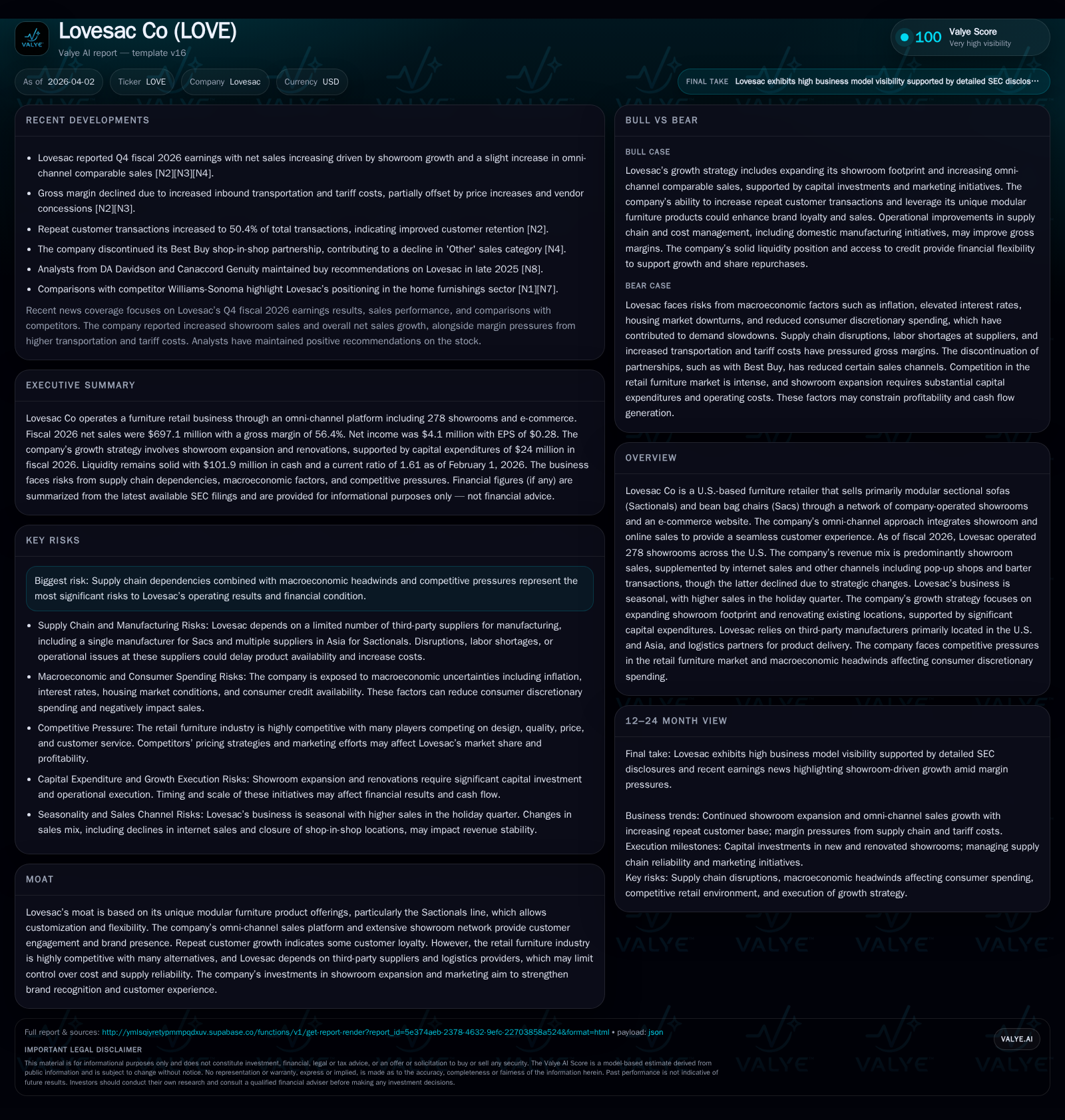
Lovesac Co’s innovative Sactionals modular sofas and expanding showroom network foster modest revenue growth of 2.4% in fiscal 2026 despite a sharp 60.7% decline in operating income. The company’s omni-channel approach and product customization support increasing customer loyalty, with repeat transactions making up over half of sales. However, escalating costs from domestic manufacturing shifts and showroom renovations compress margins, while capital expenditures rise to support showroom expansion and upgrades. Lovesac maintains positive free cash flow but faces macroeconomic headwinds including supply chain risks and consumer spending volatility, marking a cautious outlook for returning operating leverage.
Historical Sales and Profit Trends: Growth Moderation and Margin Compression
Lovesac Co’s fiscal history over the past four years illustrates a phase of moderated top-line growth paired with stark margin erosion. Revenue ascended by a modest 2.4% year-over-year to reach $697 million in FY2026, up from $680.6 million in FY2025 [F1]. However, this top-line stability belies a more challenging profitability picture—operating income contracted precipitously by approximately 60.7%, plunging from $13.6 million to just $5.36 million [F1]. Net income followed suit, shrinking by roughly 64.8%, emphasizing sustained profit pressure.
Operating cash flow displayed resilience, growing 26.6% to $49.3 million, indicating effective working capital management despite profitability challenges [F1]. Capital expenditures rose 10% year-over-year to about $23 million as Lovesac continued investing in its showroom network and infrastructure [F1]. This combination of flat revenues with compressing operating profits suggests significant cost pressures amid deliberate growth investments.
Historical performance (annual)
| FY | Rev ($mm) | Net ($mm) | CFO ($mm) | OpInc ($mm) | Rev YoY | Net YoY |
|---|---|---|---|---|---|---|
| 2026 | 697 | 4 | 49 | 5 | +2.4% | -64.8% |
| 2025 | 681 | 12 | 39 | 14 | -2.8% | -51.6% |
| 2024 | 700 | 24 | 76 | 30 | +193.6% | -9.0% |
| 2023 | 238 | 26 | -21 | 36 |
Source: SEC companyfacts cache [F1].
Capital returns and efficiency (annual)
| FY | Buybacks ($mm) | FCF ($mm) | ROE% |
|---|---|---|---|
| 2026 | 6 | 26 | 1.9 |
| 2025 | 20 | 18 | 5.3 |
| 2024 | 48 | 11.0 | |
| 2023 | -47 | 13.6 |
Source: SEC companyfacts cache [F1].
Note: Revenue YoY for FY2024 vs FY2023 reflects partial year scaling post-IPO; operating income comparability adjusts accordingly.
Sactionals and Sacs: Product Differentiation as Competitive Moat
At the heart of Lovesac’s differentiation lies the modular Sactionals series—sectional sofas designed for customization and adaptability—and their signature bean bag chairs known as Sacs [S1]. The customizable configurations tap into consumer desires for personalization, while the offering's modular nature supports long-term customer engagement through add-ons or replacements.
This product uniqueness sustains meaningful customer loyalty; about half (50.4%) of all transactions in fiscal 2026 were repeat purchases, an increase from the prior year's 46.8% [S5]. This upward trajectory in repeat business indicates the firm's success in retention strategies and strengthens its moat within a highly competitive retail furniture landscape permeated by commoditized alternatives.
Nonetheless, sustaining this differentiation depends on continuous innovation in unit economics—balancing pricing power against raw material and labor costs—and maintaining appealing showroom experiences that reinforce perceived value [S4][S7].
Omni-Channel Expansion and Showroom Strategy Driving Customer Engagement
Lovesac leverages an omni-channel distribution model integrating e-commerce with its showroom footprint—a key brand-building asset which stood at 278 stores as of FY2026 end [S1][N6]. Showrooms provide tactile opportunities to experience modular setups, facilitating customization decisions that are critical to higher conversion rates.
The firm has concurrently invested heavily in renovating existing showrooms alongside new openings to sustain a premium retail environment conducive to upselling higher-margin products [S16]. These capital expenditures underpin marketing efforts aiming to drive traffic both physical and digital.
Omni-channel comparable net sales track established locations’ performance across channels; while specific comparable store sales figures are not disclosed here, management highlights their pivotal role in assessing operational health amid expansion endeavors [S5]. This integrated strategy caters to evolving consumer shopping preferences that demand seamless transitions between digital browsing and physical engagement.
Supply Chain Shifts: Domestic Manufacturing Initiatives and Cost Dynamics
Lovesac’s supply chain pivots towards expanding U.S.-based manufacturing for its Sactionals, intending to mitigate tariff risks exacerbated by recent trade tensions, improve logistics agility, and harness automation for efficiency gains [S4][S7]. These changes aim to reduce lead times and support inventory responsiveness critical for modular product variants.
Primary cost drivers remain raw material prices, labor expenses across sourcing geographies, inbound freight burden, warehousing operations, and last-mile delivery logistics—all contributing substantially to the cost of goods sold (COGS) structure [S7]. Inventory markdowns continue as a strategic tool addressing slow-moving SKUs influenced by customer acceptance variability.
While domestic sourcing improves supply reliability prospects long term, initial phases carry front-loaded capital investment requirements and transitional inefficiencies which weigh on gross margins currently reported on a basis that includes distribution costs within COGS—less readily comparable against some peers excluding such costs therein [S4][S7].
Capital Expenditures and Their Impact on Operating Leverage
Capital allocation reflects Lovesac’s commitment to sustaining its omnichannel presence through both new showroom development and modernization efforts—capital expenditures rose by approximately 10% year-over-year to $23 million in fiscal 2026 [F1][S16][S26].
These investments encompass leasehold improvements, advanced fixtures tailored for modular display needs, information technology enhancements supporting order fulfillment accuracy, and corporate infrastructure expansion including a new headquarters [S16].
However, this surge in capex outpaces operating income gains creating an operating leverage drag evident in the disproportionate profitability decline relative to modest revenue growth [F1]. Given the seasonality inherent in the business—with peak merchandising ahead of holiday quarters—the timing mismatch between capex spend recognition and showroom maturity impacts near-term margins.
Financial Returns and Capital Deployment: Buybacks, Cash Flow, and ROE
Despite margin pressures, Lovesac generated strong positive free cash flow estimated at $26 million after subtracting capex from operating cash flows of $49 million for FY2026 [F1], underscoring efficient working capital management primarily via inventory optimization practices.
The company exhibits a relatively low return on equity at roughly 1.9%, indicative of current earnings constrained by reinvestment phases rather than fundamental profitability setbacks [F1]. Still, modest shareholder returns continue through share repurchases amounting to about $6 million during the fiscal year under an active buyback program approved in mid-2024 [S24][S25], signaling disciplined but prudent capital deployment given ongoing investments.
Leverage remains conservative with no outstanding borrowings under a $40 million revolving credit facility supporting liquidity headroom [S6][S8]. No dividends have been declared as reinvestment needs command available resources.
Macroeconomic Headwinds and Risks Facing Lovesac’s Expansion
Multiple macro factors temper Lovesac’s operational outlook including inflationary pressures driving raw materials and labor cost escalation; housing market softness dampening discretionary furniture demand; elevated interest rates affecting consumer financing; plus complexities inherent in omni-channel inventory management compounded by shifting consumer preferences [S1][S11][S15].
Supply chain dependencies on third-party manufacturers heighten risk exposure particularly during transition toward domestic sources where scalability remains unproven at full demand levels [S1]. Legal matters disclosed include prior class action settlements related to pricing practices along with securities litigation concerns that could indirectly strain management focus or financial resources if unresolved [S19][S20][S21].
Additionally, regulatory changes impacting ecommerce privacy laws require ongoing compliance investment at scale nationally—a challenge shared industry-wide [S12][S15]. Lapses could damage reputation or incur penalties.
What to Watch: Upcoming Milestones and Business Model Evolution
Though explicit forward guidance is unavailable publicly beyond recent earnings announcements indicating revenue beats yet margin compression persistence ([N1],[N2]), key metrics warrant monitoring:
- Trajectory of omni-channel comparable sales that reflect core customer traction versus showroom expansion dilution.
- Pace of new showroom openings relative to renovation depth impacting capital intensity.
- Progress on domestic manufacturing rollout measurable via gross margin stabilization or improvement signals.
- Management commentary on SG&A expense leveraging amidst marketing spend normalization.
- Further share repurchase activity reflecting confidence thresholds balanced against cash preservation.
- Macro conditions influencing consumer buying patterns tied closely to housing starts data or discretionary credit availability. Given Lovesac’s niche positioning relying heavily on Sactional modularity combined with physical retail experiential engagement amid rising costs environment; execution discipline will determine whether near-term margins rebound as growth matures or further compressions extend.[N7]
This analysis is based solely on publicly available SEC filings as of April 2, 2026 ([F1],[S1]–[S28]) along with corroborating news reports ([N1]–[N7]). The insights do not constitute investment advice but aim to provide an informed perspective on Lovesac Co’s operational dynamics grounded in disclosed financials and risk narratives.
Disclaimer: This is research-only, informational analysis and not investment advice. It may include AI-generated interpretation and general industry context. Always verify important details using primary sources.

Comments