
Seanergy Maritime Expands Fleet Amid Profit Margin Pressure and Regulatory Costs
Seanergy Maritime Holdings Corp. manages a specialized Capesize/Newcastlemax dry bulk fleet emphasizing long-term charters and sustainability initiatives while balancing aging asset challenges.
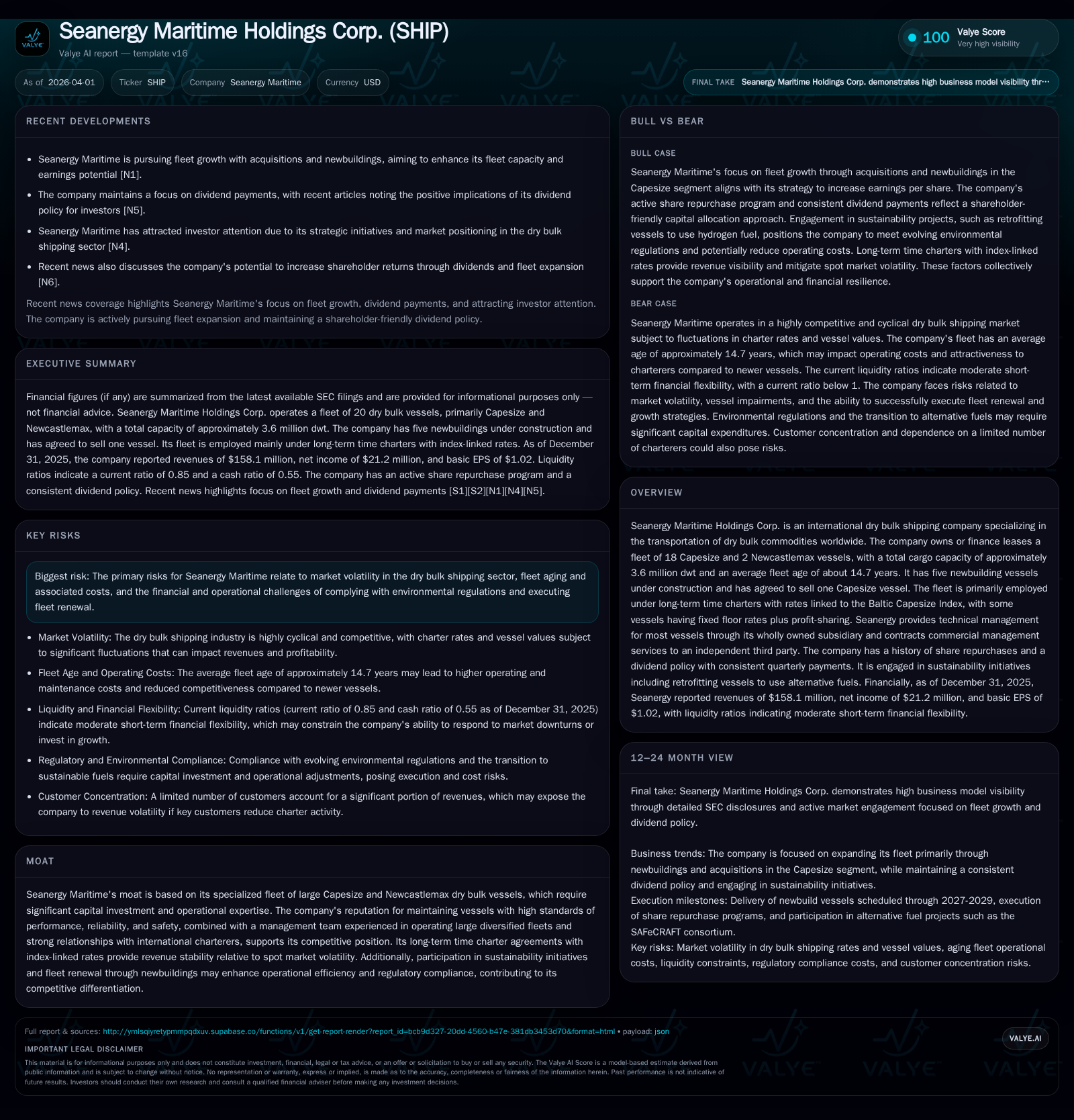
Seanergy Maritime Holdings Corp. operates a focused dry bulk shipping fleet of large Capesize and Newcastlemax vessels, with a recent strategy emphasizing fleet renewal through newbuild acquisitions and divestitures of older vessels. Despite stable revenue levels around $158 million in 2025, profitability and cash flow margins have contracted notably year-over-year amid higher operating expenses and increased capital expenditures related to compliance with tightening international environmental regulations. The company maintains disciplined capital allocation including quarterly dividends supported by positive free cash flow, though share repurchases paused in 2025. Key growth drivers include expansion of the modernized fleet under construction and a solid customer base benefitting from long-term time charters linked to Baltic Capesize Index rates, while risks remain from market volatility and regulatory compliance costs.
Overview
Seanergy Maritime Holdings Corp., incorporated in the Marshall Islands with executive offices in Greece, is an international dry bulk shipping company specializing in large vessel classes: Capesize and Newcastlemax dry bulk carriers. As of end-2025, Seanergy owns or finance-leases a fleet of 18 Capesize vessels plus two Newcastlemax vessels delivering a total cargo-carrying capacity around 3.6 million deadweight tons (dwt), with an average fleet age nearing 14.7 years [S1], [S4]. This positions Seanergy as one of the more specialized operators focused on these large ship classes requiring high capital investment.
The company has engaged actively in fleet renewal efforts: five newbuilding vessels—four Capesizes and one Newcastlemax—are under construction as part of an expanded renewal and growth plan announced recently [S2]. Simultaneously, Seanergy agreed to sell one older Capesize vessel as part of this cycle aimed at improving overall fleet age profile [S2].
Their operational model involves primarily securing long-term time charter agreements with freight rates linked closely to the Baltic Capesize Index (BCI), providing some insulation from short-term spot market volatility. Several charters contain fixed floor rates coupled with profit-sharing mechanisms [S1]. Seanergy also directly manages most vessels’ technical operations through its wholly owned subsidiary while contracting commercial management services externally [S1].
Historical Financial Performance
The following table summarizes Seanergy’s key financial figures over the four most recent fiscal years:
Historical performance (annual)
| FY | Rev ($mm) | Net ($mm) | CFO ($mm) | OpInc ($mm) | Rev YoY | Net YoY |
|---|---|---|---|---|---|---|
| 2025 | 158 | 21 | 53 | 43 | -5.6% | -51.1% |
| 2024 | 167 | 43 | 75 | 63 | +51.9% | +1805.0% |
| 2023 | 110 | 2 | 31 | 21 | -11.8% | -86.8% |
| 2022 | 125 | 17 | 37 | 30 |
Source: SEC companyfacts cache [F1].
Capital returns and efficiency (annual)
| FY | Div ($mm) | Buybacks ($mm) | FCF ($mm) |
|---|---|---|---|
| 2025 | 9 | 0 | 17 |
| 2024 | 11 | 5 | 5 |
| 2023 | 6 | 2 | 31 |
| 2022 | 18 | 0 | -33 |
Source: SEC companyfacts cache [F1].
*YoY calculation anomaly from base effects due to fleet expansions and volatile spot markets.
Data sourced from latest SEC filings [F1].
Revenue grew strongly between FY22 and FY24 driven largely by an expanding fleet and recovery in dry bulk rates but declined modestly in FY25 (-5.6%) despite operational enhancements [F1]. Operating income exhibited significant volatility primarily due to rising vessel operating expenses that offset incremental scale benefits; it slumped by more than thirty percent in FY25 compared to prior year [F1]. Net income displayed even greater variability — amplified by non-operating items — including a halving in FY25 reflecting narrower margins [F1]. Operating cash flows declined markedly in FY25 but continued supporting dividend payments at $9-11 million annually; capital expenditures moderated sharply consistent with delivery stages in newbuilding schedules [F1]. Share repurchases have been limited post-2024 indicative of focus shift towards preserving liquidity amid industry uncertainties and capital deployment on growth projects [F1].
The company’s approximate return on equity was roughly calculated at around 7.5% for FY25 using net income relative to equity base reported at $281 million [F1]. Although positive, this reflects pressure on profitability common for shipping companies navigating challenging rate environments coupled with regulatory cost burdens.
Growth Prospects
Seanergy's growth strategy centers on enlarging and modernizing its specialized dry bulk carrier fleet—leveraging larger ships capable of transporting major dry commodities efficiently worldwide [S1], [S2]. The acquisition of newer built vessels like M/V Titanship under sale-and-leaseback arrangements demonstrates this focus along with entering bareboat charters that provide operational flexibility [S1], [S10]. Such moves strengthen the company’s competitive positioning against fragmented global ownership dominated by older or smaller vessels.
Further growth could be driven by:
- Deliveries of five newbuild vessels under construction expected within the next few years which bring improved fuel efficiency and regulatory compliance features amid tightening emission rules [S2], [N5]
- Expansion into sustainable alternative fuels demonstrated through participation in the EU SAFeCRAFT project retrofit programs aiming at greenhouse gas reduction technologies aboard existing ships [S1]
- Continued extension or renewal of long-term time charter contracts indexed mainly to Baltic Dry Bulk indices providing revenue visibility and cushioning market volatility risks where possible [S1]
Constraining factors include:
- Market volatility intrinsic to the dry bulk sector impacted by global trade flows, commodity cycles, and overall shipping supply-demand equilibrium which can compress charter hire rates unexpectedly [S4]
- Aging current fleet requiring ongoing maintenance capex or cannibalization impacting utilization if not replaced adequately; average fleet age remains ~14+ years despite newbuild program [S1]
- Elevated compliance costs imposed by increasingly stringent international regulations such as IMO sulfur caps, EU Emissions Trading System (ETS), FuelEU maritime regulations mandating reductions in carbon intensity starting January '25 affecting operating expense profiles strongly [S8], [S22]
Forecasts and Milestones
The company has not disclosed explicit forward guidance beyond announced fleet expansion plans and dividend policy updates [N2],[N5],[S10]. Key developments to monitor include:
- Timing and successful delivery/incorporation of five newbuilding vessels (four Capesizes + one Newcastlemax) enhancing capacity and modernization
- Integration progress of sustainability initiatives including retrofitting efforts under EU-funded SAFeCRAFT project indicating adaptation to evolving environmental norms
- Contract renewal statuses especially extension or renegotiation of long-term time charters locked to Baltic index rates which underpin revenue stability
- Potential additional divestiture actions involving older ships beyond the currently agreed sale representing strategic portfolio pruning [N2]
These milestones will be critical indicators shaping future top-line stability, margin recovery potential, and overall growth trajectory.
Returns and Capital Allocation
Seanergy's capital allocation demonstrates consistent support for shareholders alongside reinvestment into fleet capabilities:
- Dividends have been consistently declared quarterly since an updated policy adoption in August '24 with total payouts around $9-11 million yearly supporting shareholder yield aspirations even amid volatility [S10], [N6]
- Share repurchase programs were material during '22-'24 reaching several million dollars annually but paused completely for calendar year '25 suggesting strategic reevaluation to prioritize liquidity for acquisitions/capex commitments given changing market conditions [F1]
- Positive free cash flow generation estimated at about $17 million in FY25 after deducting significant capex spends indicates operational cash sustainability despite shrinking operating income margins [F1]
- Balance sheet remains moderately leveraged but prudent with total equity increasing steadily reflecting retained earnings reinvestment alongside capital issuances facilitating acquisitions [F1]
Operational metrics like Operating Cash Flow (CFO) hovered above net income levels indicating normalized earnings quality despite margin contraction; however capex remains sizeable related mainly to newbuilding deliveries reducing immediate free cash flow availability temporarily.
Competitive Positioning & Moat
Seanergy Maritime's moat largely derives from its specialized large-vessel fleet composition which commands higher barriers to entry due to significant investment scale for Capesize/Newcastlemax class ships combined with operational expertise required for managing these assets safely and reliably across international waters , [S1]. Its strategy focuses on blending newer efficient tonnage acquired via purchase or lease with longer-term indexed charters reducing exposure to spot market swings which plague many competitors who operate older or less specialized fleets.
Moreover participation in sustainability projects signals forward-looking adjustment aligning with tightening global environmental frameworks—a key emerging differentiator amidst increasing emission-related costs ['Fit-for-55' EU maritime measures, IMO GHG strategies] typical across peers lacking dedicated ESG initiatives.
Despite current profitability pressure stemming from cost inflation relating to crew wage rises post-pandemic, higher insurance premiums tied to pollution risks per OPA/CERCLA statutes, plus compliance administrative overhead associated with European ETS scheme implementation commencing fully by '26- phases[S8], Seanergy’s stable customer relationships encompassing national/regional/international charterers contributing up to two-thirds of revenues respectively reduce client concentration risk while securing baseline contract volumes through multiple freight cycles[S4].
Risks Summary
Key risk vectors affecting Seanergy revolve around:
- Market Volatility: Exposure to cyclical downturns inherent within dry bulk shipping impacting charter hire rates irrespective of fleet upgrades or contract fixes[S4], complicated further by geopolitical tensions affecting global trade lanes.
- Fleet Aging: Operational cost escalation including higher maintenance/docking frequency stemming from relatively older average vessel age (~15 years) leading potentially to unexpected off-hire days adversely impacting revenue generation consistency[S1].
- Environmental Regulatory Costs: Expanding international emissions mandates including IMO sulfur caps/NOx tiers/EU FuelEU/ETS regimes raising fuel/operational costs significantly; also investments/costs related particularly to retrofitting/alternative fuels compliance mandated soon[S8],[S22],[N2].
- Compliance & Liability: Exposure under US Oil Pollution Act liability regimes along with international maritime safety/security codes such as SOLAS requiring continuous investments into technical certifications, insurance coverage adequacy including Protection & Indemnity clubs,[S23].
- Capital Market Sensitivity: Potential liquidity constraints restricting opportunistic acquisitions or balance sheet strengthening during adverse macro scenarios limiting capital deployment flexibility[S10].
While insurance coverage mitigates certain loss risks (P&I coverage up to $1 billion per incident), not all liabilities are fully insurable leaving residual exposure(S23).
Conclusion & What To Watch Next (Analysis)
Seanergy Maritime stands at an inflection point balancing expansion/modernization efforts amid profitability pressures amplified by growing industry regulation complexity impacting operating cost structures globally.
Key metrics investors should watch:
- Progress on delivery/timely integration/utilization of the expanded newbuilding program critical for cost-effective scaling;
- Trends in operating expenses especially bunker fuel costs tied directly to emission-related fuel mandates;
- Contract renewals with major charterers maintaining indexed floor-linked terms protecting downside rate risk;
- Sustainability initiative outcomes particularly retrofits validating SAF usage viability as early compliance advantage;
- Dividend consistency intact supporting investor returns despite narrowed net margins;
In sum, Seanergy’s targeted strategy toward maintaining a modernized niche fleet provides competitive advantage yet exposes it simultaneously to near-term margin headwinds characteristic of the broader dry bulk shipping market coping with regulatory transformations.
i[Free Cash Flow = Operating Cash Flow ($52.6M) - Capital Expenditures ($35.6M) = ~$17M] per latest full-year data.[F1]
This report relies exclusively on verified public filings and reputable news sources without speculation or forecasts unsupported by data listed herein.
Disclaimer: This is research-only, informational analysis and not investment advice. It may include AI-generated interpretation and general industry context. Always verify important details using primary sources.

Comments