
Maui Land & Pineapple’s Recovery Challenges and Revenue Surge in 2025
Examining Maui Land & Pineapple’s strong revenue rebound offset by widening net losses and the operational complexities underlying its land-centric business.
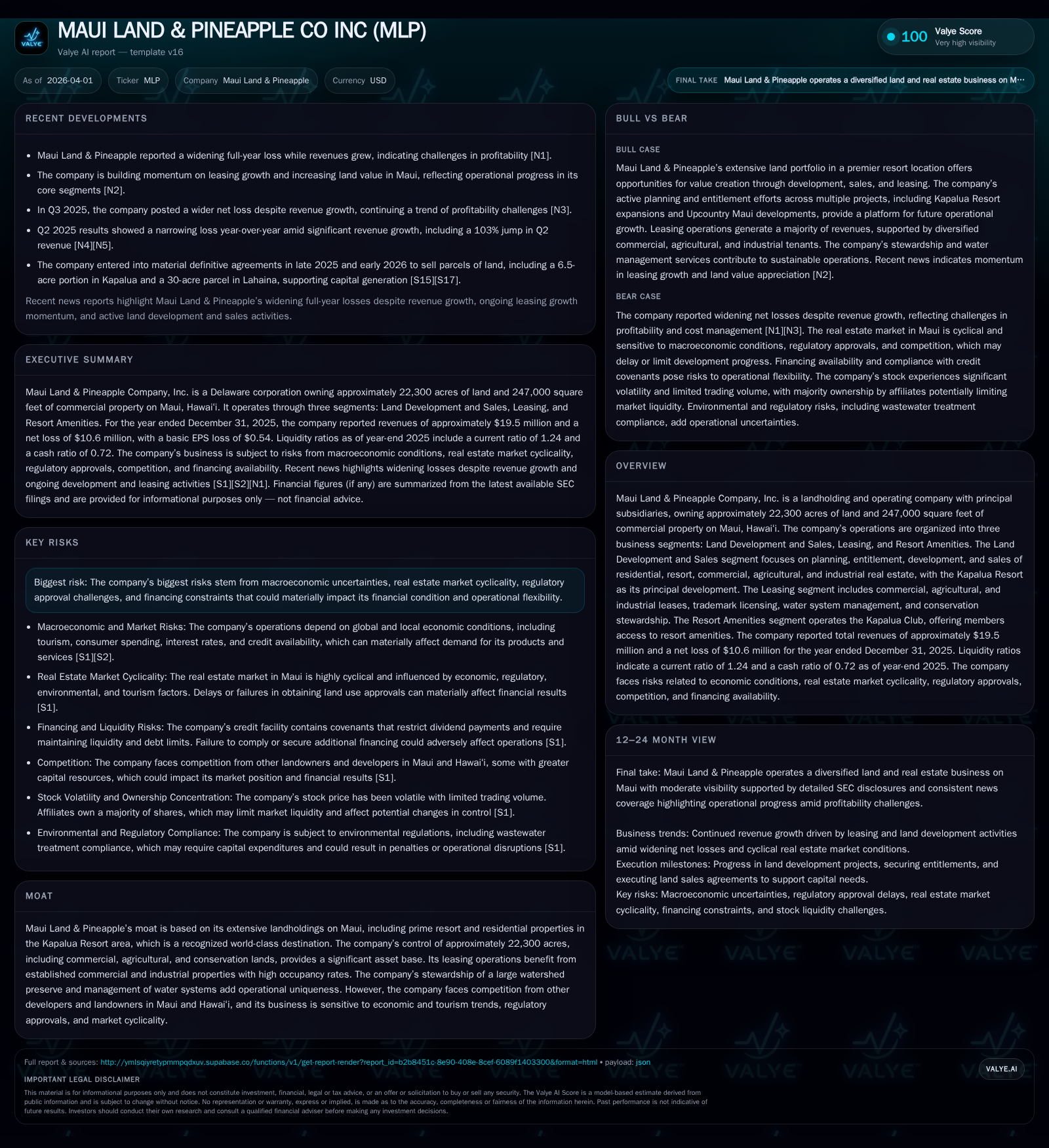
Maui Land & Pineapple Company (MLP) posted a notable 68.2% revenue increase in fiscal 2025, driven largely by growth in leasing operations and land development activities centered on its Kapalua Resort assets. Despite this top-line surge, the company’s net losses expanded significantly to $10.6 million, reflecting ongoing operating challenges and elevated costs amid market cyclicality and regulatory hurdles. Liquidity remains adequate with a current ratio of 1.24, supported by positive operating cash flows, though credit facility covenants limit dividends and financing flexibility. The company continues to advance key land development projects while managing environmental compliance and regulatory approval risks inherent to its unique Hawaiian landholdings.
Historic Revenue Upswing Coupled with Persisting Operating Losses
Maui Land & Pineapple Company experienced a meaningful rebound in its top-line during fiscal 2025 as revenue climbed to approximately $19.46 million, a sharp increase of 68.2% compared to $11.56 million in 2024 [F1]. This follows several years of fluctuating revenues that saw a decline from over $20 million in 2022 down to under $10 million by 2023 before resurging in the latest fiscal year. However, this upswing belies continued earnings difficulties; operating income remained negative at -$4.55 million despite the revenue increase, though it improved roughly 38% from the prior year’s -$7.35 million result [F1]. The net loss widened significantly to about $10.58 million in 2025 from -$7.39 million in 2024, signaling persistent challenges converting top-line gains into profitability [F1].
Historical performance (annual)
| FY | Rev ($mm) | Net ($mm) | CFO ($mm) | OpInc ($mm) | Rev YoY | Net YoY |
|---|---|---|---|---|---|---|
| 2025 | 19 | -11 | 2 | -5 | +68.2% | -43.1% |
| 2024 | 12 | -7 | 0 | -7 | +24.5% | -140.0% |
| 2023 | 9 | -3 | -1 | -5 | -55.7% | -272.4% |
| 2022 | 21 | 2 | 6 | 10 |
Source: SEC companyfacts cache [F1].
Capital returns and efficiency (annual)
| FY | FCF ($mm) | ROE% |
|---|---|---|
| 2025 | -32.0 | |
| 2024 | -22.3 | |
| 2023 | -1 | -8.9 |
| 2022 | 6 | 5.3 |
Source: SEC companyfacts cache [F1].
Table: Historical Financial Performance Snapshot FY2022-FY2025 [F1]
Key Drivers Behind Maui Land & Pineapple’s Improved Top-Line Performance
The company’s significant revenue improvement largely stems from robust activity within its Leasing segment which accounts for approximately two-thirds of total revenues ($12.8 million in 2025) [S13]. This segment manages a substantial portfolio of commercial, agricultural, and industrial properties across Maui including roughly 247,000 square feet of leased commercial space primarily within the Kapalua Resort area [S13][N2]. Strong lease rollovers combined with rental rate increases have fueled leasing growth momentum amid an improving local economy [N2].
The Land Development and Sales segment contributed about $5.8 million or nearly one-third of revenues in 2025 as the company advanced entitlement processing, planning, and pre-development activities for luxury residential lots within Kapalua Resort as well as Upcountry Maui land parcels zoned for mixed use [S10][S13]. The slow but steady progress on the Kapalua Mauka master plan — enhancing value through residential subdividing with scenic ocean views — supports pricing power despite the cyclicality typical of resort real estate [S13][S17].
Renewed interest in Maui land values is also noted externally highlighting MLP’s unique asset base composed of quality West Maui coastal properties commanding strong market appeal owing to proximity to amenities and protected conservation areas [N2]. This helps buffer against competitive pressures faced from other developers on the island.
Earnings Volatility and Its Underlying Causes in Fiscal 2025
Despite growing revenue streams, MLP’s earnings volatility reflects underlying cost pressures and ongoing operational investments weighing on profit conversion rates [N1]. Operating losses narrowed relative to prior years but remained entrenched due partly to increased expenses linked to land entitlement efforts including infrastructure improvements mandated by local government bodies [S16].
Additionally, regulatory compliance costs such as upgrades mandated by the Hawai‘i Department of Health related to wastewater treatment systems impose further financial burdens [S18]. These capital-intensive environmental improvements are critical yet cap near-term profitability.
The macroeconomic backdrop compounds these challenges; tighter mortgage markets reduce liquidity for prospective buyers while volatile fuel prices influence both tourism volumes and onsite operating costs—a material factor given Maui's reliance on visitor spending supporting resort real estate demand [S1][N1]. These economic uncertainties translate into cautious buyer behavior slowing sales velocity and contributing to reported losses.
Segment Insights: Development, Leasing, and Resort Amenities Dynamics
- Land Development & Sales: Focuses on entitlements plus phased development within Kapalua Resort — luxury homesites accounting for measured sales activity reflecting protracted timelines required for county/state approvals characteristic of Hawaii’s layered regulatory environment [S10][S16][S17]. The Upcountry zone holds potential under emerging subdivision plans but remains nascent.
- Leasing: Dominates revenue through diversified property rentals encompassing retail outlets, office spaces, warehousing facilities within Kapalua Resort environs alongside agricultural leases totaling over ten thousand acres serving ranches and eco-tourism operators [S13][S25]. High occupancy rates across segments attest to successful lease roll execution.
- Resort Amenities: A smaller component (~4%) primarily through the private Kapalua Club membership offering access to spa services, championship golf courses, dining venues—this segment supports brand loyalty though remains susceptible to tourist trends given discretionary nature [S27].
Collectively these segments exploit MLP’s extensive land stewardship which includes responsibility for natural resources like water system management and conservation preserves—factors enhancing operational complexity yet reinforcing moat characteristics versus competitors lacking such integrated asset control [S13][N2].
Capital Allocation Priorities: Cash Flow Generation Versus Dividend Policy
MLP demonstrated positive operating cash flow generation rising sharply to approximately $2.08 million in fiscal year 2025 compared with modest inflows previously [F1]. With nominal capital expenditures reported historically (around $33k annually) focused on maintenance rather than expansionary projects, free cash flow remains positive around $2 million after capex deductions [F1].
Despite this liquidity improvement, MLP has not declared cash dividends during this period with credit facility covenants explicitly restricting dividend payments absent lender approval [S6][S15]. The preservation of cash aligns with management's stated priorities toward funding ongoing pre-development initiatives while maintaining covenant compliance.
Return on equity hovered near -32%, reflecting sustained net losses outpacing equity base—indicating operational adjustment lag behind top-line recovery [F1].
Liquidity Status and Credit Facility Implications
Liquidity held firm at fiscal year-end evidenced by current assets of approximately $9.1 million against current liabilities near $7.36 million yielding a current ratio around 1.24—indicating adequate short-term coverage [F1]. Cash balance was about $5.3 million providing operational runway.
Significantly, MLP expanded its revolving line of credit facility from $15 million to $25 million effective December 22, 2025 with First Hawaiian Bank extending maturity through end-2030 alongside options for revolving or term loans convertible up to a decade maturity extension [S14][S21]. This enhancement underscores lender confidence yet imposes financial covenants limiting incremental indebtedness above $45 million total liabilities plus mandates minimum liquidity thresholds restricting shareholder returns like dividends [S6][S15].
These covenants necessitate prudent capital structure management while preserving financial flexibility amid uncertain market conditions.
Navigating Environmental Compliance and Regulatory Headwinds
Maui Land & Pineapple faces notable environmental regulation obligations underscored by an active State DOH wastewater violation order dating back several years connected to aging Upcountry treatment ponds serving legacy residential sites developed during prior agricultural operations [S18][S29]. Remediation actions implemented include leach field enhancements and aeration technology installations reassuring compliance progress though pending final state approvals pose contingent liabilities.
The company accrued approximately $23,000 related to administrative penalties but cannot reasonably estimate additional potential liabilities due to uncertainties associated with ongoing remediation requirements [S18].
Stewardship responsibilities extend beyond wastewater management encompassing watershed conservation areas subject to public trust concerns reflected in ongoing litigation involving irrigation water disputes within the Kapalua community adding legal complexity affecting stakeholder relations [S20][S28].
Further regulatory friction arises from discretionary entitlements required under Maui County zoning which traditionally involve multi-year delays exposing projects like Kapalua Mauka residential phases to timing risks impeding development realization and associated cash inflows [S16][S17][S26]. Such permitting challenges impact capital deployment efficiency requiring strategic navigation.
Forward-Looking Considerations: Market Cyclicality and Project Milestones
Looking ahead investors should monitor MLP’s ability to sustain leasing momentum amidst island-wide cyclical real estate softness influenced by mortgage tightening impacting buyer financing availability especially for high-priced second homes distinctive on Maui’s market [N2][S1][S4]. Inflationary pressures may strain margins while energy cost volatility factors critically for tourism-dependent resort success indirectly affecting demand.
Financing needs may arise if development plans accelerate necessitating incremental debt or equity raising though existing covenant limits heighten dilution or funding risk concerns prompting careful capital structure stewardship essential for unlocking growth.
Key upcoming milestones include anticipated Special Management Area (SMA) permit extensions expected during calendar year potentially reducing project execution uncertainty enhancing investor visibility around launch timelines for phased projects such as Kapalua Mauka subdivision efforts currently underway [S17][N2]. Similarly monitoring final engineering approvals related to wastewater treatment upgrades remains important given their impact on regulatory compliance risk profile.
What Investors Should Monitor Next
Stakeholders should track quarterly updates on leasing occupancy trends across segmented geographic zones especially core Kapalua Resort properties where lease expiration clusters could affect recurring income streams revealing demand stability or emerging headwinds [N2],[S25],[F1]. Official notices concerning resolution timelines or additional penalties related to DOH wastewater orders warrant close attention given their materiality plus any expanding litigation outcomes tied to community water use disputes involving Kapalua properties that might affect operational continuity or reputation.
Also relevant are developments regarding credit facility covenant waivers or amendments which will shed light on financial flexibility boundaries ahead while disclosures related to joint venture progress on Upcountry mixed-use developments might clarify secondary growth engines beyond primary resort parcels.
Finally, microeconomic indicators such as Hawaii-specific mortgage lending conditions combined with broader tourism recovery trajectories will frame achievable demand curves for new residential launches reinforcing or challenging management’s growth targets beyond historical seasonality influences.
This report summarizes publicly available information without providing investment advice or forecasts beyond documented company disclosures.
Disclaimer: This is research-only, informational analysis and not investment advice. It may include AI-generated interpretation and general industry context. Always verify important details using primary sources.

Comments