
RenX Enterprises Faces Operational and Financial Hurdles Amid Shift to Biomass Recycling and Logistics
Transition from real estate to biomass recycling and logistics brings growth opportunities paired with substantial execution risks.
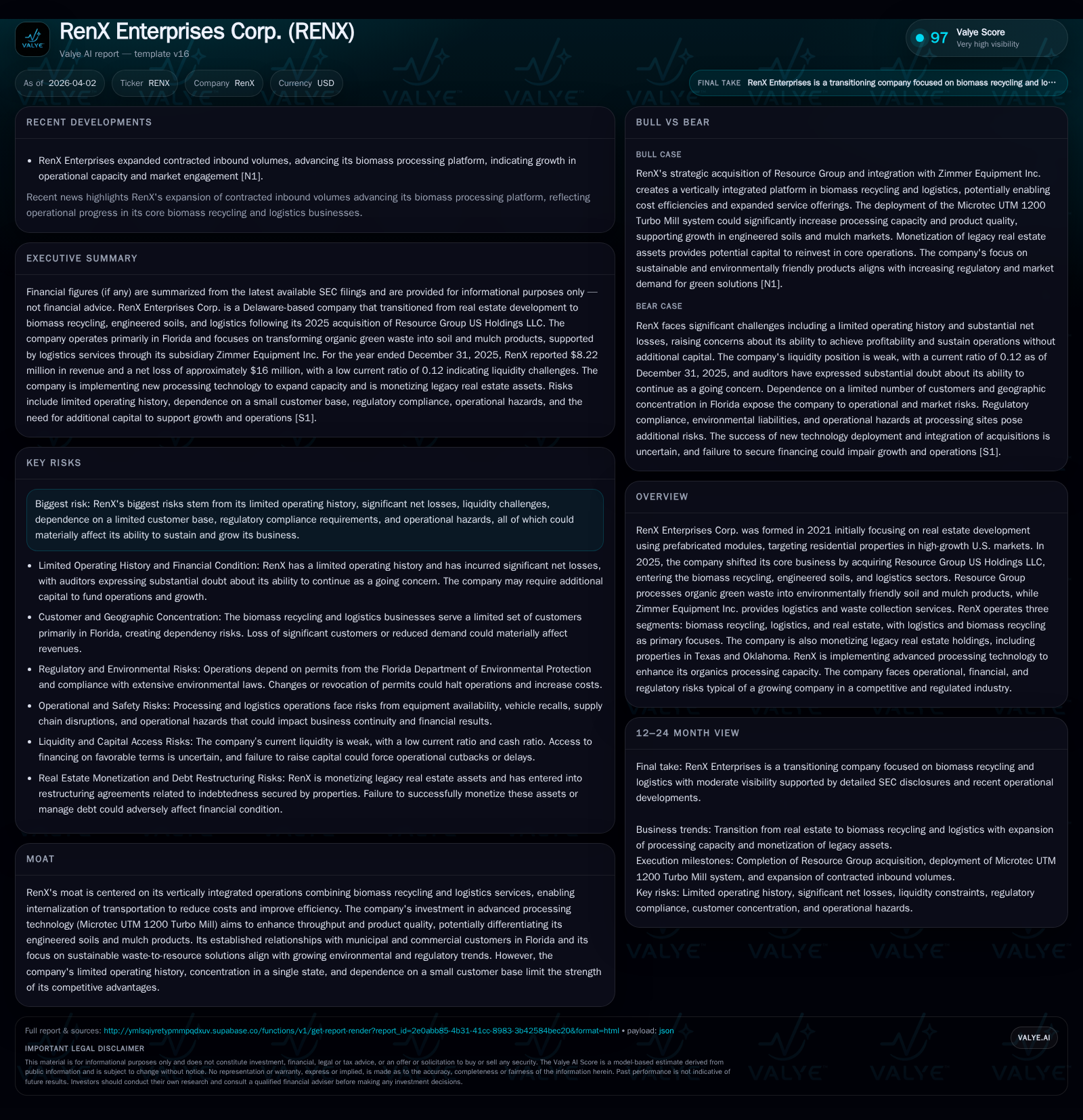
RenX Enterprises Corp., founded in 2021 with an initial focus on modular real estate development, underwent a strategic pivot in 2025 by acquiring Resource Group US Holdings LLC to enter biomass recycling, engineered soils, and logistics. This transformation drove revenue growth in 2025 to over $8.2 million from $208,000 in 2024, while net losses expanded to nearly $16 million. The company faces liquidity strain with a current ratio of 0.12 and limited cash reserves. RenX plans capacity expansion with advanced processing technology but remains dependent on Florida operations and a concentrated customer base, facing regulatory, operational, and capital-raising risks.
Company Evolution and Historical Performance
RenX Enterprises Corp. began as SGB Development Corp. in 2021, focusing on modular real estate development primarily targeting residential projects [S1][S14]. Early operations generated modest revenues tied mainly to land acquisition.
In mid-2025, RenX acquired Resource Group US Holdings LLC, marking a strategic shift into biomass recycling, engineered soils production, and logistics services [S1][S14]. This pivot reoriented the company's operations toward sustainable waste-to-resource solutions leveraging organic waste streams.
The acquisition fueled a dramatic revenue increase from $207,552 in FY2024 to $8,220,449 in FY2025—a nearly 39-fold rise—driven predominantly by biomass recycling and logistics segments operating mainly in Florida [F1][S14]. The logistics segment contributed approximately $5.94 million of total revenue with biomass recycling adding around $2.27 million [S14].
Despite this top-line growth, operating losses deepened from -$6.56 million in 2024 to -$12.45 million in 2025 due to ramp-up costs, integration expenses, and capital investments. Net losses similarly widened from -$8.91 million to -$15.96 million over the same period [F1].
Historical performance (annual)
| FY | Rev ($mm) | Net ($mm) | CFO ($mm) | OpInc ($mm) | Rev YoY | Net YoY |
|---|---|---|---|---|---|---|
| 2025 | 8 | -16 | -12 | +3860.7% | -79.1% | |
| 2024 | 0 | -9 | -3 | -7 | -112.1% | |
| 2023 | -4 | -5 | -3 |
Source: SEC companyfacts cache [F1].
Capital returns and efficiency (annual)
| FY | FCF ($mm) |
|---|---|
| 2025 | |
| 2024 | -3 |
| 2023 | -5 |
Source: SEC companyfacts cache [F1].
Note: Operating cash flow data for FY2025 is unavailable; capex surged alongside revenue growth reflecting investments in new processing technology.
Business Segments and Strategic Focus
Following the Resource Group acquisition (June 2025), RenX operates three segments: biomass recycling (organic green waste processing), logistics (waste collection & transport), and residual real estate holdings primarily in Texas and Oklahoma [S1][S14].
The biomass recycling segment produces engineered soils and mulch products from organic materials for landscaping and agricultural use. Zimmer Equipment Inc., RenX's logistics subsidiary, manages collection services utilizing specialized vehicles such as grapple trucks and walking floor trailers to internalize transportation functions aiming at cost efficiencies [S14].
Operations are heavily concentrated at the Myakka City facility in Florida — the sole permitted site under Florida Department of Environmental Protection regulations — exposing the company to heightened operational risk if permits are revoked or disrupted [S26][S27]. To increase capacity and improve product quality at this facility, RenX is installing the Microtec UTM 1200 Turbo Mill system with phase one deployment targeted for late 2026; however, this carries significant execution risks including financing challenges [S14].
Real estate holdings remain non-core but offer potential liquidity through asset monetization efforts. For example, the company owns approximately 114 acres in Durant Oklahoma acquired in early 2022 for under $900K [S1][S14]. These assets face valuation pressure from cyclical market conditions compounded by potential environmental compliance costs [S12][S18].
Financial Health: Liquidity & Capital Allocation
As of December 31, 2025, RenX's balance sheet shows acute liquidity stress with current liabilities ($21.6M) vastly exceeding current assets ($2.57M), resulting in a low current ratio of approximately 0.12 [F1]. Cash reserves were minimal at roughly $13.7 thousand as of September 30, 2024 [F1]. This strained liquidity reflects ongoing net losses combined with significant capital expenditures totaling $3.62 million in FY25 primarily funding processing upgrades [F1].
Operating cash flows have historically been negative (-$2.6M FY24; -$4.57M FY23), indicating persistent cash burn prior to expected scale benefits [F1]. Estimated free cash flow for FY25 is negative (~-$6.22M), underscoring dependence on external financing for operational continuity and growth initiatives [F1][S11][S16].
The company recently issued Series B Non-Voting Convertible Preferred Stock but faces restrictive covenants that may limit its ability to raise additional capital amid volatile credit markets [S11][S16].
RenX has never paid dividends nor does it anticipate doing so given its financial condition; shareholder returns hinge entirely on future profitability or capital raises [S1][S20].
Competitive Positioning & Risks
RenX's vertical integration of biomass recycling with dedicated logistics services offers potential cost advantages through internalized transportation versus competitors relying solely on third-party haulers [S1][S14]. Successful deployment of the Microtec UTM mill could enhance product differentiation but remains unproven at scale [S14].
However, significant risks prevail including:
- Geographic concentration at a single Florida facility heightening vulnerability to permit or operational disruptions.
- Dependence on a limited number of municipal clients subject to political or funding variability.
- Reliance on a small pool of qualified commercial drivers constraining logistics scalability.
- Exposure to stringent environmental regulations potentially increasing compliance costs or causing fines.
- Risk of product contamination affecting reputation or triggering liability claims.
- Operational hazards related to heavy machinery posing safety risks.
- Uncertainty whether anticipated benefits from the Resource Group acquisition will fully materialize amid ownership dilution concerns [S1][S27][S24][S26].
Additionally, auditors have expressed substantial doubt about RenX’s ability to continue as a going concern due to limited operating history post-transformation and ongoing losses [S1][S21].
Growth Outlook & Milestones
RenX aims to expand organics processing capacity through phased deployment of the Microtec UTM mill system targeting late-2026 completion for phase one implementation which could drive increased volumes and improved product mix if successful [S14]. Logistics growth hinges on expanding customer contracts but is currently limited by driver availability constraints.
Monetization of legacy real estate assets could generate liquidity but is subject to macroeconomic cycles impacting valuations alongside potential environmental remediation liabilities that may delay sales or reduce proceeds [S12][S18].
Competitive pressures stem from larger waste management firms offering similar services nationally along with emerging clean-tech entrants investing aggressively in composting/upcycling technologies.
Other headwinds include fluctuating fuel prices and vehicle recall risks which may increase operating costs without guaranteed ability to pass these onto customers given contract terms . Monitoring renewal or award of key municipal contracts will be critical for medium-term revenue sustainability.
Summary & Considerations
RenX Enterprises represents a company undergoing rapid repositioning characterized by strong revenue growth offset by deepening losses and acute liquidity challenges amid operational complexity shifts away from real estate toward biomass recycling logistics.
Key points include:
- Substantial near-term revenue growth driven by acquisition but no profit conversion yet.
- Significant capital investment underway with new processing technology bearing execution risk.
- Vertical integration offers cost control advantages tempered by geographic concentration risks.
- Financial strain necessitates careful capital management given restrictive covenants amid volatile markets.
- Regulatory environment imposes multi-faceted compliance risk including environmental liabilities.
- Customer concentration underscores need for diversification over time.
Stakeholders should monitor:
- Progress on Microtec mill installation,
- Retention/expansion of municipal contracts,
- Cash flow trends post-capital expenditures,
- Monetization milestones for legacy real estate,
- Regulatory permit status at Florida operations,
- Liquidity conditions influenced by capital raising efforts.
While aligned with growing sustainability trends favoring circular economy models, RenX’s fragile financial footing coupled with execution uncertainties tempers near-term optimism pending demonstrated operational stability.
This analysis is based solely on publicly available regulatory filings without investment recommendations.
Disclaimer: This is research-only, informational analysis and not investment advice. It may include AI-generated interpretation and general industry context. Always verify important details using primary sources.

Comments