
D. Boral Acquisition I Corp. Charts Its SPAC Trajectory with Strategic Expertise
A newly public SPAC leverages seasoned management to pursue high-growth acquisitions within a tight timeline and regulatory framework.
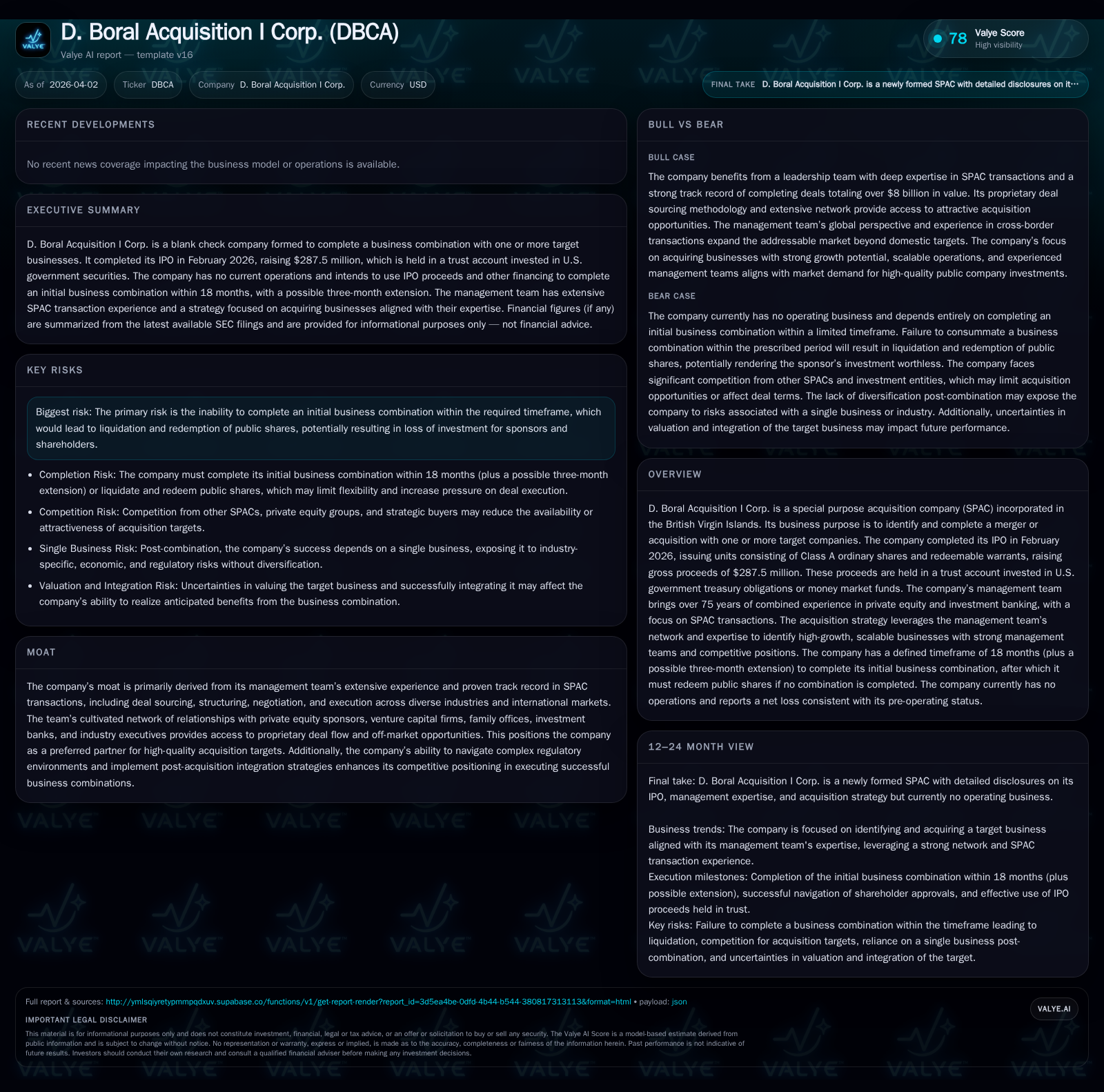
D. Boral Acquisition I Corp. launched its IPO in February 2026, raising $287.5 million to pursue an initial business combination within an 18-month timeframe. Backed by management with over 75 years of combined experience in private equity and investment banking, the company applies a disciplined acquisition strategy focused on scalable, high-growth targets internationally. While cash is prudently preserved in a trust account invested in U.S. government securities, the company faces typical SPAC risks such as time-constrained deal execution and potential dilution from shareholder redemptions. With limited operating history and an early-stage financial profile marked by a net loss, close monitoring of deal announcements and shareholder approvals will be critical milestones ahead.
SPAC Launch and Capital Preservation
D. Boral Acquisition I Corp., incorporated as a British Virgin Islands business company, completed its IPO on February 12, 2026 [S1], [S3]. It sold 28,750,000 units at $10 each—including full exercise of the underwriters' over-allotment option—generating gross proceeds of approximately $287.5 million. Each unit included one Class A ordinary share and one-half redeemable warrant exercisable at $11.50 per share. Concurrently, the company issued 200,000 private placement units to the sponsor without underwriting discounts [S1].
Proceeds from these sales were placed into a trust account invested solely in U.S. government treasury securities with maturities under 185 days or money market funds investing exclusively in direct U.S. government obligations [S5]. This approach preserves liquidity ahead of an initial business combination while mitigating Investment Company Act risks associated with prolonged trust holdings. As of March 30, 2026, approximately $288 million remained in this account [S5].
Following the IPO, shareholders could elect to separate shares from warrants for independent Nasdaq trading under symbols "DBCA" (shares) and "DBCAW" (warrants), while unseparated units trade under "DBCAU" [S5], [S23].
Experienced Leadership Driving Deal Sourcing
The company's leadership team brings over seventy-five years combined experience specializing in SPAC lifecycle management—from formation through IPO to target identification and merger execution [S8], [S13], [S17]. Key executives include Chairman David Boral and CFO/Chief Investment Officer John Darwin who have led successful de-SPAC transactions across various sectors including fintech and automotive design [S13].
Leveraging extensive networks among private equity sponsors, venture capitalists, family offices, investment banks, and industry leaders globally enables access to proprietary deal flow uncommon among generalist SPACs [S13]. Their expertise extends to cross-border transactions involving North America, Europe, Asia, and emerging markets where they manage regulatory complexities and integration challenges effectively [S8].
Acquisition Strategy and Target Criteria
D. Boral Acquisition targets companies characterized by:
- Defensible competitive positions,
- Experienced management teams,
- Scalable business models,
- Strong revenue growth potential,
- Ability to generate profits and free cash flows,
- Geographic scalability,
- Benefits from being publicly traded [S8], [S17].
The company maintains sector agnosticism but favors industries complementary to its management's expertise to enhance diligence effectiveness [S9]. Target evaluation involves thorough due diligence encompassing management interviews, document reviews, supplier/customer consultations, facility inspections when applicable, legal and operational risk assessments culminating in structured negotiation tailored to align sponsor and shareholder interests [S8], [S10].
Governance considerations include Nasdaq rules mandating shareholder approval if share issuances exceed certain thresholds or result in control changes during acquisitions; however, the company retains discretion when approvals are not legally required based on strategic factors such as timing costs or vote risks [S6].
Risks Affecting Business Combination Prospects
Key risks include the requirement to consummate an initial business combination within eighteen months post-IPO (extendable by three months) or face mandatory liquidation with public share redemptions at trust account values around $10 per share less expenses [S4], [S16]. This creates urgency that may pressure deal quality.
Post-merger concentration risk arises since success depends on a single acquired entity’s performance without diversification typical of mature holding companies [S10]. Conflicts of interest exist as sponsors hold founder shares acquired cheaply which may incentivize completion even if suboptimal for public shareholders [S24]. Overlapping sponsor ventures may also divert opportunities reducing pipeline prospects here [S21]. Regulatory compliance with Nasdaq voting rules adds complexity that can delay closings or require renegotiations impacting economics negatively [S6], [S11], [S17]. Redemption rights held by public shareholders protect investors but reduce capital available for deal financing potentially necessitating additional funding mechanisms such as forward purchase agreements or debt facilities to bridge gaps during negotiations [S11], [S16].
Capital Structure and Financial Snapshot
At IPO close on February 12, 2026 totaling $287.5 million gross proceeds plus sponsor contributions at equivalent valuations [$10 per unit], all funds were placed into a trustee-controlled account invested primarily in liquid U.S. Treasury obligations maturing within six months or approved money market funds pursuant to SEC Rule 2a-7 standards for stable NAV maintenance [S5]. Interest-bearing demand deposits may be used if operationally or regulatorily preferable.
There are no dividends or share repurchase programs planned given no operating revenues or infrastructure beyond financing activities typical for a blank-check company pre-acquisition stage [S6], [F1]. Capital allocation priorities focus on preserving liquidity pending acquisition execution.
Recent financial data as of December 31, 2025 reflects nascent operating metrics consistent with early-stage status:
Historical performance (annual)
| FY |
|---|
| 2025 |
Source: SEC companyfacts cache [F1].
The elevated ROE percentage is a reflection of minimal equity base combined with net loss typical for newly formed blank-check companies post-IPO without revenue generation yet; the small cash balance excludes the majority held separately in the trust account reserved for future mergers rather than operations [F1].
Milestones Ahead: Tracking Progress Toward Initial Business Combination
D. Boral Acquisition has until August 12, 2027—18 months post-IPO—with one possible three-month extension at sponsor discretion subject to shareholder approval to complete its initial business combination or face liquidation redemption events [S14], [S16]. Investors should monitor:
- Target identification disclosures signaling merger intent;
- Deal valuation announcements including ownership allocations;
- Proxy materials detailing transaction benefits for shareholder voting;
- Voting outcomes influencing deal closure probabilities;
- Redemption rates affecting available capital for deals;
- Any shareholder votes on timeline extensions indicating difficulty meeting deadlines.
No explicit guidance beyond these structural timelines exists; ongoing SEC filings will be key indicators of trajectory toward either successful de-SPAC event or liquidation resolution impacting both sponsor retained value and public shareholders’ capital preservation prospects.
Regulatory Environment and Shareholder Protections
Nasdaq listing rules impose shareholder approval when proposed share issuances exceed defined thresholds relative to outstanding shares—specifically issuances outside public offerings exceeding twenty percent trigger voting requirements—embedding governance safeguards though possibly delaying closings or requiring renegotiations depending on shareholder sentiment mid-process [S6], [S18].
Ownership concentration changes triggering increased insider control require transparency measures including independent fairness opinions validating financial fairness especially given sponsor founder share incentives creating inherent conflicts mandating oversight through independent directors before approving deals absent statutory mandates [S15], [S28].
The company exercises discretion whether formal shareholder votes or tender offers finalize deals providing flexibility amid fluid M&A environments where timing pressures weigh cost-benefit between voting engagement versus accelerated non-vote consummations based on best interests assessed by experienced management informed by market conditions [S6], [S11], [S17].
Investor protections are reinforced through redemption rights allowing pro rata cash exits derived strictly from trust-protected funds including accrued interest adjusted after dissolution expenses shielding against investment loss exposures while tempering transaction funding pools; this dynamic requires careful investor consideration once formal merger announcements follow target identification phases emphasizing continued vigilance across lifecycle stages until completion.
This analysis is exclusively based on D. Boral Acquisition I Corp.'s SEC filings as of April 2026 augmented by structured insights relevant specifically to blank check companies navigating regulated SPAC ecosystems rather than broader industry speculation or macro trends outside documented data points herein provided.
Disclaimer: This is research-only, informational analysis and not investment advice. It may include AI-generated interpretation and general industry context. Always verify important details using primary sources.

Comments