
Regional Health Properties Accelerates Turnaround Strategy with Integrated Operations and Expanded Pharmacy Services
The company leverages a hybrid model combining real estate ownership and direct healthcare operations in southeastern U.S. markets with growth fueled by recent acquisitions and operational improvements.
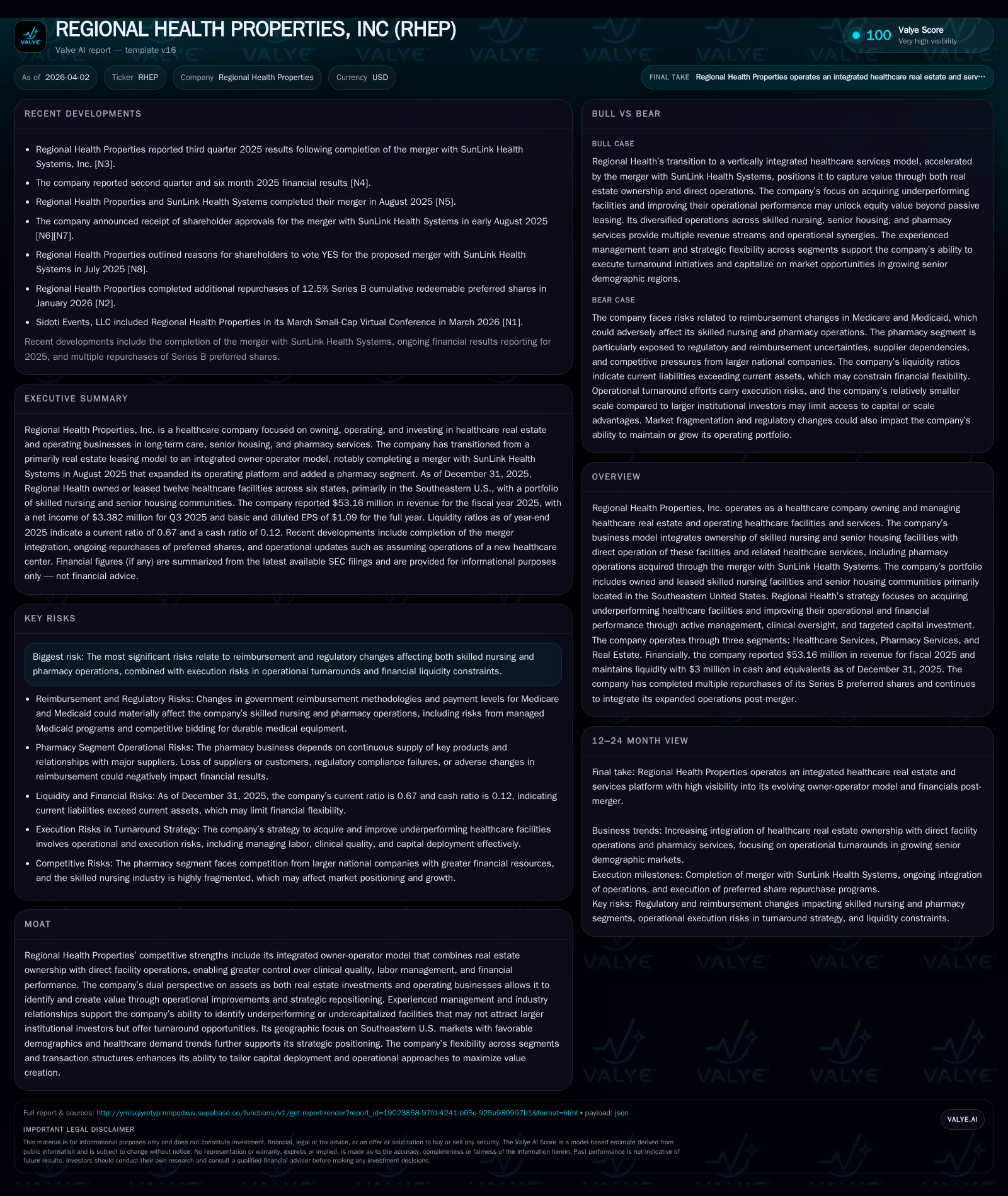
Regional Health Properties, Inc. has transformed from a mainly healthcare real estate landlord into an integrated owner-operator combining skilled nursing, senior housing, and pharmacy services. Its 2025 revenue surged to $53.16 million, nearly tripling the prior year, driven by expanded operations post-SunLink merger and strategic acquisitions. Despite operating income growth to $1.66 million, ongoing net losses and negative free cash flow indicate persistent execution risk amid evolving reimbursement landscapes. The company’s focus on turnaround of underperforming assets in the Southeast positions it to benefit from demographic trends but requires navigating reimbursement reforms and labor cost pressures.
Company Overview and Strategic Evolution
Regional Health Properties, Inc. operates a hybrid model combining ownership of healthcare real estate with direct operation of healthcare facilities focused on skilled nursing and senior housing communities. Following its August 2025 merger with SunLink Health Systems, the company accelerated its transition from a traditional triple-net lease landlord toward an integrated owner-operator platform.
This approach enables Regional Health to exert operational control over clinical quality, labor management, revenue cycle execution, and capital allocation decisions—key drivers of facility performance amid industry fragmentation and increasing emphasis on value-based care [S1][S13][S17]. The acquisition added Pharmacy Services encompassing retail, institutional pharmacy offerings, and durable medical equipment distribution predominantly in Louisiana, broadening Regional Health's scope across the senior care continuum [S1][S17].
Historical Performance Summary
Regional Health's financials between FY2022 and FY2025 reflect its strategic transformation (Table 1). Revenue increased sharply from $35.9 million in 2022 to $53.16 million in 2025, nearly tripling the prior year’s $18.33 million figure largely due to acquisition integration expanding Healthcare Services and Pharmacy segments [F1].
Operating income improved from deep losses of -$6.82 million (2022) and -$0.80 million (2023) to a small positive $0.16 million (2024), reaching $1.66 million by 2025 [F1]. Despite this progress at the operating level, net income remains negative historically (-$6.87M in 2022; -$3.89M in 2023), reflecting ongoing restructuring costs or other non-operating expenses [F1].
Operating cash flows were positive in FY2023 ($3.71M) and FY2024 ($1.94M) but turned negative in FY2025 (-$2.26M), suggesting working capital pressures or investment timing effects; capital expenditures rose to $869K consistent with active facility renovations supporting turnaround efforts [F1][S11].
Historical performance (annual)
| FY | Rev ($mm) | Net ($mm) | CFO ($mm) | OpInc ($mm) | Rev YoY | Net YoY |
|---|---|---|---|---|---|---|
| 2025 | 53 | -2 | 2 | +189.9% | ||
| 2024 | 18 | 2 | 0 | +6.8% | ||
| 2023 | 17 | -4 | 4 | -1 | -52.2% | +43.4% |
| 2022 | 36 | -7 | -4 | -7 | -481.0% |
Source: SEC companyfacts cache [F1].
Capital returns and efficiency (annual)
| FY | Buybacks ($) | FCF ($mm) | ROE% |
|---|---|---|---|
| 2025 | -3 | ||
| 2024 | 1 | ||
| 2023 | 46000 | 3 | -2101.6 |
| 2022 | 46000 | -4 | -184.8 |
Source: SEC companyfacts cache [F1].
Note: Net income for FY2025 not publicly reported as of filing date.
Growth Drivers and Strategic Outlook
Regional Health targets underperforming skilled nursing and senior housing assets primarily across Southeastern U.S., leveraging demographic tailwinds from aging populations driving sustained demand for long-term care services [S13][S19][S25]. The shift toward direct facility operations enhances value creation potential by enabling clinical oversight, labor optimization amidst sector-wide workforce shortages, compliance adherence per CMS standards, and margin capture through ancillary services including integrated pharmacy offerings [S13][S14][S26].
The Pharmacy Services segment contributes diversification with revenues stemming largely from Medicare Part D and Medicaid managed care payors while complementing facility operations through embedded pharmaceutical supply chains [S1][S17][S21].
Challenges temper growth prospects:
- Regulatory uncertainty around Medicare/Medicaid reimbursement reforms poses top-line risks including impact from Medicare Advantage penetration affecting skilled nursing utilization patterns [S4][S8][S23].
- Labor cost inflation driven by evolving nurse staffing mandates increases operating expenses for directly operated facilities [S14].
- Integration risks related to acquisition synergies remain given ramp-up timeframes are uncertain [S1][S23].
- Capital constraints evident from liquidity ratios (~0.67 current ratio) restrict financial flexibility for acquisitions or absorbing unexpected costs [F1][S10].
Returns & Capital Allocation
Return on equity is deeply negative at approximately -1114%, reflecting net losses relative to modest equity levels ($349K as of end-2025), indicative of ongoing investment phases amid restructuring [F1]. Free cash flow was negative around $3.13 million (operating cash flow minus capex), consistent with active turnaround spending exceeding cash generation.
The company has not paid dividends since at least FY2016 nor engaged materially in share repurchases beyond minimal amounts ($46K annually pre-2023), prioritizing balance sheet stabilization over capital returns [F1][S29]. Liquidity remains constrained given substantial current liabilities ($24 million), underscoring execution risk tied to debt servicing capacity [F1][S10][S27][S28].
Industry Context & Competitive Positioning
The skilled nursing sector faces structural challenges with increasing demand offset by tightening reimbursement under value-based payment models linking compensation to quality metrics rather than volume alone . Labor shortages exacerbate cost control challenges requiring nimble operators capable of workforce optimization.
Regional Health’s smaller scale relative to large national REITs or integrated operators may limit access to capital but allows focused investment in mid-market underperformers where specialized turnaround expertise can unlock value overlooked by larger competitors [S12]. Geographic concentration facilitates local market knowledge enabling selective accretive acquisitions.
Key Risks Summary
Explicitly disclosed risks include:
- Regulatory/reimbursement volatility impacting both facility operations and pharmacy reimbursements; frequent legislative changes add unpredictability affecting margins materially [S4][S23].
- Operational risks from transition toward direct facility management including licensing challenges, workforce recruitment/retention amid wage inflation pressures, billing compliance burdens [S1][S14].
- Pharmacy segment supplier dependencies pose disruption risks; competitive pressures may compress margins further [S7][S15].
- Environmental liabilities related to medical waste handling exist but have not materially impacted financials thus far [S6].
- Financial leverage constraints limit ability to absorb shocks or fund growth without dilutive financing or costly refinancing [F1][S10].
Conclusion
Regional Health Properties is executing a strategic pivot towards an integrated healthcare operator owning both real estate assets and service delivery platforms enhanced by pharmacy business expansion.
Its rapid revenue growth post-merger evidences transformational scale-up emphasizing operational control aimed at sustainable profitability through active asset management rather than passive leasing.
Profitability remains modest with historical net losses reflecting investment cycles amid reimbursement uncertainty and rising labor costs.
Liquidity constraints underscore the need for disciplined capital management while balancing growth ambitions against turnaround timelines focused on underperforming southeastern healthcare properties benefiting from favorable demographics.
Investors should monitor regulatory developments affecting Medicare/Medicaid funding for skilled nursing and pharmacy segments alongside progress integrating acquired businesses within its vertically aligned platform.
This analysis synthesizes information exclusively sourced from filings dated through April 2nd, 2026 ([F1], [N1], [S1]-[S29]) without offering investment advice or price targets.
Disclaimer: This is research-only, informational analysis and not investment advice. It may include AI-generated interpretation and general industry context. Always verify important details using primary sources.

Comments