
QUHUO Ltd Faces Revenue Decline and Operational Challenges Amid Market Pressures
QUHUO Ltd contends with declining revenues, widening losses, and liquidity constraints while investing in technology and workforce strategies to sustain its position in China's gig economy platform sector.
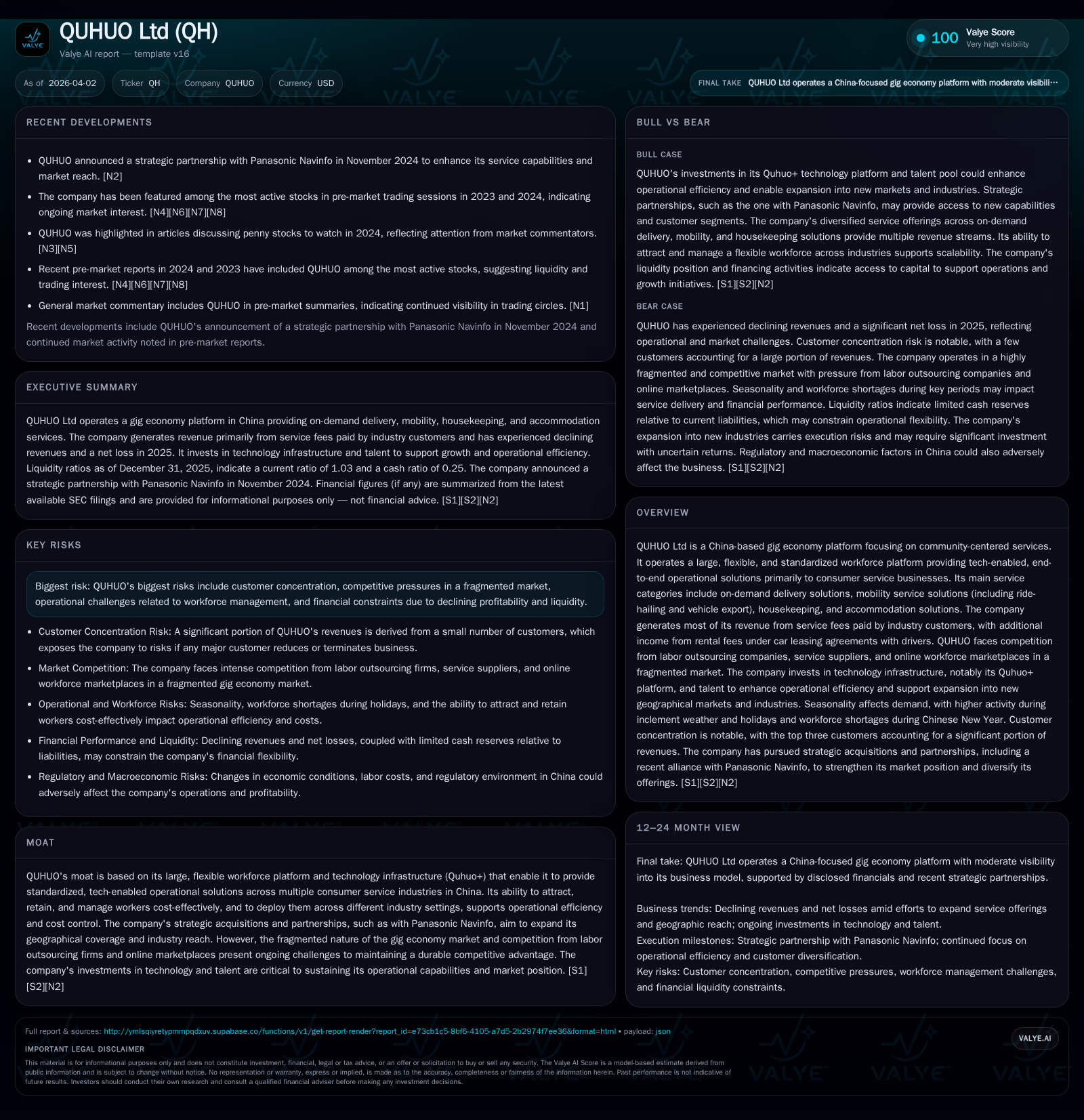
QUHUO Ltd, a China-focused gig economy services platform, experienced a revenue decline from RMB3.7 billion in 2023 to RMB2.5 billion (US$361 million) in 2025, accompanied by a net loss of approximately RMB150 million (US$21.4 million) in 2025. Investments in its Quhuo+ technology platform and workforce flexibility remain strategic priorities amid persistent customer concentration risks and operational inefficiencies. Liquidity remains constrained with negative operating cash flows over recent years and cash reserves of about US$5.5 million at the end of 2025. The company's near-term outlook hinges on operational improvements, client diversification, and managing regulatory and market challenges.
Company Overview
QUHUO Ltd operates a gig economy platform centered on community-driven consumer services in China, leveraging a large and flexible workforce supported by its proprietary Quhuo+ technology platform [S1][S15]. Its service offerings include on-demand delivery solutions—which constitute the majority of revenue—ride-hailing supported by vehicle leasing agreements, housekeeping, accommodation services, and other consumer-facing segments. Revenue is primarily derived from service fees charged to industry customers along with rental fees from leased vehicles.
Competitive differentiation is anchored on tech-enabled standardization across fragmented local markets. Strategic partnerships have expanded geographic coverage but competition remains intense with traditional labor outsourcing firms and emerging digital workforce marketplaces [S15].
Historical Financial Performance
Available data for fiscal years 2023 through 2025 highlight significant financial headwinds:
Historical performance (annual)
| FY | Net ($mm) | CFO ($mm) | OpInc ($mm) | Capex ($) | Net YoY |
|---|---|---|---|---|---|
| 2025 | -21 | -5 | -25 | 208000 | -5860.6% |
| 2024 | 0 | -2 | -1 | 127000 | -20.9% |
| 2023 | 0 | -14 | -1 | 20000 | +124.6% |
| 2022 | -2 | 11 | 5 | 675000 |
Source: SEC companyfacts cache [F1].
Capital returns and efficiency (annual)
| FY | FCF ($mm) | ROE% |
|---|---|---|
| 2025 | -6 | -42.1 |
| 2024 | -2 | 0.6 |
| 2023 | -14 | 0.7 |
| 2022 | 10 | -2.6 |
Source: SEC companyfacts cache [F1].
USD figures where available per SEC filings and company facts [F1]
Key points include:
- Revenue contracted by roughly one-third over two years primarily due to softness in core on-demand delivery services [S1][F1].
- Operating losses widened sharply reaching approximately USD -25 million by 2025 from minor losses previously; net losses followed this trend [F1][S1].
- Negative free cash flow persists with operating cash outflows exceeding capital expenditures each year [F1][S16].
- Capital investments increased moderately as the company intensified spending on Quhuo+ technology infrastructure alongside talent acquisition efforts [F1][S26].
Drivers Behind Past Performance
Multiple factors influenced QUHUO's financial results:
- On-demand delivery solutions dominate revenue but are sensitive to consumer spending trends, mobile internet penetration levels, and rising labor costs within China’s gig economy environment [S1].
- Labor cost inflation has pressured margins despite efforts to deploy a multi-role flexible workforce across service verticals to optimize expenses [S14][S15].
- Customer revenue concentration increased significantly by 2025 with the top three clients contributing nearly 87% of total revenues, heightening exposure to client-related risks [S10].
- Expansion into newer verticals like housekeeping has shown revenue growth but involves high initial costs and uncertain profitability given limited operating history [S21].
- Seasonal demand fluctuations affect volume patterns especially during Chinese New Year holidays and inclement weather conditions which can temporarily boost activity levels [S15].
Future Growth Prospects
Potential growth drivers include:
- Geographic expansion leveraging the Quhuo+ platform could unlock additional service contracts if operational efficiencies are realized [S15].
- Diversification beyond delivery into broader consumer service industries may mitigate customer concentration risks if scale economies can be achieved [S14].
- Improved worker engagement through enhanced career prospects and multi-role flexibility could optimize labor utilization and reduce cost pressures [S14].
- Continued investment into Quhuo+ aims at driving data-driven operational improvements that may support margin recovery if translated effectively into execution gains [S15][S26].
Challenges remain substantial:
- Intense competition from both traditional labor outsourcing firms and evolving online gig marketplaces limits pricing leverage.
- Managing rapid expansion while maintaining service quality entails operational risks.
- Regulatory uncertainties concerning corporate structure under PRC Foreign Investment Law pose ongoing legal risks affecting business continuity assumptions related to VIE arrangements common among Chinese platforms [S18].
- Liquidity constraints may restrict investment flexibility absent successful capital raising or improved cash flow generation capabilities [F1][S8][S16].
Milestones & Expectations
While no explicit forward guidance has been disclosed recently, key near-term developments include:
- The company is appealing a Nasdaq delisting decision triggered by ADS prices falling below USD $0.10 over an extended period; this affects market access and investor confidence [N1][S3].
- Share consolidation and termination of the ADR program reflect attempts at restructuring equity capital to enhance shareholder base stability though may impact liquidity profiles [S13].
- Success metrics will likely focus on operational efficiency improvements via Quhuo+, reducing losses, broadening customer base diversity, and strengthening the balance sheet through financing activities.
Analysts should monitor quarterly disclosures for changes in revenue composition away from concentrated clients, worker retention metrics, regulatory developments impacting corporate structure, and liquidity status.
Returns & Capital Allocation
Return metrics based on available data indicate:
- Return on equity declined sharply to approximately -42% for fiscal year ending December 31, 2025 due to net losses relative to an equity base near USD $50.7 million [F1].
- Dividend distributions or share repurchases appear absent as the company prioritizes reinvestment into technology platforms and operational stabilization amid losses [S4][F1].
- Financing activities have provided some liquidity support with proceeds around USD $4.7 million in 2025 offsetting operating cash outflows partially [F1][S16].
- Equity restructuring through share consolidations aims at optimizing capital structure though does not represent direct capital returns to shareholders currently [S13].
Overall capital management appears conservative focusing on sustaining operations rather than returning capital during periods of financial distress.
Competitive Environment & Market Positioning
QUHUO competes within a highly fragmented gig economy segment characterized by numerous independent labor suppliers alongside growing online workforce marketplaces facilitating gig work matching for Chinese consumer service sectors.
Its technology-driven standardized approach via Quhuo+ differentiates it from purely offline competitors but requires ongoing investment amid tight margin pressures.
Flexible multi-role worker deployment aligns with global gig economy trends seeking optimized resource utilization while navigating labor cost volatility influenced by social factors including migration policies.
Strategic partnerships support geographic expansion yet costly lump sum rights acquisitions for delivery stations constrain rapid scaling without strong capital backing [S7][S15]. This mirrors wider sector dynamics marked by fierce pricing competition over last-mile logistics contracts combined with elastic labor supply.
Risks Summary
Key risks identified include:
- High customer concentration raises volatility risk if major clients alter sourcing or reduce volumes unexpectedly [S10][S14].
- Operational complexity managing diverse worker roles across expanding verticals increases integration costs and execution risk [S14].
- Financial constraints highlighted by sustained losses and negative cash flows limit capacity for growth investments or absorbing shocks without dilutive financing rounds [F1][S8][N1].
- Regulatory uncertainty surrounding PRC foreign investment laws impacts viability of existing corporate structures relying on VIE arrangements common among Chinese tech companies [S18].
Conclusion
QUHUO Ltd remains a notable player within China’s evolving gig economy platform landscape offering community-centric consumer services supported by proprietary technology infrastructure. However, it confronts steep near-term challenges including significant revenue contraction since its peak in 2023 coupled with escalating operating losses.
While its technological capabilities and flexible workforce model provide competitive advantages relative to offline incumbents, converting these strengths into sustainable profitability is challenged by rising labor costs, customer concentration risk, intense competition, liquidity pressures, and regulatory uncertainties.
The company’s strategic focus must prioritize operational efficiency improvements alongside geographic diversification amidst macroeconomic headwinds particular to China’s gig economy environment.
Close monitoring of quarterly results is warranted given recent Nasdaq delisting proceedings that may materially impact market perception and financing access critical for business turnaround efforts.
This analysis is based exclusively on publicly available information as cited herein and does not constitute investment advice or endorsement of any securities.
Disclaimer: This is research-only, informational analysis and not investment advice. It may include AI-generated interpretation and general industry context. Always verify important details using primary sources.

Comments