
OLB Group Struggles with Shrinking Revenue and Operating Losses While Pursuing Spin-Off Strategy
OLB Group’s 2025 results show revenue decline and persistent losses amid operational challenges and an evolving FinTech ecosystem.
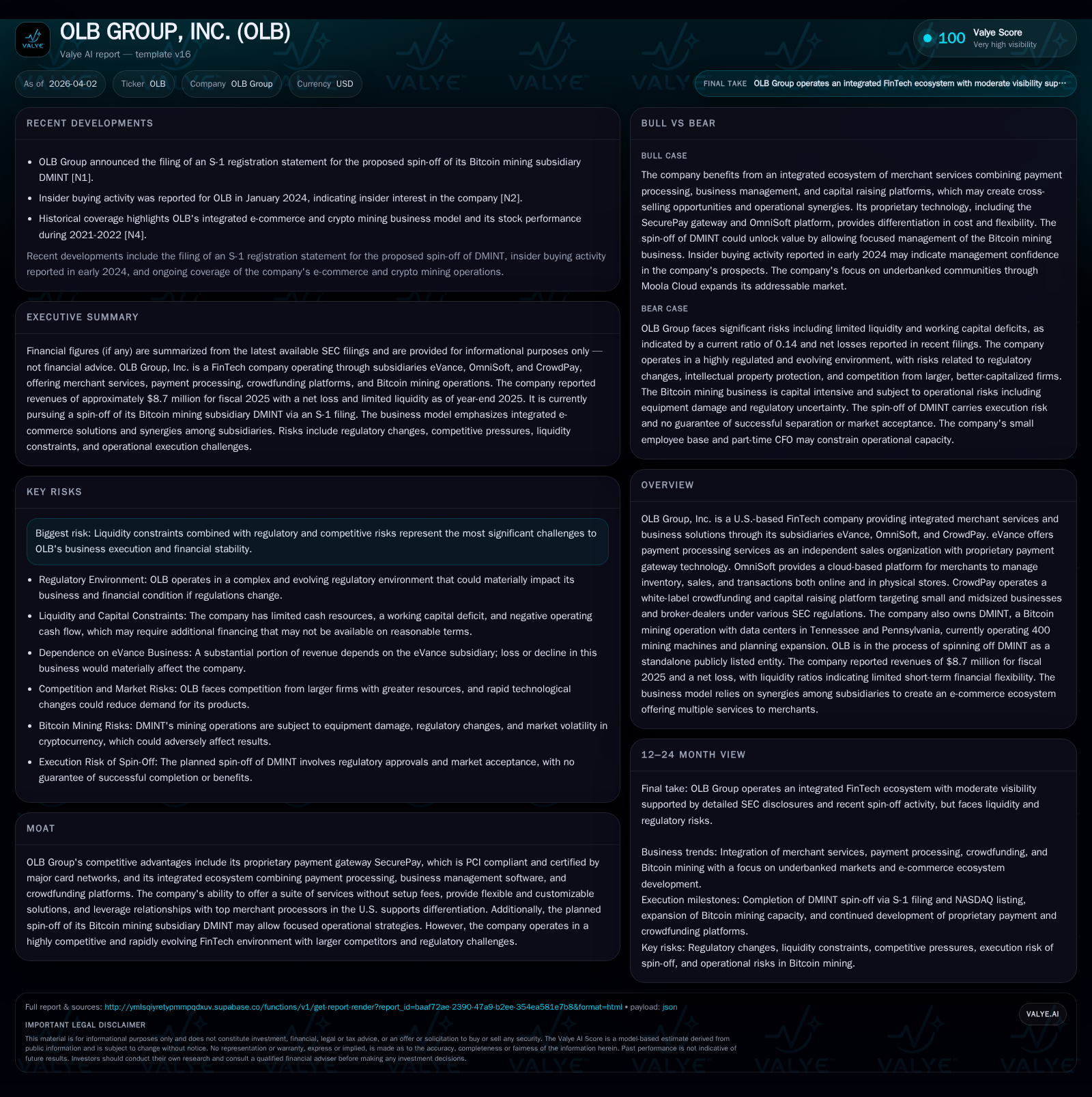
OLB Group, Inc. reported a significant drop in revenue to $8.7 million in fiscal 2025, down 32% year-over-year, as operating losses improved but remained substantial. The company operates through subsidiaries offering payment processing, business management platforms, crowdfunding solutions, and bitcoin mining via DMINT, which it plans to spin off. Liquidity constraints, regulatory compliance complexities, and intense competition pose material risks alongside growth uncertainties. Capital allocation prioritizes sustaining operations with no dividends or buybacks announced.
Company Overview
OLB Group, Inc. operates as a U.S.-based FinTech provider delivering integrated merchant services and business solutions through its wholly owned subsidiaries: eVance, OmniSoft, and CrowdPay [S5]. eVance offers payment processing utilizing its proprietary SecurePay gateway technology compliant with PCI standards. OmniSoft develops a cloud-based platform empowering merchants to manage inventory and sales across online and physical stores. CrowdPay delivers white-label crowdfunding solutions catering to small- and mid-sized businesses under SEC regulations like Reg CF and Reg D. A distinctive line of business is DMINT, a bitcoin mining operation with data centers in Tennessee and Pennsylvania that currently runs about 400 machines; OLB is pursuing a spin-off of DMINT into a standalone public company to sharpen its operational focus [S14],[S16].
Historical Financial Performance
The company has experienced a notable deterioration in revenue over the last few years alongside persistent operating losses:
Historical performance (annual)
| FY | Rev ($mm) | Net ($mm) | CFO ($mm) | OpInc ($mm) | Rev YoY | Net YoY |
|---|---|---|---|---|---|---|
| 2025 | 9 | -1 | -5 | -32.4% | ||
| 2024 | 13 | -11 | -3 | -12 | -58.0% | +51.6% |
| 2023 | 31 | -23 | 2 | -23 | +0.7% | -197.7% |
| 2022 | 30 | -8 | -2 | -8 | -56.4% |
Source: SEC companyfacts cache [F1].
Capital returns and efficiency (annual)
| FY | FCF ($mm) | ROE% |
|---|---|---|
| 2025 | ||
| 2024 | -4 | -352.0 |
| 2023 | 1 | -189.6 |
| 2022 | -3 | -22.5 |
Source: SEC companyfacts cache [F1].
*Note: Approximate YOY changes where intermediate year data is missing.
Revenue halved from the peak near $30 million in FY23 to under $9 million in FY25 [F1]. Although operating losses narrowed by more than half from FY24 to FY25 due to expense control measures or structural changes within operations; they remain well above $5 million annually [F1]. The steady negative cash flow from operations (CFO) continues despite the reported improvement in operating income figures.
A glaring concern is the company's weak liquidity profile: as of December 31st, 2025 the working capital deficit stood at approximately $6.64 million with current liabilities vastly exceeding current assets resulting in a current ratio near a critical low of ~0.14 [F1],[S1]. This highlights severe short-term financial pressure.
Additional financial strain arises given reliance on external related-party financing historically—including short term loans from CEO Ronny Yakov—which is neither assured nor stable long term [S1],[S20].
Business Model and Industry Positioning
OLB’s multi-subsidiary structure creates an ecosystem designed to interconnect merchant service offerings:
- eVance provides payment processing supported by the proprietary SecurePay gateway certified by major card networks.
- OmniSoft.io delivers SaaS business management tools that allow merchants to seamlessly track inventory levels and process sales both online and in storefronts via digital platforms.
- CrowdPay.us operates a white-label capital raising platform focused on Regulation CF and Regulation D exempt crowdfunding campaigns facilitating small business fundraising initiatives across broker-dealers and investor networks.
This integrated approach offers bundled services without setup fees combined with flexible pricing models and customization tailored largely toward underbanked segments of the U.S. merchant market [S7],[S10],[S14]. The company highlights synergistic effects where client data centralization across platforms enables streamlined processing.
Complementing these services is the DMINT bitcoin mining segment representing a diversification into cryptocurrency infrastructure with expansion plans albeit fraught with technology evolution risks inherent in this domain [S16],[S18].
Growth Prospects and Challenges
The core drivers that could underpin future top-line recovery are:
- Leveraging integrated suite cross-selling capabilities among its subsidiaries.
- Capturing incremental wallet share within small-to-mid sized merchant segments underserved by larger players.
- Expansion or commercialization of proprietary technology such as the pending patent on transferable QR codes embedded within OmniSoft devices.
- Successful spin-off execution of DMINT could unlock shareholder value by allowing focused operational strategies separate from core FinTech services [S14],[S16].[N/A]
However considerable constraints loom:
- The highly competitive FinTech payments landscape dominated by bigger incumbents limits pricing power.
- Regulatory complexity spanning financial compliance (e.g., CFPB scrutiny post-Dodd-Frank Act), data privacy laws (Gramm-Leach-Bliley Act implications), anti-money laundering/sanctions programs necessitate costly compliance infrastructure increasing operating expenses.
- The fragile liquidity position reduces agility to invest significantly in growth initiatives or scale operations without further financing.
- Rapid technological shifts require continuous investment in R&D with uncertain returns while facing risks from open source software dependencies potentially diluting IP protection.[S25]
- Customer attrition risks if system disruptions occur given critical dependence on reliable transaction infrastructure.[S16,S23]
Expectations & Forward-Looking Indicators (Analysis)
OLB has not publicly disclosed explicit near-term revenue or profitability guidance beyond general strategic narratives around spin-off plans for DMINT and ongoing technology enhancements.[N/A]
Investors will need to monitor closely:
- Execution progress on the DMINT spin-off detailing timing and valuation terms.
- Trends in recurring revenue streams across payment processing and SaaS platform usage post any enhanced integrations or product rollouts.
- Financial metrics signaling stabilization or improvement of liquidity metrics particularly working capital dynamics.[N/A]
Compliance outcomes linked to regulatory inspections or any enforcement actions also represent important potential inflection points impacting share price volatility.[N/A]
Returns & Capital Allocation
ROE remains deeply negative at an estimated -352% calculated using latest reported net loss over shareholders’ equity levels indicating no current value creation for stakeholders from equity invested [F1].
Cash flow reflects ongoing operational burn totaling over -$1.3 million CFO during FY25 while capital expenditures moderate around ~$1.2 million annually signaling restrained reinvestment capacity relative to prior periods [F1].
No dividend distributions or stock repurchases have been disclosed with available filings suggesting all cash resources are prioritized towards maintaining operational continuity instead of returning capital to shareholders.[F1],[S28]
Risk Factors Summary
Major risk vectors derive from:
- Severe liquidity constraints risking solvency without additional funding commitments or increased revenues.[S1,S20]
- Regulatory complexities spanning multiple jurisdictions that can impose fines or limit licenses if breached imposing costly adaptations.
- Competitive pressures from larger FinTech firms with deeper R&D budgets potentially eroding client base.[S16,S27]
- Cybersecurity threats disrupting critical payment infrastructure undermining customer confidence.[S16,S23]
- Uncertain acceptance and operation challenges related to evolving Bitcoin mining asset class represented by DMINT risking financial drain on parent entity.[S16,S18]
Closing Perspective
OLB Group presents as a diversified but financially stressed FinTech company attempting to carve out relevance through a multiply integrated merchant service ecosystem augmented by innovative payment gateways and niche crowdfunding capabilities. The upcoming separation of the cryptocurrency-focused mining arm may unlock strategic clarity yet exposes operational execution demands under tight liquidity conditions.
While recent results indicate notable contraction in top-line performance mitigated only partially by cost containment efforts resulting in smaller but still substantial losses—and deteriorating liquidity metrics—future viability hinges on regulatory navigation success alongside technology upgrades that maintain competitive differentiation amidst industry maturation.
Stakeholders should carefully weigh these elements given the absence of visible profit trajectory or cash flow generation sufficiency coupled with dependence upon related party support for bridging near-term capital needs.
Disclaimer: This report is for informational purposes only and does not constitute investment advice or recommendation.
Disclaimer: This is research-only, informational analysis and not investment advice. It may include AI-generated interpretation and general industry context. Always verify important details using primary sources.

Comments