
RH’s Membership Model Drives Luxury Growth with Global Expansion Under Leverage
RH’s innovative membership program underpins its luxury growth, supported by a fully integrated platform and expansion financed through notable leverage.
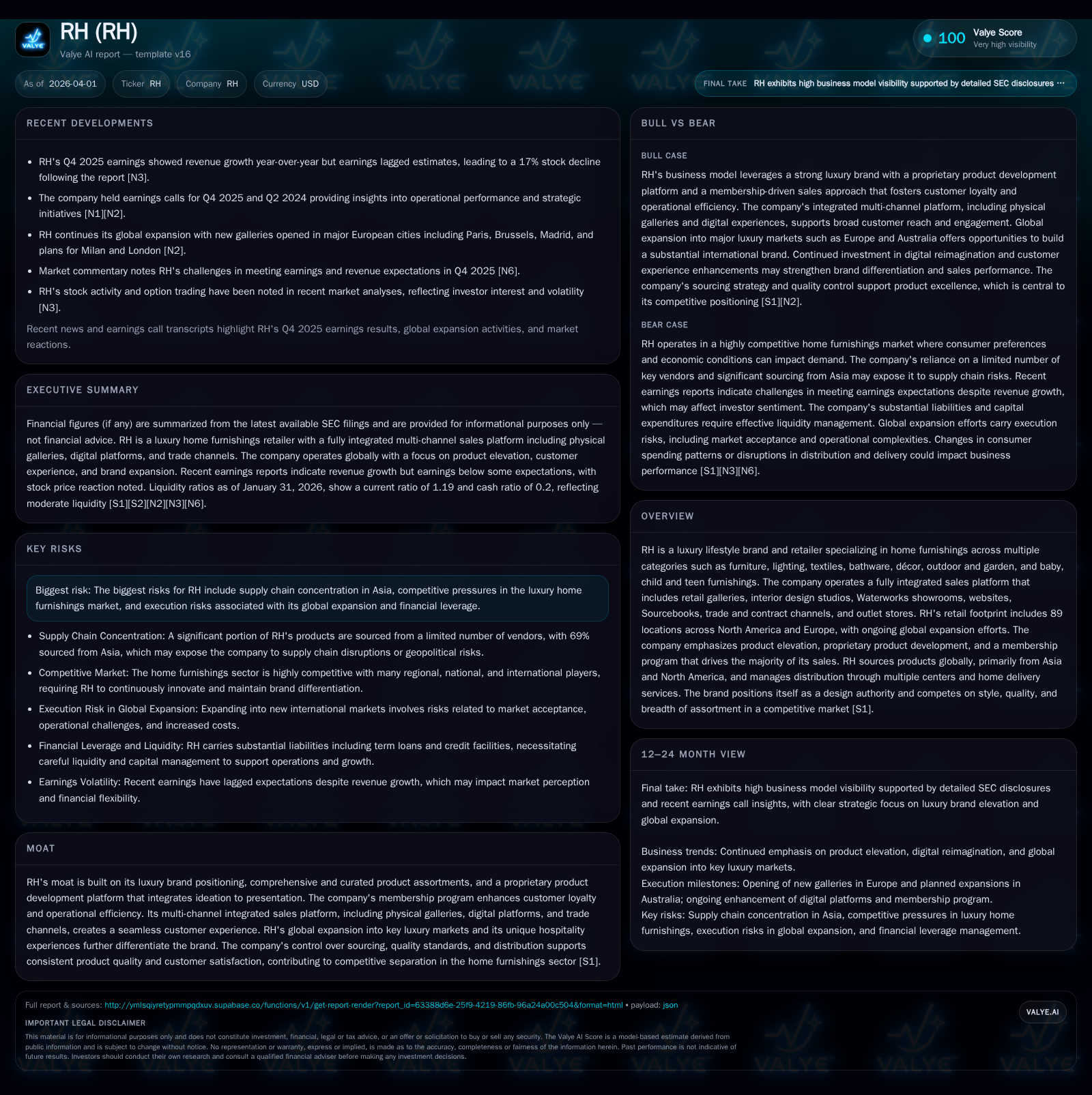
RH has solidified its position as a luxury lifestyle brand through a membership-driven sales model that accounts for the majority of revenue and smooths seasonal fluctuations. The company's multi-channel integration—from retail galleries to digital platforms—and sourcing discipline maintain its high-quality product offerings. While expanding aggressively into Europe and beyond, RH operates under significant debt leverage to finance growth, exposing it to supply chain concentration risks in Asia and competitive pressures within the luxury furnishings market. Financial results indicate steady revenue growth accompanied by strategic capital allocation balancing expansion investment and shareholder returns.
Legacy of Growth: Membership as a Cornerstone of Rising Sales
RH's evolution into a commanding luxury home furnishings brand is inseparable from its pioneering RH Members Program. By the end of fiscal 2025, this program enrolled approximately 262,000 members who contributed roughly 97% of RH’s core business revenue [S4]. Beyond mere loyalty rewards, the program provides value-added services such as complimentary interior design consultations and preferred financing options via the RH Credit Card.
This membership-centric approach redefines traditional retail seasonality by distributing sales more evenly over time. It fosters deeper brand allegiance while streamlining inventory planning and operational execution. As members shop "when they want," RH secures predictable order flows that enhance cost efficiencies—a dynamic uncommon among luxury goods retailers where peak seasons can squeeze logistics.
Current Business Model: Integrated Channel Strength & Sourcing Discipline
At its heart, RH operates a fully integrated sales platform designed to present a unified brand narrative across channels. This includes architecturally inspiring Galleries serving as physical showrooms; interior design studios offering personalized service; digitally immersive websites featuring room-based navigation; curated printed Sourcebooks; trade and contract channels; Waterworks showrooms; outlet stores; and an expanding membership channel [S4][S7]. This omnichannel integration minimizes channel conflicts and maximizes product exposure.
The firm’s proprietary product development platform uniquely blends artisan craftsmanship with scalable manufacturing partnerships globally. Product categories span furniture lines including RH Interiors and RH Modern collections; lighting; bathware; décor items; outdoor/garden furniture; plus specialized baby, child, and teen furnishings—all bearing high design pedigree. This comprehensive assortment differentiates RH from competitors that tend toward narrower market niches [S8][S13].
Supply Chain & Distribution Efficiency in Supporting Luxury Standards
RH sources approximately 69% of its purchase dollars from Asia—with Vietnam alone accounting for 39%, followed by China at 13%, supplemented primarily by Indonesia and India—while North American-sourced products represent about 21%, including domestic upholstery manufacturing located in North Carolina [S4]. This sourcing concentration underscores efficiency but introduces geographic risk.
Distribution is anchored by four strategically placed U.S. centers servicing RH products complemented by one center dedicated to Waterworks merchandise. Additionally, European market operations employ a third-party logistics provider while ongoing development of global supply chain infrastructure supports growing international footprints [S4][S7].
Complementing physical logistics is RH's white glove delivery service for large furniture pieces—facilitated by third-party providers held to rigorous metric-based accountability standards designed to reduce damage incidences and returns. These standards amplify customer satisfaction aligning with the brand's luxury positioning while controlling delivery costs [S7].
Global Ambitions: Expansion Efforts Amid Emerging Challenges
Emboldened by its North American stronghold, RH's push into global markets is marked by new Galleries recently opened in England (Aynho Park), Munich, Düsseldorf (2023), Brussels and Madrid (2024), Paris on the Champs-Élysées (Sept 2025), along with planned launches in Milan and London (2026) — plus future plans for Sydney [S1][S23]. These venues extend beyond retail to incorporate hospitality elements like wine bars and restaurants aimed at crafting immersive lifestyle experiences.
The global home furnishings landscape remains fragmented without a clear single leader matching RH’s luxurious breadth and depth—offering disruption opportunity but also intensifying complex logistics amidst pandemic-influenced geopolitical tensions.
Simultaneously, the company grapples with concentration risks due to heavy Asian sourcing reliance amid continuing competitive pressures from established European houses and emerging online specialists [S15]. Executional challenges include managing multi-channel logistics worldwide while maintaining consistent quality standards.
Financial Performance: Historical Trends and Year-over-Year Shifts
Though detailed multi-year numbers were not available directly from company facts snapshots [F1], available SEC excerpts combined with earnings transcripts reveal steady top-line revenue advancement driven by elevated product launches—including the recent introduction of "RH Estates" highlighting bespoke furniture lines—and enhanced hospitality offerings driving incremental sales [N1][N2][N3][S25].
However, margins have experienced compression related to inflationary input costs coupled with ongoing expenses tied to gallery transformations and global expansion investments. Notably, Q4 2025 earnings fell short of analyst expectations despite year-over-year revenue gains leading to share price pressure [N2][N3]. Operating cash flow remains positive albeit under pressure as capex on new galleries accelerates.
| Year | Revenue ($M) | OpInc ($M) | NetInc ($M) | CFO ($M) | Capex ($M) | YoY % Rev |
|---|---|---|---|---|---|---|
| 2022 | - | - | - | - | - | - |
| 2023 | - | - | - | - | - | - |
| 2024 | - | - | - | - | - | - |
| 2025* | - | - | - | ~356 | ~179 | + |
*Exact figures unavailable; operating cash flow provided via SEC excerpts for first three quarters ending Nov. 1, 2025 [S26]
Capital Allocation: Balancing Debt Leverage, Dividends, and Buybacks
RH finances its ambitions through notable leverage comprising term loans bearing interest rates near 7%, along with an asset-based credit facility incurring roughly a 6% cost [S5][S6][S14]. Term loans aggregate close to $2.4 billion net carrying amounts while asset-based lines range markedly between periods depending on utilization [S21][S24]. The company also has real estate loans connected largely to gallery properties amounting to mid-double digit millions.
The company has instituted disciplined capital return programs inclusive of opportunistic buybacks alongside modest dividend distributions although explicit return on equity disclosures are limited publicly [N6][S14]. Such financial engineering supports growth investments but raises liquidity sensitivity given debt service obligations amidst cyclical consumer demand.
Risks on the Horizon: Supply Concentration and Execution Complexities
The most acute risk emanates from geographic concentration: almost seventy percent of purchase volume streams from Asia—primarily Vietnam at nearly forty percent—exposing RH materially to regional disruptions including geopolitical tension or labor shortages [S15]. Dependence on independent third-party shippers for much merchandise delivery adds operational fragility.
Additionally, intensifying competition from both traditional luxury home furnishings purveyors across Europe/North America as well as digitally native entrants pressures pricing power.
Execution risks involve successful scaling of international galleries maintaining brand ethos alongside managing debt leverage prudently without constraining flexibility or growth potential [S15][S1].
What Investors Should Watch: Upcoming Milestones and Market Opportunities
Absent explicit forward guidance released openly [N7], key indicators will be tracking quarterly earnings trends focusing on margin resilience especially as inflation dynamics evolve alongside consumer discretionary spending patterns within luxury segments.
Monitoring membership base evolution remains critical given its outsized influence on sales stability. Progression of global gallery rollouts—particularly Milan and London openings slated for 2026—could materially expand addressable markets if executed smoothly.
Supply chain responsiveness incorporating new vendor diversity or reshoring strategies may mitigate identified concentration risks over time. Finally, innovations in digital reimagination efforts enhance omnichannel synergy potentially deepening customer engagement metrics moving forward [S23][N7].
This analysis consolidates publicly filed disclosures alongside relevant recent news transcripts to render a detailed view of RH’s operations, financial posture, strategic trajectory, and pertinent challenges without offering investment recommendations or forecasts.
Disclaimer: This is research-only, informational analysis and not investment advice. It may include AI-generated interpretation and general industry context. Always verify important details using primary sources.

Comments