
Copley Acquisition Corp’s Strategic Road to a Defining Business Combination
Examining how Copley Acquisition Corp leverages its management expertise and capital base to pursue a transformative business combination in tech and lifestyle sectors.
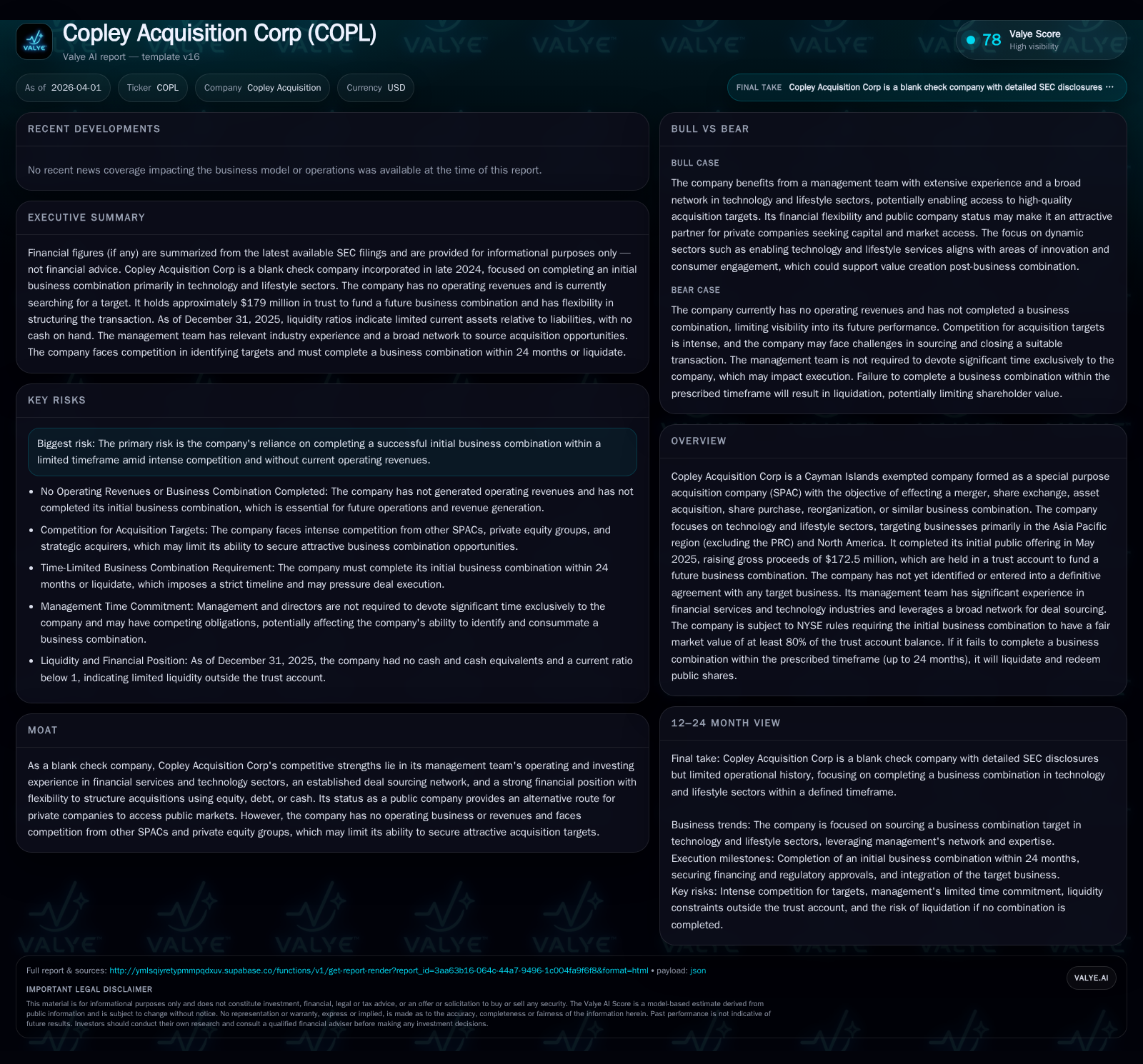
Copley Acquisition Corp, a Cayman Islands-based SPAC, launched its IPO in May 2025 raising approximately $172.5 million, targeting technology and lifestyle companies primarily in Asia Pacific (excluding China) and North America. With no operating revenues to date, the company is actively pursuing an initial business combination guided by a seasoned management team boasting deep financial services and technology experience. Their extensive network and flexible capital structure position them well in a crowded SPAC environment, although significant risks remain related to timing pressures and competition for attractive acquisition targets.
SPAC Origin and Early Milestones
Historical performance (annual)
| FY |
|---|
| 2025 |
Source: SEC companyfacts cache [F1].
Copley Acquisition Corp was incorporated as a Cayman Islands exempted company on November 26, 2024, operating as a special purpose acquisition company (SPAC) focused on identifying acquisition targets within technology and lifestyle sectors. It completed its IPO in May 2025, raising approximately $172.5 million in gross proceeds. These funds are held in an interest-bearing trust account reserved exclusively for funding an initial business combination involving merger or share exchange structures [S1][F1].
The company has generated no operating revenues since inception as its activities have been limited to organizational setup, IPO completion, and ongoing search for an acquisition target [S1]. The ability to consummate a successful business combination is time-limited by NYSE listing rules and regulatory requirements.
Historical Financial Snapshot: Pre-Revenue Phase
At fiscal year-end December 31, 2025, Copley Acquisition Corp reported an operating loss of approximately $479.7 thousand driven mainly by administrative expenses without any corresponding revenue streams [F1]. Despite this operating loss, net income was approximately $4.13 million primarily attributable to non-operating gains related to trust account assets [F1].
The balance sheet showed current assets of roughly $159 thousand against current liabilities of about $237 thousand resulting in a current ratio of 0.67—indicating limited working capital outside the trust funds [F1]. Calculated return on equity stood near -79%, consistent with early-stage operational losses prior to any business combination or revenue generation [F1].
This financial profile is typical for a SPAC prior to completing its initial combination.
Management Expertise and Strategic Focus on Asia Pacific & North America
Copley's competitive positioning stems from its management team's significant investment banking and operational experience across financial services and technology industries [S4][S7][S8]. Several executives based in Hong Kong bring valuable knowledge of Asian markets excluding the PRC due to regulatory constraints [S1][S7]. This regional focus provides access to high-growth markets across Asia Pacific (excluding China) alongside North America.
Their capabilities encompass cross-border M&A facilitation leveraging extensive networks spanning venture capital investors, private equity sponsors, industry executives, and regulators familiar with diverse environments outside mainland China [S4]. This expertise is critical given the complex regulatory frameworks and cultural integration challenges faced by target companies expanding globally.
Unlike some SPACs led solely by financial sponsors without operational experience, Copley’s leadership aims not only to identify candidates but also assist post-merger integration leveraging sector knowledge—a key differentiator in deal quality.
Target Sector Opportunities in Technology and Lifestyle Services
Copley's targeted sectors include two interconnected verticals: enabling technologies and lifestyle services.
Within enabling technologies are sub-industries such as robotics automation platforms, electric vehicle technologies aligned with sustainability trends, and cybersecurity solutions addressing evolving digital threats—all supported by Gartner projections forecasting global IT spending exceeding $8 trillion before decade-end [S3]. These segments embody disruptive technologies with scalable growth potential.
Complementing tech are lifestyle brands including luxury goods manufacturers, wellness service providers (including digital health platforms), travel-related companies benefiting from post-COVID "revenge travel," plus digitally native e-commerce businesses leveraging omni-channel strategies [S3][S6]. Millennials and Generation Z consumers increasingly drive these spaces through emotional engagement via influencer marketing and seamless brand experiences.
This thematic selection aligns with scalable monetization opportunities where intellectual property ownership—digital content or brand identity—provides durable competitive moats.
Competitive Advantages Amidst a Crowded SPAC Market
Despite many blank-check vehicles targeting similar sectors, Copley offers several differentiators. Its management’s operating capabilities combined with deep investing experience create credibility among potential targets and capital partners [S8].
An extensive proprietary deal sourcing network cultivated through institutional relationships across continents offers privileged access to deals often unavailable to less experienced sponsors [S8].
Financially, approximately $179 million held in trust specifically for transactions plus publicly traded ordinary shares allow acquisition financing flexibility ranging from all-cash deals to hybrid equity-debt structures depending on target preferences [S8].
Finally, being an existing public entity provides acquired companies streamlined access beyond traditional IPO routes into public markets—enhancing visibility that aids talent recruitment and customer engagement post-merger—an attractive option amid volatile public offering windows [S6].
Financial Position: Capital Strengths and Structural Considerations
As of March 19, 2026, about $179.3 million resides in the trust account dedicated exclusively for consummating Copley’s first business combination—a figure slightly adjusted for deferred underwriting fees paid during the IPO process resulting in roughly $173 million available net of these expenses [S5][S8][F1].
While possessing ample liquidity internally strengthens negotiating power relative to purely equity-reliant peers, the absence of secured third-party financing commitments so far implies potential constraints if targets require supplemental funding beyond trust assets [S8][S9].
Additionally, zero cash & equivalents outside the trust assets coupled with marginal working capital deficits reflect limited liquidity beyond transactional purposes at this stage [F1]. This illiquidity poses no operational risk currently given minimal day-to-day operations but underscores reliance on successful acquisition execution or timely external financing access.
Legal indemnifications limit sponsor exposure but entail contingent claims risks that could affect per-share redemption returns if litigation or creditor claims impact trust assets indirectly [S5][S25][S28].
Capital Allocation Outlook: Focused on Initial Business Combination Execution
Given its blank-check nature, Copley's capital allocation strategy centers overwhelmingly on executing the initial business combination within regulatory timelines while maximizing shareholder value through deployment of trust funds. There are currently no dividends or share repurchase programs consistent with typical SPAC structures; all capital is directed towards growth via acquisition infusion or refinancing moves post-combination completion [S10][S11][S23].
Management retains discretion over structuring deals using cash from the trust account combined optionally with equity issuance or debt securities depending on deal size preferences. This flexibility requires balancing redemption rights exercised by public shareholders so as not to overly dilute available cash resources potentially jeopardizing transaction viability [S10][S14][S17].
Insider agreements waive certain redemption rights behind founder shares but permit limited sponsor share purchases under strict regulatory compliance aimed at stabilizing shareholder bases pre- or post-transaction without causing market manipulation concerns [S18][S20][S23]. Investor returns will largely depend on carefully timed deal structures balancing partner interests against preservation of liquid resources.
Risks, Timing Pressures, and Investor Considerations
Key risks include pressures faced by blank-check vehicles like Copley: it must identify attractive acquisition targets delivering fundamental growth potential before expiration deadlines typically imposed by NYSE listing rules around five years post-IPO; failure leads to liquidation returning roughly IPO price minus expenses back to investors—without accrued opportunity benefits [S1][S16]. Competition intensifies these challenges as multiple SPACs alongside private equity groups aggressively pursue overlapping pools of high-quality technology or lifestyle businesses thereby constraining pricing power dynamics.
Post-transaction operational concentration risk persists since success depends heavily on one combined entity achieving sustainable profitability potentially exposing shareholders to sector-specific downturns absent diversification buffers found in multi-acquisition entities or diversified asset managers [S9][S16]. Sponsor fiduciary conflicts remain theoretical hazards if officers/directors hold parallel interests impacting alignment though governance frameworks seek mitigation via disclosures and independent director oversight surrounding target selection processes [S9][S16]. Investors should monitor progress toward signing definitive agreements meeting NYSE valuation rules requiring target(s) collectively represent at least 80% of trust account value net deferred fees plus redemption obligations—a critical regulatory milestone before approval processes including shareholder votes/redemption tender offers signaling material transaction commitment ahead of completion deadlines[S14][S27].
Disclaimer: This analysis is based solely on information available from SEC filings dated March 31, 2026 ([F1],[S#]) without forecasts provided by the company nor external news coverage. It does not constitute investment advice but aims to present a factual synthesis supporting an informed understanding of Copley Acquisition Corp’s strategic outlook.
Disclaimer: This is research-only, informational analysis and not investment advice. It may include AI-generated interpretation and general industry context. Always verify important details using primary sources.

Comments