
Actinium Pharmaceuticals Advances Radiopharmaceutical Pipeline Despite Ongoing Losses and Regulatory Risks
The clinical-stage biotech focuses on novel targeted radiotherapies with promising pipeline assets while navigating financial and regulatory challenges.
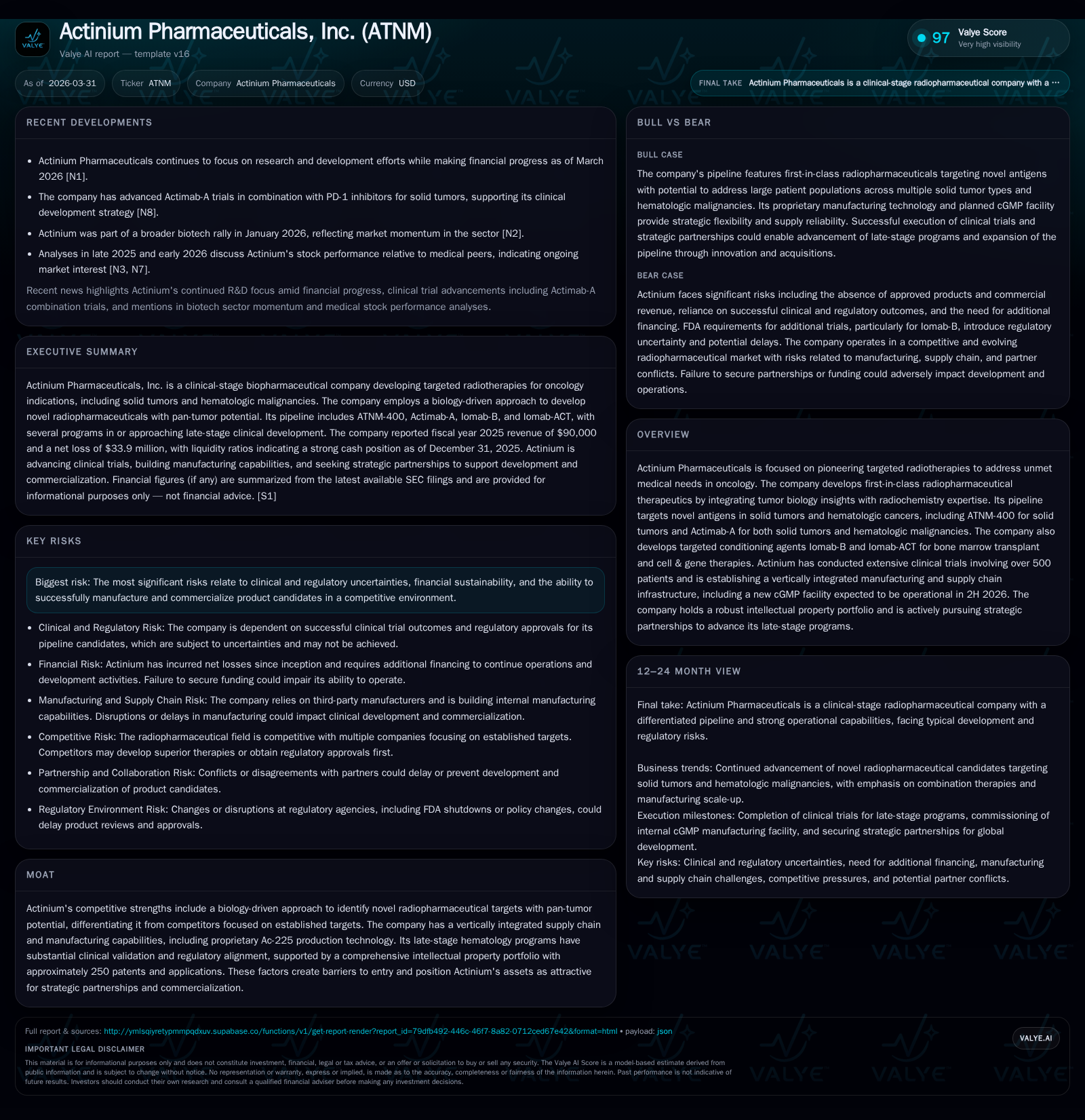
Actinium Pharmaceuticals has steadily developed a portfolio of first-in-class targeted radiotherapy candidates addressing solid tumors and hematologic cancers. With proprietary Ac-225 production technology and plans for a new cGMP manufacturing facility, the company aims to leverage late-stage assets like Actimab-A and Iomab-B toward regulatory milestones. However, historical performance shows continued net losses and negative operating cash flow, highlighting reliance on external financing amid unproven commercial viability. Regulatory complexities, intense competition, and pending litigation remain key challenges shaping its outlook.
Historical Performance
Actinium Pharmaceuticals remains a clinical-stage biopharmaceutical company pioneering targeted radiotherapies for oncology indications. The company has generated negligible revenue from commercial sales, consistent with its early development status. According to the latest annual report [F1], revenue totaled $90,000 for FY 2025, while operating losses were $36.2 million. Net loss narrowed modestly to $33.9 million in FY 2025 from $38.2 million in FY 2024.
Operating cash flow (CFO) remained negative at approximately $24.6 million in FY 2025 after prior years of deep negative cash flows, reflecting ongoing investment in R&D and operations. Capital expenditures were minimal at about $104,000 in 2025, mainly related to infrastructure such as a new manufacturing facility expected online later in 2026 [N1][S1][F1]. Equity capital declined significantly from $66.5 million in 2022 to $7.8 million in 2025 due to accumulated losses.
Historical performance (annual)
| FY | Rev ($) | Net ($mm) | CFO ($mm) | OpInc ($mm) | Rev YoY | Net YoY |
|---|---|---|---|---|---|---|
| 2025 | 90000 | -34 | -25 | -36 | +11.1% | +11.4% |
| 2024 | 81000 | -38 | -33 | -42 | 0.0% | +21.7% |
| 2023 | 81000 | -49 | -47 | -52 | -92.1% | -47.9% |
| 2022 | 1030000 | -33 | 9 | -34 |
Source: SEC companyfacts cache [F1].
Capital returns and efficiency (annual)
| FY | FCF ($mm) | ROE% |
|---|---|---|
| 2025 | -25 | -432.6 |
| 2024 | -33 | -116.7 |
| 2023 | -47 | -134.2 |
| 2022 | 8 | -49.7 |
Source: SEC companyfacts cache [F1].
This summary highlights persistent losses typical of early-stage biotech development without commercialization.
Pipeline and Growth Outlook
Actinium pursues a biology-driven approach targeting novel antigens beyond established markers such as PSMA or CD33 [S1][S9]. Key programs include:
- ATNM-400: Targets solid tumors including metastatic castration-resistant prostate cancer (mCRPC), non-small cell lung cancer (NSCLC), and breast cancer.
- Actimab-A: CD33-targeted radioimmunotherapy developed with the National Cancer Institute (NCI), aimed at acute myeloid leukemia (AML) and myelodysplastic syndrome (MDS), poised for late-phase trials.
- Iomab-B: Conditioning agent for bone marrow transplant with Phase II/III readiness supported by extensive clinical validation.
- Iomab-ACT: Conditioning agent potentially used in cell & gene therapies.
The company emphasizes its proprietary cyclotron-based Ac-225 isotope production technology as a potential competitive advantage addressing supply constraints common in alpha-emitter therapeutics [S18]. Its upcoming cGMP manufacturing facility expected by second half of calendar year 2026 will enable vertical integration from isotope production through drug manufacturing [N1][S18].
Despite these advances the programs remain at clinical or preclinical stages lacking proven efficacy or regulatory approval [S4][S15]. Success depends on pivotal trial outcomes and regulatory decisions which remain uncertain.
Regulatory Milestones and Expectations
No product candidate has yet received FDA marketing approval. Near-term focus includes pivotal studies for Actimab-A in AML/MDS and registrational trials for Iomab-B [S1][N1]. International approvals will face additional complexities due to differing regulatory frameworks and reimbursement environments [S11].
Orphan drug designations provide developmental incentives yet do not assure timely approvals or commercial success [S14][S17]. Investors should monitor clinical progress and regulatory feedback closely.
Returns and Capital Allocation
Financial returns reflect the developmental stage with approximate return on equity near -433% based on reported net loss relative to equity [F1]. Free cash flow was roughly negative $24.7 million in FY25 indicating continued cash burn primarily funding R&D and infrastructure rather than profitability.
No dividends or share repurchases are reported given capital allocation priorities towards advancing clinical programs and building manufacturing capabilities [F1][N1]. Liquidity appears adequate with a current ratio near 6.2 but future capital raises are likely required per management commentary [F1][S2][N1].
Competitive Landscape and Differentiation
The radiopharmaceutical market is rapidly expanding following recent blockbuster approvals such as Pluvicto® ($2 billion sales in ’25). Major pharmaceutical companies including Novartis and Bristol Myers Squibb aggressively develop pipelines often focused on validated targets such as PSMA or somatostatin receptors [S9][S18].
Actinium differentiates by:
- Pursuing novel tumor biology-driven targets offering pan-tumor potential;
- Vertical integration including proprietary isotope production addressing supply challenges;
- A substantial intellectual property portfolio (~250 patents/applications);
- Late-stage hematology assets with clearer FDA pathways.
Risks include faster competitors launching superior therapies; potential shifts via mergers/acquisitions; reimbursement pressures; technological change; regulatory setbacks; or manufacturing scale-up issues [S9][S18].
Legal Matters and Risks
Ongoing litigation includes a securities class action lawsuit related to alleged misstatements during disclosure of Iomab-B Phase III trial data filed March 2025 with motions pending decision as of early 2026 [S24]. Related derivative shareholder complaints against certain officers/directors add governance risk.
Such proceedings may impact financial resources and management focus though outcomes remain uncertain.
Summary
Actinium Pharmaceuticals is developing innovative targeted radiotherapies addressing unmet oncology needs through novel biologic targets coupled with integrated manufacturing solutions. Its pipeline spans solid tumors via ATNM-400 alongside hematological malignancies through Actimab-A/Iomab-B series supported by extensive patent coverage.
However persistent annual net losses exceeding $30 million together with negative free cash flow underscore reliance on external financing amid uncertain clinical results and regulatory approvals. Competitive pressures from large pharma entrants compound risks despite proprietary isotope supply advantages.
Investors should closely watch upcoming pivotal trial readouts regulatory developments financing activities manufacturing progress plus resolution of legal matters as key factors influencing the company's trajectory within emerging oncology radiotherapeutics innovation.
This analysis synthesizes public SEC filings including recent Form 10-Ks/10-Qs supplemented by industry context without providing investment advice or valuation opinions.
Disclaimer: This is research-only, informational analysis and not investment advice. It may include AI-generated interpretation and general industry context. Always verify important details using primary sources.

Comments