
Curanex Pharmaceuticals Charts Path from Botanical Innovation to Clinical Validation
Curanex Pharmaceuticals' strategic pivot towards developing Phyto-N as a botanical drug redefines its trajectory amidst substantial financial and regulatory challenges.
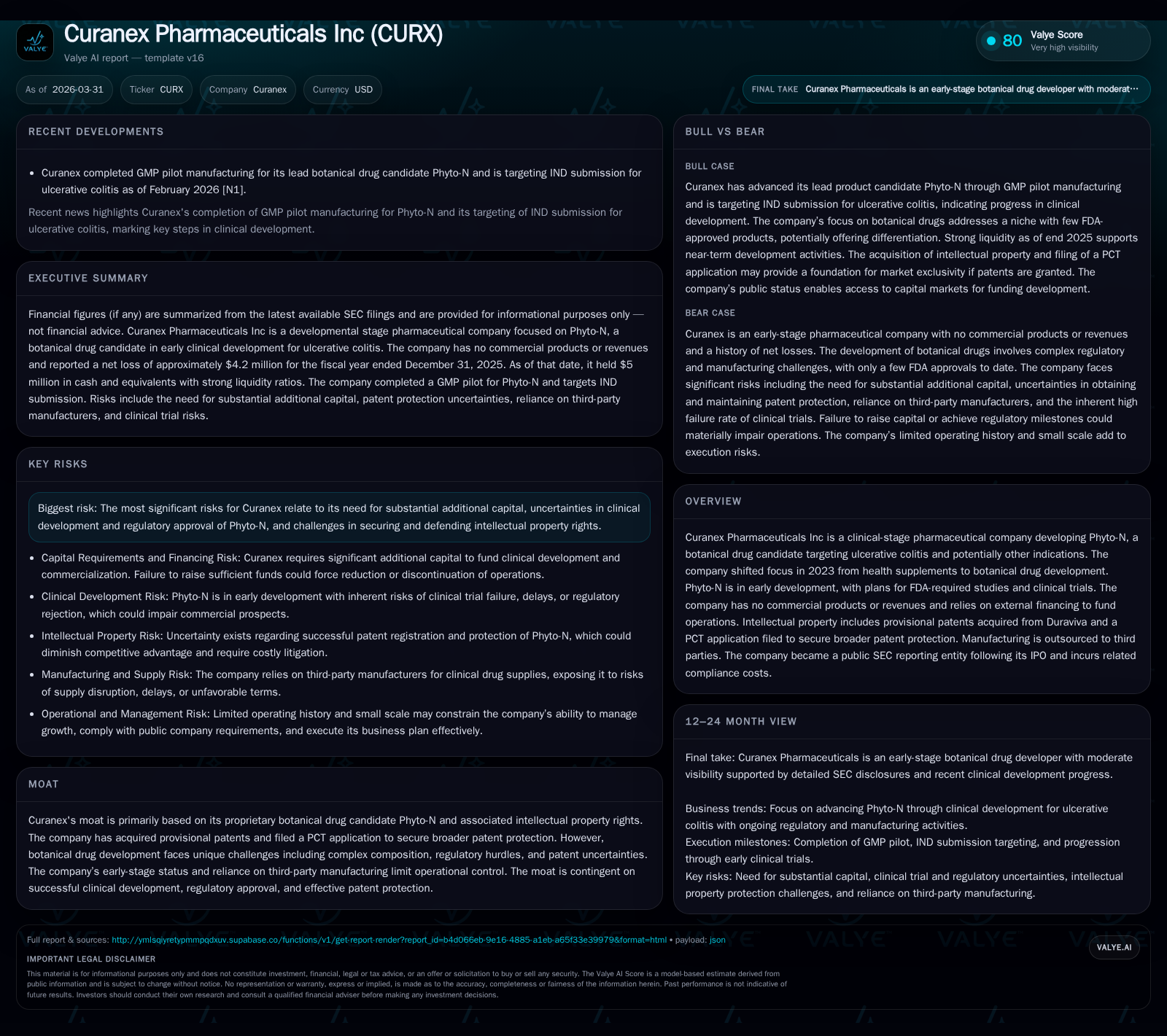
Curanex Pharmaceuticals transitioned in 2023 from selling health supplements to focusing exclusively on the clinical-stage development of Phyto-N, a botanical drug candidate targeting ulcerative colitis. The company currently operates without revenue, relying heavily on external financing to fund costly FDA-required studies and planned clinical trials. Its intellectual property portfolio includes provisional patents and a PCT filing, but botanical drug development inherently faces complex regulatory and patent uncertainties. Capital requirements exceeding $150 million through approval present significant risks alongside dependencies on third-party manufacturing and clinical success.
Strategic Pivot: From Supplements to Botanical Drug Development
In 2023, Curanex Pharmaceuticals undertook a pronounced strategic transformation by ceasing all operations involving health and dietary supplements to focus exclusively on developing Phyto-N as a botanical drug candidate. This pivot reflected an ambitious repositioning within the pharmaceutical arena, departing from consumer supplement sales — a relatively commoditized segment — towards tackling the rigorous regulatory and scientific demands of botanical drug development. While this transition aligns with industry trends that increasingly valorize novel botanical therapies for inflammatory diseases such as ulcerative colitis, it simultaneously marks the discontinuation of all prior revenue streams. As such, Curanex entered an entirely pre-revenue phase concentrated on early-stage clinical validation and regulatory compliance [S1]; this redirection demands significant investment in research infrastructure, third-party manufacturing relationships, and intellectual property establishment.
Historical Financial Performance
The financial profile through fiscal year 2025 corroborates the company’s nascent stage status post-pivot. Operating income registered at approximately -$4.24 million while net income was close to -$4.23 million. This level of operating loss reflects typical early biotech expenditures focused on R&D, administration, and initial compliance obligations rather than product commercialization [F1]. Cash and equivalents stood at about $5.0 million at year-end 2025, offering limited runway considering the projected capital requirements ahead. The current ratio was unusually high—around 81.9—indicating low current liabilities against ample short-term assets; nonetheless, this metric is influenced by minimal operational payables inherent in a developmental entity with few vendors engaged beyond select contract manufacturers.
Return on equity (ROE) was deeply negative at roughly -37.7%, highlighting ongoing operating losses without offsetting earnings or asset growth [F1]. Given that the company has no revenues or profits as yet, these results underscore its dependency on external financings to sustain operations.
Historical performance (annual)
| FY |
|---|
| 2025 |
Source: SEC companyfacts cache [F1].
Table: Curanex Pharmaceuticals’ latest annual financials highlight deep operating losses consistent with early-stage clinical development costs [F1].
Clinical Development Progress: Phyto-N’s Journey Towards IND Submission
Significantly advancing its lead compound’s preparatory groundwork, Curanex announced completing Good Manufacturing Practice (GMP) pilot production of Phyto-N by February 2026 [N1]. This milestone is critical in pharmaceutical development—ensuring material supply meets stringent quality standards suitable for clinical testing. Following GMP batch validation, the company aims to file an Investigational New Drug (IND) application with the FDA focused on Phyto-N’s treatment for ulcerative colitis.
The IND submission requires comprehensive preclinical data including meticulously conducted GLP toxicology and pharmacokinetics studies designed to establish safety profiles prerequisite for human trials [S1]. The progression into Phase I clinical trials will primarily assess safety in healthy volunteers or patients while laying groundwork for subsequent efficacy evaluations in Phase II trials targeting inflammatory bowel disease indications. Delays or deficiencies during these stages could extend timelines materially or jeopardize regulatory acceptance.
Intellectual Property Position: Patents and Regulatory Complexities
Curanex inherited four provisional patent applications related to Phyto-N through acquisition from Duraviva in mid-2024; each served as placeholders securing priority dates but lacked substantive enforceable rights alone [S17]. To transform these filings into robust market barriers against competition, the company filed a Patent Cooperation Treaty (PCT) utility application internationally in March 2025 combining three provisional applications into a comprehensive utility patent effort.
However, patenting botanical drugs presents unique complexities. Unlike single-molecule drugs amenable to clear composition-of-matter claims, botanicals comprise complex mixtures with multiple active constituents complicating claims' scope definition and novelty assertions [S16]. Additionally, variability introduced by natural raw material sourcing challenges standardization processes fundamental both for regulatory approval and sustaining patent validity.
The company's decision not to pursue patent protection related to acne treatment—dropping one provisional application—illustrates early-stage go/no-go decisions informed by internal clinical findings dismissing that indication [S17]. The residual IP portfolio thus hinges heavily on successful prosecution of remaining claims protecting Phyto-N's core composition for ulcerative colitis use.
Capital Structure and Cash Flow Dynamics Amid Early-Stage Losses
Reflecting its developmental biotech status without revenue generation since refocusing efforts in 2023, Curanex forecasts capital requirements exceeding $150 million through regulatory approval and commercial launch phases of Phyto-N [S1]. This sizeable capital demand encompasses conducting GLP toxicology/pharmacokinetic studies, multiple phases of clinical trials (Phase I to Phase III), scaled manufacturing setup via contractors, and eventual marketing infrastructure deployment.
Present cash holdings of about $5 million provide only limited near-term operational runway [F1], heightening reliance on future equity raises or debt issuances — modalities endemic to the sector but carrying dilution risk or restrictive covenants respectively.
No commercial revenues exist currently; therefore negative returns persist with continuous cash burn driven predominantly by R&D spendings aligned with drug development stages.
Risks: Financing Needs, Clinical Trials & Market Entry Barriers
Disclosed risk factors reveal multiple vulnerabilities:
- Acute undercapitalization risk if anticipated capital inflows fail or are delayed potentially forcing operational downsizing or cessation [S1][S18].
- High likelihood of failure inherent in early-stage clinical trials exacerbated by botanical drug-specific regulatory uncertainties around chemical heterogeneity impacting FDA evaluation stringency [S16].
- Intellectual property risks including difficulties obtaining enforceable utility patents given complex composition-of-matter challenges coupled with potential infringement claims necessitating costly litigation [S7][S8].
- Dependence on third-party contract manufacturing exposes supply chain risk; any disruption may delay clinical programs reducing overall project viability timelines [S10][S13].
- Governance compliance burdens following IPO increase cost structure consuming managerial bandwidth away from core R&D efforts potentially creating operational inefficiencies [S14].
- Market acceptance uncertainties stemming from botanical class novelty restricting traditional uptake assumptions especially if orphan exclusivity or other exclusivities are not granted timely [S16]. These risks underscore the precarious balance between ambitious development goals versus structural hurdles typical within pioneering botanical pharma ventures.
Anticipated Milestones & Outlook: Investor Considerations
While explicit forward-looking guidance remains absent beyond initial IND filing plans, key inflection points include:
- Completion of GLP toxicology/pharmacology studies needed before IND acceptance.
- FDA feedback milestones post-IND submission including possible requests for additional data affecting trial start timelines.
- Initiation of Phase I safety studies marking clinical entry point.
- Potential expansion into Phase II efficacy trials subject to positive safety outcomes focusing primarily on ulcerative colitis indication.
- Pursuit of additional Phase II indications pending proof-of-concept results may broaden therapeutic scope enhancing commercial attractiveness. Monitoring capital raise announcements remains crucial given high funded needs nearing $150M+ horizon through approval per management disclosures [N1][S1], while partnership deals could alter developmental velocity or risk exposures.
Competitive Moat Evaluation: Proprietary Formulation Amid Industry Challenges
Curanex's protective moat centers primarily around its intellectual property claims linked to Phyto-N’s proprietary multi-component botanical formulation coupled with progressive clinical validation efforts aimed at FDA approval. Success here could confer differentiation within a sparse botanical drug landscape where evidentiary hurdles are steep and competitors less numerous due to high barriers-to-entry related to natural product complexities.
Nevertheless, this moat remains fragile— dependent not only upon securing enforceable patents protecting chemical compositions but also establishing convincing efficacy and safety profiles amidst challenges like natural extract variability affecting quality control reproducibility during scale-up manufacturing run via third parties.
Manufacturing outsourcing limits direct control over critical supply chain consistency which could impact product comparability assessments demanded by regulators – an acknowledged pain point widely seen in botanical pharma production dynamics. Hence operational scalability combined with robust IP defense represents essential prerequisites before sustainable competitive advantage can crystallize fully within this niche sector.
This report synthesizes publicly available SEC filings and recent news disclosures without offering investment advice or price targets. Readers are urged to consider Curanex Pharmaceuticals’ inherent business risks associated with early-stage biotech companies focusing on complex botanical drug innovation.
Disclaimer: This is research-only, informational analysis and not investment advice. It may include AI-generated interpretation and general industry context. Always verify important details using primary sources.

Comments