
GDEV Inc.: From Contractual Risks to Leadership Consolidation
Analyzing GDEV’s financial trends, liquidity challenges, and a significant CEO stake increase shaping its strategic stance.
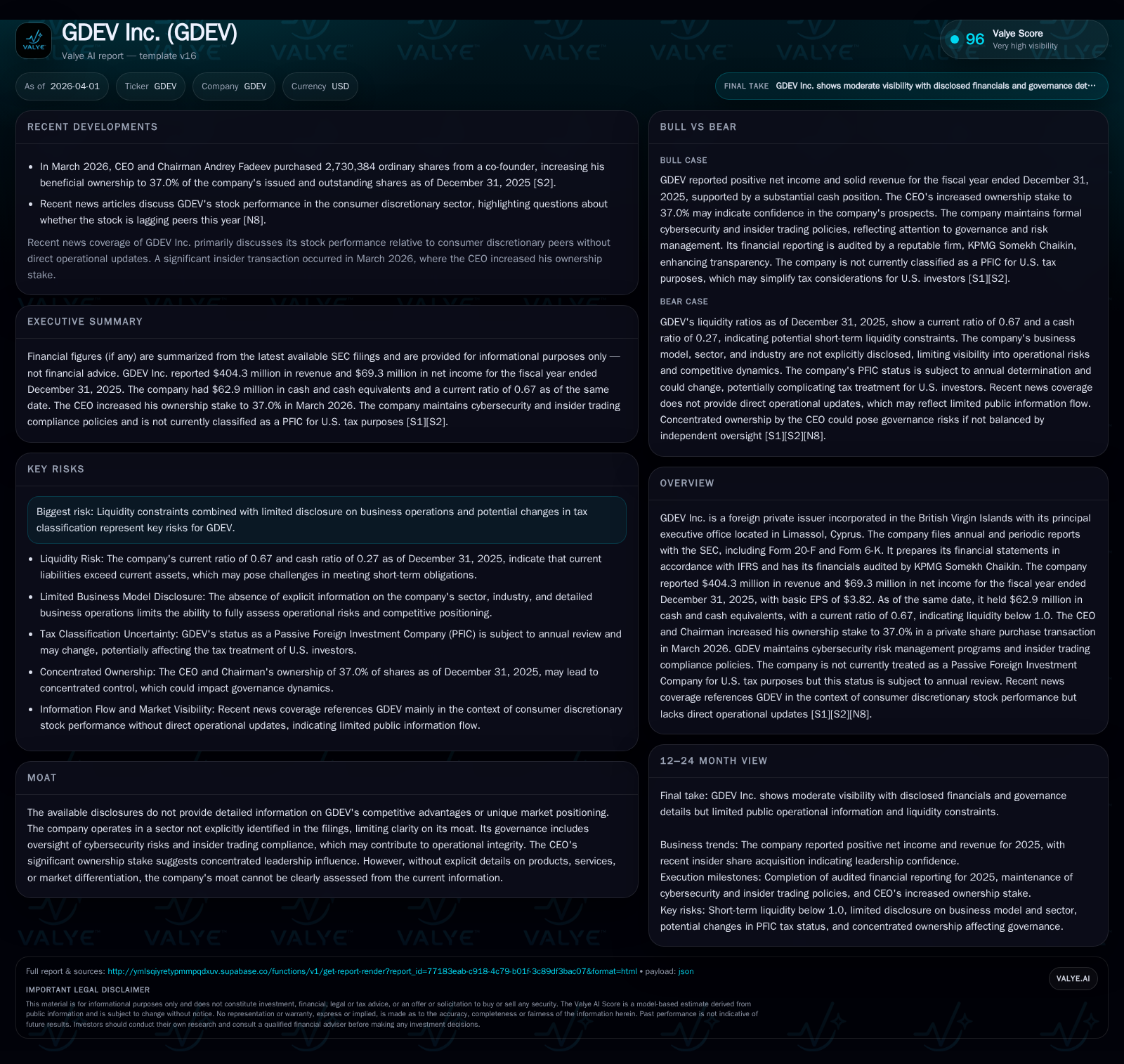
GDEV Inc. reported a marked decrease in revenue for fiscal year 2025, dropping nearly 4% to USD 404 million, while net income surged over 170% to USD 69 million, reflecting strong operational leverage or margin improvement despite top-line pressure [F1]. The company faces liquidity constraints with a current ratio at 0.67 and substantial contractual liabilities including put options totaling USD 15 million [S1][S6]. In March 2026, CEO Andrey Fadeev deepened his ownership to 37%, acquiring shares from a founding director, consolidating control amid these structural challenges [S2]. The firm operates in a largely opaque sector with limited disclosure on growth drivers or moat, emphasizing the importance of its cybersecurity frameworks and tax-related uncertainties as potential risk factors [Valye_Report_Excerpt][S1].
Historical Financial Trajectory: Revenue Declines Amid Rising Earnings
GDEV Inc.'s financial performance over the four-year period ending in FY2025 reveals contrasting trends: a consistent decline in revenue alongside volatile but ultimately substantially improved net income. Revenue decreased from USD 479.7 million in FY2022 to USD 404.3 million in FY2025, representing an aggregate decline of approximately 15.7%. Notably, the year-over-year revenue drop was nearly 4% from FY2024’s USD 420.9 million to FY2025’s figure [F1].
Conversely, net income escalated dramatically by 171.5% year-over-year in FY2025, reaching USD 69.3 million from just USD 25.5 million in the prior year. This rebound follows a previous peak in FY2023 at USD 46.1 million before the dip in FY2024 [F1]. This divergence suggests the company may have benefited from operating leverage or improved cost management despite pressures on top-line sales.
However, GDEV’s equity remains negative throughout this window, albeit improving marginally to negative USD 90.6 million at the end of FY2025 from negative USD 148.8 million at the end of FY2022. The persistently negative book value highlights ongoing balance sheet stress and impacts traditional returns metrics such as ROE which is estimated around -76.6% for FY2025 when calculated naively using net income against negative equity [F1].
Historical performance (annual)
| FY | Rev ($mm) | Net ($mm) | Rev YoY | Net YoY |
|---|---|---|---|---|
| 2025 | 404 | 69 | -3.9% | +171.5% |
| 2024 | 421 | 26 | -9.4% | -44.6% |
| 2023 | 465 | 46 | -3.2% | +522.3% |
| 2022 | 480 | 7 |
Source: SEC companyfacts cache [F1].
Capital returns and efficiency (annual)
| FY | Div ($mm) | ROE% |
|---|---|---|
| 2025 | -76.6 | |
| 2024 | -25.1 | |
| 2023 | 99 | -46.2 |
| 2022 | 99 | -5.0 |
Source: SEC companyfacts cache [F1].
Table: GDEV Inc.'s Selected Financial Data for FY2022–FY2025 extracted from SEC filings [F1]
Liquidity and Capital Structure: Navigating Below-Optimal Ratios
GDEV’s liquidity profile as of December 31, 2025 indicates substantive short-term strain with a current ratio of just 0.67 derived from current assets of USD 155 million against current liabilities of USD 232 million [F1]. This disparity underscores working capital deficits that could impede operational flexibility.
Contractual liabilities include formidable trade and other payables amounting to approximately USD 25 million due within the next twelve months, along with lease liabilities totaling almost USD 1 million currently owed but expanding over next five years [S1][S6]. Particularly notable is the presence of put option liabilities aggregating to USD 15 million repayable within twelve months, which represents a non-trivial refinancing or cash outflow risk if exercised.
Additionally, share warrant obligations are recorded at around USD 362 thousand with a maturity beyond one year [S1][S6], adding another layer of contingent liability.
These obligations place considerable pressure on GDEV’s capital structure—financing costs and refinancing risks may rise if external credit conditions tighten or revenues fail to rebound adequately.
CEO Share Purchase: Leadership Stakes Deepen Amid Structural Challenges
On March 17, 2026, CEO Andrey Fadeev completed a private purchase of approximately 2.73 million ordinary shares from co-founder Boris Gertsovskiy, increasing his personal stake to over one-third (37%) of total issued shares as of December 31, 2025 [S2]. Simultaneously, Mr. Gertsovskiy divested entirely from holdings and transferred all director appointment rights jointly held with Mr. Fadeev exclusively to him.
This transaction was explicitly personal rather than corporation-directed; it signals either heightened confidence by leadership in company prospects or an effort toward consolidating control during uncertain times marked by liquidity pressures and negative equity conditions.
From a governance perspective, such concentrated ownership may expedite decision-making yet raises questions concerning minority shareholder influence balance going forward.
Growth Prospects Shrouded by Limited Sector Clarity
Despite being publicly listed on NASDAQ with extensive reporting following IFRS standards audited by KPMG Somekh Chaikin, GDEV exposes minimal detail about its industry classification or competitive positioning within filings and risk disclosures [S1].
No direct articulation exists regarding core products or markets served; consequently, assessing sustainable growth avenues remains speculative without additional company disclosures.
Risk narratives center more heavily on operational compliance factors such as cybersecurity risk management frameworks drawn from NIST CSF and OWASP guidelines rather than product innovation or market expansion strategies [S1]. This suggests that internal efficiency and regulatory adherence may presently dominate the company's priorities over aggressive top-line growth pursuits.
Cash Flow Dynamics and Capital Allocation Patterns
Available data reveals that while GDEV reported substantial cash & equivalents balances at about USD 63 million as of fiscal year-end 2025 [F1], this stockpile contrasts against hefty contractual payables leading to stretched working capital.
Historically documented dividend payments ceased after early distributions around calendar year 2021 exceeding USD 98 million annually; no dividends were declared for subsequent fiscal periods up to fiscal year-end 2025 underscoring possible retention policies due to liquidity constraints or strategic reserves building [F1][S5][S16].
Share repurchase activity appears limited or absent recently given no explicit disclosures; capital allocation seems cautious reflective of ongoing financial tightening.
R&D expense commentary is minimal but highlighted under corporate IP sections hinting ongoing developmental investment consistent with technology-oriented firms yet exact outlays remain unspecified in quantitative terms [S10].
Cybersecurity Governance as Operational Risk Mitigation
Formally embedded cybersecurity oversight mechanisms constitute a notable strength within GDEV’s governance framework given its operational opacity resulting from nondisclosure of business specifics.
The Audit & Risk Committee bears responsibility for monitoring cyber risks while senior management—including personnel holding ISACA Certified Information Systems Auditor (CISA), ISC2 Certified Information Systems Security Professional (CISSP), and AWS Certified Security Specialty credentials—direct implementation efforts surrounding information system security spanning application layers through cloud infrastructure [S1].
Given increasing global cyber threats especially impacting technology companies operating across multi-jurisdictional environments, this structured approach constitutes prudent mitigation aligning with best practices for organizations dependent on digital asset integrity.
Potential Tax and Regulation Risks to Monitor
Taxation remains an area of inherent uncertainty tied closely to IFRS-based accounting judgments regarding indirect taxes and cross-border considerations given incorporation in British Virgin Islands with principal offices in Cyprus plus stock listing in US markets [S1].
The firm has not obtained IRS rulings regarding US federal income tax treatments; thus adverse interpretations could materially affect future earnings post taxation steps especially considering Passive Foreign Investment Company (PFIC) rules discussed broadly but without concluding treatment clarity [S1].
Moreover, undefined exposures stemming from indirect tax estimation could introduce volatility into cash flows beyond operational performance variability.
Key Metrics Table: A Vintage of Financial Stress and Recovery Signals
The following table recapitulates the annual financial performance figures discussed earlier focusing on absolute values alongside growth percentages illuminating trends relevant for ongoing evaluation:
| Year | Revenue (USD Mn) | YoY % Rev | Net Income (USD Mn) | YoY % Net Income | Equity (USD Mn) | Current Ratio |
|---|---|---|---|---|---|---|
| 2022 | 479.7 | 7.4 | -148.8 | |||
| 2023 | 464.5 | -3.2 % | 46.1 | +522.7 % | -99.8 | |
| 2024 | 420.9 | -9.4 % | 25.5 | -44.7 % | -101.5 | |
| 2025 | 404.3 | -3.9 % | 69.3 | +171.5 % | -90.6 | 0.67 |
Note: Negative equity throughout highlights sustained balance sheet deficits despite profit improvements.
Disclaimer: This report synthesizes facts as disclosed within SEC filings and validated XBRL data regarding GDEV Inc., excluding any investment recommendations or forward-looking guidance absent from official sources.
Disclaimer: This is research-only, informational analysis and not investment advice. It may include AI-generated interpretation and general industry context. Always verify important details using primary sources.

Comments