
Zeo Energy Corp. Battles Profitability Challenges While Expanding US Solar Footprint
Zeo Energy pursues broad geographic growth and vertical integration but struggles with mounting losses amid industry headwinds.
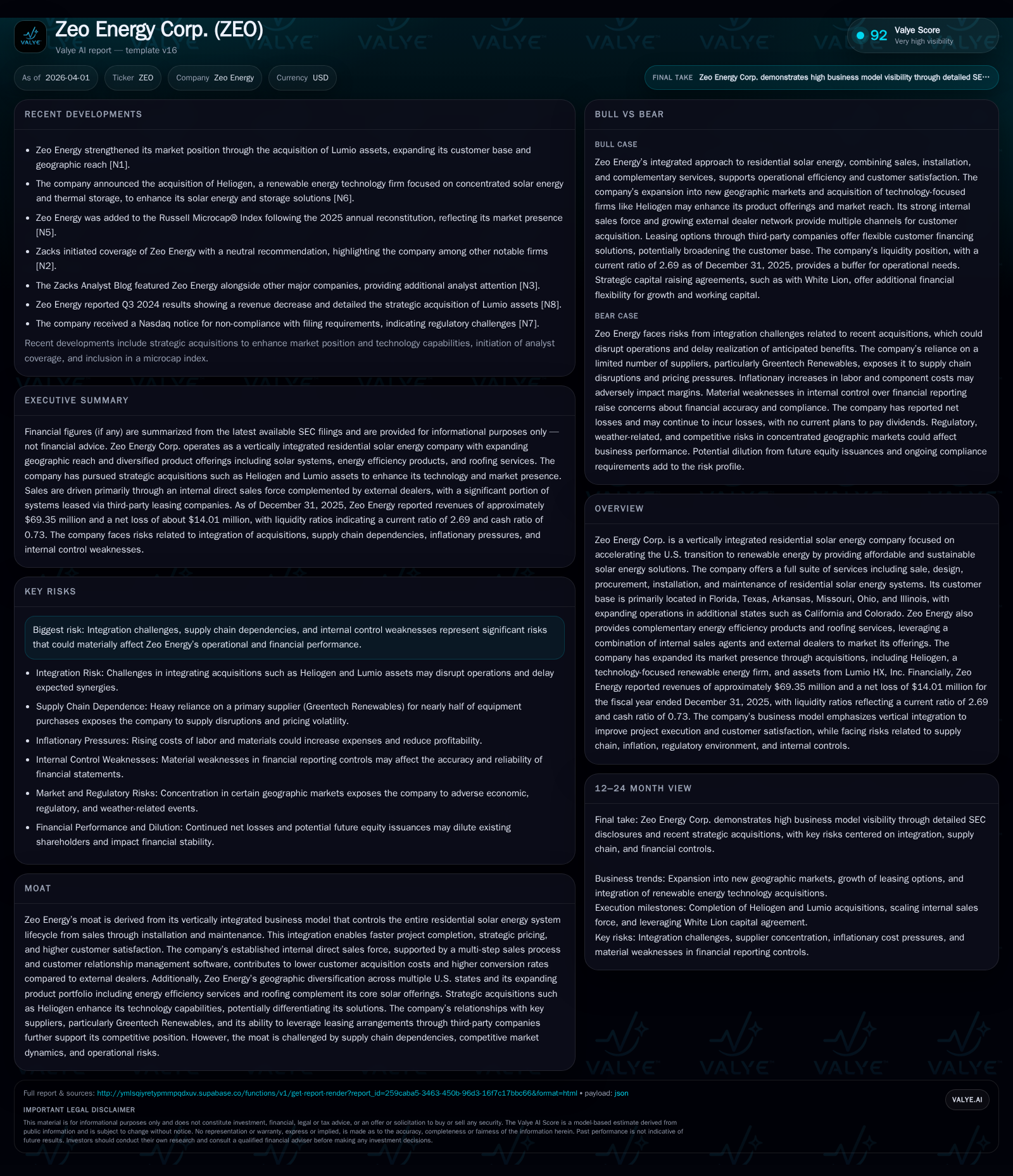
Zeo Energy Corp. has rapidly expanded its residential solar energy footprint across multiple U.S. states through a vertically integrated business model and strategic acquisitions like Heliogen and Lumio HX assets. Despite top-line revenues hovering near $70 million in 2025, the company faces steeply deteriorating profitability, with operating losses nearly doubling year-over-year and negative net income reversing prior gains. Its integration of sales, design, procurement, installation, and maintenance aims to drive customer conversion and satisfaction but also introduces operational complexities and supply chain vulnerabilities amid fluctuating regulatory environments and tariffs on solar equipment. Zeo’s liquidity remains solid with a current ratio near 2.7, though cash flow burn is significant, driven by growing capital expenditures as it invests in scaling capacity. Going forward, growth hinges on expanding energy efficiency offerings and geographic reach, yet profitability constraints and regulatory risks remain material challenges.
Historic Revenue Trends and Profitability Dynamics
Zeo Energy Corp.’s financial trajectory from FY2022 through FY2025 paints a stark picture of mounting operating challenges despite steady revenue scale. In FY2025, revenue declined by 5.3% to $69.3 million from $73.2 million in FY2024, signaling pressure on top-line growth likely influenced by macroeconomic instability within the residential solar sector [F1]. Concurrently, operating losses nearly doubled year-over-year (89.6% increase) soaring to $20.5 million in FY2025 from $10.8 million the prior year.
Net income followed an even more volatile path, plummeting from a modest loss of roughly $1.8 million in FY2024 to a deeper loss exceeding $14 million in FY2025 — a nearly sevenfold deterioration (669.6%) compared with the positive net income of approximately $14.3 million recorded in FY2022 [F1]. This erosion reflects both increased sales channel costs amidst an expansive internal sales force and the burdensome expenses related to acquisitions and integration efforts.
Margins have come under sustained pressure due to competitive pricing dynamics against large electric utilities — Zeo's primary competitors — compounded by supply chain constraints inflating input costs for panels and inverters predominantly imported from China subject to antidumping (AD) and countervailing duties (CVD) [S1][S6][S7]. These tariffs elevate procurement costs despite volume-based negotiation advantages within their vertical integration model.
Unpacking Vertical Integration as a Moat and Its Operational Impact
Central to Zeo Energy’s strategic moat is its vertically integrated business model managing the entire residential solar value chain: from direct-to-consumer sales via an internal team optimizing sales funnel conversion rates to engineering design, procurement partnerships primarily through Consolidated Electrical Distributors (Greentech Renewables), installation execution including subcontracts where needed, as well as post-installation maintenance services [S10][S11]. This integration enhances installation throughput speed after contracts close — helping reduce delays typical within municipal permitting processes — resulting in higher job completion ratios versus dealer-originated sales.
Additionally, Zeo employs a multi-step setter-closer internal sales process complemented by proprietary customer relationship management software that tracks key pipeline metrics at every stage of sale development [S10]. This approach lowers customer acquisition cost sensitivity compared to external dealers who often lack such coordinated feedback loops or real-time project oversight.
However, this intricate structure invites integration complexity risks especially following acquisitions like Heliogen in 2025 which focuses on concentrated solar energy technology for commercial applications — presenting new operational demands outside residential domains — alongside absorbing incomplete project backlogs from bankrupt Lumio HX impacting California market deployments [N1][S2]. Such integration requires harmonizing disparate systems accounting for procurement efficiencies with consistent installation quality control protocols.
The balance between leveraging cost efficiencies across procurement channels versus managing layered operational workflows contributes significantly to both conversion success rates and margin compression observed in recent fiscal periods.
Geographic Expansion and Market Penetration: Recent Developments
Zeo’s geographic footprint spans established markets primarily in Florida, Texas, Arkansas, Missouri, Ohio and Illinois with increasing exposure into high-potential but fiercely competitive western states including California and Colorado as of late 2024–2025 [N1][S10]. The acquisition of Lumio HX assets enabled rapid entry into markets where unfinished installations presented growth opportunities but also potentially delayed revenue recognition due to construction backlogs.
This multi-state deployment strategy intends to capture regions demonstrating favorable electricity retail pricing structures coupled with supportive net metering policies incentivizing residential solar adoption [S25]. However, local regulatory variances impose operational adjustments; for instance California’s regulatory environment imposes comprehensive interconnection procedures distinct from those observed across Midwestern jurisdictions impacting permit cycle timing.
Zeo continues expanding external dealer relationships augmenting its internal sales force presence to ensure scalable lead generation without fully bearing recruitment overheads within new locales [S25]. Yet market penetration rates remain sensitive to consumer adoption cycles affected by economic conditions influencing long-term contract commitments essential for upfront capital recoupment.
Risks from Regulatory Shifts, Supply Chain Pressures, and Integration Hurdles
Zeo faces layered risks emanating from volatile government policy changes that dictate solar incentive availability such as tax credits, rebates and utility tariffs crucial for customer economics driving demand [S1][S4][S6][S7]. Potential cliffs or reductions in these incentives could depress demand ahead with limited mitigation given Zeo's capital intensity.
Furthermore, U.S.-imposed tariffs on imported crystalline silicon PV cells originating predominantly from China disrupt supply chains increasing component prices notably through antidumping (AD) and countervailing duties (CVD). Geopolitical trade restrictions contribute additional sourcing uncertainty complicating procurement cost forecasting [S7][S14].
Compliance risk arises around ensuring internal sales personnel and external dealers uniformly adhere to evolving regulations governing customer data privacy laws (especially California’s CCPA), home improvement contract statutes, licensing requirements for electricians involved in installations, as well as truthful marketing practices under consumer protection laws [S4][S6]. These constraints necessitate continuing investments in training programs and monitoring systems to prevent litigation or regulatory fines attributable to noncompliance or perceived misconduct.
Legal proceedings remain infrequent currently but the company acknowledges routine exposure inherent in managing subcontractor obligations as well as numerous jurisdictional standards across states amplifying administrative burden [S5][S6].
Capital Allocation, Liquidity Position, and Shareholder Returns
Despite ongoing losses, Zeo maintains liquidity strength demonstrated by a robust current ratio of approximately 2.69 at the end of FY2025 based on current assets of $22.55 million against liabilities near $8.39 million providing sufficient short-term financial flexibility [F1][S16]. Nonetheless, operating cash flow continues reflecting burn patterns consistent at about -$8.7 million annually over recent years leading to a free cash flow deficit approaching -$9.9 million after accounting for a capex surge (+231% YoY) which climbed to about $1.22 million primarily invested toward expanding installation capacity and technology upgrade initiatives supporting scalability objectives through workforce training tools and software enhancements [F1][S15].
Equity stands at roughly $5.33 million compared with deepening net losses ensuring a heavily negative return on equity estimated near -263%, underscoring challenges producing shareholder value absent profitable operational turnaround [F1]. Dividend distributions remain symbolic totaling just over $620K paid out during FY2025 despite sizable deficits evidencing a conservative approach toward capital return with no share repurchases noted or signaled given need for reinvestment prioritization amid scaling efforts [F1][S27].
Looking Ahead: Growth Opportunities Versus Profitability Constraints
Management emphasizes plans for continued expansion into additional states selected upon criteria involving electricity rate structures, existing solar market saturation levels, regulatory favorability concerning net metering policies, and potential dealer network development capacity allowing penetration without disproportionate upfront investment hurdles [N2][N3][S25]. Complementary offerings around energy efficiency products—such as insulation upgrades and hybrid water heaters—as well as roofing services promise incremental revenue streams diversifying dependence on solar installed-system volume alone.
However industry-wide demand uncertainties intensified by fluctuating macroeconomic factors including employment rates affecting creditworthiness of potential customers dampen visibility into sustained growth trajectories [S1]. Capital-intensive nature of projects coupled with seasonality effects related to weather conditions also contribute operational volatility obscuring near-term margin improvement projections.
No explicit guidance has been issued recently regarding milestone targets or profitability timelines; investors should monitor trajectory of internal direct sales funnel conversion efficiency metrics mentioned by management for indications that customer acquisition cost elasticity can be reined in alongside successful integration outcomes following recent acquisitions particularly around Heliogen's commercial-scale renewable solutions incorporation [N2][N3][S2].
Key Financial Metrics Table: A Snapshot of Zeo’s Recent Fiscal Performance
Historical performance (annual)
| FY | Rev ($mm) | Net ($mm) | CFO ($mm) | OpInc ($mm) | Rev YoY | Net YoY |
|---|---|---|---|---|---|---|
| 2025 | 69 | -14 | -9 | -21 | -5.3% | -669.6% |
| 2024 | 73 | -2 | -9 | -11 | +39.3% | |
| 2023 | -3 | 1 | -5 | -120.9% | ||
| 2022 | 14 | 3 | -3 |
Source: SEC companyfacts cache [F1].
Capital returns and efficiency (annual)
| FY | Div ($) | FCF ($mm) | ROE% |
|---|---|---|---|
| 2025 | 621063 | -10 | -262.8 |
| 2024 | 139067 | -9 | 2.0 |
| 2023 | 34.0 | ||
| 2022 | -119.5 |
Source: SEC companyfacts cache [F1]. Table captures key revenue trends with simultaneous operating performance deterioration outlined alongside cash flow dynamics.
This report synthesizes substantial SEC filings along with recent news releases emphasizing Zeo's aggressive expansion efforts counterbalanced by escalating financial headwinds common under complex vertical integration strategies within competitive renewable energy sectors.
Disclaimer: This analysis is for informational purposes only. It does not constitute investment advice or recommendations regarding securities transactions.
Disclaimer: This is research-only, informational analysis and not investment advice. It may include AI-generated interpretation and general industry context. Always verify important details using primary sources.

Comments