
Conagra Brands' Earnings and Revenue: Decoding Recent Shifts and Future Ambitions
Conagra's iconic brand portfolio fuels organic growth even as earnings face headwinds from cost pressures and liquidity constraints.
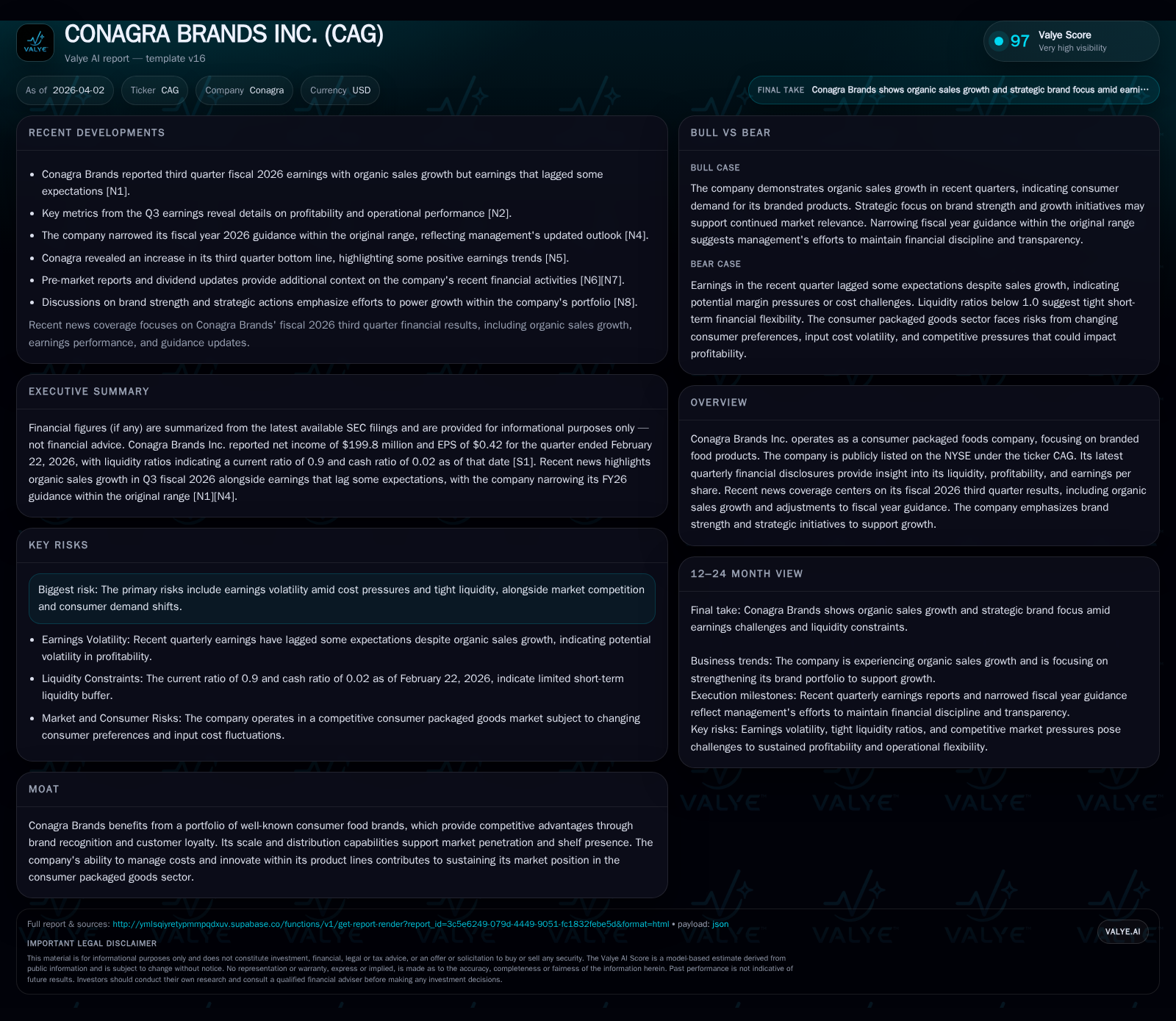
Conagra Brands Inc. exhibits a paradox of strong brand-driven revenue resilience countered by margin compression and tight liquidity that challenge earnings growth. The company's fiscal 2025 results show a notable top-line decline tempered by a rebound in operating and net income driven by operational efficiencies. Recent Q3 fiscal 2026 reported organic sales growth contrasts with an earnings miss, highlighting ongoing cost absorption difficulties. Strategic initiatives focus on innovation and channel expansion, while capital allocation remains disciplined amid working capital pressures and heightened market competition.
From Market Leader to Recent Performance: Tracing Revenue and Earnings Evolution
Conagra Brands Inc., a stalwart in the consumer packaged foods sector driven by a roster of household names, is currently navigating a complex financial narrative. Its FY2025 figures reveal a revenue downturn to about $1.5 billion — a steep approximately 21% fall from FY2024 levels near $1.9 billion [F1]. This retreat reflects intensified competition and shifts in consumer preferences impacting top-line traction.
Yet beneath this surface-level shortfall lies an intriguing rebound in profitability. Operating income advanced by over 16% year-over-year to roughly $1.36 billion in FY2025, recovering from prior margin headwinds, an indication of more effective cost management strategies [F1]. Even more pronounced is the net income surge exceeding 230%, climbing to just above $1.15 billion, partly due to operational efficiencies combined with perhaps favorable one-time items reported in filings [F1].
This divergence between revenue softness and margin accretion suggests that Conagra has leveraged its scale advantages while optimizing its brand portfolio's production footprint. However, operating cash flow tells a more cautious story: down nearly 16% year-over-year to about $1.69 billion, revealing that the company faces challenges converting earnings strength into liquid resources seamlessly. Capital expenditures remain stable at around $389 million, pointing to continued investments underpinning growth ambitions [F1].
Historical performance (annual)
| FY | Net ($mm) | CFO ($bn) | OpInc ($mm) | Capex ($mm) | Net YoY |
|---|---|---|---|---|---|
| 2025 | 1152 | 1.7 | 1365 | 389 | +231.9% |
| 2024 | 347 | 2.0 | 1175 | 388 | -49.2% |
| 2023 | 684 | 1.0 | 1464 | 362 | -23.0% |
| 2022 | 888 | 1.2 | 1588 | 464 |
Source: SEC companyfacts cache [F1].
Capital returns and efficiency (annual)
| FY | Div ($mm) | Buybacks ($mm) | FCF ($mm) |
|---|---|---|---|
| 2025 | 669 | 64 | 1303 |
| 2024 | 659 | 150 | 1628 |
| 2023 | 624 | 150 | 633 |
| 2022 | 582 | 50 | 713 |
Source: SEC companyfacts cache [F1].
Source: Financial data compiled from Conagra’s SEC filings [F1].
Dissecting the Fiscal 2026 Third Quarter: Organic Sales Uptick vs Earnings Miss
The Q3 fiscal year 2026 reporting cycle illuminated a tension between topline vitality and bottom-line performance at Conagra. Despite posting encouraging organic sales increases—a key barometer for true consumer demand untouched by pricing or acquisition effects—the company failed to meet consensus earnings expectations [N1][N2].
This earnings shortfall chiefly traces back to margin contraction resulting from persistent input cost inflation that outpaced price realization efforts—a scenario frequently termed 'cost absorption' challenges within the food-packaged goods realm [S2][S3]. Elevated commodity prices for raw materials such as grains and packaging supplies undermined profitability even as brand loyalty preserved volume growth.
Moreover, intensifying competition among packaged goods brands has pressured channel mix dynamics, necessitating higher trade promotions or discounts which further squeezed margins [N3]. Collectively, these factors underscore the fragile balance Conagra maintains between sustaining organic growth through brands while battling cost headwinds.
Strategic Levers for Growth: Brand Innovation and Market Penetration Plans
Conagra’s path forward leverages its enduring moat anchored on strong brand equity and expansive distribution networks—tools it actively refines through an innovation pipeline focused on product differentiation and health-conscious choices—themes resonant with evolving consumer tastes [N4][N7].
The company is reportedly prioritizing channel expansion initiatives targeting emerging retail formats including e-commerce platforms and convenience channels that capture younger demographic segments increasingly seeking convenience without sacrificing quality or taste.
Portfolio enhancement is also underway via reformulations reducing sodium or artificial ingredients aligning with wellness trends, reinforcing brand relevance within competitive shelf real estate.
Such initiatives suggest management’s intent on fortifying organic growth potential notwithstanding external cost pressures.
Constraints on Expansion: Cost Pressures, Competitive Landscape, and Consumer Dynamics
Despite strategic optimism, Conagra wrestles with multiple headwinds constraining margin expansion or sales acceleration beyond current plateaus [S4][N14]. Input cost volatility remains volatile due to macroeconomic factors such as energy costs impacting supply chain efficiency.
Pricing power is limited given intense competition in both premium and value segments of the industry; consumers have exhibited increased price sensitivity as discretionary budgets tighten amid inflationary cycles.
Furthermore, shifts in channel mix—with greater reliance on channels demanding higher trade spend—exert additional pressure on profitability frameworks.
These forces converge to cap upside potential absent significant innovations or market disruptions.
Outlook and Milestones: Guidance Refinements and What Investors Should Monitor
For fiscal year 2026 overall, management has narrowed guidance ranges but kept them within original brackets reflecting cautious confidence tempered by uncertainty around commodity price trends and macroeconomic conditions [N4][N10].
Market-watch points center on sustaining organic sales momentum amidst intensifying economic challenges and assessing any inflection points where gross margin trajectories might stabilize or improve.
Monitoring quarterly updates for shifts in input costs pass-through effectiveness as well as changes in promotional intensity will also help decode forward earnings viability.
Capital Deployment Recap: Dividends, Share Buybacks, and Cash Flow Analysis
On capital allocation fronts, Conagra maintains a robust dividend payout history with disbursements around $669 million for FY2025—an increase over prior years—signaling commitment to shareholder returns even amid earnings variability [F1][S11][S19].
Conversely, share buyback activity has receded recently from $150 million in prior years down to approximately $64 million in FY2025 signaling selective capital discipline aligned with liquidity preservation priorities.
Free cash flow—operating cash flow less capex—remains positive at roughly $1.3 billion supporting dividend coverage while preserving flexibility against episodic liquidity stresses.
Liquidity Dynamics: Navigating Current Assets, Liabilities, and Structural Leverage
Liquidity indicators portray constraints masked behind strong brand fundamentals: the current ratio settled near a cautious sub-1 benchmark (approximate current assets at $2.89 billion against liabilities of $3.21 billion) illustrating working capital pressures potentially tied to inventory builds or receivables extension strategies amidst supply-chain variability [F1][S14][S16].
Structural leverage levels compounded by recent debt maturities require vigilant balance sheet management although no immediate distress signals appear based on filings.
Efficient working capital turnover will be critical going forward to mitigate liquidity risks without sacrificing operational throughput.
Risks on the Horizon: Volatility Drivers from SEC Risk Disclosures
Conagra’s public risk disclosures echo broad sector concerns encompassing litigation exposures typical for food companies alongside regulatory compliance complexities particularly around labeling standards or ingredient disclosures [S4][S7][S8].
Commodity price swings remain an uncontrollable variable affecting input costs unpredictably—risks heightened amidst geopolitical uncertainties impacting agricultural markets.
Supply chain disruptions threaten production continuity although ongoing mitigation measures are noted.
Earnings volatility is thus an expected feature framing cautious but proactive management responses.
This analysis aims solely to provide a comprehensive review of available data on Conagra Brands without constituting investment advice or recommendations. Readers should consider publicly available information comprehensively before forming opinions related to the company’s financial prospects or risks.
Disclaimer: This is research-only, informational analysis and not investment advice. It may include AI-generated interpretation and general industry context. Always verify important details using primary sources.

Comments