
Direct Digital Holdings Wrestles With Liquidity and Platform Hurdles in 2025
The company’s sharp financial losses and tight liquidity contrast with operational challenges amid evolving digital advertising conditions.
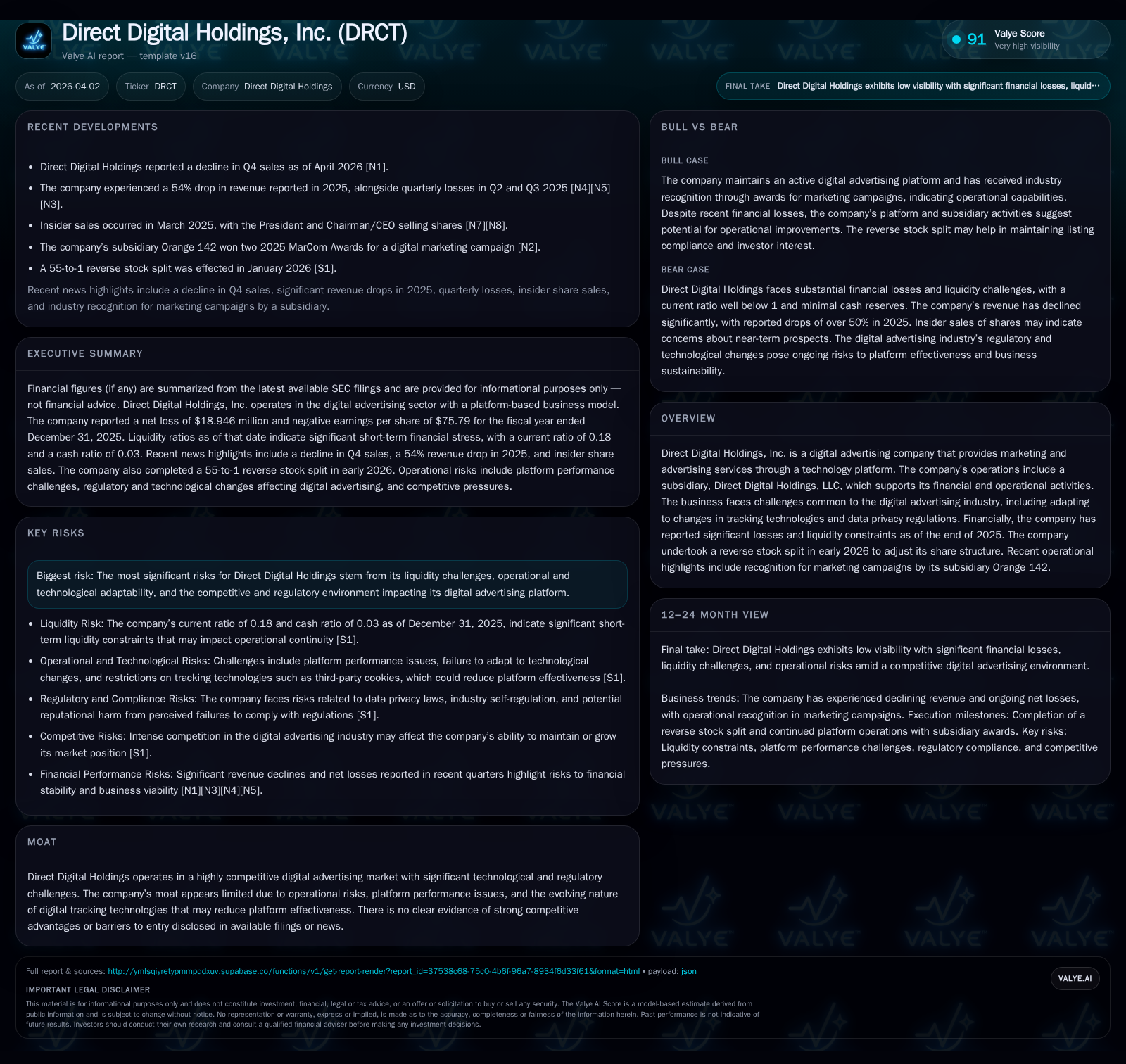
Direct Digital Holdings, Inc. experienced significant declines in profitability and cash flow through 2025, with net losses more than tripling year-over-year. The company faces operational headwinds from changes in tracking technologies, regulatory pressures, and competitive intensity that have impaired platform effectiveness. Management has implemented a 55-for-1 reverse stock split and amended equity financing agreements to enhance liquidity. Despite these efforts, cash reserves remain limited relative to liabilities, highlighting ongoing balance sheet vulnerabilities and constraining shareholder return potential.
Financial Performance Highlights: Declining Profitability and Cash Flow
Direct Digital Holdings reported an operating loss of $14.8 million for fiscal year 2025, representing an 11.5% decline compared to the prior year's operating loss of $13.2 million [F1]. The net loss widened substantially to $18.9 million in 2025 from $6.2 million in 2024, marking a deterioration exceeding 200% year-over-year [F1]. These figures underscore escalating operational challenges.
Operating cash flow remained negative at $8.9 million for the year, nearly flat compared to the prior year's outflow of $8.6 million. Combined with modest capital expenditures near $20,000 annually, free cash flow also stayed deeply negative around -$8.9 million, exacerbating liquidity concerns [F1].
Liquidity pressures intensified as current assets totaled approximately $4.7 million against current liabilities of $26.4 million at December 31, 2025, resulting in a critically low current ratio of just 0.18 [F1]. Cash and equivalents were limited to $728,000.
Historical performance (annual)
| FY | Net ($mm) | CFO ($mm) | OpInc ($mm) | Capex ($) | Net YoY |
|---|---|---|---|---|---|
| 2025 | -19 | -9 | -15 | -203.8% | |
| 2024 | -6 | -9 | -13 | -184.2% | |
| 2023 | -2 | 3 | -2 | 19000 | -152.7% |
| 2022 | 4 | 2 | 8 | 19479 |
Source: SEC companyfacts cache [F1].
Capital returns and efficiency (annual)
| FY | FCF ($mm) | ROE% |
|---|---|---|
| 2025 | ||
| 2024 | ||
| 2023 | 3 | -96.2 |
| 2022 | 2 | 90.7 |
Source: SEC companyfacts cache [F1].
Table: Annual financial performance shows worsening losses since FY2023 alongside sustained negative cash flows.
Operational Environment: Regulatory and Technological Obstacles
Direct Digital's platform confronts significant challenges due to evolving industry dynamics such as restrictions on third-party cookies and mobile device identifiers essential for ad targeting and measurement [S4][S13]. These factors diminish tracking reliability crucial for digital advertising monetization.
Simultaneously increasing data privacy regulations impose compliance complexities that may limit marketing reach or efficiency [S5][S13]. The company also faces risks related to advertising fraud detection lapses which could cause reputational harm and financial loss if fraudulent activity distorts campaign outcomes or billing accuracy [S8][N1].
High customer concentration further elevates revenue volatility risks if major clients reduce business or delay payments [S6][N1]. Moreover, intense competition from well-funded peers investing heavily in technology exacerbates pricing pressure and client retention challenges.
Strategic Outlook: Management Initiatives Amid Uncertainty
Management emphasizes navigating these headwinds by upgrading technology to adapt to digital tracking restrictions through alternative data strategies and non-cookie attribution methods [N1]. Efforts also focus on diversifying the client base to reduce dependency on large accounts vulnerable to volatility.
While no explicit growth forecasts or timelines were provided, recent industry recognition for its Orange142 subsidiary’s marketing campaigns highlights some operational strengths despite broader market difficulties.
Capital Structure Actions: Reverse Stock Split and Equity Financing Facility
In January 2026, the company completed a reverse stock split at a ratio of 55-to-1 aimed at meeting Nasdaq minimum bid price requirements after extended periods below threshold levels while improving share structure perception among investors [S11][S24][S27].
Additionally, an amendment to the equity reserve facility with New Circle Principal Investments LLC permits Direct Digital to issue up to $100 million of Class A common stock under predetermined discount pricing formulas tied to recent market prices—providing a critical potential funding source amid liquidity constraints [S12].
Monitoring the timing and extent of share issuances under this facility will be important indicators of financial flexibility recovery.
Capital Allocation Focused on Liquidity Preservation
No dividends or share buybacks were declared during this period given ongoing losses; capital deployment centers on maintaining liquidity and operational continuity rather than shareholder returns [S9][S16][F1].
Share issuances under equity sale agreements represent the primary source of working capital support amid constrained cash balances relative to liabilities. Loan amendments have deferred principal repayments into late-2026 while incorporating substantial fees added to outstanding balances—highlighting survival-oriented financial management [S20][F1].
Shareholder Value Considerations: Negative Returns Reflect Ongoing Challenges
Given the growing net losses combined with a modest equity base estimated near $2.3 million as of end-2023 (latest available), approximate return on equity stands near -830%, underscoring significant erosion of shareholder value driven by persistent unprofitability and weak cash flows [F1].
Persistent negative operating cash flows since FY2024 further strain debt servicing capacity absent improved margins or revenue growth.
In a rapidly evolving digital advertising landscape where agility is key to monetization success amid regulatory shifts and privacy concerns, Direct Digital faces substantial hurdles that constrain confidence around near-term recovery of shareholder returns.
This analysis synthesizes all available SEC filings through fiscal year-end December 31, 2025 along with recent disclosures into early 2026. Forward-looking observations are analytical perspectives based solely on disclosed corporate information without speculative assumptions or unsupported forecasts.
Disclaimer: This is research-only, informational analysis and not investment advice. It may include AI-generated interpretation and general industry context. Always verify important details using primary sources.

Comments