
XWELL, Inc. Faces Capital Hurdles While Reframing Wellness Offerings for Travelers
XWELL balances operational restructuring and capital constraints to reshape its airport-focused wellness and bio-surveillance businesses.
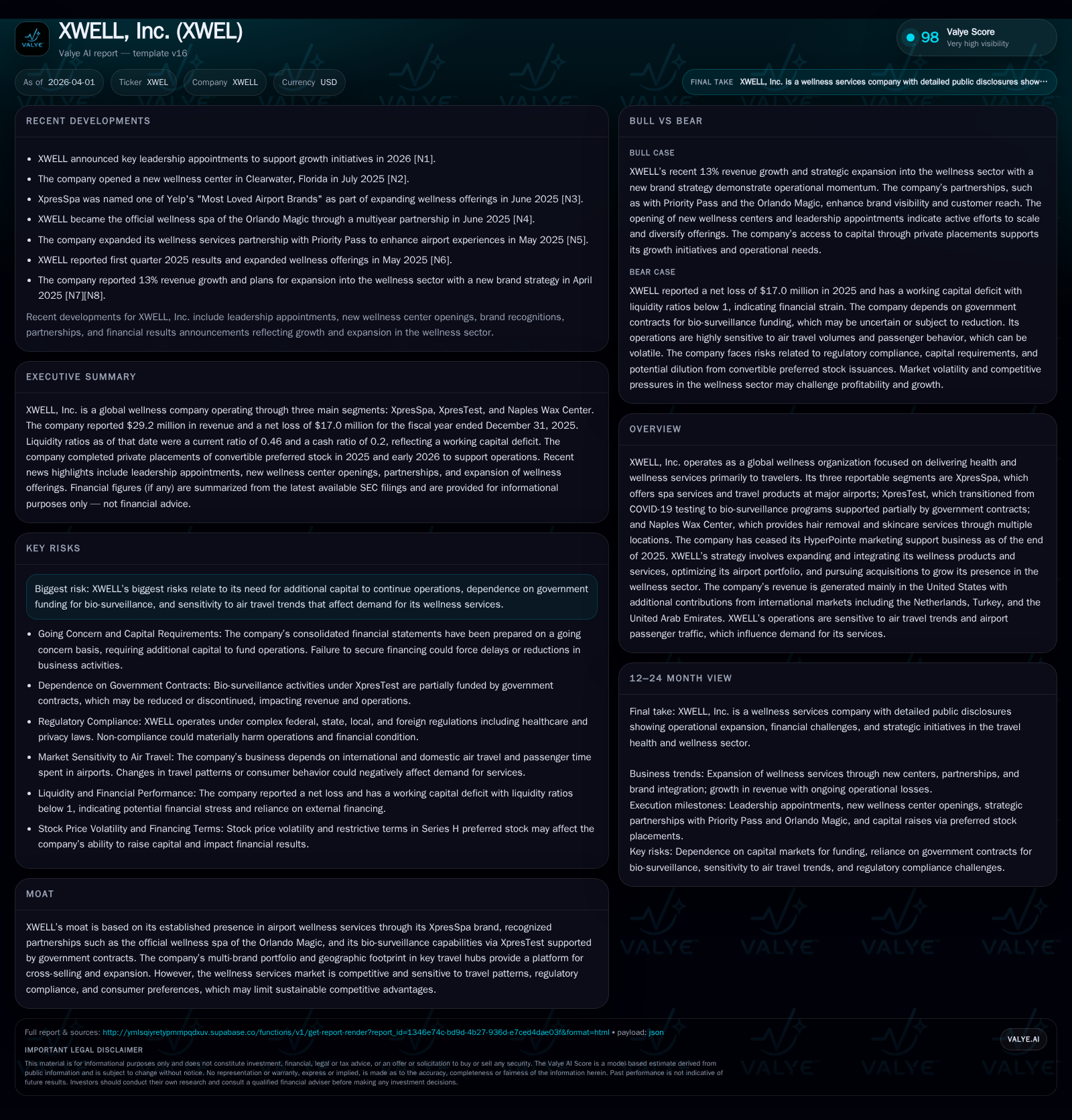
XWELL, Inc.’s recent years have seen revenue contraction amid persistent operating losses, reflecting challenges in its spa and bio-surveillance segments tied to travel patterns and government funding dependencies [F1][S1]. The company’s strategic pivot includes ceasing its HyperPointe marketing business and focusing on integrating wellness offerings at airports alongside growth in bio-surveillance supported partly by government contracts [S1][S9]. Despite significant liquidity pressures resulting in working capital deficits as of end-2025, recent private placements of convertible preferred stock have improved near-term solvency prospects [S4][S6][F1]. Leadership changes announced in early 2026 aim to strengthen operational execution and international expansion [N1]. Future growth is tempered by the volatility of air travel demand, reliance on government contracts, and regulatory risks. XWELL has not returned capital via dividends or buybacks recently due to financial strain but continues to invest selectively in its assets [F1][S18].
Financial Trajectory: Analyzing XWELL’s Recent Performance Decline and Cost Structure
XWELL's financials over the past four years tell a story of contraction yet tentative stabilization after sharp declines during the pandemic era. Revenue dropped substantially from $55.9 million in FY2022 down to $29.2 million in FY2025 (-47.8% cumulatively), with a notable dip between FY2024 ($33.9 million) and FY2025 (-13.8%) [F1]. Operating losses remained sizable but improved from a peak loss of approximately -$31.2 million in FY2022 narrowing down modestly to about -$15.7 million in FY2025 (a 6.2% YoY improvement) [F1]. Despite the shrinking top-line, expenses related to labor, occupancy (notably costly airport leases), product costs, depreciation plus impairments kept the gross profit margin under pressure.
Operating cash flows remained firmly negative throughout this period though showed relative improvement from -$24.2 million in FY2022 to -$8.7 million by FY2025 as cost controls took hold but were insufficient for positive cash flow generation [F1][S12]. The company's capex notably contracted following pandemic lows yet increased again sharply by more than 66% YoY into FY2025 ($2.96 million) as investments targeted asset optimization across segments.
This tighter cash flow dynamic also amplifies fixed cost challenges inherent in airport-based wellness services where lease liabilities (operating leases recognized at $7 million long term) contribute heavily to leverage without commensurate revenue uplift when passenger flows decline [S4][S17].
Segment Insights: Spa Services, Bio-surveillance Pivot, and the Wax Center Contribution
XWELL’s operations span three reportable segments differentiated primarily by customer location and service focus:
- XpresSpa: Core airport spa services offering massages, skincare treatments, and travel-related products centered around high foot-traffic hubs like major US airports.
- XpresTest: Originally built for COVID-19 testing at airports but now repositioned towards broader public health bio-surveillance programs supported via government contracts—particularly wastewater and nasal sampling coordinated with agencies such as CDC [S1][S9]. This segment’s pivot reflects adaption to falling pandemic test demand and pursuit of more stable institutional funding.
- Naples Wax Center: Operates upscale hair removal and skincare outlets beyond airports (currently six locations), extending wellness offerings into retail-based personal care.
The cessation of the HyperPointe marketing support business by end-2025 indicates strategic refocusing away from non-core direct-to-business services toward integrated wellness [S1]. Cross-selling potential exists among these brands given geographic overlap and traveler-centric touchpoints but requires execution amidst evolving traveler behaviors.
Liquidity Stress and Capital Infusions: Private Placements as a Lifeline
Liquidity challenges represent one of XWELL’s most acute issues heading into fiscal 2026. At December 31, 2025, the company reported a working capital deficit approaching $7 million owing mainly to current liabilities nearly twice current assets ($12.9 million vs $5.9 million) [F1][S4]. This deficit situation prompted 'going concern' language alerting investors that additional capital was imperative for ongoing viability.
Responding to this need, XWELL executed a series of equity-linked financings:
- January 14, 2025: Series G Convertible Preferred Stock issuance raising approximately $4 million alongside warrants issued at strike prices around $1.50 per share [S5].
- February 24, 2026: Larger private placement delivering gross proceeds near $31.3 million via Series H Convertible Preferred issuance priced at market (conversion price approx $0.47/share). Part of these funds repurchased senior notes (~$9 million), redeemed some Series G preferreds and provided working capital infusion [S6][S20].
These transactions helped alleviate immediate solvency pressures though increased complexity around equity dilution given conversion features embedded in preferred stocks and warrants [S25]. The balance sheet remains technically insolvent with equity deep negative at approximately -$22.3 million as of end-2025 reflecting cumulative net losses offset only partially by this recent capital influx [F1][S8].
Strategic Leadership Changes Aiming to Unlock Growth Opportunities
In early April 2026, XWELL announced key executive appointments designed explicitly to strengthen management bandwidth for expanding internationally, optimizing operations financially and operationally, and advancing acquisition-led growth initiatives [N1]. This leadership refresh aims at addressing previously noted governance control weaknesses flagged internally and externally [S1].
Institutional investors likely view these moves as steps toward tighter accountability frameworks while cementing roadmaps for sustainable profitability expansion within the challenging wellness marketplace that increasingly overlaps public health surveillance demands.
Outlook on Expansion Versus Operational Risks from Market Sensitivities
Looking forward, XWELL’s growth narrative hinges on several factors:
- Passenger traffic recovery post-pandemic directly influences onsite spa visit frequency; shrinking dwell times or altered traveler behaviors could cap upside [S7][S27].
- Continuation or expansion of government bio-surveillance funding is critical for sustaining XpresTest revenues; such contracts remain competitive with renewal risk [S1][S7].
- Regulatory compliance across jurisdictions (U.S., Netherlands, Turkey, UAE) imposes operational complexity with licensing requirements potentially limiting fluid expansion [S15][S21].
- Consumer preferences toward wellness services evolve rapidly demanding innovation in product portfolios coupled with brand affinity management amid competitive pressure.
Risk management conversations center on forecasting travel pattern analytics while coordinating closely with public health policy shifts affecting funding cycle stability.
Capital Allocation Patterns: Debt, Equity, and Returns to Shareholders
Historical capital returns are non-existent with no dividend distributions or share buybacks recorded over recent fiscal years reflecting cash conservation imperatives during losses accumulation phases [F1][S18]. Instead:
- Significant equity issuances under preferred stock arrangements with attached warrants have dominated capital raises,
- Convertibles introduced derivative liabilities adding accounting complexity,
- Debt was partly retired using infusion proceeds but overall leverage heavily influenced by operating lease commitments remains elevated [F1][S24].
Return on equity analysis is academic here given deeply negative book equity (-$22M) against net losses (-$17M annually), implying technical insolvency yet modest improvement trajectory because fresh financing injections increase net assets accordingly [F1].
Key Metrics Table: Historical Financial Performance Snapshot
Historical performance (annual)
| FY | Rev ($mm) | Net ($mm) | CFO ($mm) | OpInc ($mm) | Rev YoY | Net YoY |
|---|---|---|---|---|---|---|
| 2025 | 29 | -17 | -9 | -16 | -13.8% | -0.8% |
| 2024 | 34 | -17 | -11 | -17 | +12.6% | +39.2% |
| 2023 | 30 | -28 | -16 | -28 | -46.2% | +15.5% |
| 2022 | 56 | -33 | -24 | -31 |
Source: SEC companyfacts cache [F1].
Capital returns and efficiency (annual)
| FY | Buybacks ($mm) | FCF ($mm) | ROE% |
|---|---|---|---|
| 2025 | -12 | 76.3 | |
| 2024 | -13 | 2138.7 | |
| 2023 | 24 | -18 | -213.4 |
| 2022 | 24 | -31 | -82.2 |
Source: SEC companyfacts cache [F1].
Table summarizes consolidated annual results illustrating declining revenues alongside persistent operational deficits mitigated somewhat by cost cuts.
Risks on Horizon: Government Contracts, Travel Trends,and Regulatory Pressures
The company highlights multiple material risks that could materially impact future performance:
- Reliance on government-operated bio-surveillance contracts exposes revenue streams to policy shifts or non-renewal risks;
- Negative social media or reputational events may swiftly affect consumer demand given brand sensitivity;
- Employment litigation settled confidentially signals ongoing operational legal oversight needs;
- Cybersecurity risks potentially threaten sensitive health data integrated within bio-surveillance systems;
- Jurisdictional regulatory variability heightens compliance costs across US/EU/Turkey/UAE operations;
- Product liability exposures persist albeit no current material claims have emerged;
- Declining passenger dwell time or altered airport spending behavior weaken spa segment economics.
Managing these complex risks while balancing investor expectations demands agile governance paired with robust internal controls enhancements noted by prior financial reporting weaknesses [S1][S7][S15][S21].
This analysis is based exclusively on publicly available filings dated up to April 1st , 2026 . It refrains from offering investment advice or price targets but seeks to elucidate financial performance drivers alongside strategic imperatives for XWELL Inc., contextualizing its operational challenges intrinsic to the global wellness services sector tethered closely with aeronautical travel dynamics.
Disclaimer: This is research-only, informational analysis and not investment advice. It may include AI-generated interpretation and general industry context. Always verify important details using primary sources.

Comments