
Osprey Bitcoin Trust Tackles Volatility with Strategic Infrastructure
Examining how OBTC’s Nasdaq listing and institutional custody underpin resilience amid Bitcoin’s turbulent price swings.
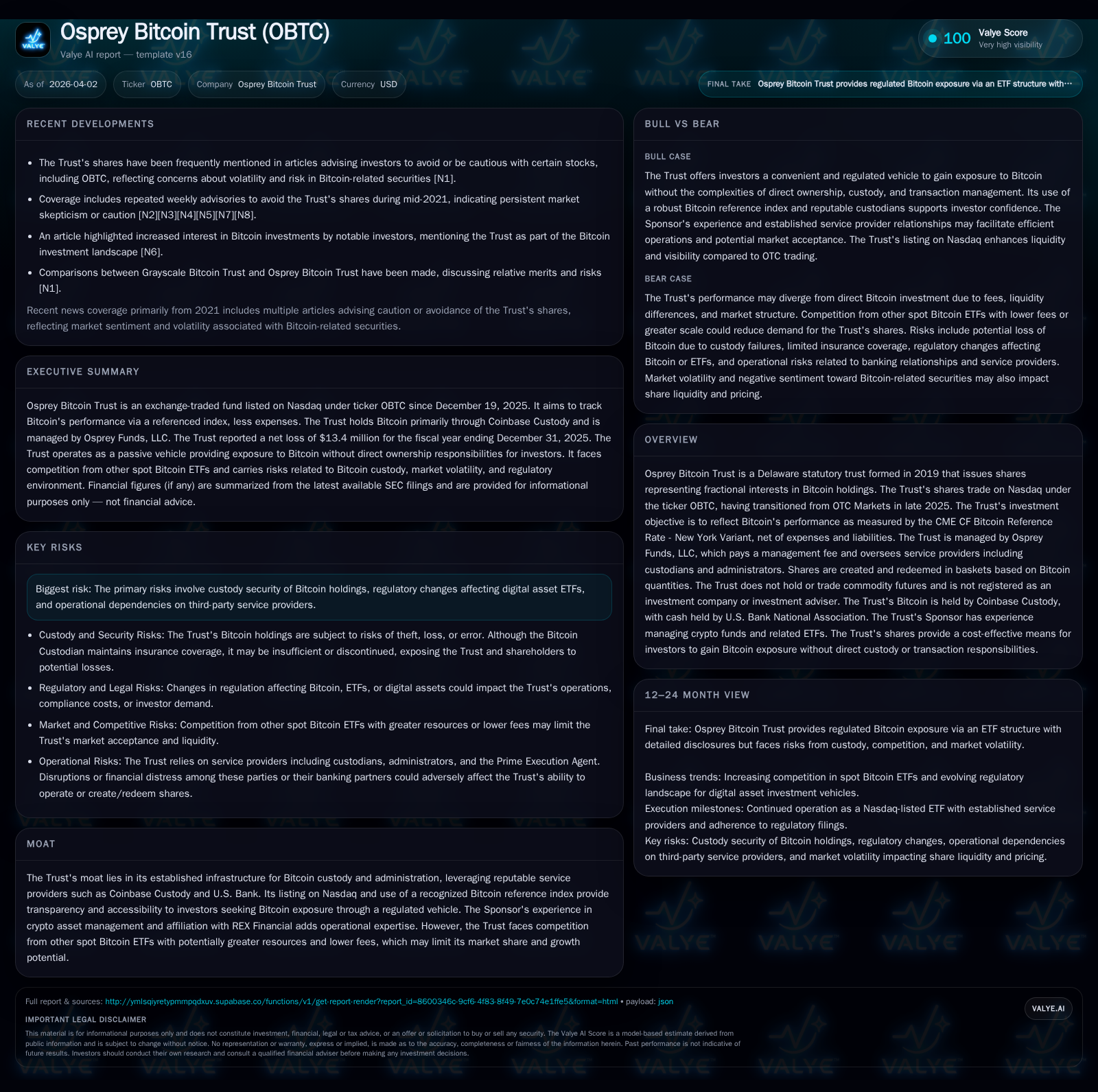
Osprey Bitcoin Trust (OBTC), a Delaware statutory trust launched in 2019, offers Nasdaq-listed shares representing fractional Bitcoin interests. The Trust experienced sizable net losses correlating with Bitcoin's pronounced volatility over recent years but leverages institutional custodianship via Coinbase Custody and sophisticated operational frameworks that form its competitive advantage. Regulatory uncertainty and risks associated with digital asset custody remain foremost challenges, though its December 2025 Nasdaq listing enhances investor accessibility and market credibility. Future growth hinges on navigating regulatory clarity, maintaining secure custody, and competing within an increasingly crowded spot Bitcoin ETF landscape.
Historical Growth Patterns and Market Drivers Through 2025
Since its inception in early 2019, Osprey Bitcoin Trust (OBTC) has encapsulated investor access to Bitcoin by offering shares corresponding to fractional beneficial interests in real Bitcoin holdings. Its financial results are tightly coupled with Bitcoin's sharp price volatility cycles. The 2021-2022 period was particularly tumultuous: BTC prices soared above $67,000 before plunging over 77% to near $15,600 amidst industry setbacks such as Celsius Network and Three Arrows Capital bankruptcies, culminating in FTX's collapse late 2022—events that reverberated through the Trust's NAV.
Bitcoin's rebound into late 2024 saw it crest $100,000 briefly, driven partly by political sentiment expecting a supportive regulatory environment. However, 2025 exhibited continued wide swaths of volatility between roughly $76,700 and $125,600. OBTC’s financials mirror this rollercoaster; it recorded a net loss of approximately $13.4 million for fiscal year 2025 [F1], reflecting management expenses alongside the price-driven valuation swings inherent in its assets.
OBTC Historical Financial Summary (USD millions)
Historical performance (annual)
| FY |
|---|
| 2025 |
Source: SEC companyfacts cache [F1].
This net loss aligns significantly with the downward pressure on BTC prices during parts of the period. Cash flow from operations or capital expenditures data is not disclosed.
Basket creation and redemption activity fuels changes in outstanding shares but remains constrained to authorized participants acting through sizeable baskets pegged exactly to Bitcoin units less accrued fees [S1], which affords closeness between share value and underlying asset value.
Regulatory and Market Risks Impacting Osprey’s Trajectory
OBTC operates amid persistent regulatory ambiguity affecting digital assets broadly. Its filings detail extensive risks stemming from past market crises—including the bankruptcy of FTX Trading Ltd., Celsius Network et al.—which accelerated governmental scrutiny from agencies like the SEC, CFTC, DOJ, FINRA, CFPB among others [S1][S3][S5][S8]. Such scrutiny carries significant implications: regulatory shifts could compel registration under securities laws or commodities regulations resulting in increased compliance costs or forced liquidation.
The Trust specifically notes risks if Bitcoin were deemed a "security," which could reclassify OBTC as an unregistered investment company under SEC rules thereby necessitating trust liquidation — a potentially value-destructive outcome for shareholders [S23][S24]. Furthermore, anti-money laundering (AML) compliance and exposure to illicit financing attempts within digital asset markets remain ongoing concerns that could trigger penalties or operational disruptions if custodians or service providers faced regulatory enforcement [S8][S12].
Third-party dependency is another vector of risk where losses stemming from hacks or failure at Coinbase Custody or U.S. Bank could impair OBTC’s ability to safeguard assets [S7][S12]. Frequent regulatory dialogues around stable custody standards heightened since major crypto ecosystem collapses illustrate this vulnerability.
Nasdaq Listing: Implications for Accessibility and Market Perception
The transition from OTC Markets to Nasdaq on December 19, 2025 symbolizes a crucial credibility enhancement for OBTC shares [S1]. This shift benefits institutional investors seeking regulated exchange-listed vehicles over less liquid OTC counterparts. Nasdaq listing fosters better visibility, tighter bid-ask spreads attributable to deeper liquidity pools among authorized participants, and greater confidence tied to transparency mandates imposed on listed entities.
Nevertheless, this move places OBTC in direct competition with other spot Bitcoin ETFs that may leverage larger scale economies or lower fee structures. While nascent compared to industry titans like Grayscale's GBTC or ProShares offerings, the improved trading venue is expected to aid OBTC’s market penetration provided it can sustain fee competitiveness and operational integrity.
Capital Allocation, Management Fees and Shareholder Returns Overview
OBTC does not pay dividends or repurchase shares; all capital deployment centers on acquiring and holding actual Bitcoins under custody [F1][S4][S9]. The management fee owed to Sponsor Osprey Funds LLC compensates for oversight services including administration and custodian coordination but contributes materially to negative net income outcomes seen in recent years.
Shareholders have limited rights compared to traditional equity investors—they cannot elect directors nor receive dividends—but hold pro-rata fractional interests representing bitcoin holdings encapsulated within baskets redeemable only through authorized participants [S4]. As such returns derive almost wholly from market appreciation (or depreciation) of bitcoin itself less ongoing fees.
Institutional Custody and Operational Dynamics in Crypto Asset Management
Security forms the cornerstone of OBTC’s moat. Custodianship of Bitcoin resides with Coinbase Custody Trust Company LLC—a well-regarded institutional custodian—with cash balances held at U.S. Bank National Association [S6][S7]. The Trust employs Coinbase Inc. affiliates as prime execution agents facilitating trade execution for basket creations/redemptions leveraging Coinbase Credit as short-term trade lender to obviate pre-funding constraints.
This well-established infrastructure enables efficient operations whereby authorized participants transact sizable baskets costing millions without fragmented settlement delays common on retail platforms [S7]. Rigorous segregation of assets combined with insurances and continuous AML compliance efforts reflect industry best practices vital for trust stability.
Nonetheless, recourses are legally limited if custodial failures occur without willful misconduct; thus residual counterparty risk exists despite protocols [S7].
Emerging Challenges in Digital Asset Regulation and Their Effects on OBTC
Elevated federal investigations alongside legislative proposals such as the GENIUS Act illustrate increasing U.S. government focus on clarifying crypto regulation while balancing innovation facilitation with investor protection [S8][S12][S15][S16]. The rescission of SAB121 by SAB122 clarifies custody disclosures but underscores ongoing compliance complexities for entities safeguarding crypto assets.
Potential categorization shifts classifying bitcoin or OBTC shares under securities laws—or alternatively under Commodity Exchange Act provisions—could trigger novel registrations or impose operational restraints leading potentially to trust termination if compliance becomes untenable [S23][S24]. Anti-money laundering vigilance is mandatory given OFAC listings impacting certain bitcoin addresses that may introduce secondary market discounts potentially affecting NAV calculations.
Competition among spot ETF providers aiming for regulatory safe harbors compels continual monitoring of policy changes that might advantage incumbents or favor more resource-rich entrants possibly squeezing smaller players like OBTC.
Looking Ahead: What Milestones and Metrics Will Signal Progress?
Absent explicit forward guidance from the Sponsor or filings detailing forecasted milestones implies attention should focus on:
- Post-volatility stabilization patterns in bitcoin pricing impacting NAV stability;
- Basket creation/redemption volumes signaling demand shifts among institutional intermediaries;
- Fee pressure trends influenced by peer ETF proliferation affecting sponsor economics;
- Regulatory clarity developments potentially easing operational uncertainties;
- Governance enhancements expanding shareholder protections beyond current limited rights framework.
Ultimately, OBTC’s capacity to leverage its Nasdaq listing alongside trusted custodianship while managing regulatory headwinds will dictate its competitive longevity within the increasingly crowded crypto ETP arena.
Disclaimer: This analysis is based solely on publicly available SEC filings ([F1], [S#]) as of April 2, 2026. It holds no investment recommendations or price targets and avoids speculative conclusions beyond disclosed facts.
Disclaimer: This is research-only, informational analysis and not investment advice. It may include AI-generated interpretation and general industry context. Always verify important details using primary sources.

Comments