
Bimergen Energy’s Scale-Up Hinges on Project Financing and Tolling Contract Finalizations
Bimergen Energy Corp is accelerating development of a multi-gigawatt battery energy storage and solar project portfolio but faces key execution risks.
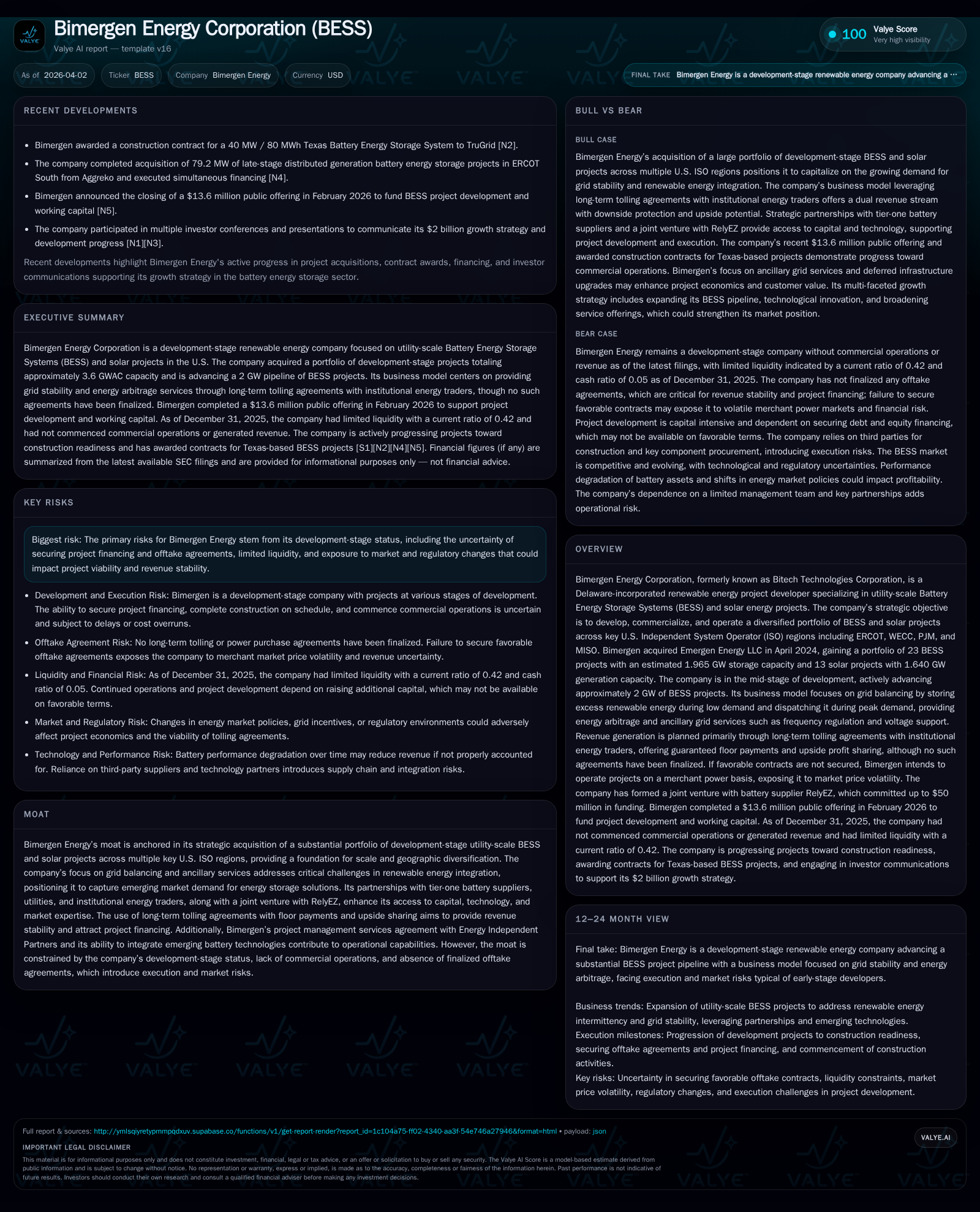
Bimergen Energy Corp, a developer of utility-scale battery energy storage systems (BESS) and solar projects, is transitioning from a development-stage company towards commercialization. Its strategic acquisition of Emergen Energy’s portfolio provides a diversified pipeline of nearly 3.6 GW combined capacity spread across major US ISO markets. Despite no commercial revenue to date, Bimergen aims to leverage tolling agreements and emerging partnerships to secure stable revenues and project financing. Execution risks include securing offtake contracts, raising capital, and navigating regulatory and market uncertainties intrinsic to BESS ventures. Capital deployment focuses on advancing projects to construction readiness with financial backing from joint ventures and equity offerings [S1][S4][S5][S10][S19][N10].
Company Background and Evolution
Bimergen Energy Corporation, formerly Bitech Technologies Corporation, completed its rebranding in early 2025 following a reverse stock split aimed at repositioning the company within the renewable energy sector [S1]. The company specializes in developing utility-scale Battery Energy Storage Systems (BESS) and solar power projects primarily across the United States.
In April 2024, Bimergen acquired Emergen Energy LLC, gaining ownership rights to a portfolio consisting of 23 development-stage BESS projects totaling approximately 1.965 gigawatts (GW) in storage capacity alongside 13 solar projects estimated at 1.640 GW generating capacity [S1][S11]. This acquisition laid the foundation for the company's targeted expansion into renewable asset development.
Historical Financial Performance
As of December 31, 2025, Bimergen remains a development-stage entity without commercial operations or meaningful revenue generation [S1]. The company recorded nominal revenues primarily from legacy activities prior to its strategic pivot: $168,880 in fiscal year 2021 with a slight decline year-over-year [-1.8%] [F1]. Operating losses have expanded substantially in line with increased developmental activity — from approximately $818k in fiscal year 2023 to nearly $4.9 million by fiscal year-end 2025; net loss trends track similarly [-80.3% YoY] [F1].
Despite these losses, the company reported positive operating cash flow of $878k in FY2025, reflecting non-cash adjustments and timing effects amid minimal capital expenditures recently reported [F1]. Liquidity is constrained with current assets around $3.3 million against current liabilities exceeding $7.8 million resulting in a current ratio below 0.5 [F1]. Shareholders’ equity increased to roughly $19.4 million at year-end due to recent equity issuances supporting project development efforts [F1].
### Historical performance (annual)

| FY | Net ($mm) | CFO ($) | OpInc ($mm) | Net YoY |
| --- | :---: | :---: | :---: | :---: |
| 2025 | -5 | 878442 | -5 | -80.3% |
| 2024 | -3 | -349833 | -3 | -239.7% |
| 2023 | -1 | -457806 | -1 | -0.0% |
| 2022 | -1 | -789344 | -1 |  |

*Source: SEC companyfacts cache [F1].*

### Capital returns and efficiency (annual)

| FY | ROE% |
| --- | :---: |
| 2025 | -25.7 |
| 2024 | -12.8 |
| 2023 | -633.2 |
| 2022 | -407.2 |

*Source: SEC companyfacts cache [F1].*
Business Model and Market Position
Bimergen's core business model targets utility-scale renewable integration by addressing supply-demand imbalances caused by intermittent solar and wind generation [S22]. Its BESS projects aim to store excess electricity generated during low-demand periods—typically midday solar peaks—and dispatch it during peak evening hours or grid stress events. This energy arbitrage supports grid stability while capturing value from price differentials.
Beyond arbitrage trading, the company plans to provide ancillary grid services such as frequency regulation and voltage support critical for maintaining grid reliability amid increasing renewable penetration. These services are expected to generate additional revenue streams when operational.
The company’s growth strategy emphasizes expanding its current approximately 2 GW BESS pipeline to over 5 GW within the next three to five years across strategically selected U.S. Independent System Operator (ISO) regions including ERCOT, WECC, PJM, and MISO [S4][S10]. This expansion aligns with rising demand for grid balancing solutions driven by renewable energy adoption.
Capital Allocation and Financing Strategy
To support its growth ambitions, Bimergen has executed a joint venture agreement with RelyEZ Energy Group committing up to $50 million—including an initial $10 million funding tranche—to develop up to 2 GW of utility-scale BESS projects through 2027 [S11][S19]. Under this arrangement, RelyEZ holds an initial majority ownership stake in project special purpose vehicles until refinancing occurs.
Additionally, the company closed a $13.6 million public offering in February 2026 intended for working capital and advancing project development activities [N10][S19]. Management anticipates supplementing these funds with potential tax equity financing and long-term project-level debt subject to market availability.
Project management services are contracted through Energy Independent Partners under terms linked explicitly to project financing milestones ensuring alignment with capital deployment objectives [S6].
Execution Risks and Outlook
Key execution risks remain centered on securing binding tolling agreements or other favorable offtake contracts required for stable revenue generation prior to construction commencement [S9][S19]. The company also faces challenges related to obtaining necessary interconnection permits and finalizing project-level financing structures.
While commercial operations have not yet commenced as of fiscal year-end 2025, management’s proactive approach aims at progressing select projects toward construction readiness within the next twelve months leveraging available cash balances alongside newly raised capital sources [S19].
The outlook remains cautiously optimistic given the accelerating market demand for battery energy storage systems driven by grid modernization efforts and renewable integration imperatives across North America [S12][S17]. The planned portfolio expansion beyond five gigawatts over several years positions Bimergen as a potential significant player in the evolving clean energy infrastructure landscape.
Disclaimer: This is research-only, informational analysis and not investment advice. It may include AI-generated interpretation and general industry context. Always verify important details using primary sources.

Comments