
Velo3D’s Balancing Act: Production Scaling and Financial Headwinds
Velo3D's cutting-edge metal additive manufacturing platform fuels modest growth, yet persistent financial strain casts shadows over its scalability ambitions.
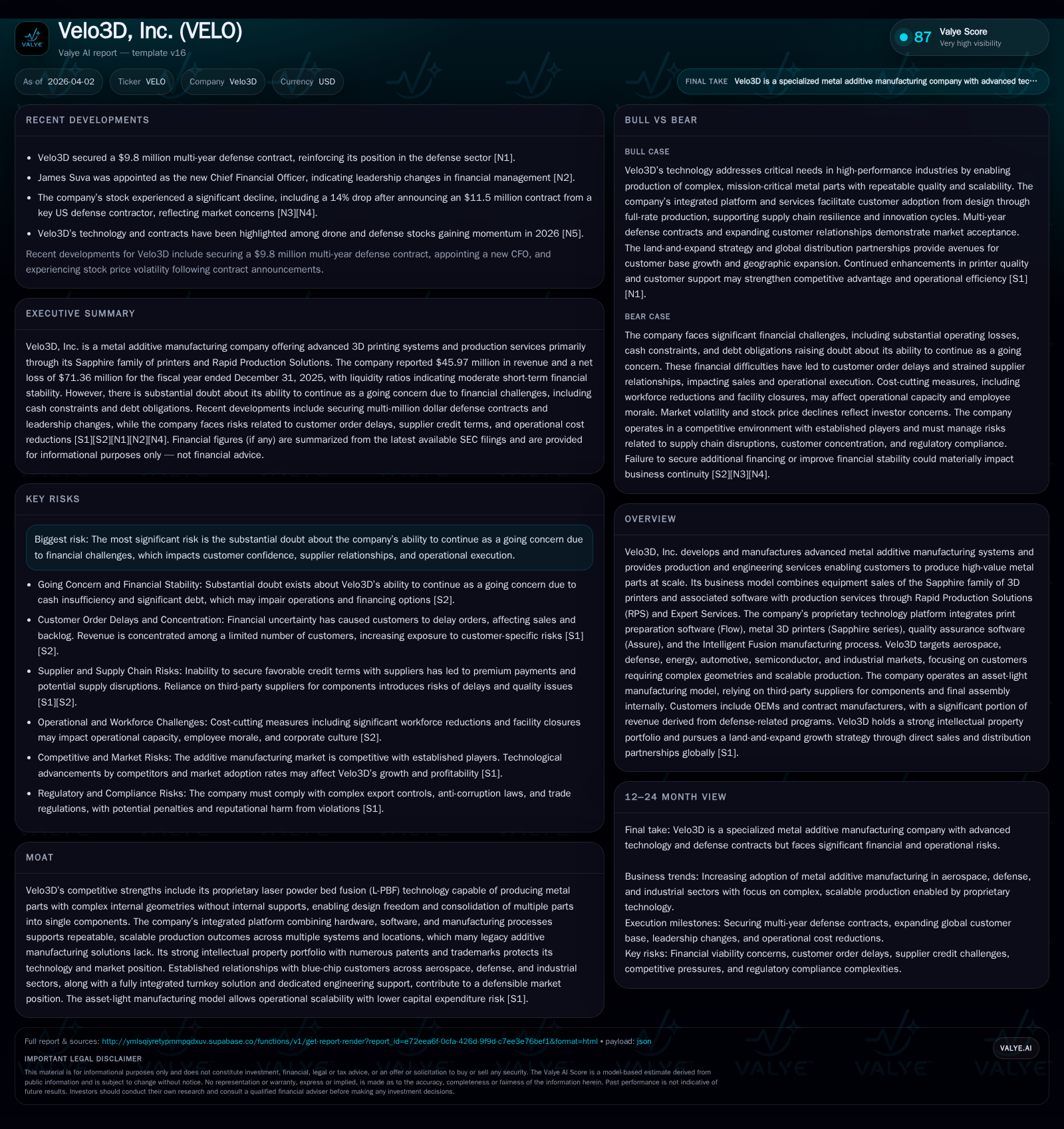
Velo3D, Inc. operates at the frontier of metal additive manufacturing with its integrated Sapphire series printers and proprietary software stack enabling complex geometries without supports. The company recorded a 12.1% revenue increase in fiscal 2025, driven by technology adoption in aerospace and defense, though sizable operating losses persist albeit reduced year-over-year. Liquidity constraints and substantial doubt about going concern status impede operational execution and customer confidence, even as multi-year defense contracts and global distributor partnerships hint at growth potential. Capital allocation focuses on technology enhancement amid negative cash flows and a very challenging financial landscape. Key near-term indicators to watch include contract execution ramps, supply chain normalization, and liquidity improvements that will clarify Velo3D’s path to stabilization.
From Innovation to Revenue: A History of Growth and Setbacks
Velo3D operates in the rapidly evolving metal additive manufacturing (AM) sector, targeting high-value parts with its proprietary technology stack. Over the last four fiscal years, revenues have oscillated significantly — from $80.76 million in FY2022 down sharply by nearly half by FY2024 before rebounding moderately to $45.97 million in FY2025 ([F1]). This recent 12.1% increase versus FY2024 was partly offset by disruptions such as delayed customer orders and shipment timing issues cited in filings ([S1]). Operating losses remain sizeable but have improved year-over-year by approximately one-third from -$82.35 million to -$54.92 million in FY2025, signalling some operational leverage though still under pressure ([F1]). Net losses mirror this pattern with only mild improvement.
Cash flows also reflect ongoing stress: with an operating cash outflow of -$27.33 million plus a capital expenditure inflection to $2.72 million (a +30,067% surge YoY), free cash flow is strongly negative around -$30 million for the year ([F1]). Such numbers underscore the company’s continuing heavy investment posture alongside growth challenges.
Historical performance (annual)
| FY | Rev ($mm) | Net ($mm) | CFO ($mm) | OpInc ($mm) | Rev YoY | Net YoY |
|---|---|---|---|---|---|---|
| 2025 | 46 | -71 | -27 | -55 | +12.1% | +2.6% |
| 2024 | 41 | -73 | -33 | -82 | -47.1% | +45.8% |
| 2023 | 77 | -135 | -106 | -133 | -4.1% | -1448.7% |
| 2022 | 81 | 10 | -124 | -104 |
Source: SEC companyfacts cache [F1].
Capital returns and efficiency (annual)
| FY | FCF ($mm) | ROE% |
|---|---|---|
| 2025 | -30 | -187.0 |
| 2024 | -33 | -184.8 |
| 2023 | -107 | -197.7 |
| 2022 | -138 | 7.1 |
Source: SEC companyfacts cache [F1].
FY = Fiscal Year; Text percent values are approximate YoY changes.
Velo3D’s Proprietary Platform: Technology Differentiators Driving Customer Adoption
The cornerstone of Velo3D’s competitive positioning lies in its integrated hardware-software-manufacturing platform encompassing the Sapphire series metal AM systems, Flow print preparation software, Assure quality assurance software, and its Intelligent Fusion process ([S19]; [S7]; [S16]). This laser powder bed fusion (L-PBF) innovation uniquely allows manufacturing of support-free complex internal geometries — a significant departure from legacy AM platforms that require internal supports interfering with design freedom.
The company captures validated process parameters into "Golden Print Files," ensuring consistent replication machine-to-machine across multiple sites ([S16]). This approach addresses a common pain point in additive manufacturing: variability during scale-up phases that stalls qualification progress for mission-critical applications like aerospace propulsion components or hypersonic engine parts ([S19]).
Moreover, Velo3D’s asset-light manufacturing model outsources component fabrication while concentrating final assembly and testing internally ([S4]). Their platform serves sectors demanding both high complexity and reliable volume production scalability—the aerospace/defense segment currently accounts for roughly 80% of revenue streams ([S16]), reflecting early but growing adoption.
Contracts Won and Customer Expansion: Signs of Market Validation
Recent developments underscore customer recognition of Velo3D’s technological edge despite financial headwinds: notably a $9.8 million multi-year contract awarded by the U.S Department of Defense as announced in March 2026 ([N2]). Earlier announcements detailed an $11.5 million contract involving key U.S defense contractors ([N4]), signaling trust in Velo3D's capability within sensitive government markets.
Outside direct sales operations, global distribution partnerships extend the company’s geographic footprint—Taiyo Nippon Sanso holds territory rights in Japan while SBO covers Austria ([S5]). This channel strategy amplifies international reach without commensurate fixed-cost obligations.
However, stock price reactions to these news pieces highlight market skepticism linked to liquidity concerns ([N3]), exemplifying the contradictory signals investors confront: rising order interest against underlying financial fragility.
The company also pursues extensive efforts to ‘land-and-expand’—targeting existing customers who scale deployments internationally as their internal validation matures ([S5]). This approach enhances customer lifetime value through repeat purchases of Sapphire systems alongside service contracts.
Stark Financial Realities: Operating Losses, Cash Flow, and Going Concern Issues
A critical challenge overshadowing Velo3D's growth narrative is its precarious financial position flagged explicitly under 'substantial doubt about our ability to continue as a going concern' per its latest annual report ([S1]; [S2]; [S23]). Despite a current ratio approximating 2.37 derived from $80 million current assets against $33 million current liabilities ([F1]), constrained cash balances ($39 million end-2025) place near-term runway under pressure given persistent net losses exceeding $70 million annually.
Investor confidence further erodes due to delayed shipments and deferral of customer orders amid credit concerns ([S1]; [S11]). Suppliers demand upfront payments or premium terms due to unsettled accounts payable creating a cascade effect impairing supply chain reliability ([S11]). Supplier term deterioration complicates cost structures amidst already tight liquidity.
Legal prudence mandates considering potential bankruptcy reorganization contingencies should funding avenues dry up ([S1]; [S2]), intensifying operational uncertainty from customers' viewpoint impacting sales pipelines.
Capital Allocation Patterns: Investment Priorities and Return Constraints
Despite operating losses, Velo3D ramped up capital expenditures dramatically in FY2025 relative to previous years (+30000%), investing approximately $2.7 million mainly towards system upgrades and capacity enhancements ([F1]; [S6]). This inflection contrasts with historically modest capex reflective of their asset-light strategy reliant on outsourcing subcomponent manufacture while limiting heavy internal asset deployment.
Return on equity stands deeply negative at an estimated -187%, consistent with continuous net deficits relative to dwindling equity bases rendered by accumulated losses ([F1]). No dividends or share repurchases are planned or reported post-2022 amidst this backdrop.
Further financing raises appear imperative according to disclosures with potential equity issuance risks diluting shareholders or debt raising constrained by covenant burdens compromising operational flexibility ([S24]). Asset monetization through sale-leaseback arrangements started late 2025 illustrates tactical liquidity measures wrestling with mounting fixed payment obligations long-term ([S6], [S24]).
Future Prospects Amid Financial Strain: Risks, Opportunities, and Strategic Measures
Velo3D faces immediate risks primarily arising from liquidity gaps jeopardizing sales cycles due to eroding customer confidence echoing 'substantial doubt' commentary ([N2], [S14], [S23]). Furthermore, workforce retention challenges arise as operating result pressures mandate cost-cutting including potential headcount reductions affecting service delivery capabilities ([S11], [N1]).
Conversely, growth avenues remain anchored on expanding geographical penetration via established distribution partnerships coupled with quality improvements planned for next-gen Sapphire printers targeting reliability gains catering especially to aerospace/defense clients requiring stringent uptime metrics ([S5], [N2], [S14]).
Leadership transitions—including appointment of James Suva as new CFO—signal potential recalibration toward more disciplined financial stewardship aiming at fortifying balance sheet resilience amidst ongoing restructuring efforts ([N1]).
If liquidity stabilizes allowing normalizing supplier relationships while ramping backlog execution supported by defense contracts moving into production phases, Velo3D may leverage its disruptive L-PBF platform for incremental share capture domestically and internationally.
Monitoring Milestones: What Will Signal Stabilization or Further Risk
Absent formal forward guidance on exact breakeven timing or cash runway extension measures, observers should track key performance indicators reflective of operational stabilization:
- Rate of new contract awards vs cancellations or deferrals,
- Progression on backlogged orders fulfillment timelines,
- Effectiveness of implemented cost controls including workforce management,
- Improved supplier payment terms restoring supply chain integrity,
- Any capital raise successes either via equity or structured finance vehicles,
- Signs of strategic partnerships or acquisitions leveraging core IP assets strategically.
Failure across these vectors would reinforce going concern threats necessitating bankruptcy protection scenarios flagged repeatedly in risk disclosures ([S1]; [S2]; [S23]) emphasizing ongoing material uncertainty despite technological promise.
This analysis strictly summarizes publicly available information without offering investment recommendations or price forecasts.
Disclaimer: This is research-only, informational analysis and not investment advice. It may include AI-generated interpretation and general industry context. Always verify important details using primary sources.

Comments