
NIKE Faces Margin Pressures and Regional Headwinds Despite Stable Revenue Growth
Flat reported revenues in Q3 FY2026 mask underlying regional divergences and margin challenges linked to tariffs and channel shifts.
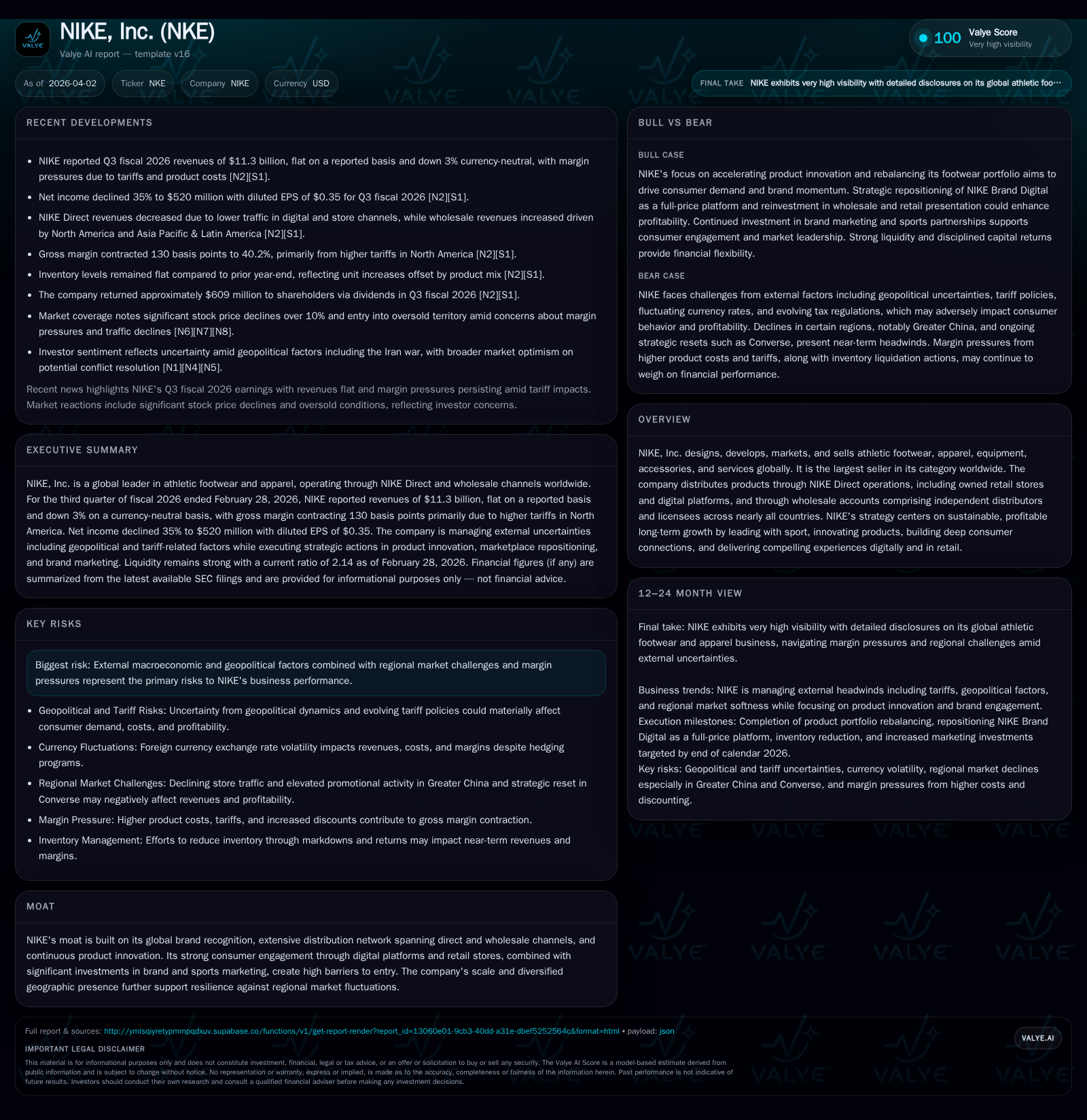
NIKE, Inc. maintained stable revenue at $11.3 billion in Q3 FY2026 compared with a year ago, with wholesale growth offsetting declines in direct-to-consumer sales. The company continues to grapple with gross margin contraction driven mainly by higher tariffs in North America and inventory management initiatives. Regional performance diverged sharply as North America and APLA posted gains while Greater China and EMEA faced declines. NIKE’s near-term outlook hinges on successful execution of product innovation and marketplace repositioning strategies amid ongoing macroeconomic uncertainties. Strong capital returns persist despite a notable drop in net income and operating cash flow in the most recent fiscal year.
Historical Growth and Company Positioning
NIKE, Inc., the world’s largest athletic footwear and apparel seller, has exhibited steady revenue growth over recent years with its fiscal year 2018 revenue reaching approximately $36.4 billion [F1]. Revenues increased at a compound rate surpassing 6% annually from FY2015 through FY2018, driven by broad global expansion and strong wholesale distribution alongside the burgeoning direct-to-consumer (DTC) digital platform.
The company’s strategic model balances NIKE Direct operations—comprising owned retail stores and digital sales—and extensive wholesale distribution encompassing independent licensees worldwide [S2][S23]. This dual-channel approach underpins NIKE's moat, supported by brand strength, sports marketing investments, and deep consumer engagement through digital innovation.
Financially, NIKE demonstrated robust profitability with approximate return on equity around 24.4% as of FY2025 [F1], supported historically by strong operating cash flow exceeding capital expenditures significantly.
However, profitability took a hit recently: net income tumbled 43.5% YoY in FY2025 to about $3.2 billion [F1], while operating cash flows halved relative to FY2024's $7.4 billion, reflecting mounting cost pressures including tariffs, markdowns, and increasingly promotional activity [S2][S9]. Despite this, NIKE sustained disciplined capital returns with $3 billion allocated to share repurchases in FY2025 alongside dividends totaling approximately $609 million returned to shareholders in Q3 FY2026 alone [F1][S2].
Recent Financial Performance: Fiscal Third Quarter 2026
NIKE's Q3 FY2026 revenues were essentially flat at $11.3 billion but down 3% on a currency-neutral basis [S2]. Wholesale revenues—accounting for about 58% of sales—grew nearly 4%, propelled predominantly by gains in North America (+11%) and Asia Pacific & Latin America (APLA) regions [S7][S13]. Conversely, NIKE Direct channel revenues declined approximately 6%, driven largely by reduced digital traffic [S2][N2], highlighting persistent challenges facing omnichannel retail.
Gross Margin Compression
Gross margin retreated by 130 basis points to 40.2%, principally due to higher import tariffs imposed in North America which raised product costs by an estimated $1.5 billion annualized impact [S26][S25][N2]. Additional pressures stemmed from deeper discounting employed both within NIKE Direct (to clear excess inventory) and wholesale partners [S2]. The company also described strategic reductions in supply of select footwear products aiming to rebalance its portfolio mix [S2].
Geographical Segment Divergence
Historical performance (annual)
| FY | Net ($bn) | CFO ($bn) | Capex ($mm) | Net YoY |
|---|---|---|---|---|
| 2025 | 3.2 | 3.7 | 430 | -43.5% |
| 2024 | 5.7 | 7.4 | 812 | +12.4% |
| 2023 | 5.1 | 5.8 | 969 | -16.1% |
| 2022 | 6.0 | 5.2 | 758 |
Source: SEC companyfacts cache [F1].
Capital returns and efficiency (annual)
| FY | Buybacks ($bn) | FCF ($bn) | ROE% |
|---|---|---|---|
| 2025 | 3.0 | 3.3 | 24.4 |
| 2024 | 4.3 | 6.6 | 39.5 |
| 2023 | 5.5 | 4.9 | 36.2 |
| 2022 | 4.0 | 4.4 | 39.6 |
Source: SEC companyfacts cache [F1].
Converse Segment Challenges
Converse revenues declined roughly 30%, driven by unit sales decreasing approximately 24% coupled with lower average selling prices due to increased discounts [S8][S27]. This segment's profitability deteriorated markedly during the quarter, contributing negatively to consolidated EBIT [N2][S27].
Strategic Outlook: Growth Drivers and Constraints
NIKE’s strategy emphasizes leading with sport through accelerated product innovation combined with enhanced consumer engagement via immersive digital platforms and elevated physical retail experiences [S2][S23]. Key initiatives include:
- Accelerating launch of innovative products while reducing legacy inventory supply.
- Repositioning NIKE Brand Digital toward full-price selling.
- Reinforcing wholesale channels through selective reinvestment.
- Increasing demand creation spend targeting brand marketing linked directly to key sports events. These efforts address ongoing softness in digital traffic and store visits globally that have pressured direct channel revenues this fiscal year [N2][N3].
Macro risks remain material including tariff changes impacting costs significantly ($1.5B annualized), geopolitical uncertainties especially affecting Greater China and Europe markets, plus currency fluctuations given extensive international operations [S2][N1].
Forecasts, Milestones, and What To Watch
While explicit numeric guidance beyond Q3 FY2026 was not provided, NIKE expects completion of marketplace management actions by December 2026 aimed at normalizing inventories while supporting margin recovery [S2]. Investors should monitor:
- Gross margin trends reflecting tariff cost trajectory.
- Digital platform traffic patterns affecting direct channel sales.
- Regional revenue momentum notably in Greater China and EMEA.
- Progress on Converse turnaround efforts.
- Capital allocation balance between shareholder returns and reinvestment needs.
Returns Profile and Capital Allocation
NIKE maintains a history of strong shareholder returns: in FY2025 it repurchased approximately $3 billion of shares while paying consistent dividends; Q3 FY2026 alone saw roughly $609 million returned via dividends [F1][S12]. Despite earnings pressure causing net income decline (-43.5%) and operating cash flow falling from $7.4 billion to about $3.7 billion year-over-year, free cash flow remained positive near $3.27 billion after capital expenditures [$430 million] indicating solid financial flexibility [F1].
Balance sheet strength is underscored by cash & equivalents of about $6.66 billion versus current liabilities near $10.8 billion at February 28, 2026 — yielding a current ratio above 2x — providing liquidity cushion amid market uncertainties [F1].
Summary
NIKE navigates a complex environment marked by flat headline revenue but significant margin pressure related primarily to tariffs, regional softness notably in Greater China, direct channel e-commerce headwinds from declining traffic, plus acute challenges in the Converse segment impacting overall profitability. The company’s multi-pronged strategic response focuses on innovation-led growth balanced with marketplace repositioning aimed at restoring sustainable profitability. While external macroeconomic risks persist, NIKE’s brand strength combined with prudent capital allocation provides resilience as it advances toward completing key initiatives into late fiscal year 2026.
This report is for informational purposes only and does not constitute investment advice.
Disclaimer: This is research-only, informational analysis and not investment advice. It may include AI-generated interpretation and general industry context. Always verify important details using primary sources.

Comments