
WinVest Acquisition’s Path Forward: Challenges and Opportunities in SPAC Completion
Evaluates WinVest Acquisition Corp.'s financial condition, merger timeline extensions, and capital tactics as it seeks to finalize its first business combination.
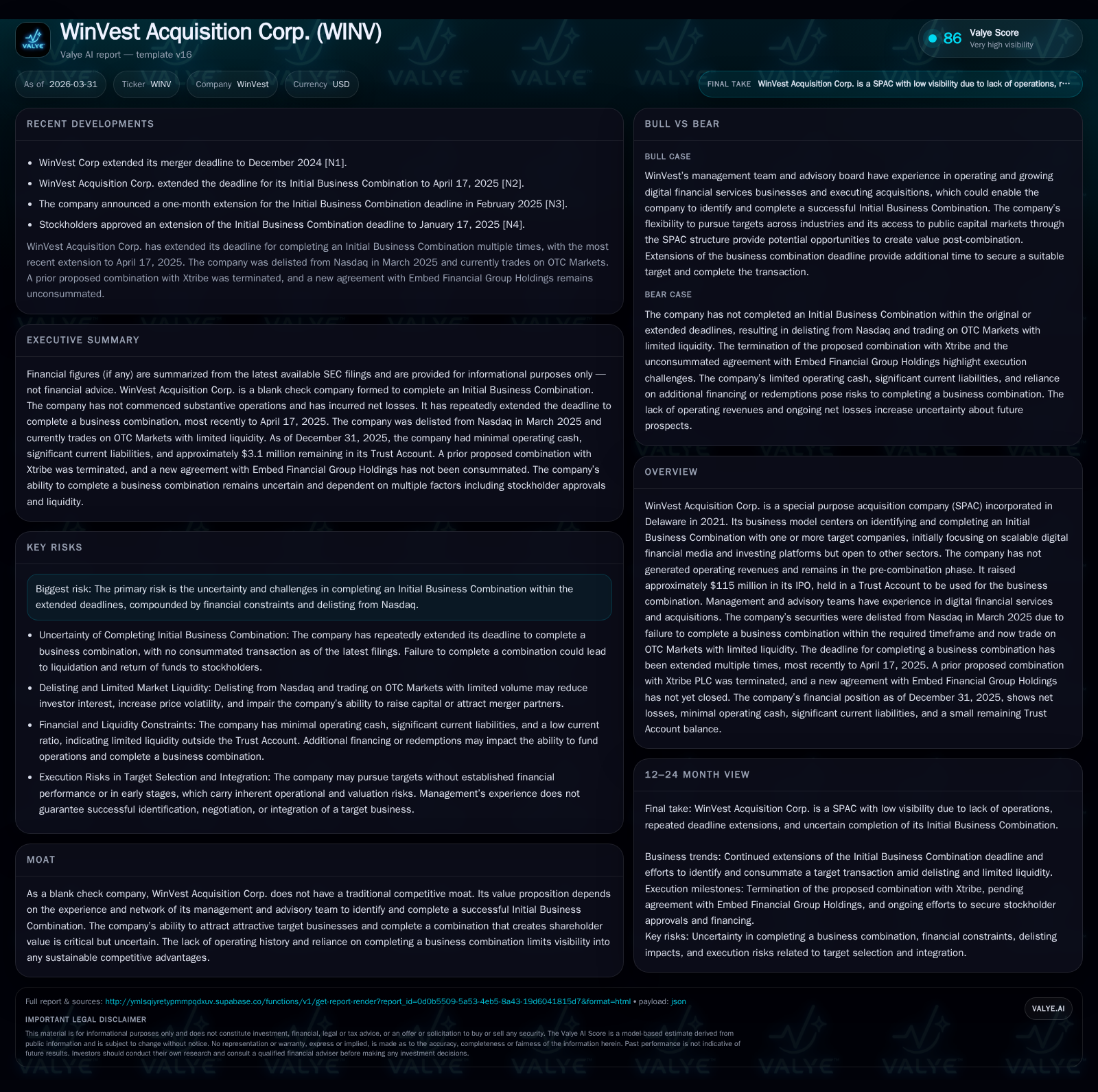
WinVest Acquisition Corp., a SPAC initially targeting digital financial media and investing platforms, has encountered significant hurdles completing its Initial Business Combination (IBC). Despite raising approximately $116 million in its IPO and private placements [S1][F1], the company failed to close a deal within Nasdaq’s original 36-month deadline, resulting in delisting in March 2025 [S2][N1]. Sponsor-backed promissory notes and shareholder-approved charter extensions have kept the SPAC operational through multiple deadline extensions now extended to December 2024 [N1][S4]. However, persistent operating losses, deteriorating equity and tight liquidity ratios underscore elevated execution risks [F1][S6]. The company halted efforts with Xtribe in 2025 but remains positioned for an eventual business combination, though the probability of successful consummation remains uncertain amid limited cash and ongoing redemptions [S16][S9].
SPAC Model Foundation and Early Performance Overview
WinVest Acquisition Corp., incorporated in Delaware in March 2021, was established as a blank check company to identify and complete an Initial Business Combination (IBC) primarily targeting scalable digital financial media and investing platforms but retaining flexibility across sectors [S1][S8]. The company completed its IPO in September 2021, issuing 10 million units at $10 each plus a full exercise of its over-allotment totaling approximately $116.15 million in proceeds (including private placement warrants sold to the Sponsor), with all net proceeds deposited into a U.S.-based Trust Account managed by Continental Stock Transfer & Trust Company pursuant to SEC rules governing SPACs [S1][F1][S13].
Each Unit comprised one share of common stock, one redeemable public warrant exercisable for half a share at $11.50, plus rights associated with post-combination equity adjustments. Approximately $10.10 per share sold was secured in the Trust Account specifically earmarked for the IBC or liquidation proceeds upon failure to consummate a deal within prescribed timeframes [S1]. Through December 31, 2025, WinVest had no operating revenues owing to its pre-combination status; its financial inflows were restricted to interest income on trust assets and modest dividend income prior to January 2025 when money market funds were liquidated back to cash [F1][S7].
Management’s experience synthesizes operational knowledge across digital finance and acquisition-oriented platform building – factors vital to forming credible relationships with potential targets yet inherently uncertain absent actual merger transactions [S8]. This structural foundation underscores the typical risk profile of SPACs reliant on management acumen without active operating histories.
WinVest exemplifies standard SPAC mechanics with capital held in trust pending deal closure; value hinges exclusively on completing a viable business combination.
Financial Trends: Operating Results and Liquidity Limitations
Financial statements reveal persistent operating deficits despite gradual loss reduction: operating income improved from -$2.57 million in FY2024 to -$1.50 million in FY2025, reflecting a year-over-year recovery of approximately 41.7%. Net losses decreased similarly from -$2.23 million to -$1.41 million over the same period (about 36.6% improvement) but remain material given lack of business operations generating revenue [F1]. Operating cash flow continues negative trends (-$483,887 in FY2025), albeit better than prior years, illustrating ongoing expenditures largely related to professional services including legal counsel, compliance reporting, due diligence activities for target evaluation, and administrative costs financed outside the Trust Account via sponsor loans [F1][S12].
The balance sheet reveals acute liquidity stress outside of the Trust Account: current assets stood at approximately $97K against current liabilities exceeding $7.79 million as of December 31, 2025 yielding an extremely constrained current ratio near 0.01 – indicative of insufficient liquid resources available for short-term obligations beyond secured IPO funds [F1][S6]. This also reflects sizeable payables including accrued expenses due primarily to sponsor support fees ($463K owed under administrative services arrangements) and unsecured promissory notes aggregating several million dollars issued by the Sponsor – all non-interest bearing and convertible into warrants upon merger completion or repayable from residual assets upon dissolution [S4].[F1]
Redemptions of public shares approved by stockholders have significantly depleted the trust proceeds available; shareholder redemptions totaled approximately $116 million during multiple extension votes thus diluting remaining public float down to just over 220 thousand shares by end-2025 [F1][S13]. Trust funds dropped from initial levels near $3.14 billion at IPO closing toward just over $3.08 billion before massive liquidations coordinated around redemptions and business combination delays.
WinVest’s cash burn profile matches expectations for prolonged SPAC search phases but highlights inherent challenges when dilutive redemptions reduce combined deal capital.
Deadline Extensions and Strategic Maneuvers
After failing to consummate an IBC by the original deadline of September 14, 2024 aligned with Nasdaq’s listing rule mandating closure within 36 months of IPO effectiveness date (September 17, 2021), WinVest received a delisting notice from Nasdaq’s Listing Qualifications Department effective September 26, 2024 due to non-compliance with IM-5101-2 rules [N1][S2]. The company successfully appealed trading suspension temporarily while pursuing shareholder approval for multiple deadline extensions via charter amendments granting management authority—upon sponsor request—to extend termination dates up to June 17, 2023 initially then further monthly increments up to a total extension currently set through December 2024 with prospects for additional one-month extensions till September 2026 through incremental deposits of approximately $30K monthly into the Trust Account funded by sponsor loans under new extension notes consistent with prior practice [N1][S4][S7].
Initially aligned with Xtribe PLC for a transformational combination announced mid-2024 under amended business combination agreements (A&R BCA), these efforts stalled mid-2025 leading WinVest to cease active pursuit despite agreement terms still being technically valid on paper—the transaction appears formally abandoned as no regulatory filing updates or proxy solicitations were advanced post-termination announcement impacting future milestones significantly [S16][N1].
These repeated extensions go beyond mere delay tactics representing strategic leverages allowed under corporate governance rules tailored for SPACs; however, each extension compounds redemption risk while tightening financial runway.
Capital Structure, Sponsor Support, and Liquidity Management
Capital deployment centers on initial IPO gross proceeds (~$116M) securely held primarily in the Trust Account invested conservatively only permitted securities such as short maturity U.S. government treasury obligations or eligible money market funds following SEC-regulated investment guidelines designed specifically for pre-deal SPAC escrow accounts [F1][S24]. Simultaneously, Sponsor committed over $3 million via unsecured promissory notes including: March 2021 Note ($300K), October 2023 Note ($1M drawn fully), January 2025 Note (approx. $388K drawn), multiple Extension Notes adding incremental coverage ($750K First Extension Note plus others extending loan capacity further) which bear no interest and convert into Private Placement Warrants exercisable under terms mirroring public warrants at $0.50 per warrant conversion price post-merger closing; these loans fund working capital shortfalls such as legal fees, admin costs linked with searches or extension-related trust payments not covered by main escrow funds restricted exclusively for M&A deal funding or redemptions upon liquidation/failure scenarios [S4].[F1]
WinVest also incurs monthly administrative fees payable directly to Sponsor (~$10K/month) covering overhead support including office space and secretarial services continuing until liquidation or successful business combination completion—an element reflecting typical Sponsor compensation models phenotypic across similar SPAC structures managing tight cost controls during interim phases—outstanding payables under this agreement stood at ~$463K end-2025 highlighting cumulative accrued obligations amid escalating financing complexity outside main trust balances [S26].[F1]
Public stock buybacks recorded at ~$518K during FY2025 illustrate management's repurchases likely reflecting structured redemptions or secondary support transactions amid sharply contracted public float compared against massive buyback levels exceeding $10 million in FY2024 reflecting large scale prior ratified shareholder redemptions reducing shares outstanding substantially year-over-year [F1].
WinVest depends heavily on sponsor infusions characteristic of late-stage pre-combination profiles where external lender-sponsor support mitigates insolvency risk but simultaneously amplifies leverage exposure if operational milestones falter.
Risks Surrounding Business Combination Completion
Principal risks crystallize around failure to consummate an IBC before legally mandated deadlines despite extended timelines granted via successive stockholder consents affecting listing status adversely—delisting severely restricts liquidity as trading migrated from Nasdaq Capital Market to OTC Markets where bid-ask spreads widen materially limiting price discovery mechanisms for shareholders seeking exits especially amidst volatile redemption cycles exacerbated by dual-stage redemption rights afforded first during extension amendment votes then again at proposed IBC approval meetings increasing aggregate dilution potential substantially relative to initial prospectus assumptions per SEC general guidance on SPAC governance protocols ([N1],[S2]).
Liquidity depletion outside of escrowed IPO proceeds exacerbates default risk given working capital deficits nearing almost eight million USD versus negligible readily available cash (<$100K) evidencing material strain even with sponsor credit lines partially addressing capex demands payable exclusively through non-trust sourced funds thereby restricting refinancing flexibility absent further sponsor participation raising classic solvency quandaries prior commercial post-merger operation commencement—in particular when considering that operational profitability hinges presently on revenue-generating entities acquired only after closing which remains inherently speculative absent definitive targets beyond discontinued Xtribe transaction attempts ([F1],[S6],[S9],[S10]).
Further latent regulatory risks include excise tax liabilities incurred under recent Inflation Reduction Act provisions relating indirectly to deferred consideration components embedded in structuring deals potentially impacting eventual transaction economics alongside looming legal exposure emanating from vendor claims typical at protracted negotiated combinations typical amongst intricate cross-border acquisitions all detailed comprehensively within risk factors disclosures underscoring potential contingent losses unforeseen during due diligence phases ([S9],[S10]).
These intertwined timing-sensitive risks contextualize why prolonged SPACs face systemic challenges combining elevated redemption volatility coupled with limited operational moats heightening investor uncertainty.
Future Outlook: What Lies Beyond the Extended Deadlines
Going forward investors should carefully monitor developments around whether WinVest can finalize an IBC before expiration of extended deadlines currently set December 17, 2024 per latest official notices supplemented by optional one-month extensions subject to incremental trust fund deposits funded principally by Sponsor loans—uncertainty remains high given past deal discontinuation with Xtribe PLC announced mid-2025 effectively resetting search dynamics requiring management action toward novel target sourcing or potential strategic pivots announced publicly in forthcoming filings or investor communications ([N1]).
Liquidity sustainability absent further sponsor goodwill injections will remain critical given tight current ratios (0.01) alongside negative equity magnitudes (-$11.8M) signifying erosion pressure contingent upon successful merger closure unlocking working capital release from Trust Accounts currently constrained by shareholder redemptions conducted progressively diminishing available capital arms race ([F1]).
Attention should focus next quarter filings expected post special meetings regarding new transaction proposals including proxy statements if forthcoming; industry observers will gauge management's ability leveraging advisory networks specializing in digital financial media sectors (core focus area originally emphasized) alongside adjacent fintech or tech-enabled services capable of delivering scalable growth post-combination albeit such prospects yet unvalidated materially beyond signaling intent per stated strategy outlined historically ([N1],[S8]).
Despite ongoing operational uncertainties rooted fundamentally in delayed deal execution profiles inherent within SPAC lifecycle stages WinVest's extended runway sustains viability conditional on timely sponsor support translating pipeline opportunities into credible negotiated transactions.
Key Metrics at a Glance
Historical performance (annual)
| FY | Net ($mm) | CFO ($) | OpInc ($mm) | Net YoY |
|---|---|---|---|---|
| 2025 | -1 | -483887 | -2 | +36.6% |
| 2024 | -2 | -975430 | -3 | -94.5% |
| 2023 | -1 | -1255741 | -2 | -406.4% |
| 2022 | 0 | -534243 | -1 |
Source: SEC companyfacts cache [F1].
Capital returns and efficiency (annual)
| FY | Buybacks ($mm) | ROE% |
|---|---|---|
| 2025 | 1 | 12.0 |
| 2024 | 10 | 22.5 |
| 2023 | 17.0 | |
| 2022 | 4.9 |
Source: SEC companyfacts cache [F1].
Note: Improvements represent reduced losses from peak FY24 figures indicating some expense control progress though negative profitability persists.
Disclaimer: This analysis does not constitute investment advice nor recommendations regarding securities purchase or sale decisions related to WinVest Acquisition Corp. It is based solely on publicly available information as of March 31, 2026 [F1]; subsequent developments may affect factual accuracy.
Disclaimer: This is research-only, informational analysis and not investment advice. It may include AI-generated interpretation and general industry context. Always verify important details using primary sources.

Comments