
American Eagle Outfitters' Financial Pullback and Strategic Growth Trajectory
American Eagle Outfitters reports a marked contraction in profitability for FY2025 while advancing omni-channel retail innovations and expanding its brand portfolio.
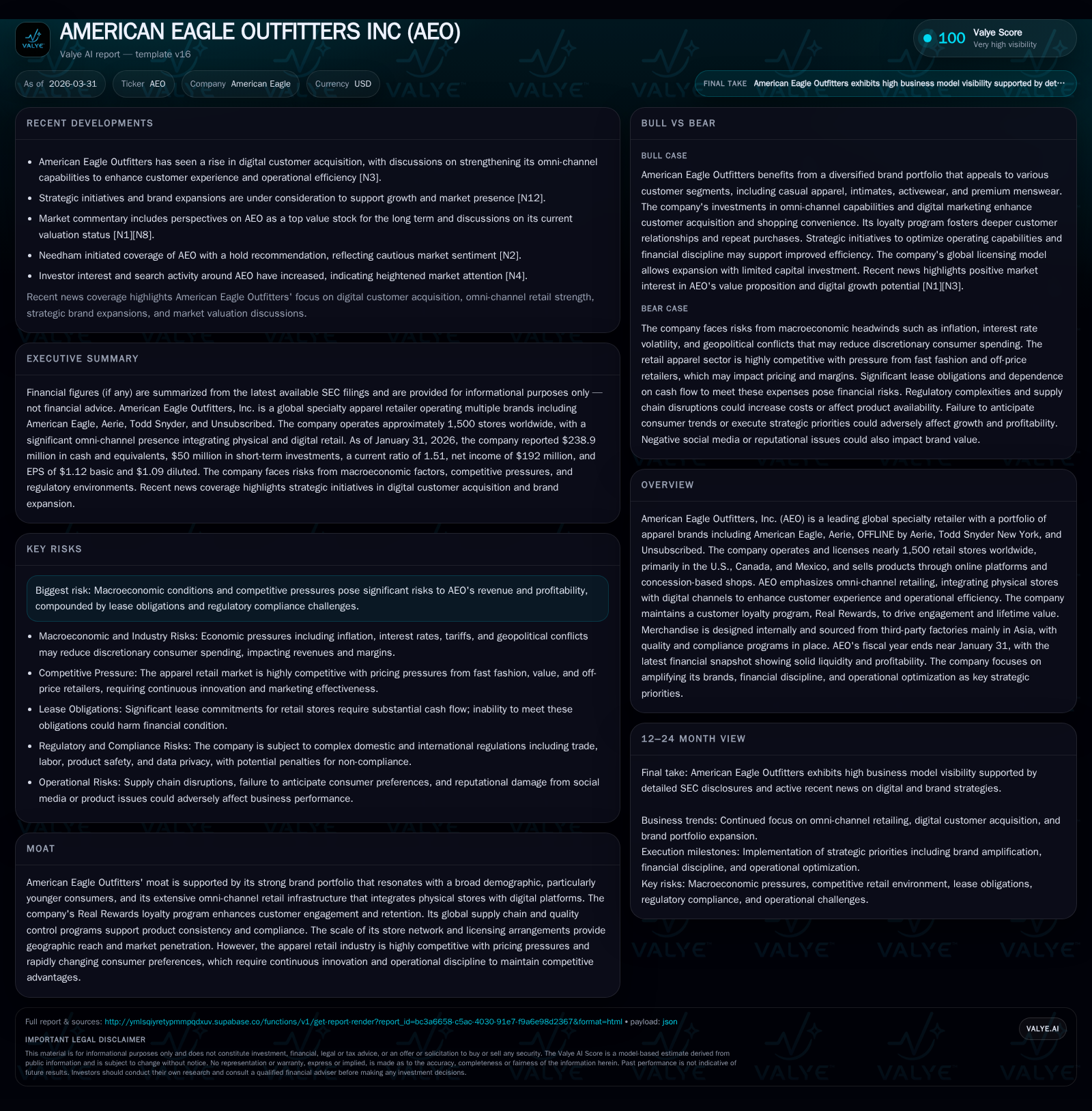
American Eagle Outfitters (AEO) experienced a significant decline in operating and net income during fiscal 2025, driven by challenging macroeconomic conditions and competitive pressures that weighed on discretionary consumer spending. Despite this profit setback, the company intensified investments in omni-channel capabilities, including enhanced digital sales platforms and integrated loyalty programs, alongside broadening its brand presence through acquisitions such as Todd Snyder and Unsubscribed. Capital allocation showed disciplined dividend payments with moderated share repurchases and increased capital expenditure focused on technology and supply chain optimization. Going forward, AEO's growth will hinge on sustaining digital engagement, effective supply chain adjustments, and navigating evolving market risks including tariffs and changing consumer preferences.
Financial Performance Evolution: Tracking AEO's Profitability Trends
American Eagle Outfitters (AEO) faced a notable pullback in fiscal 2025 profitability metrics. Operating income shrank nearly half from $427.3 million in FY2024 to $226.2 million in FY2025 (-47.1%), while net income receded from $329.4 million to $192.0 million (-41.7%) [F1]. Operating cash flow experienced a comparatively mild decline of approximately 4.3%, underscoring some resilience in core cash generation despite margin pressures [F1]. Return on equity approximated 11.3% based on net income relative to equity at year-end [F1]. These declines reflected a combination of macroeconomic headwinds compressing consumer spending on discretionary apparel goods and internal cost dynamics described in risk disclosures [S1]. Seasonality remains impactful given the concentration of sales during back-to-school and holiday periods [S16]. The company’s current ratio of roughly 1.51 signals solid short-term liquidity for operational needs [F1].
Historical performance (annual)
| FY | Net ($mm) | CFO ($mm) | OpInc ($mm) | Capex ($mm) | Net YoY |
|---|---|---|---|---|---|
| 2025 | 192 | 456 | 226 | 261 | -41.7% |
| 2024 | 329 | 477 | 427 | 223 | +93.7% |
| 2023 | 170 | 581 | 223 | 174 | +35.9% |
| 2022 | 125 | 406 | 247 | 260 |
Source: SEC companyfacts cache [F1].
Capital returns and efficiency (annual)
| FY | Div ($mm) | Buybacks ($mm) | FCF ($mm) |
|---|---|---|---|
| 2025 | 85 | 57 | 195 |
| 2024 | 96 | 191 | 254 |
| 2023 | 84 | 20 | 406 |
| 2022 | 65 | 20 | 146 |
Source: SEC companyfacts cache [F1].
Table: Summary of AEO annual financial performance showing recent volatility across earnings metrics.
Operational Drivers Behind Revenue Changes and Margin Pressures
The company's revenue trajectory and margin compression are rooted primarily in macroeconomic downturn effects on discretionary consumer spend particularly impacting softline/apparel retail segments [S1][S6]. Inflationary pressures resulted in heightened sourcing costs including raw materials such as cotton, pushing up merchandise expense lines [S1]. Weakening consumer confidence paired with volatile interest rates curtailed appetite for apparel purchases [S1]. Competitive dynamics intensified pricing pressure as fast fashion and value retailers continue to erode price elasticity in core demographics [S9].
Inventory management also posed challenges amid moderating demand—with SKU rationalization efforts underway but offset by elevated markdown rates prompted by excess inventories [S6][S26]. Increased reliance on digital channels further pressured promotional intensity due to heightened customer return expectations and shipping cost considerations [S9]. The company reported meaningful promotional activity linked to shifting product mix strategies between casual American Eagle goods versus higher-margin premium lines like Todd Snyder [N6][S4][S10].
Strategic Omni-Channel Investments and Brand Portfolio Developments
AEO accelerated investments in its omni-channel platform to bridge physical retail locations with online channels under a unified inventory view enhancing multi-modal fulfillment options including ship-to-home from stores, curbside pickup, and store-to-door ordering [S5][N5]. The Real Rewards loyalty program acts as an engagement lever integrating these touchpoints into a tiered structure rewarding frequency and spend with digital exclusives and shipping benefits, aimed at boosting lifetime customer value [S8].
Furthermore, the company has expanded its brand portfolio notably with the premium menswear line Todd Snyder New York, which blends classic tailoring inspiration with modern refinement targeting an affluent male segment [S4][S10]. Complementing this is Unsubscribed, a conscious slow-fashion label reflecting sustainability trends attractive to socially responsible consumers [S4][S10]. Licensing arrangements sustain global footprint growth outside North America through third-party operated stores in Asia, Europe, Latin America, and the Middle East—around nearly 350 licensed locations planned to increment beyond fiscal 2026 paired with online presence expansion via international marketplaces [S5].
Supply Chain Optimization Efforts and their Financial Impact
Fiscal 2025 saw AEO conclude operations of Quiet Platforms—a regionalized fulfillment center network which also serviced third-party customers—reflecting a strategic shift intended to simplify supply chain complexity and reduce fixed costs [S4][S5]. This move eliminates third-party distribution services previously offered by Quiet Platforms to external clients while focusing resources on proprietary omni-channel fulfillment capabilities.
However, raw material price volatility persisted as a notable headwind with cotton costs among key factors inflating merchandise costs constraining gross margins [S1][S26]. The company maintains a rigorous quality control process involving on-site factory inspections aligned with supplier codes of conduct emphasizing compliance with labor rights, safety discipline, environmental standards, which safeguards product consistency amid outsourced production mainly based in Asia [S17]. Supply chain delays or disruptions remain an inherent risk given geopolitical tensions such as tariffs or transportation interruptions impacting timely product availability [S27][S13][N6].
Capital Allocation Patterns: Dividends, Buybacks, and Capex Efficiency
Analysis of capital deployment reveals that AEO sustained dividend payments relatively unchanged albeit modestly reduced from prior years to $85 million in FY2025 following $96 million in FY2024—a reflection of cautious cash preservation amidst profit contraction [F1]. Share repurchases decreased materially from $191 million down to $57 million over the same period indicating restrained buyback activity likely driven by earnings softness paired with strategic reallocation towards investment projects rather than aggressive capital returns.
Capital expenditures increased sharply by over 17% year-over-year reaching approximately $261 million focused heavily on bolstering technology infrastructure supporting digital commerce platforms alongside store environment enhancements aimed at delivering seamless shopping experiences consistent with omni-channel ambitions [F1][N5][N6][S5]. Efficient capex deployment will be critical going forward to justify higher fixed costs within thinner margin contexts.
Market Risks Including Macroeconomic Dynamics and Competitive Landscape
AEO faces considerable downside risks tied to overarching macroeconomic instability including inflation-driven cost escalations impacting consumer wallet share across discretionary categories along with unpredictable interest rate trajectories dampening credit-access for shoppers [S1][S6]. Inflation’s adversarial impact on freight expenses combined with ongoing tariff uncertainty—highlighted recently by U.S.’s imposition of temporary global tariffs affecting imports—injects additional variability into COGs (cost of goods sold) profiles threatening margin sustainability if not adequately absorbed or passed through [S12][S13].
Competitive retail pressures remain steep due to fragmented apparel marketplace participants spanning fast fashion disruptors to value chains exerting discounting forces eroding pricing power [S9]. Digital landscape intensifies competition further requiring constant innovation both in user engagement technologies—such as AI-enabled personalized marketing—and operational delivery speed to maintain relevance against digitally native brands competing for attention across social media platforms where algorithm changes can abruptly affect traffic acquisition costs or conversion funnel efficacy [S18][N5].[N6]
Data privacy regulations impose mounting compliance demands globally exposing AEO to potential operational bottlenecks or penalties should governance falter amid growing scrutiny on AI-driven personal data usage embedded within marketing activities or customer data platforms reinforcing the importance of robust governance frameworks around technology adoption practices moving forward [S11][S23].
Emerging Growth Opportunities Via Licensing and Digital Channels
Growth prospects hinge substantially on international expansion leveraging the licensing model which involves minimal capital expenditure yet garners retail footprint broadening particularly through partnerships targeting rapidly developing markets such as India, Southeast Asia, Middle East region sectors fostering brand awareness under well-calibrated localized assortments adapted via online marketplace integrations enhancing accessibility beyond physical store constraints [N6][S5].[N7]
The Real Rewards loyalty program's effective monetization through tiered benefits offers scalable potential by deepening customer retention metrics improving purchase frequency—as evident through digital behavioral analytics driving tailored merchandising recommendations—and cross-selling among AE flagship goods alongside Aerie intimates while integrating new brands like OFFLINE activewear into unified customer journeys extending wallet share per user profiles created via CRM systems advancement initiatives documented within recent disclosures [N6],[N7],[S8].[S10]
Moreover, strategic use of advanced mobile technology upgrades aligns closely with younger demographic preferences driving digital-first acquisition pathways minimizing reliance on traditional brick-and-mortar traffic adversely impacted by mall traffic downturn trends confronting the broader sector landscape [N5].[N6]
Monitoring Future Catalysts: What Investors Should Watch
Absent direct forward guidance disclosures from American Eagle Outfitters management at this juncture,[N12],[N13] future performance indicators worth monitoring include quarterly comparable same-store sales trends particularly shifts favoring digital channel penetration over legacy store counts providing insight into maturity levels reached within omni-channel transformations. Equally important are gross margin ratios for signs of stabilization or improvement linked to effective markdown management alongside inventory turnover rates signaling whether SKU rationalizations successfully align stock availability with demand forecasts preventing excessive clearance losses.[N12] Capital allocation signals such as renewed buyback programs or dividend policy adjustments could suggest confidence returning contingent on earnings recovery timing.[N13] Successful integration progress around branding initiatives especially premium tiers afforded by Todd Snyder combined with measured geographic footprint extensions via licensing deals might present incremental revenue diversification offsets to domestic market saturation.[N6] Market watchers should also track regulatory developments around trade policies impacting import costs plus any emerging data privacy compliance impacts influencing marketing efficiency metrics providing early read-across into operational cost structures framed against consumer sentiment indices linked closely to macroeconomic forecasts.[S1],[S13],[N12],[N13]
Disclaimer: This analysis is intended for informational purposes only based on publicly available filings and news sources as of March 31, 2026. It does not constitute investment advice or recommendations.
Disclaimer: This is research-only, informational analysis and not investment advice. It may include AI-generated interpretation and general industry context. Always verify important details using primary sources.

Comments