
Bio Green Med Solution’s Post-Acquisition Trajectory Hampered by Financial Losses and Market Risks
The 2025 acquisition of Fitters Sdn. Bhd. expanded Bio Green Med Solution’s fire safety product portfolio but introduced significant operational and financial challenges.
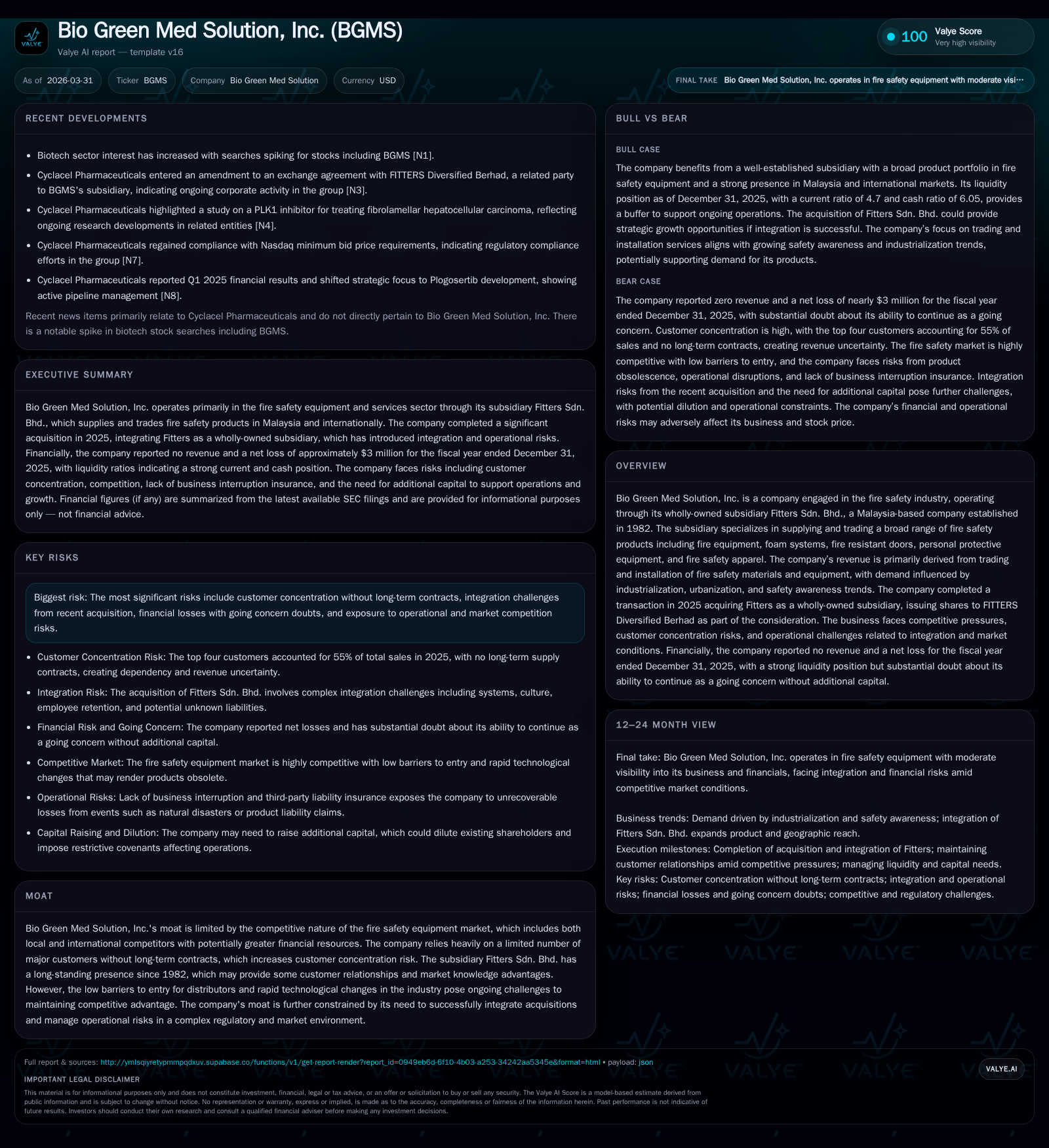
Bio Green Med Solution, Inc. acquired Fitters Sdn. Bhd. in 2025, bringing a respected fire safety business under its umbrella with established market presence since 1982. While the acquisition broadened its product offerings and geographic reach, BGMS continues to struggle with substantial operating losses, zero recorded revenues in 2025, and customer concentration risks. Integration complexities, evolving regulatory requirements in Malaysia, and market competition further burden the company’s prospects. Capital resources remain tight, with negative cash flows from operations and no clear guidance on profitability ahead.
Company Overview and Acquisition Context
Bio Green Med Solution, Inc. operates through its wholly owned subsidiary Fitters Sdn. Bhd., a Malaysian company founded in 1982 specializing in fire safety products including foam systems, fire resistant doors, personal protective equipment (PPE), and apparel relevant to fire protection . The strategic acquisition completed in September 2025 transitioned Fitters into a wholly-owned subsidiary of BGMS via a share exchange agreement with FITTERS Diversified Berhad that resulted in approximately 20% ownership dilution in BGMS stock [S2]. This transaction aimed to expand BGMS’s footprint into the industrializing Southeast Asian fire safety equipment markets.
Historical Performance Analysis
BGMS’s consolidated financials post-acquisition reveal mounting operational challenges. For fiscal year 2025, the company surprisingly reported $0 revenue despite integrating Fitters’ established operations—an anomaly likely reflecting accounting consolidation timing or transitional adjustments rather than absence of business activity [F1]. Operating losses narrowed substantially to approximately -$8.4 million from -$12 million in 2024 but remain sizable relative to equity of $6.8 million at year-end [F1]. Net income improved correspondingly to a loss of roughly -$3 million compared to -$11 million prior year yet still indicates ongoing earnings pressure.
Operating cash flow remains negative at approximately -$4.77 million as capital expenditures stay nominal around $6,000 indicating minimal investment spending during this period [F1]. The current ratio surpasses 4x evidencing solid short-term liquidity but reflects high receivables or inventory levels tied to integration [F1]. This operating picture reveals an ongoing struggle to realize revenue synergies or cost efficiencies promised by the acquisition.
Historical performance (annual)
| FY | Net ($mm) | CFO ($mm) | OpInc ($mm) | Capex ($) | Net YoY |
|---|---|---|---|---|---|
| 2025 | -3 | -5 | -8 | +73.3% | |
| 2024 | -11 | -8 | -12 | 6000 | +50.3% |
| 2023 | -23 | -16 | -25 | 6000 | -6.4% |
| 2022 | -21 | -21 | -28 | 7000 |
Source: SEC companyfacts cache [F1].
Capital returns and efficiency (annual)
| FY | FCF ($mm) | ROE% |
|---|---|---|
| 2025 | -43.8 | |
| 2024 | -8 | 515.7 |
| 2023 | -16 | -3715.8 |
| 2022 | -21 | -133.0 |
Source: SEC companyfacts cache [F1].
Future Growth Prospects
BGMS’s future revenue growth critically hinges on successfully leveraging Fitters’ historic presence within Malaysia's industrial sectors marked by urbanization trends supporting demand for fire protection products [S7][S12]. However, management explicitly cautions that product sales depend heavily on rapid industrialization rates and increasing safety awareness — macro drivers outside their direct control [S1].
Major risk encumbers customer concentration: the top four customers accounted for over half of sales collectively in FY25 with no binding long-term supply agreements securing these relationships [S7][S12]. Any loss of a dominant customer could severely impair revenue generation capacity.
Technological change within the fire safety industry demands continuous product innovation and adaptation; failure to timely deliver new product enhancements risks obsolescence amid competition from better-resourced global peers [S21]. Additionally, stricter Malaysian fire safety regulations require compliance upgrades possibly increasing costs or delaying deployments if not managed effectively [S4][S11]. The competitive landscape also includes multinational players who may operate integrated supply chains providing scale advantages difficult for BGMS's mid-sized operation to match.
Forecasts and Milestones to Watch
Explicit guidance regarding topline growth or profitability targets has not been disclosed by BGMS or derived from SEC filings up through Q1-2026 [N1][S1][S3]. Close monitoring should focus on:
- Revenue reporting clarity following the post-transaction consolidation period,
- Retention or expansion of Fitters’ key customers amidst competition,
- Progress reports on integration initiatives measuring cost synergies,
- Regulatory compliance achievements especially under Malaysia's BOMBA certification regimes,
- Capital raising efforts given continued operating cash burn.
Any resolutions addressing these milestones will clarify whether the company can reverse historical losses into sustainable profits.
Returns and Capital Allocation Dynamics
Financial data underscores negative profitability metrics reflected by an approximate Return on Equity (ROE) near -44% based on FY25 net loss against shareholders’ equity of about $6.8 million [F1]. Given ongoing operational deficits and cash outflows near $4.77 million annually net of minimal capex spend ($6k), free cash flow generation remains negative posing funding challenges.
Bio Green Med Solution has not declared dividends nor engaged in share repurchase programs recently; historical buybacks date back more than a decade before this recent period reflecting limited capital returns currently [F1][S29]. To sustain operations and pursue growth opportunities post-acquisition integration costs likely requires fresh equity or debt financing which could dilute existing shareholders or increase financial leverage riskiness.
Industry and Market Environment Insights
From an industry vantage point, the global fire safety equipment sector exhibits low barriers to entry for trading/distribution businesses yet demands continual technological innovation due to product life cycle contraction tied to evolving standards and safety regulations — trends markedly visible across Southeast Asia including Malaysia where fit-for-purpose solutions are essential.
Supply chain complexity also grows with increasing environmental regulation pressures requiring manufacturers/distributors alike to adapt formulations (e.g., foam chemicals) meeting eco-friendly mandates without compromising efficacy — this demands investments potentially burdensome for mid-sized operators like BGMS/Fitters.
Customer purchasing decisions are often cyclical influenced by construction activity cycles sensitive to interest rates and credit availability impacting commercial real estate development—the key market driver for infrastructure scaled deployments involving fire suppression equipment installations.
Risks Summary Highlighting Challenges Ahead
- Customer Concentration: Heavy reliance on few major buyers without binding contracts creates volatility risk if procurement patterns change abruptly [S7][S12].
- Integration Complexity: Aligning operational processes between BGMS and newly acquired Fitters presents execution hazards that may delay synergy realization and strain management bandwidth [S2][S10].
- Financial Distress Signs: Persistent operating losses paired with cash burn require urgent capital infusion strategies; failure may threaten ongoing operations viability questions flagged by going concern disclosures [F1][S8].
- Regulatory Pressure & Compliance Costs: Malaysia’s evolving fire safety standards enforced by BOMBA escalate compliance burden potentially affecting sales channels unless maintained proactively [S4][S11].
- Competitive Intensity: Strong rivalry from established multinational players with broader portfolios challenge BGMS’s market share retention efforts amidst pricing pressures [S21].
- Macroeconomic Uncertainties: Exposure to trade policy changes, currency fluctuations impacting import costs/exports revenues adds complexity in emerging market dynamics [S14][S20].
- Litigation Risk: Although currently no material legal proceedings exist, sector typical product liability exposure demands adequate risk mitigation given hazardous end-use environments [S18].
Conclusion
Bio Green Med Solution stands at a crucial inflection point following its transformative acquisition of Fitters Sdn. Bhd., inheriting both valuable market positioning within Southeast Asia's growing fire safety sector alongside significant financial stressors marked by persistent losses absent clear revenue evidence for FY25. Although improvements in top-line recognition may be forthcoming as integration matures post-2025 year-end finality, management confronts balancing operational execution risks against regulatory mandates and competitive forces against a backdrop of tight liquidity.
Investors should monitor key developments related to enhanced revenue transparency post-acquisition accounting adjustments; customer retention stability amid fierce competition; stringent Malaysian regulatory adherence; alongside corporate finance maneuvers addressing cash flow deficits essential for survival beyond the near term.
This report is prepared solely for informational purposes and does not constitute investment advice or recommendations.
Disclaimer: This is research-only, informational analysis and not investment advice. It may include AI-generated interpretation and general industry context. Always verify important details using primary sources.

Comments