
BGSF’s Strategic Refocus on Property Management Staffing Challenges Profitability and Scale
After divesting non-core segments, BGSF has narrowed its focus on property management staffing but faces significant operational and market pressures.
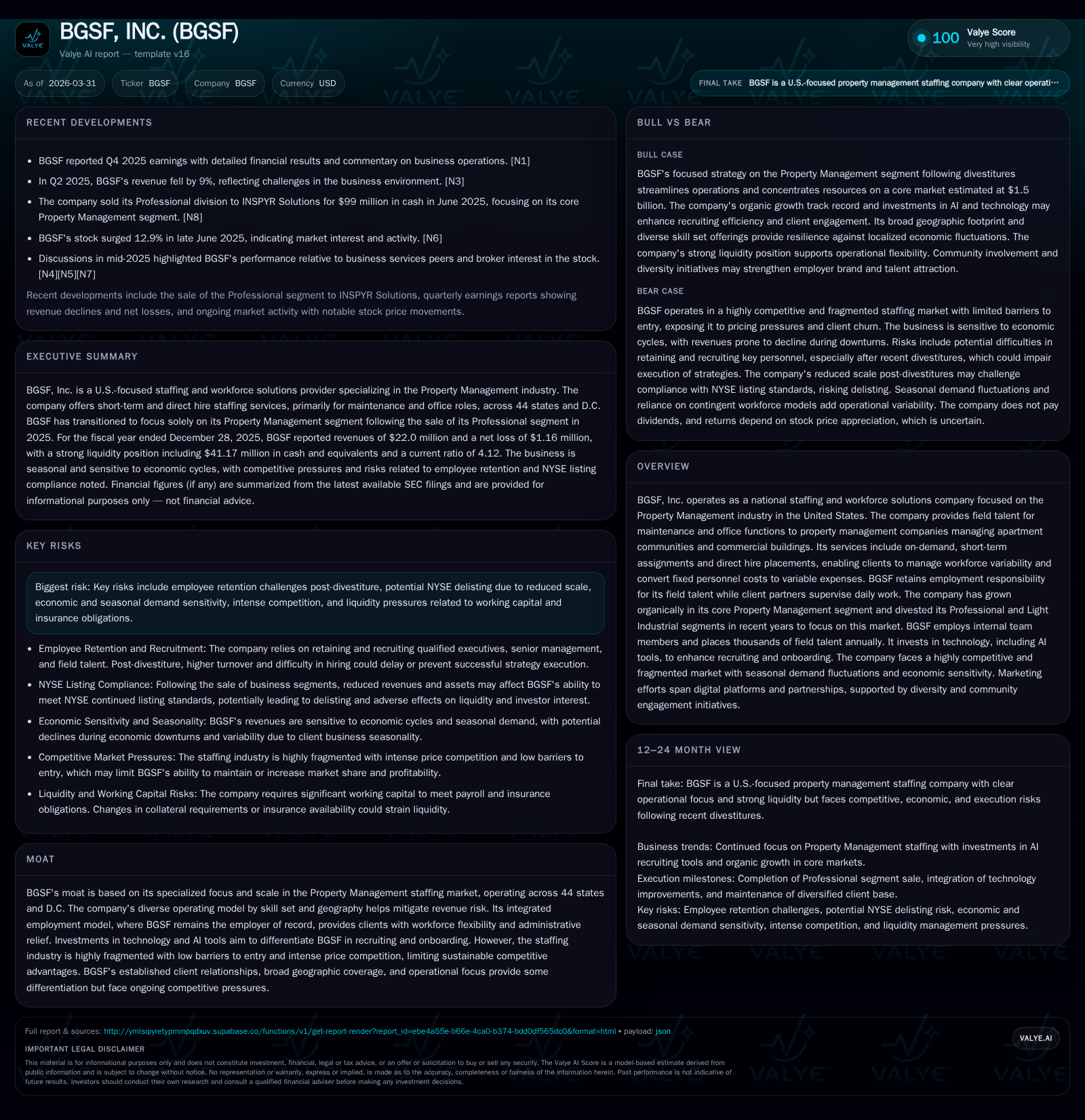
BGSF, Inc. has transformed from a multi-segment staffing provider to a specialized player solely in the U.S. property management staffing market following recent divestitures. The company’s revenue plummeted nearly two-thirds in 2025 as it exited professional and light industrial segments, resulting in operating losses despite a strong liquidity position. Continued organic growth in property management staffing remains the central engine, supported by investment in AI and technology, yet profitability remains elusive. Key risks include intense competition in a low-barrier industry, employee retention post-sale, market concentration in Texas, and liquidity pressures linked to working capital demands.
Company Overview and Historical Performance
BGSF, Inc. operates as a specialized national workforce solutions provider focused exclusively on the Property Management industry across 44 states and D.C. [S1][S11]. Historically formed through the acquisition of BG Personnel Services in 2010, which marked its entrance into property management staffing with $23 million revenue, BGSF grew this segment organically to $93.3 million by fiscal year 2025 [S15][S6]. Prior to divestitures finalized in 2024 (Light Industrial segment) and September 2025 (Professional segment), BGSF operated multiple lines including IT consulting and finance/accounting services [S15]. The recent strategic narrowing toward Property Management marks a pivotal transition.
Financially, revenue contracted sharply to $22 million in FY2025 from $64.4 million in FY2024 — a 65.8% decline reflecting business divestitures [F1]. Operating income swung heavily negative at -$8.9 million following near break-even or modest profitability in previous years (e.g., +$1.2 million operating income in FY2024) [F1]. Net income was also negative at approximately -$1.16 million versus -$0.98 million prior year despite lower top-line [F1]. Operating cash flow was effectively flat at just $142,000 with limited capital expenditure of $138,000 illustrating curtailed investment [F1]. Equity declined concomitantly from ~$82 million to ~$48 million [F1]. This compresses return on equity to roughly -2.4%, underscoring near-term profitability challenges post-restructuring.
Historical performance (annual)
| FY | Rev ($mm) | Net ($) | CFO ($mm) | OpInc ($mm) | Rev YoY | Net YoY |
|---|---|---|---|---|---|---|
| 2025 | 22 | -1160000 | 0 | -9 | -65.8% | -18.2% |
| 2024 | 64 | -981000 | 24 | 1 | ||
| 2022 | 74 | 999000 | 20 | -7 | +8.7% | |
| 2021 | 68 | 7 | 15 |
Source: SEC companyfacts cache [F1].
Capital returns and efficiency (annual)
| FY | Div ($mm) | FCF ($mm) | ROE% |
|---|---|---|---|
| 2025 | 22 | 0 | -2.4 |
| 2024 | 2 | 23 | -1.2 |
| 2022 | 7 | 18 | 1.2 |
| 2021 | 5 | 3 |
Source: SEC companyfacts cache [F1].
Table: Selected Annual Financials (Source: [F1])
The decline primarily results from shedding the higher-revenue Professional and Light Industrial segments—the latter sold in early 2022—focusing BGSF’s business exclusively on the Property Management segment [S15][S19]. Despite lower scale, the firm maintains a sizeable cash balance ($41 million as of Sept ’25) ensuring runway amidst working capital requirements [F1][S14].
Core Business Model & Market Positioning
BGSF’s core offering encompasses short-term assignments and direct hires for maintenance and office roles supporting apartment communities and commercial properties managed by its client partners [S11]. They maintain employment responsibility for field talent while clients supervise day-to-day work—mitigating fixed personnel costs through flexible workforce models [S11]. The company serves predominantly small to mid-sized property management companies with mostly non-exclusive, on-demand contracts that can be terminated with little notice [S4].
The market itself is highly fragmented—only three firms possess national scale—characterised by roughly 27,000 workforce solution providers across various sectors nationwide [S6][S7]. The property management staffing subset is estimated around a $1.5 billion opportunity currently [S5]. Competition largely hinges on pricing dynamics, candidate placement speed, scope of assignments available, service quality, geographic coverage, and technology-enabled recruitment efficiency [S6][S7].
While barriers to entry remain low—with vendors ranging from local temp firms to large multi-service agencies—BGSF invests heavily in technology upgrades like AI-driven recruiting tools initiated in 2025 aimed at accelerating hiring cycles and enhancing candidate experience to differentiate against price pressure [S6]. The company also benefits from geographic diversification across nearly all states, although Texas accounts for nearly one-third of revenues (~28% in FY2025) exposing results materially to regional economic fluctuations [S12][S26].
Growth Prospects & Constraints
Post-divestiture growth hinges chiefly on organic expansion within existing markets and leveraging enhanced technology platforms to streamline field talent sourcing operations [S6]. Although acquisitions were historically minimal in the Property Management segment, BGSF remains open to selective targets aligned with its focus markets moving forward but appears cautious given recent portfolio pruning [S6][S10].
market tailwinds include ongoing labor shortages exacerbated by increasing demand for workforce flexibility among property managers who seek to reduce fixed overhead costs amid volatile tenant turnover rates tied seasonally to lease expirations (peaking Q3 each year) [S7].
Conversely, resistance stems from intense competition driving down gross margins due to freely available alternatives for candidates and demand-side pressure limiting bill rates [S6][S7]. Employee retention is an acute challenge since workers often have multiple staffing options; moreover, post-divesture internal team attrition among executives or recruiters could disrupt momentum amid leaner operations [S2][S23]. Regulatory risk around worker classification laws and compliance elevate operational costs relative to peers [S17][S21], especially given responsibilities for payroll liabilities borne by BGSF.
Additionally, concentration risk related to Texas accentuates vulnerability; any localized economic downturn there could disproportionately impact consolidated results given that region’s outsized revenue contribution sustaining nearly a third of business volumes [S12][S26].
Capital Allocation & Financial Trends
BGSF’s capital deployment reflects repositioning following asset sales selling off non-core units that reduced total scale but generated liquidity allowing distribution back to shareholders evidenced via dividends totaling $22.4 million paid out for FY2025 despite operational losses incurred during that period [F1]. This suggests returns of excess capital realized from divestments rather than earnings-generated distributions.
Operating cash flow dynamics have deteriorated nearly fully trailing profitability declines; cash flow from operations collapsed more than 99% year-over-year down to approximately $140 thousand for FY2025 from over $24 million previously indicating tight free cash generation capacity ahead unless turnaround measures prove effective [F1]. Correspondingly capex plummeted reflecting a pause in investments aside from necessary technological upgrades.
Liquidity remains abundant with current assets outpacing liabilities by over four times as of December ’25 underpinning working capital-heavy operations wherein payroll must be serviced ahead of client receivables clearance extending up to three months under standard terms—a typical net working capital strain seen in contingent staffing firms where wage obligations precede collections substantially [F1][S14]. However, reliance on internal funding without external credit facilities adds uncertainty if operating cash deteriorates further.
Return on equity inverted post restructuring at approximately negative two percent given net losses versus equity base declining after dividend draws prompting cautious monitoring moving forward [F1].
Risks Overview
Key risks identified include:
- Employee turnover: Loss of key executives or recruiters could impair execution following downsizing [[S2],[S23]].
- NYSE listing risks: Reduced scale may challenge continued exchange listing if metrics fall below minimum standards [[S2],[N1]].
- Economic sensitivity: Demand drops sharply during downturns due to client retrenchment or inability to pay [[S12],[S16]].
- Competitive intensity: Low entry barriers spur price wars eroding margins [[S6],[S7],[S21]].
- Regulatory compliance: Exposure to employment practice claims and regulatory shifts raises legal exposure [[S17],[S18]].
- Liquidity constraints: High working capital needs necessitate robust cash management; loss of insurance coverage would be critical [[S10],[S14],[S20]].
- Market concentration: Localized economic shocks especially in Texas bear high influence [[S12],[S26]].
What To Watch / Analysis Outlook
While explicit near-term guidance has not been disclosed post-sale completion [[N1]], investors should monitor sequential quarterly trends for signs of margin stabilization or recovery driven by cost rationalization or pricing power improvements within the Property Management segment.
Customer retention rates and new account growth will indicate success navigating competitive pressures alongside progress integrating AI tools into recruiting workflows — faster placement velocity may translate directly into higher revenue throughput.
Employee turnover metrics particularly amongst recruiters or leadership would signal potential disruption risks impacting organic growth efforts.
Finally, liquidity adequacy remains critical considering high pay-to-bill float inherent; failure here would severely restrict operational flexibility during seasonal troughs or macroeconomic stresses.
BGSF operates effectively as a focused niche player specializing in an underpenetrated but competitive segment leveraging scale mainly through geographical breadth rather than acquisitions presently — growth prospects exist but hinge critically upon effective execution amid thin operating leverage visible in recent financials.
Disclaimer
This analysis is based solely on publicly available information as of March 31, 2026 including SEC filings and public news releases without incorporation of any non-public material information. It does not constitute investment advice nor recommendations but aims to provide an informed overview of BGSF’s business profile, historical performance trends, current challenges and potential outlook considerations.
Disclaimer: This is research-only, informational analysis and not investment advice. It may include AI-generated interpretation and general industry context. Always verify important details using primary sources.

Comments