
Akari Therapeutics’ Novel ADC Pipeline Targets Cancer with Dual Action Amid Fiscal Strains
Akari’s spliceosome-targeting ADCs show promise for difficult cancers while financial challenges cast uncertainty on development progress.
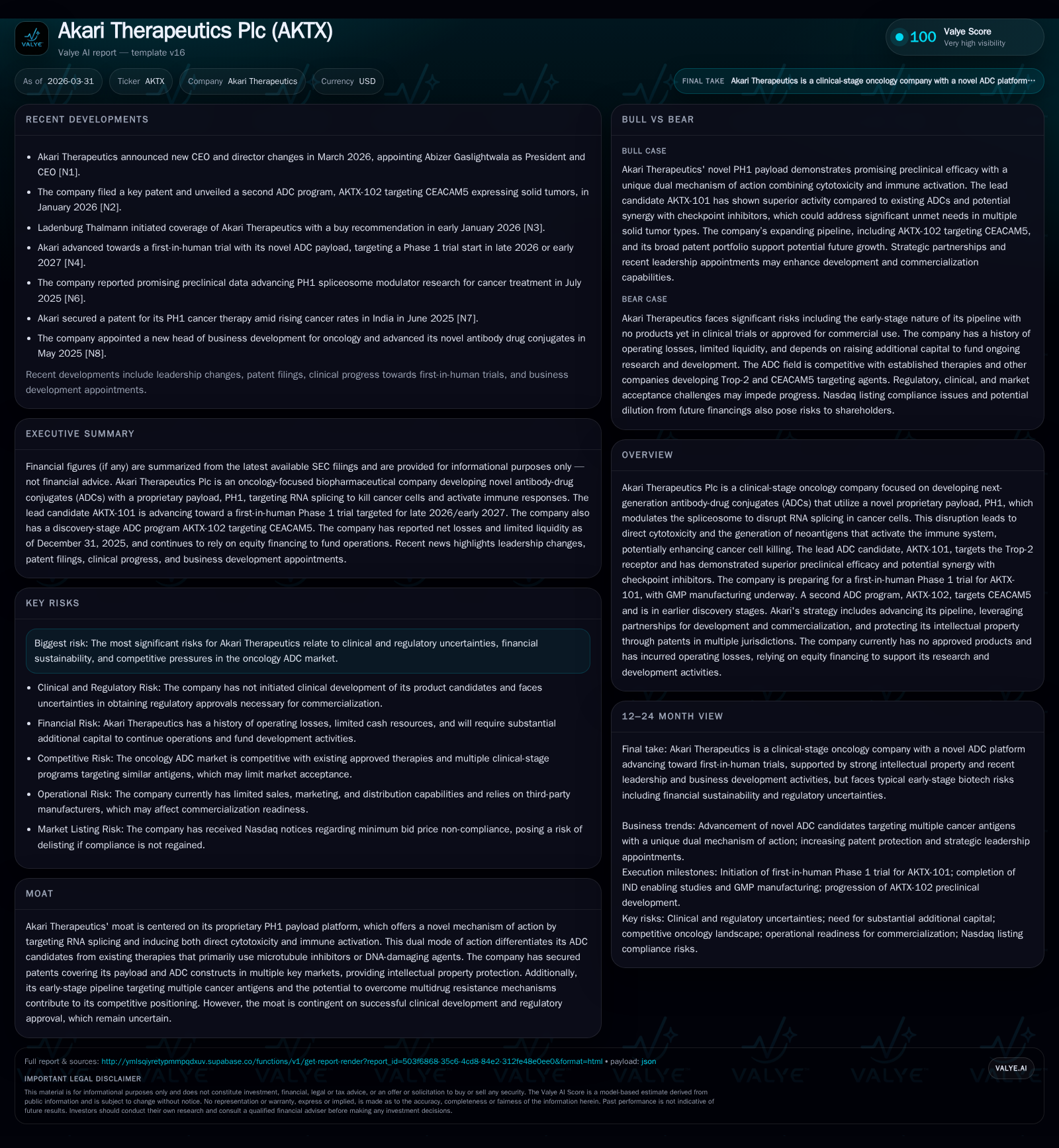
Akari Therapeutics is pioneering a unique class of antibody-drug conjugates (ADCs) utilizing the proprietary PH1 payload that disrupts RNA splicing to kill cancer cells directly and activate immune responses. Its lead candidate, AKTX-101, poised for a Phase 1 trial by late 2026, targets Trop-2 and shows potential synergy with checkpoint inhibitors in preclinical models. Despite technological differentiation, Akari faces persistent operating losses, zero year-end cash reserves in 2025, and low liquidity that raise material going concern questions. Capital raising and clinical milestones will be critical to sustain its path toward commercialization amid steep regulatory and competitive hurdles.
Innovating Cancer Treatment: The PH1 Payload and ADC Pipeline Evolution
Akari Therapeutics distinguishes itself in oncology drug development through its novel proprietary payload platform centered on PH1—a chemical moiety designed to modulate the spliceosome, which is essential for RNA processing within cells. By disrupting RNA splicing in tumor cells, PH1 exerts not only direct cytotoxic effects causing cancer cell death but also induces the generation of neoantigens that engage both innate and adaptive immunity against tumors [S1]. This dual mode of action may address key limitations observed with conventional ADC payload classes that primarily deploy microtubule inhibitors or DNA-damaging agents.
The lead antibody-drug conjugate candidate AKTX-101 is engineered to target Trop-2, a transmembrane glycoprotein overexpressed on many epithelial cancers including urothelial carcinoma and certain lung cancers [S1]. Preclinical comparisons reveal that AKTX-101 provides prolonged survival benefits relative to standard payload ADCs such as those armed with topoisomerase I inhibitors. Importantly, the payload’s immunogenic neoantigen formation shows synergistic potential when combined with immune checkpoint blockade—an increasingly standard therapeutic backbone—offering rationale for combination regimens [S1].
A second asset, AKTX-102, targets CEACAM5 relevant in pancreatic, colon, stomach, esophageal, and lung cancers but remains in discovery stages [S1]. Its development could broaden Akari’s portfolio into tumors often refractory to existing treatments. Together these programs leverage the platform’s ability to create ADCs addressing diverse antigen targets implicated in aggressive malignancies.
Such spliceosome modulation approaches remain experimental and unvalidated clinically, positioning Akari amongst early innovators but also underscoring mechanistic risks inherent to first-in-class treatment modalities [S18].
Historical Growth and Operating Performance Trends
Akari's financial track record over the past four fiscal years reflects persistent operating losses typical of a discovery-driven biotech yet displays signs of gradual improvement in managing expenditures (see Table below). Operating income losses improved from approximately -$23.1 million in FY2022 to -$21.6 million in FY2024 before falling further to -$17.3 million by FY2025 [F1]. Net losses generally parallel this trend though they widened notably between FY2023 (-$10.0 million) and FY2024 (-$19.8 million), indicating episodic cost escalations likely linked to development activities ramp-up.
Despite these modest improvements, operating cash flow remains deeply negative reflecting heavy investment in R&D and clinical programs without offsetting revenues [F1]. Negative cash flows contracted from -$21.5 million in FY2022 to -$10.6 million in FY2025, signaling some operational discipline or sequencing of expenses but insufficient to achieve cash breakeven.
Historical performance (annual)
| FY | Net ($mm) | CFO ($mm) | OpInc ($mm) | Net YoY |
|---|---|---|---|---|
| 2025 | -17 | -11 | -17 | +12.6% |
| 2024 | -20 | -13 | -22 | -97.8% |
| 2023 | -10 | -16 | -17 | +43.6% |
| 2022 | -18 | -22 | -23 |
Source: SEC companyfacts cache [F1].
Capital returns and efficiency (annual)
| FY | ROE% |
|---|---|
| 2025 | -61.1 |
| 2024 | -89.0 |
| 2023 | 4370.3 |
| 2022 | -991.1 |
Source: SEC companyfacts cache [F1].
Table summarizing key annual operating performance metrics illustrating loss reduction trends though sustained negative cash flow [F1].
Financial Position and Operating Cash Flow Dynamics
Akari faces acute liquidity constraints as evidenced by its financial statements ending December 31, 2025. Cash and equivalents were exhausted completely by year-end while current liabilities nearly doubled current assets contributing to a critically low current ratio of 0.44 [F1]. Such imbalance highlights immediate concerns regarding operational runway without fresh capital infusion.
This precarious position aligns with company disclosures noting management's acknowledgment of going concern risks given pending large expenditures needed to initiate clinical trials shortly [S1]. The absence of product revenues—typical for clinical-stage biotech companies—places full reliance on external funding sources such as equity raises.
Equity stood at $28.3 million positive as of FY2025 compared with negligible or slightly negative levels previously reflecting some successful financing rounds; however these funds must sustain ongoing GMP manufacturing scale-up activities plus expensive IND enabling studies amid no near-term commercial cash inflows [F1][S1].
Free cash flow remains negative approximately $10.6 million annually given capital expenditures are minimal relative to operational spending levels (no meaningful capex recorded recently) [F1]. This suggests all financial resources are funneled predominantly toward preclinical and clinical development rather than infrastructure investments or commercial capability building.
Development Milestones: Preparing for AKTX-101 Clinical Trials
One tangible milestone anchoring near-term growth hopes is Akari’s planned first-in-human Phase 1 trial for AKTX-101 expected by late 2026 or early 2027 [N1][S1]. IND-enabling studies have culminated successfully accompanied by initiation of good manufacturing practice (GMP) production run via WuXi Biologics/XDC partnership chosen specifically for scale-up consistency critical to regulatory submissions [S14][S15]. This manufacturing advancement represents a pivotal step from exploratory research to definitive clinical evaluation.
AKTX-101’s targeted malignancies span complex indications such as FGFR3 fusion-positive urothelial carcinomas and lung cancers harboring SMARCA4 deletions or BRAF mutations—subpopulations historically challenging due to molecular heterogeneity [S1]. The PH1 payload’s mechanism possibly confers advantages over competitors who rely on more conventional payload classes lacking immune engagement capabilities.
Detailed trial designs aim at evaluating both monotherapy efficacy markers alongside combinational dosing regimens incorporating checkpoint inhibitors given compelling preclinical synergy data [S1]. Successful demonstration of safety profiles coupled with early signals of immune potentiation would validate Akari’s moat built around its dual-functioning spliceosome modulation technology.
Capital Allocation Strategy Amid Funding Constraints
Akari has not declared any dividends or engaged in share repurchase programs reflecting typical biotech growth-phase capital stewardship prioritizing reinvestment over returns [F1]. Return metrics like ROE remain deeply negative at about -61% reflecting net income losses relative to shareholder equity [F1].
Capital allocation tilts heavily towards R&D expenditures encompassing clinical trial expenses, manufacturing scale-up costs, regulatory compliance efforts as well as corporate administration which are necessary prerequisites before any revenue generation transition could occur [S1][F1].
The company’s history shows dependence on multiple rounds of equity financings both public and private without other significant debt instruments disclosed thus far [S1], emphasizing vulnerability should capital markets conditions deteriorate or investor appetite wane amid biotech sector volatility.
For sustainability beyond imminent trial launches Akari needs continued access to external capital—both organic license deals or strategic partnerships might be considered routes for future financial support aligned with risk mitigation objectives.
Regulatory and Competitive Risks Impacting Future Prospects
On corridor realities temper scientific enthusiasm: Akari faces standard yet formidable hurdles governing drug approval pathways enforced variably across jurisdictions such as FDA (U.S.), EMA (EU), MHRA (UK). Protracted timelines for marketing authorization may delay commercialization even if development milestones pass.
Compliance burdens extend well beyond trial success encompassing strict adherence to healthcare laws including anti-kickback statutes that regulate inducements relating to prescriptions/reimbursements; false claims acts imposing liability for inaccurate government billings; data privacy frameworks such as GDPR/UK GDPR adding complexity especially with multinational operations; plus pharmaceutical pricing regulations which influence market access dynamics profoundly [S26]
Further legal fragility arises from intellectual property considerations where patents protecting the novel PH1 payload architecture must withstand challenges from generic biosimilar manufacturers or design-arounds—requiring active prosecution enforcement strategies [S25].
Competition from established ADC therapies targeting Trop-2 epitopes includes approved drugs like Trodelvy® (sacituzumab govitecan) and Datroway®, both backed by leading pharma companies with broader commercial capabilities creating pressure on market acceptance unless Akari demonstrates compelling clinical differentiation based on mechanism of action or tolerability advantages [S14].
Additionally ongoing pipeline innovation by competitors threatens obsolescence risks inherent to early-stage players if they fail rapid advancement timelines relative to peer breakthroughs.
What to Watch: Clinical Progress & Strategic Partnerships Ahead
Key near-term catalysts center on initiation and subsequent readouts from AKTX-101 Phase 1 patient cohorts testing dose escalation safety parameters along with pharmacodynamic evidence supporting immunogenic neoantigen activity presumed central to the platform’s promise [N1][S1]. Positive initial signals could catalyze expanded trials possibly involving combination immunotherapies enhancing market positioning.
Parallel monitoring involves business development trajectories where collaboration agreements licensing out regional rights or co-development partnerships could provide crucial capital infusions as well as commercial expertise currently absent at Akari essential for eventual product launch execution.
Investors should also observe regulatory interactions including FDA feedback cycles potentially impacting dosage form changes or analytic requirements that might alter timing estimates materially.
In sum this evolving story balances breakthrough biotechnological innovation against stark financial realities defining Akari Therapeutics’ road ahead: Success hinges on navigating costly developmental stages prudently while proving meaningful clinical value capable of carving a sustainable niche within a crowded oncology arena.
This report is prepared solely for informational purposes without offering investment advice or recommendations.
Disclaimer: This is research-only, informational analysis and not investment advice. It may include AI-generated interpretation and general industry context. Always verify important details using primary sources.

Comments