
Tempest Therapeutics Advances Dual-Targeting CAR-T and Small Molecule Oncology Pipeline Amid Capital Constraints
Tempest Therapeutics aims to leverage novel dual-targeting CAR-T therapies and innovative small molecules while navigating clinical development and financial challenges.
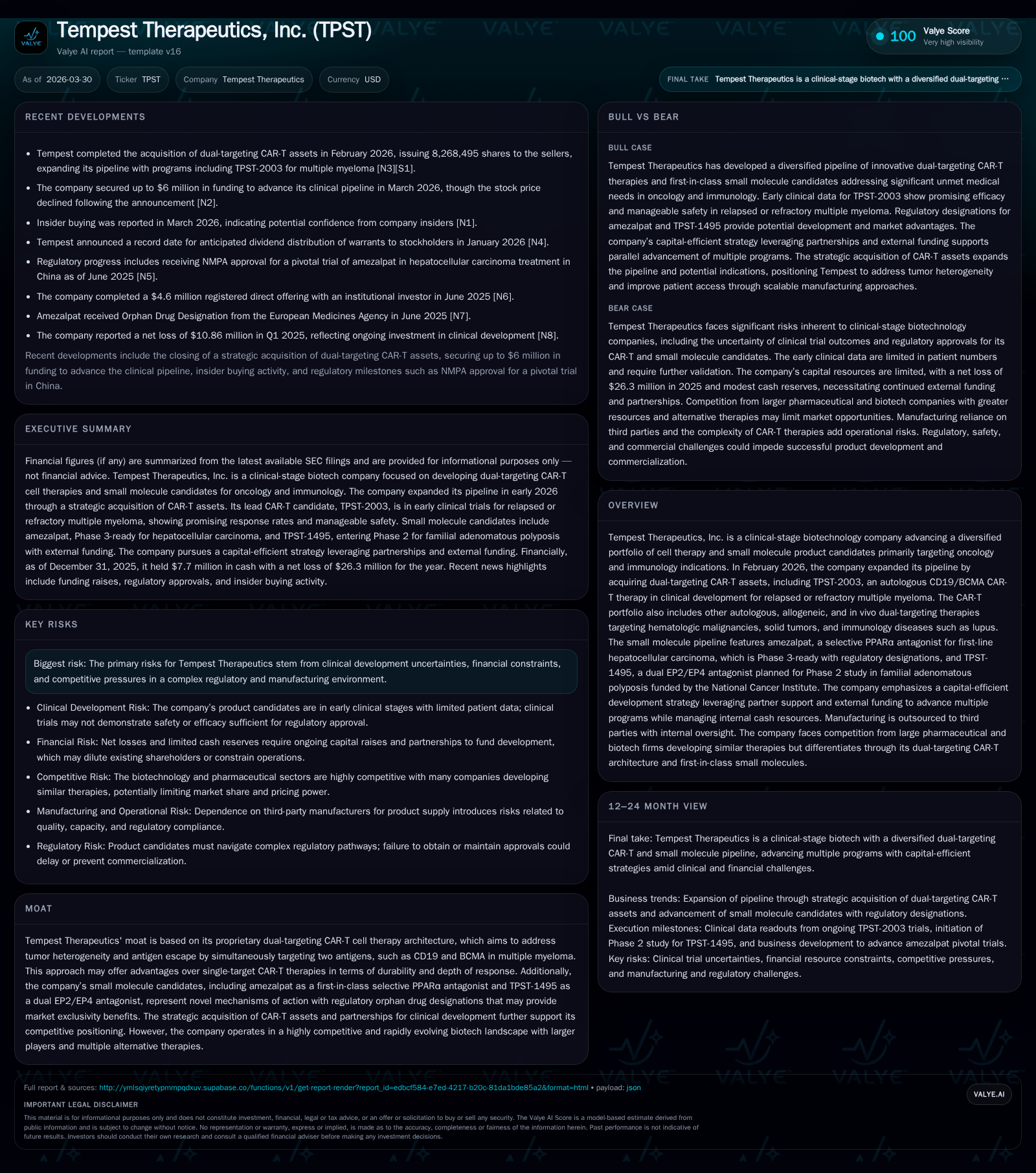
Tempest Therapeutics, Inc. is a clinical-stage biotech company focused on advancing a portfolio combining dual-targeting CAR-T cell therapies and first-in-class small molecule candidates primarily in oncology and immunology indications. The firm recently acquired multiple dual-targeting CAR-T assets, expanding its pipeline to include autologous, allogeneic, and in vivo programs targeting hematologic malignancies, solid tumors, and immune diseases. Despite these strategic moves, the company remains pre-revenue with net losses exceeding $26 million in 2025 and limited cash resources, underscoring capital efficiency as a key imperative. Upcoming milestones include ongoing Phase 1/2a trials for TPST-2003 in relapsed/refractory multiple myeloma, initiating a National Cancer Institute-funded Phase 2 trial for TPST-1495 in familial adenomatous polyposis, and pursuing pivotal Phase 3 development of amezalpat for hepatocellular carcinoma.
Company Overview
Tempest Therapeutics is a clinical-stage biotechnology company focused on oncology and immunology through a diversified portfolio that integrates cutting-edge cell therapy with innovative small molecule drug candidates [S1]. In early 2026, the company expanded its footprint by acquiring dual-targeting chimeric antigen receptor T-cell (CAR-T) therapy assets from Erigen LLC and Factor Bioscience Inc., adding autologous CD19/BCMA dual-targeting CAR-T therapy (TPST-2003), as well as allogeneic and in vivo CAR-T approaches targeting hematologic cancers, solid tumors, and autoimmune conditions [S1], [S18].
The small molecule pipeline includes amezalpat (formerly TPST-1120), a selective PPARα antagonist aimed at first-line hepatocellular carcinoma (HCC) which has completed Phase 2 studies with orphan drug status; and TPST-1495, a dual EP2/EP4 prostaglandin E2 receptor antagonist planned for Phase 2 evaluation in familial adenomatous polyposis (FAP), funded by the National Cancer Institute [S1], [S24].
Historical Performance
Tempest remains pre-commercial with no meaningful revenue since fiscal year 2017 ($295K) [F1]. Operating losses narrowed from $42.0 million in 2024 to $26.6 million in 2025, reflecting continued investment typical of clinical-stage biotech companies [F1]. Net loss followed a similar trend at $26.3 million in 2025.
Operating cash flow was negative $26.8 million in 2025 with zero capital expenditures reported that year, consistent with efforts to preserve capital during intensive R&D activities [F1]. Shareholders' equity declined to $6.7 million at the end of 2025 from $19.1 million the prior year due to accumulated losses [F1]. The current ratio was approximately 2.5x based on current assets ($8.3 million) relative to liabilities ($3.3 million), indicating adequate short-term liquidity but limited runway without additional financing or milestone payments [F1], [N2].
Historical performance (annual)
| FY | Net ($mm) | CFO ($mm) | OpInc ($mm) | Capex ($) | Net YoY |
|---|---|---|---|---|---|
| 2025 | -26 | -27 | -27 | 0 | +37.2% |
| 2024 | -42 | -33 | -42 | 435000 | -41.9% |
| 2023 | -29 | -27 | -29 | 170000 | +17.4% |
| 2022 | -36 | -31 | -35 | 562000 |
Source: SEC companyfacts cache [F1].
Capital returns and efficiency (annual)
| FY | FCF ($mm) | ROE% |
|---|---|---|
| 2025 | -27 | -393.9 |
| 2024 | -33 | -218.8 |
| 2023 | -28 | -110.2 |
| 2022 | -32 | -197.2 |
Source: SEC companyfacts cache [F1].
Note: Revenue data only available for earlier years; operating metrics reflect recent years.
Pipeline and Growth Prospects
Dual-Targeting CAR-T Therapies
The acquisition of Erigen’s portfolio strengthens Tempest’s position in cell therapy with advanced dual-targeting CAR-T candidates [S1]. TPST-2003 targets CD19 and BCMA antigens implicated in relapsed or refractory multiple myeloma (rrMM), aiming to reduce relapse caused by tumor antigen heterogeneity seen in single-target therapies [S12], [S16]. Ongoing Phase 1/2a trials include rrMM patients as well as investigator-initiated studies for POEMS syndrome [S1].
Additional programs include TPST-2206 targeting CD70 for solid tumors and gene-edited allogeneic products TPST-3003/3206 designed to enhance scalability by eliminating T-cell receptors to mitigate graft-versus-host disease risk [S1], [S16]. An in vivo CAR-T platform (TPST-4003) complements this multi-modality approach addressing delivery challenges.
While this diversified pipeline offers potential advantages over conventional single-antigen CAR-T therapies by tackling tumor heterogeneity and improving manufacturing scalability across autologous and allogeneic modalities, these assets remain early stage with significant clinical execution risks including safety management challenges common to this modality [S12], [S18].
Small Molecule Programs
Amezalpat is positioned for pivotal Phase 3 evaluation in first-line HCC following Phase 2 completion demonstrating safety/tolerability alongside checkpoint inhibitors like atezolizumab/bevacizumab with encouraging activity signals [S24], [S25]. It holds FDA Fast Track designation and orphan drug status from both the FDA and EMA. Business development discussions are planned to advance pivotal trials externally to manage capital needs prudently [S1], [S24].
TPST-1495 targets EP2/EP4 prostaglandin E2 receptors involved broadly across malignancies by modulating immune surveillance pathways. It offers selective antagonism potentially limiting off-target effects seen with other EP4-only antagonists under development by competitors such as Adlai Nortye or Ono [S11], [S17], [S25]. An NCI-funded Phase 2 trial for FAP—a hereditary cancer predisposition syndrome lacking approved systemic treatments—is scheduled to enroll patients in 2026 via the Cancer Prevention Clinical Trials Network enabling low capital exposure parallel advancement [S1], [S11].
Intellectual Property Positioning
The acquired patent estate includes issued U.S. patents expiring up to mid-2040s covering compositions of matter and use claims around TPST-2003 and related programs enhancing exclusivity beyond the small molecules’ patent expirations projected into the late 2030s without considering patent term extensions yet [S20], [S27]. This comprehensive protection provides a significant barrier given the complexity inherent in multi-antigen CAR-T designs.
Financial Outlook & Milestones
While explicit numeric guidance is not provided publicly, several near-term value inflection points are anticipated: readouts from ongoing Phase 1/2a trials of TPST-2003 focusing on efficacy durability especially among rrMM patients including those with extramedullary disease; early efficacy data from the NCI-funded TPST-1495 Phase 2 study; regulatory interactions leading to initiation of amezalpat Phase 3 pivotal trials supported by priority designations suggesting possible accelerated timelines pending positive data [N2], [S24].
The company disclosed securing up to $6 million funding early Q1 2026 supporting pipeline advancement while emphasizing disciplined capital allocation aligned closely with clinical milestones achievement amid limited internal cash reserves approaching $7.7 million at year-end reflecting liquidity constraints highlighted as principal risk factors in SEC filings [N2], [F1], [S28]-[S29].
Capital Allocation & Returns Dynamics
No dividends or share repurchases have been declared or are expected given developmental stage priorities focused on R&D investment generating persistent operating losses totaling approximately -$26.6 million in FY25 (improved from -$42 million FY24). Zero capital expenditures were reported in FY25 reflecting emphasis on cost containment leveraging external manufacturing rather than fixed asset buildout typical of early-stage biopharma innovators without commercial infrastructure yet [F1], [S15], [N2].
Operating cash flow closely tracks net loss magnitude indicating minimal capitalization of expenses; free cash flow is similarly negative around -$26.8 million emphasizing need for new capital sources or milestone payments under licensing agreements (Novatim & Factor Bioscience licenses obligate milestone-based payments potentially totaling hundreds of millions long term) underpinning business viability beyond current reserves nearing runway limits absent monetization events soon per risk disclosures extensively elaborating regulatory/commercial hurdles facing early-stage biotechs generally [F1], [S28]-[S29], [N2].
Return on equity approximates -394%, reflecting accumulated losses relative to shareholders’ equity illustrating typical characteristics of pre-revenue innovation companies investing heavily before any monetization potential materializes downstream.
Industry Context & Competitive Positioning
Tempest faces intense competition within cell therapy where major biopharma players including Johnson & Johnson, Bristol Myers Squibb (Celgene), Gilead Sciences (Kite/Yescarta), Legend Biotech/Janssen, Allogene Therapeutics dominate markets with approved or late-stage BCMA/CD19-targeted therapies primarily employing single-antigen constructs rather than Tempest’s dual-targeting strategy seeking deeper durable responses by addressing antigen heterogeneity driving relapse post single-target CAR-T therapies [S12], [S17].
In small molecules, amezalpat’s PPARα antagonism represents a distinct first-in-class approach differing from kinase inhibitors or checkpoint modulators dominating HCC therapy today despite pricing pressures evolving from healthcare reform initiatives such as Medicare Drug Price Negotiation Program impacting future reimbursement dynamics substantially across US and international markets extensively discussed within regulatory risk factors sections highlighting commercial entry challenges unrelated directly to science but critical for valuation considerations going forward.[S4]-[S6],[S9],[S13],[S23]
Conclusion
Tempest Therapeutics exemplifies an early-stage biotech innovator advancing promising bifurcated strategies combining next-generation dual-targeted cell therapies addressing unmet needs around tumor heterogeneity alongside differentiated small molecule programs targeting liver cancer indications and rare hereditary cancer syndromes leveraging external funding partnerships intended to extend limited internal financial resources prudently. These opportunities coexist with substantial execution risks spanning clinical outcomes achievement, regulatory approvals complexity, outsourced manufacturing dependencies, market access impediments including evolving reimbursement reforms exerting downward pricing pressure combined with resource constraints accentuating importance of strategic collaborations execution discipline going forward. This positioning warrants close monitoring across upcoming trial readouts financing developments regulatory timelines during remainder calendar year informing forward trajectory materially.
DISCLAIMER: This analysis is informational focusing on company fundamentals based on public disclosures as of March 30, 2026. It does not constitute investment advice nor recommendations regarding securities.
Disclaimer: This is research-only, informational analysis and not investment advice. It may include AI-generated interpretation and general industry context. Always verify important details using primary sources.

Comments