
LGL Group Advances through Precision Instruments and Merchant Investments: Performance Review and Strategic Outlook
LGL Group integrates specialized electronic instrument manufacturing with flexible merchant investment strategies, balancing growth ambitions against profitability pressures and regulatory complexities.
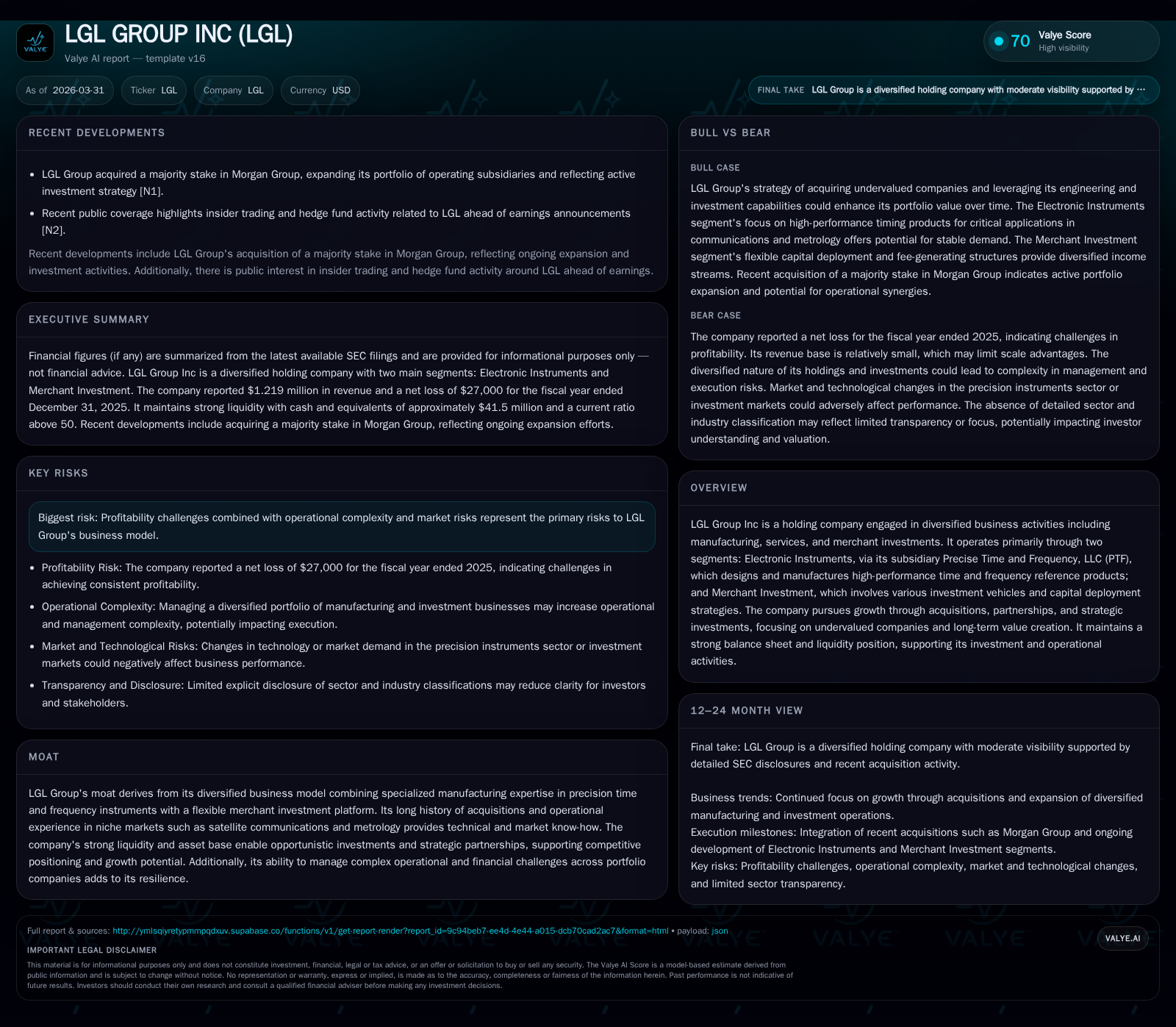
LGL Group Inc. operates a unique dual-segment model combining high-performance precision timing products via its subsidiary PTF with a merchant investment arm focused on opportunistic capital deployment. Recent financials show modest revenue growth alongside sharply compressed operating income and a return to net loss, reflecting operational challenges in cyclical industrial markets and competitive pressures. The March 2026 acquisition of a majority stake in Morgan Group aligns with LGL's strategy of expanding selectively through value-driven investments. While liquidity remains robust, risks including customer concentration, supply chain volatility, and potential classification under the Investment Company Act temper the outlook. Monitoring order backlog developments, integration success, and product upgrade progress will be key to assessing near-term trajectory.
LGL’s Historical Financial Trajectory: Growth Patterns and Profitability Challenges
LGL Group has demonstrated modest top-line expansion in its latest fiscal year with revenue climbing to approximately $1.22 million in 2025—a 5.4% increase compared to the prior year’s $1.16 million [F1]. However, this revenue growth masked a significant squeeze on operating profitability; operating income plummeted by over 64%, sliding from $699,000 in 2024 to $249,000 in 2025 [F1]. The deterioration proceeded directly to the bottom line where net income flipped into a slight loss of $27,000 for the year versus a profit of $202,000 previously—a decline exceeding 113% year-on-year [F1].
Operating cash flow mirrored these adverse dynamics with a striking contraction—falling nearly 92% from $874,000 in 2024 down to just $70,000 by the end of 2025 [F1]. Capex spending was fully pared back to zero after moderate investments in prior years (e.g., $662,000 in capex incurred in 2022), indicating a retrenchment on capital expenditures possibly tied to cautious management posture amid cyclical headwinds affecting their manufacturing operations [F1].
The combination of reduced profit margins alongside shrinking cash generation underscores operational challenges likely stemming from supply-chain disruptions and pricing pressures typical of industrial time-frequency instrument manufacturers serving multi-layered OEM channels.
Historical performance (annual)
| FY | Rev ($) | Net ($) | CFO ($) | OpInc ($) | Rev YoY | Net YoY |
|---|---|---|---|---|---|---|
| 2025 | 1219000 | -27000 | 70000 | 249000 | +5.4% | -113.4% |
| 2024 | 1157000 | 202000 | 874000 | 699000 | +16.3% | +50.7% |
| 2023 | 995000 | 134000 | 385000 | +0.8% | ||
| 2022 | 133000 | -817000 | -192000 |
Source: SEC companyfacts cache [F1].
Capital returns and efficiency (annual)
| FY | FCF ($) | ROE% |
|---|---|---|
| 2025 | -0.1 | |
| 2024 | 0.5 | |
| 2023 | 385000 | 0.3 |
| 2022 | -1479000 | 0.3 |
Source: SEC companyfacts cache [F1].
The Dual Engines of LGL: Electronic Instruments and Merchant Investments Explained
LGL operates fundamentally through two interrelated but distinct segments: Electronic Instruments and Merchant Investment. The Electronic Instruments segment is predominantly run by its wholly owned subsidiary Precise Time and Frequency LLC (PTF), which specializes in designing and producing high-performance frequency synchronization instruments that serve critical niches including aerospace communications satellite ground stations, electric utilities network synchronization, broadcasting systems, telecommunications infrastructure, and metrology applications [S20][S21][S13].
PTF’s portfolio includes frequency standards, time standards synchronized to Coordinated Universal Time (UTC) within under ten nanoseconds precision for highly sensitive satellite and broadcast needs. Complementary products encompass RF distribution amplifiers capable of handling multiple signal types such as HF/RF digital/time code signals across customizable channel configurations with advanced remote monitoring capabilities (including SNMP integration) along with sophisticated redundancy auto-switches for signal reliability critical to military-grade applications [S13][S21].
The Merchant Investment segment functions as LGL’s flexible merchant capital deployment platform managing various investment vehicles ranging from special purpose vehicles (SPVs) focused chiefly on undervalued manufacturing sector businesses to strategic minority stakes convertible into controlling interests over time. This business adopts an opportunistic style without fixed exit timetables emphasizing long-term value creation through operational enhancements across portfolio companies complemented by advisory and back-office services affiliated only within group entities [S19][S20][S17].
This bifurcated model offers diversification benefits but brings complexity—where the manufacturing side faces cyclical supply-demand dynamics common in precision industrial markets while the merchant investment side confronts regulatory constraints notably risking classification as an investment company under the Investment Company Act if asset allocations tilt excessively towards securities holdings (>40%) or if ownership percentages shift unfavorably [S1][S9][S25][S28].
Recent Acquisitions Spotlight: The Morgan Group Stake and Its Strategic Implications
On March 25th, 2026, LGL announced the acquisition of a majority ownership stake in Morgan Group—an addition reinforcing its strategic approach of expanding via targeted acquisitions designed to augment existing competencies or unlock new opportunities within synergistic markets [N1][S1].
While exact financial terms remain undisclosed publicly, this move aligns closely with LGL’s stated philosophy of identifying undervalued or under-recognized companies amenable to operational improvements or market repositioning through LGL's expertise. However, such integration carries risks including distraction from core business management and potential cultural or operational mismatches which have been acknowledged generally among risk factors across recent disclosures [S24].
This latest transaction exemplifies an extension of their merchant investment strategy transitioning select holdings toward larger control stakes aimed at sustained value realization rather than short-term trading.
Segment-Level Dynamics: Customer Concentration, Product Upgrades, and Market Positioning
Within the Electronic Instruments segment’s manufacturing operation at PTF lies substantial customer concentration risk: four largest customers contributed nearly 54% of total revenue ($2.45 million total sales split) as reported for calendar year-end December 31, 2025 [S4][S6]. This narrow customer base heightens exposure where shifts either from customer consolidation or purchasing behavior could materially impact LGL’s top-line.
Critical product initiatives include ongoing comprehensive upgrades to signature signal distribution amplifier lines representing roughly forty percent of net sales at PTF. These updates incorporate state-of-the-art technologies designed not only to elevate overall performance but also deliver cost efficiencies via improved manufacturing processes—all crucial given intense competition among frequency synchronization instrument producers globally where pricing concessions are frequent amidst consolidating OEMs pressuring margins [S5][S21].
Marketing levers consist largely of high-level engineering support coupled with custom configurations tailored precisely for complex OEM system integration demands—an approach well understood among sector specialists requiring skilled representation across direct sales teams supplemented by global distributors versed technically enough to ensure stringent client requirements are met practically at each design stage [S4][S6].
Operational Headwinds and Competitive Pressures in Niche Industrial Markets
LGL operates within tightly contested domains spanning defense contractors to aerospace manufacturers where cyclical shifts profoundly influence purchasing patterns for capital equipment integrating their precision instruments. Customers often endure periods oscillating between excess capacity versus shortages impacting ordered volumes unpredictably quarter-to-quarter.[S7]
Moreover, escalating global supply chain disruption risks are compounded by environmental regulatory mandates such as RoHS compliance impacting component availability and costs—within electronics manufacturing sectors recognized for fine tolerances these can trigger redesign cycles adding cost overruns or shipment delays adversely affecting customer satisfaction metrics essential for retention.[S8][S18]
Competitive forces intensify as LGL contends against larger financially robust multinational competitors boasting more extensive R&D budgets alongside diversified product portfolios permitting aggressive price positioning under bid scenarios typical within government procurement frameworks characterized by rigorous certification hurdles and anti-counterfeit controls all driving thinner average margins.[S12]
Labor market shortages for highly specialized engineers further stress development velocity threatening time-to-market responsiveness especially given need for customization aligned closely with OEM programs whose own timelines dictate vendor qualification pacing impacting revenue recognition windows.[S16]
Financial Health Check: Liquidity Status, Capital Structure, and Risk of Investment Company Classification
Despite earnings volatility evident throughout recent years—including four consecutive years exhibiting erratic operating income swings—LGL boasts an enviable liquidity position anchored by roughly $41.5 million held in cash equivalents plus marketable securities at year-end December 31, 2025 against minimal current liabilities slightly under $1 million yielding an extraordinary current ratio above fifty indicating robust short-term solvency without reliance on external debt facilities[F1][S9].
Simultaneously however the holding company structure fosters inherent regulatory compliance risks regarding potential inadvertent registration as an investment company under the Securities Exchange Act should asset composition thresholds be breached due principally to increased securities holdings or ownership structure changes within subsidiaries—which would impose highly restrictive regulatory burdens inimical to current operating models requiring careful portfolio management and possible transactional restructuring.[S1][S25][S28]
This necessitates transaction design sometimes less economically advantageous solely aimed at regulatory avoidance—a tradeoff limiting strategic flexibility though currently managed actively by board-level oversight committees especially concerning transactions involving affiliated mutual fund managers linked through controlling shareholders.[S1]
Capital Allocation Overview: Buybacks, Dividends Landscape, and Shareholder Return Metrics
Capital return activities remain modest reflective of ongoing profitability pressures; LGL repurchased shares worth approximately $366,000 during fiscal year ending December 31st, 2025 marking continued active if restrained buyback engagement consistent with limited free cash flow generation after operational reinvestment reductions.[F1]
No dividends have been declared or paid recently consistent with preservation priorities given fluctuating net results evidenced by near breakeven ROE (-0.06%) calculated as net loss relative to reported equity base near $43.5 million at end-2025.[F1]
Capex absence further supplements free cash flow albeit indicating minimal organic investments potentially constraining future growth outside acquisition-led catalysts.[F1]
Buybacks appear aimed primarily at enhancing shareholder value opportunistically rather than signaling sustained earnings leverage amplification suggesting cautious stewardship amidst elevated industrial cyclicity.
Outlook Considerations: What to Monitor Amid Earnings Volatility and Market Shifts
Explicit forward financial guidance is absent; therefore monitoring key indicators remains indispensable for assessing trajectory:
- Order backlog increased notably from $336K at end-2024 to $625K at end-2025 implying stronger near-term revenue visibility important for smoothing cyclical variance inherent in OEM demand patterns.[S6][S9]
- Integration progress on recent acquisition—Morgan Group stake secured March ‘26—particularly regarding synergy realization or dilution risks associated with scaling merchant investments.[N1][S24]
- Successful implementation accelerating product upgrades especially signal distribution lines critical for regaining margin footholds amid pricing pressures.[S5][S21]
- Customer contract renewal trends amid concentrated buyer exposure particularly against backdrop of macroeconomic uncertainties impacting defense/aerospace procurement cycles.[S4][S6]
- Continued mitigation efforts addressing Investment Company Act classification risks ensuring unimpeded business model operation without onerous regulatory encumbrance.[S28]
These elements collectively frame an environment requiring balanced optimism offset by vigilance given fundamental dependence on cyclical industrial OEM demand coupled with financial complexity brought by diversified investment activities.
This analysis is based exclusively on publicly available data including SEC filings up through March 2026 and related news releases as cited. It refrains from speculative forecasting beyond documented guidance or explicitly stated management intentions.
Disclaimer: This is research-only, informational analysis and not investment advice. It may include AI-generated interpretation and general industry context. Always verify important details using primary sources.

Comments