
Nevada Canyon Gold Corp’s Exploration-Stage Performance and Strategic Portfolio Growth
A junior exploration company navigating early-stage financial challenges while expanding its royalty-based asset portfolio in Nevada and Idaho.
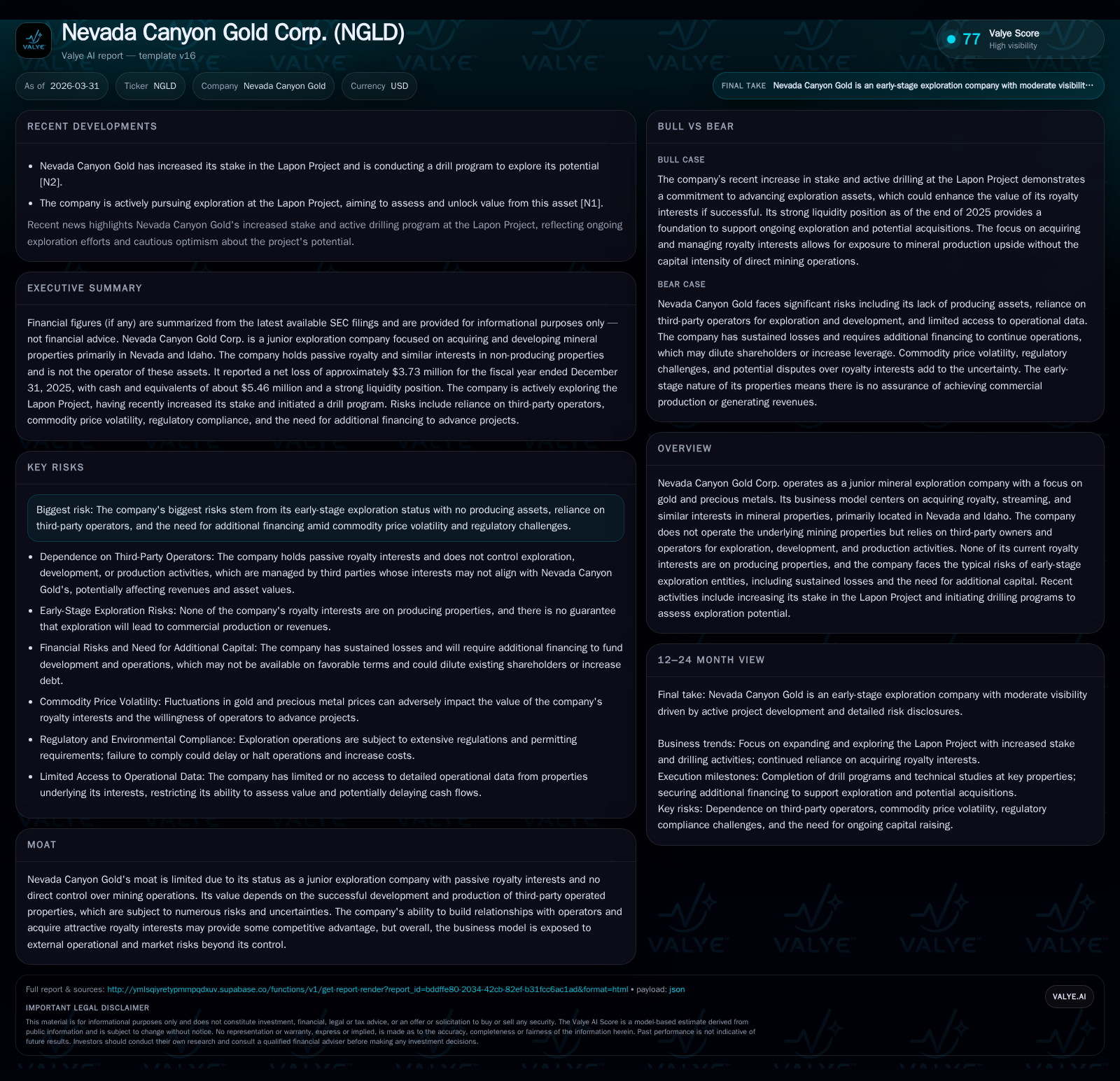
Nevada Canyon Gold Corp. operates as a junior mineral exploration entity focusing on acquiring royalty and streaming interests, primarily in early-stage projects across Nevada and Idaho. Its financials reflect the challenges typical of non-producing explorers, with minimal revenue, persistent losses, and negative operating cash flow over recent years. The company's strategy centers on growing its portfolio through partnerships and earn-in agreements, exemplified by increased stakes and drilling activity at the Lapon Project. However, its business depends heavily on third-party operators’ success and faces regulatory, market, and financing uncertainties that shape its capital allocation outlook.
Exploration-Stage Growth: Historical Financial Trajectory and Key Drivers
Nevada Canyon Gold’s financial profile illustrates the common challenges faced by junior mineral exploration companies focused on early-stage assets rather than producing operations. The company reported stagnant revenue at approximately $4,000 since at least FY2015, highlighting the absence of operational cash inflows from mineral production [F1]. Despite nominal revenue levels remaining unchanged over more than a decade, net income has exhibited an increasingly negative trend—culminating in net losses of $3.73 million for FY2025 alone [F1].
Operating cash flow similarly underscores this development stage pattern. Reflecting the exploratory nature with no direct production income streams, operating cash flow has been persistently negative: evolving from -$429 thousand in FY2022 to -$1.91 million in FY2025 [F1]. This loss trajectory corresponds to an adverse return on equity; based on reported figures for FY2025 ($3.73 million net loss against $7 million equity), the implied ROE stands near -53.6%, reflecting capital consumption characteristic of firms yet to generate commercial revenues.
Equity levels reveal capital attrition—from about $9.1 million at the end of FY2024 down to roughly $7 million by FY2025—signaling sustained operational deficits likely funded through prior financings or investment inflows [F1]. This erosion underscores the tension junior explorers face between long development timelines and recurring expenditures necessary to advance exploration programs.
Historical performance (annual)
| FY | Net ($mm) | CFO ($) | Net YoY |
|---|---|---|---|
| 2025 | -4 | -1909016 | -4.8% |
| 2024 | -4 | -954282 | -34.2% |
| 2023 | -3 | -1145448 | -70.6% |
| 2022 | -2 | -429919 |
Source: SEC companyfacts cache [F1].
Capital returns and efficiency (annual)
| FY | ROE% |
|---|---|
| 2025 | -53.6 |
| 2024 | -39.1 |
| 2023 | -27.0 |
| 2022 | -274.4 |
Source: SEC companyfacts cache [F1].
Data sourced directly from company filings ([F1]); ROE is calculated as Net Income divided by Equity.
Royalty and Streaming Interests: Business Model and Asset Portfolio
Nevada Canyon Gold operates primarily through holding royalty and streaming interests rather than directly managing mining operations. Its asset base concentrates on properties in Nevada and Idaho—areas historically notable for gold exploration—with none currently generating production revenue [S1]. This model positions the company as a passive investor dependent on third-party owners or operators responsible for advancing exploration and eventual extraction.
The royalty agreements entitle Nevada Canyon to payments contingent on production or revenue generated by these projects. However, these rights provide limited influence over operational decisions made by partners who assume exploration risk and capital requirements [S1]. Operators may prioritize development pacing based on their risk assessments or focus investments on areas outside Nevada Canyon’s royalty interests within larger projects—potentially diluting earnings despite ongoing expenditures tied to the assets.
To mitigate such risks inherent to reliance on third parties’ execution strategies, Nevada Canyon pursues diversification across multiple licenses to spread exposure; however this also subjects it to variability beyond its direct control. While royalty interests offer leveraged upside potential without operational burden upon successful discoveries, they carry execution risk tied closely to partners’ commitment levels.
Milestones and Exploration Initiatives
A notable recent development is Nevada Canyon’s increased interest in the Lapon Project managed by Walker River Resources Corp., where it holds an Exploration Stream Earn-in Agreement alongside a royalty interest [S3]. In early 2026, Walker River announced completion of a reverse circulation drilling program conducted during 2025 targeting this project area.
Nevada Canyon’s February 25 disclosure summarized drill results released by Walker River that could materially impact resource understanding pending assay confirmations of mineralization trends [S3]. These milestones represent critical junctures potentially transitioning the company from pure exploration toward revenue-generating streaming agreements if operator progress continues toward development.
Timing uncertainties persist given operator control over project schedules; nevertheless such drilling results serve as key indicators monitored closely by investors for valuation inflection signals typical among junior explorers.
Regulatory Environment and Industry Risks
The company operates within a complex regulatory landscape involving environmental protection laws such as the Clean Air Act (CAA), Clean Water Act (CWA), Comprehensive Environmental Response Compensation Liability Act (CERCLA), state regulations including those enforced by the Nevada Department of Conservation & Natural Resources, as well as federal permitting frameworks affected by National Environmental Policy Act (NEPA) requirements [S4–S8][S11–S15][S18–S19].
Compliance demands substantial costs related to permits required for exploration activities or mine construction; failure to comply could result in fines or permit revocations adversely affecting project timelines or economics. For a royalty holder like Nevada Canyon without direct operational authority, delays encountered by operators can defer expected cash flows.
Additionally, commodity price volatility combined with challenging financing conditions compounds risks faced by junior explorers reliant on equity raises for sustaining operations [S17]. Competitive pressures from better-funded peers intensify challenges around property acquisitions and talent recruitment necessary for technical advancement [S8][S26]. While no legal proceedings are currently outstanding [S9], contractual disputes over interpretation or enforcement of royalty rights pose latent litigation risks due to inherent ambiguities in such agreements [S18].
Capital Allocation and Financial Positioning
At fiscal year-end 2025 Nevada Canyon held approximately $5.45 million in cash equivalents against current liabilities reported at prior dates yielding a strong current ratio near 4.91—indicating short-term liquidity sufficiency [F1]. Nonetheless persistent operating losses (-$1.91 million CFO in FY2025) highlight ongoing capital burn necessitating future financing events to support continued exploration activities [F1][S24].
The company does not pay dividends nor conducts share repurchases consistent with its developmental stage focus on conserving capital amid lack of producing royalties or positive earnings.
Management retains broad discretion over use of proceeds including funding mineral property expenditures or pursuing additional asset acquisitions; however deployment effectiveness remains subject to execution risks common among junior resource companies navigating volatile market conditions [S24].
Investor Considerations: Outlook and Key Monitors
Investors should prioritize updates regarding drill results from Walker River relating to the Lapon Project following completion of the 2025 program [S3], as positive assay outcomes could validate resource potential underpinning future revenue streams via streaming agreements.
Progression through permitting milestones under stringent environmental controls will be critical checkpoints influencing project timelines given regulatory complexities outlined above.
Capital raising initiatives warrant attention given recurring negative cash flows precluding self-sufficiency absent commercial revenues; how management balances dilution against funding needs amid uncertain markets will significantly impact shareholder value.
Activities across other portfolio assets remain less visible but contribute collectively to overall valuation; disclosures beyond core projects would enhance insight into broader operational progress.
Overall potential investors must weigh promising technical developments against pronounced execution risks stemming from dependence on third-party operators without guaranteed paths toward production—a hallmark speculative characteristic within this sector.
Disclaimer: This analysis is based solely on publicly available information including recent SEC filings ([F1], [S#]) and does not constitute investment advice or recommendation.
Disclaimer: This is research-only, informational analysis and not investment advice. It may include AI-generated interpretation and general industry context. Always verify important details using primary sources.

Comments